Dry Tortugas National Park

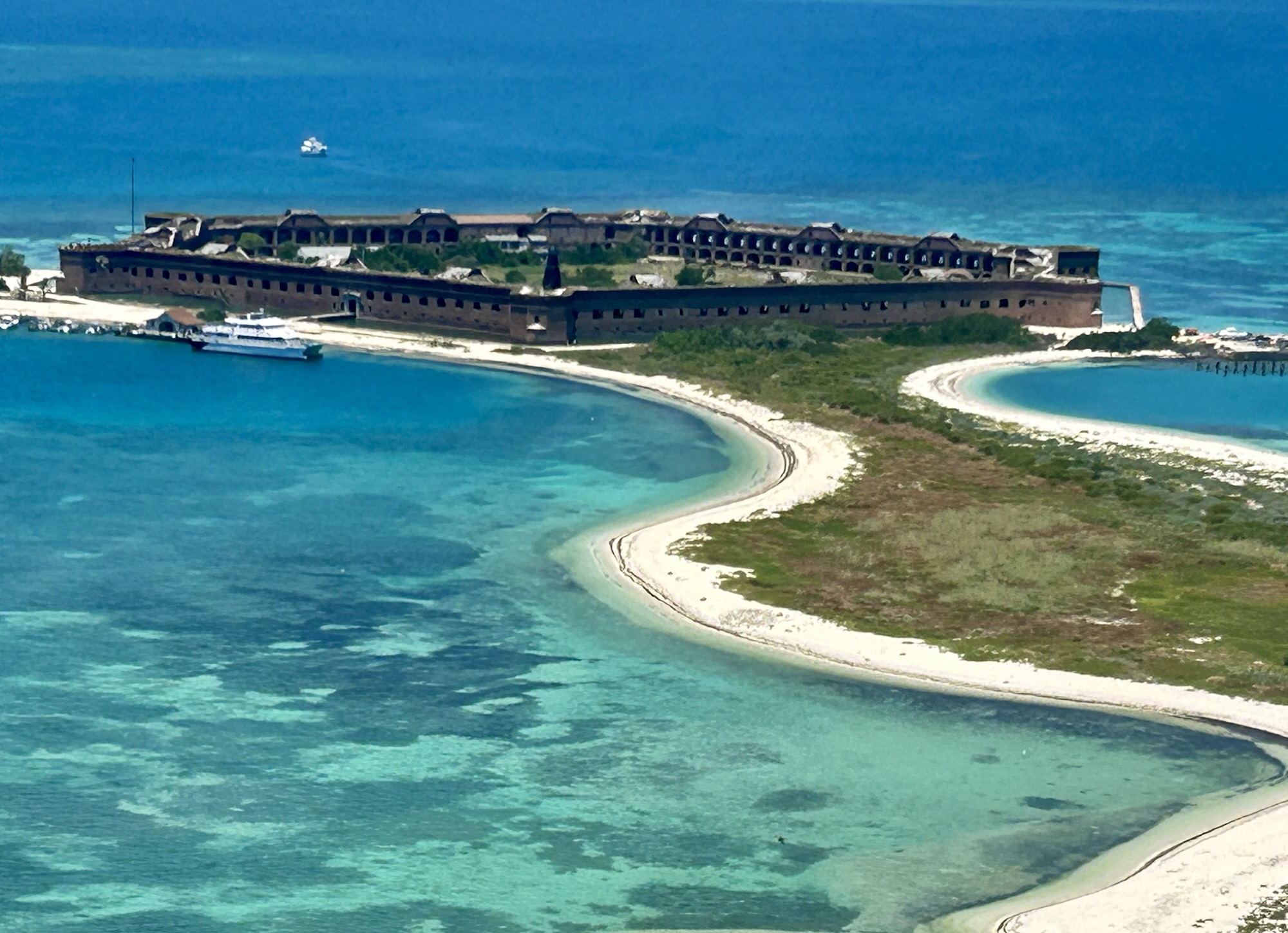
Fort Jefferson is an impressive 19th century structure, used to police ship traffic between Florida and Cuba. The island was named for the sea turtles that still nest here, and there are many seabirds too. There are lovely views of the courtyard above and all around the small island from the top of the walls. I was pleased to see a goliath grouper near the ferry dock, and despite the poor coral condition, the snorkeling was very good among the old dock pilings near the south beach. Together with the Everglades, Dry Tortugas is a large UNESCO Biosphere. I saw hundreds of fish and birds. This is one of my favorite national parks.

The flight is much more expensive than the ferry, but there are some benefits. I was kicking myself for not reserving ferry tickets enough months in advance, but when I realized that the seaplane only flies a hundred and fifty feet or so over the shallow waters, I decided the short flight was worthwhile for the views. From the air, we saw two shipwrecks, one a navy boat used for target practice and the other a famous treasure hunter’s floating guard shack, plus many sea turtles, some sharks, maybe a stingray, a pod of dolphin, and flying fish scattering over the surface. First time for me to see all that from the air. Also, the flight saved me a lot of time. If you’re just visiting Key West—I took the Conch Tour decades ago—to get to the Dry Tortugas, then you can drive in, catch a 10 am flight, and be on your way, saving two very expensive hotel nights on Key West. Plus, it’s less crowded when you first arrive, they include snorkel gear—definitely snorkel—, and you get the view of the fort below.

Florida National Scenic Trail

The southern terminus (above) of the Florida Scenic Trail is in Big Cypress National Preserve on the Loop Road. One of the two barely visible signs at the virtually unmarked entrance almost apologetically notes that the trail is maintained by volunteers. 1,500 meandering, swampy miles northwest is the northwestern terminus (below) at Fort Pickens in Gulf Islands National Seashore. While I’ve been to both ends of the trail, and crossed over it a few times, I have not hiked any significant sections. It’s reportedly a rather solitary experience likely requiring significant wading.

I should mention that Fort Pickens was a Union held fort during the Civil War, protecting Pensacola Bay. The Confederates tried taking it, but the fort is on a rare bluff in the area, giving it the high ground for miles. When the Confederates took some smaller forts across the channel, the Union guns expertly demolished the smaller positions. The beginning of the trail here is beautiful, with many birds and water on both sides.

Big Cypress National Preserve

In the bigger, more famous neighboring park in southern Florida, the paid guide assured me that the American alligator “is a solitary creature, you never see more than one or two together”. In Big Cypress, I counted 16 alligators in one puddle and 17 in the next. Unlike most other wildlife I try to photograph, the alligators don’t run away; they look you right in the eyes and even slowly move towards you. Some are easy to spot, but while I was counting, three more were sneaking up on me.

Most of the million acres in Big Cypress and its smaller partners are actually prairie habitat for the endangered Florida panther, but there was a devastating fire recently, in our rapidly heating world. I drove the loop road instead, looking for gators in the gullies, but I often found myself looking up at the various trees to look at the air flowers hanging on to trunks and branches. In the hardwood hammocks, you might see some tree snails. And I saw a lot of birds, especially wood storks and other large wading birds.

Coming from the Naples side, I stayed in Everglades City, which is tucked in between the Ten Thousand Islands, the Everglades western estuaries and mangrove islands, and Big Cypress. Before the highway was extended to Key West, many visitors took boats to Key West from Everglades City. They’re rebuilding the hurricane damaged visitor center there in the name of Marjorie Stoneman Douglas, who wrote the book, River of Grass, that led to the protection of 2.5 million acres of lower Florida. Fortunately, large commercial efforts to farm, graze and otherwise exploit the land had all failed, so the environmental coalition won. Carbon pollution raises sea levels, so the future is uncertain. But for now, this is a good place for adventure travel out into the mangroves.

National Heritage Areas in Georgia

In addition to part of the multi-state Gullah Geechee Cultural Heritage Corridor, Georgia has two unique heritage areas.

Arabia Mountain is a large site east of Atlanta, managed in sections by city, county and state park rangers. While Stone Mountain—infamous for its carving of three traitors—just north has similar granite monadnock geology, Arabia Mountain is a natural area, protecting Diamorpha and other rare species that thrive in shallow sandy puddles in the rock. It’s more of a low granite hill with a gentle slope, and there are signs of quarrying. At the top, I saw a Killdeer (see photo above) drinking out of one of the larger pools, so I turned on my birdsong identifier app and quickly recorded 18 more birds, including an uncommon Swainson’s Thrush, an Indigo Bunting, a Purple Martin, a Tufted Titmouse, 2 different Vireos and a Red-shouldered Hawk. I was well pleased for such a short hike. Panola Mountain is an even more protected part of the Arabia Mountain heritage area, but you need to reserve a hike with a ranger to climb it. The historic quarrying town of Lithonia is also in the area and has an old African American cemetery.

The other heritage area is the Augusta Canal NHA. That’s a miles long canal with tow-road paths, parks and views from the north of the city down to the historic district. The most famous historic sight along the canal is the Confederate Powderworks square chimney below. It’s the last remnant of the city’s impressive wartime industry. Late in the Civil War, one of the gunpowder mill buildings exploded killing 9, including one boy, which also sparked a strike. There’s now a fancy new Salvation Army multi-function center funded by the founder of McDonalds across the canal. The waterfront is a pretty area to hike or kayak.

Natural Bridge

George Washington surveyed it in 1750, and Thomas Jefferson bought the largest limestone arch in North America above in 1774. At 200’ tall, it’s higher than Niagara Falls. See if you can find the people in the photo. It’s an NPS affiliate, managed by Virginia State Parks. There’s a pretty 1.7 mile trail up under and past the arch along Cedar Creek, with many steps, interesting rock formations, heron below, woodpeckers, chickadees and other birds.

Virginia Coast Reserve Biosphere

This is one of two UNESCO Biospheres in the Mid Atlantic region; the other is Pine Barrens in New Jersey. Dedicated to scientific research, protected for decades by dedicated environmentalists and locals, including Federal, State and Local lands, and managed by the Nature Conservancy, this UNESCO Biosphere protects much of the Virginia part of the Delmarva Peninsula, including its fragile barrier islands. It’s a crucial stop for birds on the Atlantic flyway from the Yucatán, over Florida and up the coast to Canada. And of course, studying these coastal wetlands is critical for combating the effects of the climate crisis.

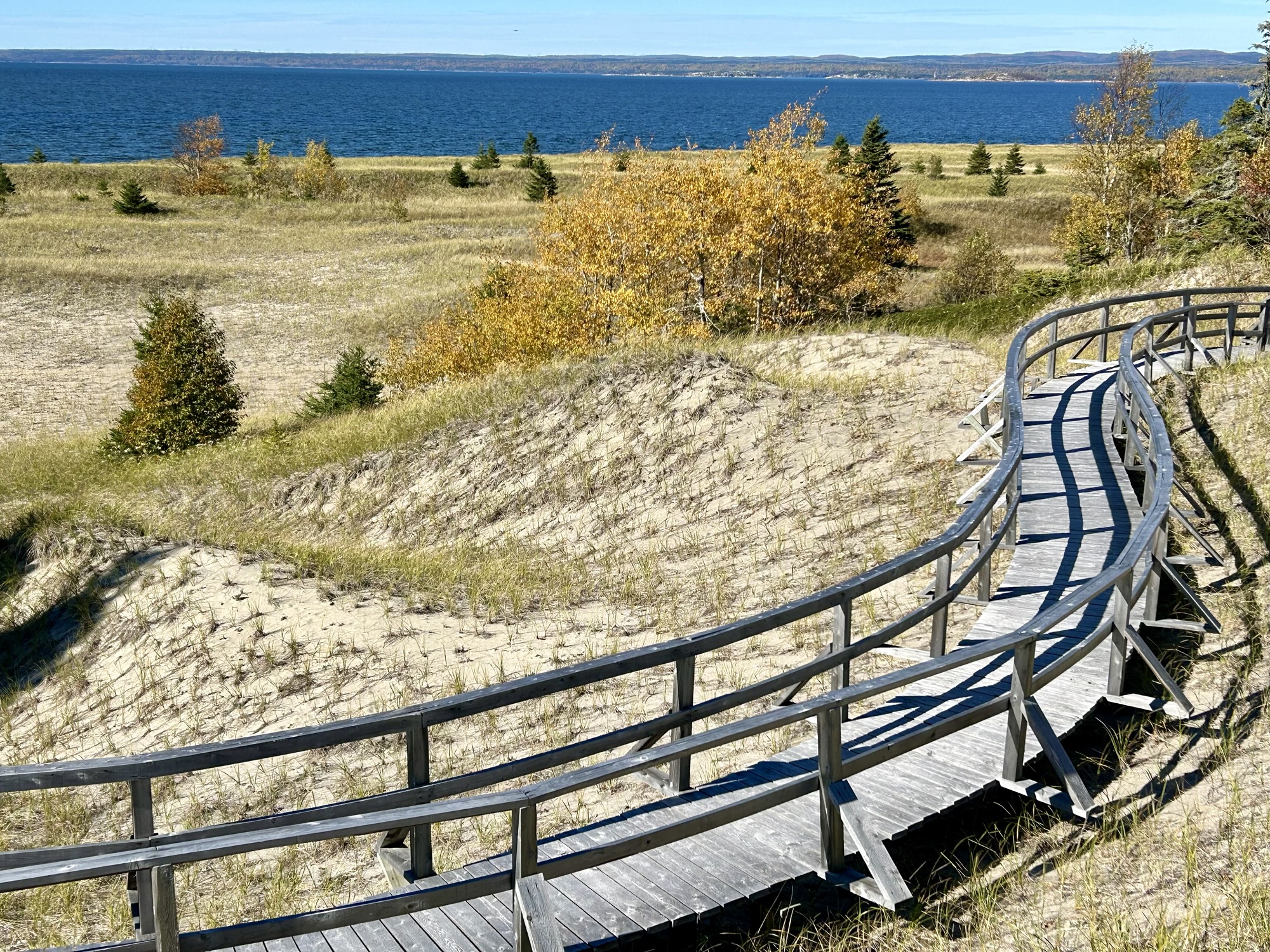
There’s a nice trail next to the Brownsville HQ with boardwalks out to the Atlantic view below and a similar one facing the inland wetlands. I saw a great blue heron, two large turtles, and many butterflies, spiders and frogs. Frogs were much more common in my youth, so it was a delight to see so many hopping across the trail or grass in front of me.

Channel Islands National Park

Kayaking around Scorpion Rock, above, is truly a great national park experience. You are completely surrounded by wildlife, with brown pelicans flying in formation above, various seabirds perched and nesting on the rocky cliffs, harbor seals and California sea lions popping up curiously, and a brown kelp forest below with colorful sea stars and garibaldi fish. Our adventure tour had us on the water for several hours exploring both east and west of the scorpion ranch dock. Due to a fault line running through the volcanic rock, combined with powerful waves, this particular corner of Santa Cruz Island has perhaps the largest concentration of sea caves in the world, and I kayaked past a big blow hole, through several arches, skirting a gyrating whirlpool, around a pillar, and far enough into the back of one cave that the entrance almost disappeared in the swell. Wonderful!

If that’s your cup of tea, get in touch with the Santa Barbara Adventure Company, who can arrange a whole day tour. The guides were excellent, despite being frequently interrupted by seals and sea lions, and offered memorable stories to explain what we were paddling through and to inspire us to pay closer attention and care more about the natural world around us. Some flexibility helps, as weather can affect camping, ferry crossings and kayaking conditions significantly. The ferry operator contacted me the night before my trip to advise me of a storm that would bring hazardous winds, rains to turn my campsite to mud, and the likelihood of a canceled return ferry. They suggested changing to a day trip to avoid all that, so I left my camping gear in my trunk and had a spectacular, slightly rushed, day on the water.

I feared that I would not get to see the Island Fox, but one popped out as we were eating a late lunch (see below). Frankly, I needn’t have worried about not seeing any wildlife, especially on a kayak tour. Black oystercatchers, several different cormorants, the island scrub jay, pigeon guillemots, and a wandering tattler were just a few birds we saw. A large pod of common dolphin greeted our ferry’s arrival at Santa Cruz Island and played in our wake, and I spotted several whale spouts on the ride back.

I recommend arriving the day before your trip, going to the visitor center near the ferry dock, and watching the park film, narrated by a local high school grad named Kevin Costner of Water World fame. There you can learn about the islands, the Chumash cultural heritage, and all that you hope to see. The five Channel Islands are often called the Galapagos of the US, and, having been to the actual Galapagos, I must say it’s not true. There are similarities, including some seabirds resembling penguins, numerous playful seals & sea lions, and the sense of being surrounded by species in an extraordinarily special place, but there are no giant tortoises or brightly colored iguanas or other tropical species. The Channel Islands are unique in their own right, in a Mediterranean climate, on a busy seaway for whales and other marine mammals, remarkably accessible from one of the country’s largest urban areas. Marvelous!

Cascade Head Biosphere

The Salmon River flows into the Pacific just out of sight between the headland and the beach above. The trail up here to the lower viewpoint starts at the boat launch, climbs through a lovely mossy old growth grove and crosses a few small bridges—the cascades were hidden in the brush—before reaching the meadow where a rare flower and butterfly live. There’s an upper viewpoint some 700 feet further up the hill, but I figured the closer view was better.

This UNESCO Biosphere is mostly on Nature Conservancy land, thanks to concerned citizens who rallied to protect it. Definitely needed the birdsong app: white-crowned sparrow, golden-crowned kinglet, chestnut-backed chickadee, pacific wren and a brown creeper, not to mention the usual coastal waterfowl and some raptor I couldn’t identify. Lovely spot on the Oregon coast with about a dozen other hikers on the trail on a beautiful day last fall.

Beaver Hills Biosphere

This large UNESCO biosphere near Edmonton Alberta includes Elk Island National Park, which has hundreds of plains and wood bison. But Elk Island is fenced, so, as important as that park is for restoring the bison population, I came to see beaver. And on the Beaver Hills Biodiversity Trail, I saw several large beaver dens, like the one above.

Beaver are quite destructive, and their homes are surrounded by felled and drowned trees and pointy stumps. But they also create year round dens and dams with ponds and small lakes for many other species. Besides the many waterfowl, blue dragonflies, and chattery squirrels, I saw a magnificent golden eagle circle above the pond. And of course, I saw five or six beaver, swimming far from their dens, playing and occasionally climbing on branches to dry off, scratch or hang out.

When humans create zoos, safari parks or even national parks with fences, it’s not right to call the enclosed animals ‘wild’. Some may have been born wild, but as long as they’re locked up, they’re no longer wild animals. Humans make the rules in those spaces, so, no matter how we try to copy nature, the spaces are artificial. But when beaver fell trees, build dams and create lakes, they make the rules. And the species gather there naturally. Beaver Hills is a natural area, filled with wild animals, and it is delightful to pause here and take in the peaceful balance of life.

Redberry Lake Biosphere

I saw ducks and geese in the thousands, a flock of whooping cranes, a pair of sharp-tailed grouse, and many other birds, but they kept their distance from me. Saskatchewan has many lakes, and occasionally one will be full of birds. I also saw a young moose walking near the road, and there were bison behind fences. Since I was there during harvest, I could see the giant combines gathering grain. The self-guided driving tour gives several suggestions for exploring the area, which is mostly farms and First Nation communities. I believe there’s a visitor center opening soon.

The lake is at the center of a UNESCO Biosphere Reserve, but there’s also a popular state park camping and recreation area. So there are RVs, cabins, a beach below with a playground, mini golf, a golf course, a boat launch and even a few JetSkis, which hardly seem compatible with an internationally important bird refuge. Humans have trouble sharing our world with all the other species.