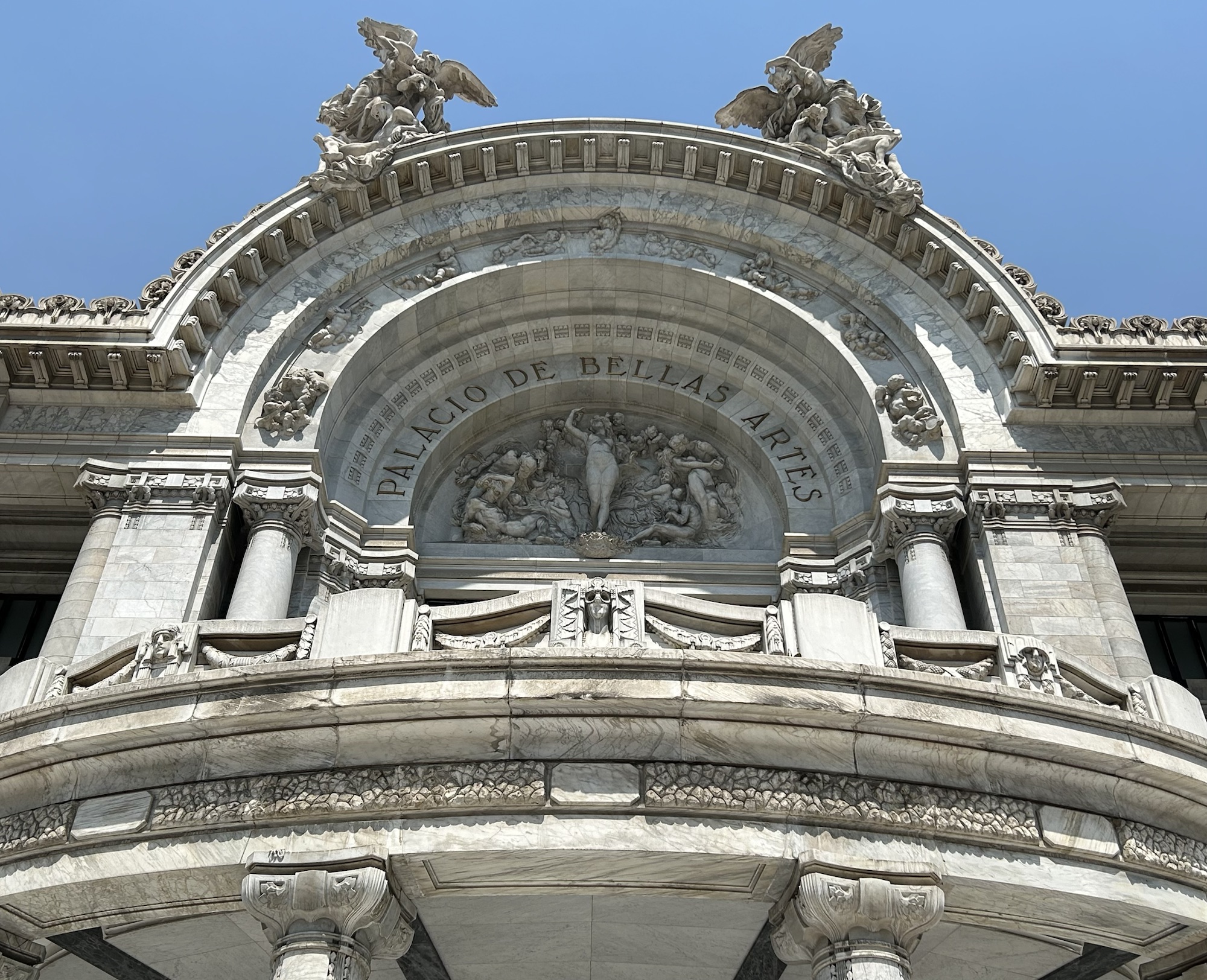
In the US, the Independence War means the same as the Revolutionary War, but in Mexico, they are two different wars. 100 years after Hidalgo cried out for Independence from Spain in 1810, the country was under the control of the dictator Porfirio Díaz, who ruled for 35 years over a growing gap between the elites and the masses. He commissioned the ostentatious building above to celebrate his rule, but it ended up celebrating the end of his rule after the Revolution of 1910-1920. Since the common people were uneducated, the new era of called for artists to paint huge public murals to tell the story of Mexico. The three great muralists were Diego Rivera, David Alfaro Siqueiros and Jose Clemente Orozco. All three have murals on permanent exhibit on the oversized second floor inside. Siqueiros uses stunning, clear images to depict the drama of human suffering and bondage. Orozco contrasts vivid lives with cold modern weapons. And Diego Rivera presents his profound understanding of social struggle, using historic figures, ancient images and modern allegories, to awaken people.
The historic center includes far more than one museum, but to appreciate it, you need to understand what’s buried beneath the metropolitan cathedral, grand government buildings and the huge public square. Once there was a lake ringed by volcanoes, and the Aztecs built an empire around an island, using landfill and bridges to create a moated city. Thousands of captured warriors were sacrificed publicly and walls of skulls have been uncovered. From this easily defended base, rich with food grown on floating gardens such as at Xochimilco, over 200,000 lived here, with a sophisticated canal system and extensive trading network. When Hernán Cortés arrived here in 1519, it was one of the largest cities in the world. After building boats and bringing in cannon, the besieged city fell, and the Spanish drained the lake, tore down the temples to make a cathedral, and paved the ruins of the temples and markets to make the huge, empty square Zócalo public space, where over 100,000 now gather to hear the President speak from the balcony of the National Palace or to listen to pop music stars perform. Begin in the Zócalo and take the walking tour to learn about the excavated Aztec ruins and much more in this fascinating, important and historic city center.

 Zero Carbon Travel