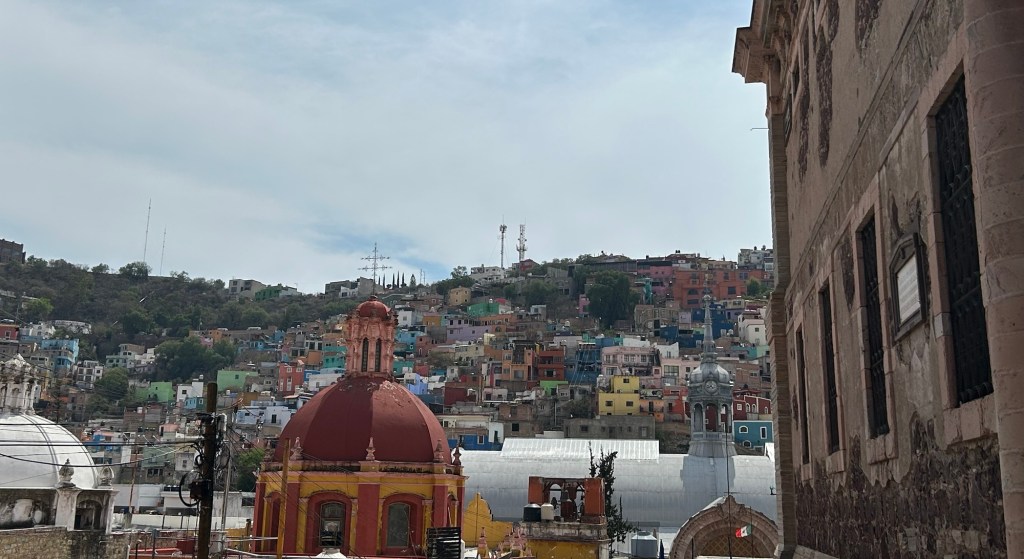
UNESCO recognizes this colorful, artistic city for its historic zone reflecting its native and colonial combined roots. Otomi musicians and doll vendors walked in the narrow alleyways winding around grand churches, much as they have for hundreds of years. Beautiful public plazas with historic groves of trees, Baroque churches, vibrant architecture, and galleries fill the spaces. And art flows into the streets, with public displays of famous paintings, both local and international exhibited outside. While I intended to focus on the history of revolutionary conspirators, the trial of Maximillian and the drafting of the Mexican constitution, the fascinating streets pulled me away from the Teatro de la República and had me wandering around in circles taking in the atmosphere amazed. This is a cultural feast!
On the right is the Alhóndiga, an old grain exchange, which houses a history museum, has a stunning Morado mural, was stormed by Hidalgo during the Independence War, and was where the heads of Hidalgo, Allende, Aldama & Jiménez were later hung, one from each corner, including above, top right.
The old town center and churches are part of the UNESCO World Heritage Site, and the churches are particularly lavish, due to the rich silver mines in the hills around the city. There’s also a decadent theatre, built for the dictator Porfirio Díaz, who impoverished millions. The independence leaders would have been furious with the ostentatiously royal display.
I love the town, climbed the narrow alley stairs to see from above and also walked through a long dark tunnel to loop back to my car. Diego Rivera’s childhood home has been extended upwards to become an exceptional museum of his life and art. Highly recommended.
In 1969, just below the confluence of the Rio Grande, Devils and Pecos Rivers, a dam was built, creating Lake Amistad (friendship en Español). The lake caused the mouths of the Pecos River and Seminole Creek (above) to silt up, and now that the water level has fallen (like Lake Mead and Lake Powell) they’re cut off from the Rio Grande (see far right). Most of the boat ramps, like the small dock at the cave above, are no longer accessible. The lake is far below minimum expectations, because the US diverts virtually all the Rio Grande water before it even reaches Big Bend. From there most of the river comes from Mexico’s Río Conchos. The park is run in partnership with many agencies, and the two towns that share the border are friendly and have joint cultural festivals annually. Mexico maintains a small fishery, US residents enjoy bass fishing, and the border is marked with buoys. I took one of the old highway ‘spurs’ straight down to the water, but it was too hot to kayak in winter.
Panther Cave, across the canyon above, is on the far western park boundary. While the park film absurdly claims that “no Native Americans have any ties to the area”, the canyon is Seminole Canyon, and the cave is an important site for prehistoric cave art. The Amistad visitor center has information and large reproductions of the cave art, and the excellent Seminole Canyon State Park has morning ranger-led tours to another similar cave and a few miles of hiking trails to see the view above. Before man dammed and drained the rivers and destroyed the riparian ecosystems, Native Americans must have traveled up the Rio Grande to Albuquerque, where some of the oldest petroglyph art was created at the same time as the art here. Sitting on the cliff above observing the wildlife, I imagined prehistoric people hunting, traveling by canoe, drawing on the cave walls and protecting their families from panthers, until thunder warned me to seek shelter.
My old favorites from the first 100 sites still stand. But, especially traveling so much in the northeast recently, many of my new favorites are Historical Parks, which are treasure troves.
Most in need of a big budget Hollywood epic to tell the story: Clark.
When I say that I don’t like J. Alden Weir’s paintings, don’t misunderstand me. I was kicked out of my only art class at age 9 for drawing sketches of a battle including graphic illustrations of stick figures getting blown apart by WWII tanks & planes. I couldn’t tell you the difference between a tint or a tinge from a tincture. One of my favorite pieces of modern art remains the remains of an artist named Art, who, according to his will, was cremated and put on display. So, don’t judge Weir by my predilections.
Actually, I do like “On the Porch”, a Japanese inspired watercolor of two of his daughters painted here on his farm. But I don’t like “The Red Bridge”, where he contrasts a natural setting with a railroad bridge, and I find his landscapes to be too muted and subtle in color to hold my attention. Unlike some European impressionists, Weir didn’t typically paint laborers, preferring farm animals or his family (although he sold paintings to help the unemployed). In any case, tastes change, so creativity must overcome tastes.
Weir, the son of a West Point drawing instructor, helped found American Impressionism. Where his brother went to Hudson Valley, Julian went to Paris, where he overcame his initial horror of Impressionism to adopt some of the techniques. Soon he was back in the US, exhibiting impressionist paintings with his friends, Twachtman, Ryder, and others who organized a group of ten artists to promote the new style. His daughters grew up to be artists as well, and one married one of Brigham Young’s grandsons, Mahonri Young, whose studio is also on the Weir Farm.
While the tour of Weir’s house and studio is interesting, the magic of the place is in the artists who continue coming here to paint. Art colonies and communities constantly influence and depict each other, as when a student of Saint-Gaudens created a bronze relief of Weir. There’s an artist-in-residence, and a small army of artists of all levels who continue to see the new in the old barn, gardens, fields, forest, pond and porch. Some of their paintings are in bold, bright dramatic colors, which I like.
But honestly, real nature is subdued and muted in color. Light on leaves reflected in water is blurred. Roots and rocks on dirt trails near muddy banks are all shades of brown and gray. The real bear in the woods here isn’t kaleidoscopic. Nature is messy, mostly dully boring and awkwardly chaotic, with one tiny amphibian emerging from the algae to catch one’s eye on a stone before almost being trampled. Hmm, maybe I should go back and take another look at Weir’s landscapes.
Like the Oklahoma City Memorial and the Touro Synagogue, this is an affiliated site that’s run separately from the park service, so there’s a $15 fee for the house tour. I’m a fan of Cole’s The Course of Empire set of paintings, which depict the same landscape from Nature to height of civilization and to forgotten ruins. The reproduction in his old studio above is from another series called The Voyage of Life.
Cole immigrated from England in 1818 at 17 and settled in the Catskill area of the Hudson River Valley to become a painter in 1825. Witnessing both the natural beauty and its destruction due to rapidly growing industry, Cole created romantic and allegorical landscapes to convey both his love of nature and his sadness at its devastation. He was extremely influential, and there’s a whole Art Trail devoted to the landscape artists who followed his style.
“Nature has spread for us a rich and delightful banquet.








 Zero Carbon Travel