Robert Russa Moton High School

Equality is the ideal we have yet to achieve. Jefferson wrote of equality in our Declaration of Independence. Our Constitution did not recognize it. Lincoln guided the country through a Civil War for equality, but then the country slid backwards again. But we must try.

W.E.B. Du Bois had supported and tracked inequality, progress and hope for schooling in the African American community of Prince Edward County in 1898. The state of Virginia revised their post Civil War Constitution in 1902 to permit racial segregation. In 1951, the inequality had long been unconscionable. While white students had cafeterias, gymnasiums, school busses and laboratories, black students needed warm clothes and umbrellas inside tar paper shacks.

Frustrated by the systemic racism that prevented adults—who faced retribution for asking for change—from fixing the problem, the students decided to act by themselves. 16 year old Barbara Johns addressed her fellow students, banging her shoe on the podium, and called a strike, asking for cooperation and saying “don’t be afraid”. The students all went on strike, and their minister said they should contact the NAACP. Barbara Johns called Richmond lawyer Oliver Hill to help.

Their case, which lost, became part of the Brown v. Board of Education appeal, but the Prince Edward County school district refused to follow the Supreme Court ruling. A new school was built, but rather than comply with integration, even after Little Rock, the Governor of Virginia closed schools for five years. Martin Luther King visited in 1962. JFK and RFK publicly excoriated Prince Edward County in 1963. Finally, the Supreme Court ruled again, saying “time… has run out”.

Every student should know this story, which began with a student walkout to demand a new school building. I was moved to tears listening to Barbara Johns’ recreated speech in the school auditorium and thinking about their courage in the face of terrible injustice. If you can visit, go and listen for yourself. This affiliate site, a favorite of mine, in Virginia is a powerful part of our Civil Rights history.

Protest at César E. Chávez NM

Daniel Romero marched with César Chávez back in the day, so when a nationwide protest against recent cuts to the national parks & US forest service popped up today at noon, of course, he came wearing his ‘¡Si, Se Puede!’ T-shirt. He knows from experience that predicting turnout is a fool’s game, but instead of the expected 3, there were around 20, even at a very small park in a rural area best known for a loop of track for trains to change elevation to traverse the Tehachapi pass. Another was Fernando Chávez, a grandson of César, who discussed the need for solidarity, coalition building, and activism at the base of the old oak tree next to Martyr’s Garden, where his grandparents lie at rest. “We’ve been protesting forever”, said Romero. “Even though we are sometimes excluded, we have always tried to support each others’ causes”, said Chávez, recounting how spontaneous protests recently broke out after a particularly brutal local raid by ICE. Romero listed the unions that marched with them, describing diverse families and even weddings during the boycott and strike.

This was an early park visit for me, as it’s local. Unlike my quiet visit 3 years ago, folks here today were sad, angry and surprised by the chaotic decisions to cut 1,000 NPS staff and 10% of the USFS. One employee here had just transferred from New Mexico when his job was axed by Elon Musk. Many of those affected were young, promising staffers, full of optimism. Supposedly he is scrambling to get the transfer reversed to stay employed. While there may be some cost savings, in the long run, the work these folks do protects and adds a lot of value to our country, so cutting when hiring is needed is counterproductive. I felt the need to apologize for still driving a Tesla, but folks understood, knowing others who are now trying to unload theirs. I’m keeping mine, as the climate crisis is going to get worse, despite efforts to delete the word climate from government documents.

I know Saturdays are supposed to alternate state photos, so I’ll add another and a video below. But I thought you might like this real time update from a very appropriate park for a protest, with people whose lives were defined by the proud history of protesting in America. Next week will return with another western state. Thanks for reading!

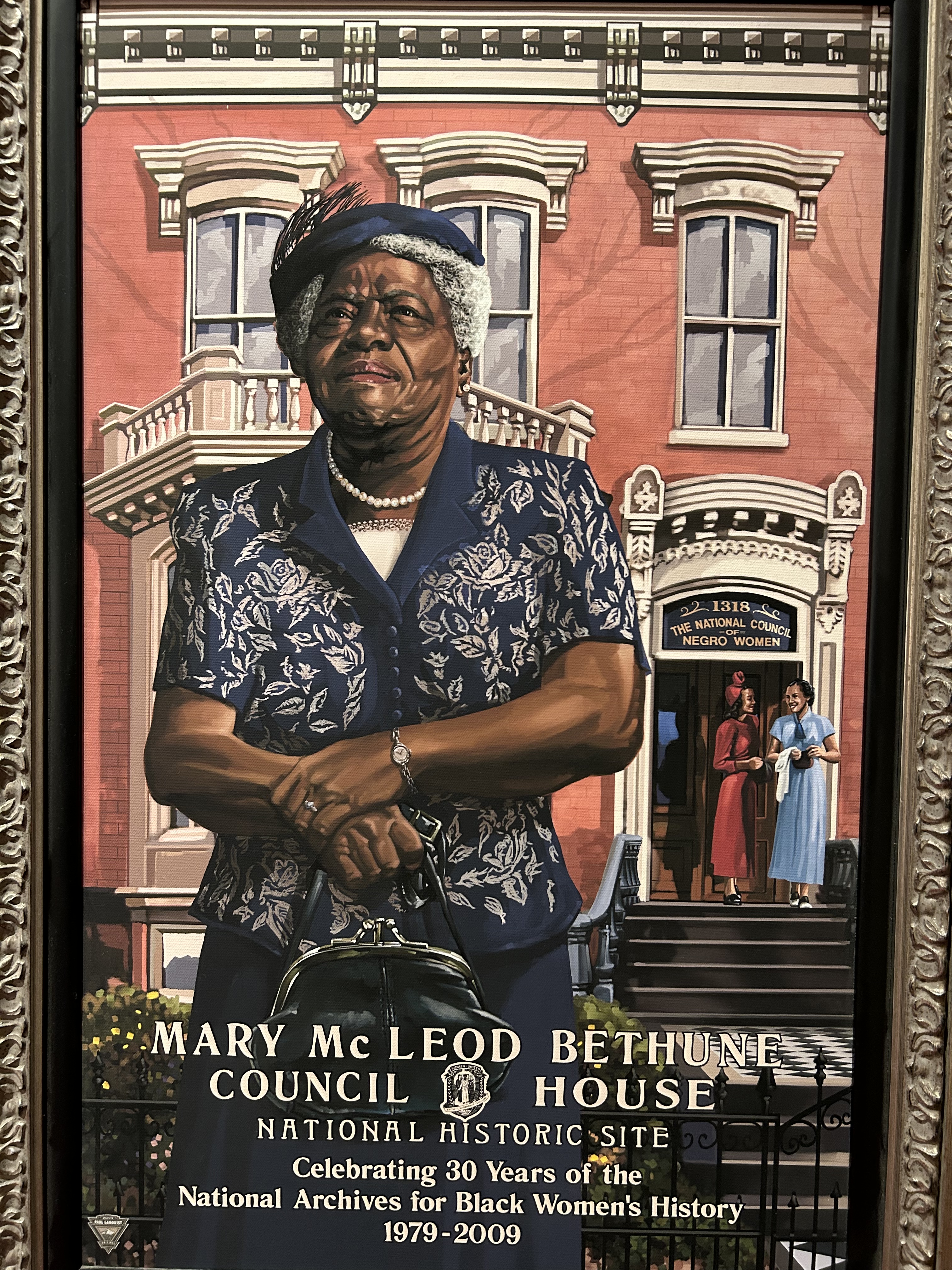
Mary McLeod Bethune Council House National Historic Site

An advisor to half a dozen presidents, founder of schools, civics organizations and the archive above, Mary McLeod Bethune was a dynamo who devoted her life to advancing the lives of people who had been denied equal rights for centuries. Her home office in DC, the headquarters for the African American women’s movement, is just up the street from the White House, where she worked in FDR’s administration, as the first African American woman to lead a federal department. She later was the only African American woman to attend the founding of the UN in San Francisco. She worked with Frederick Douglass, Booker T. Washington, WEB Du Bois, Maggie L Walker, Nannie Burroughs, and Carter Woodson, and she skillfully raised funds from John D. Rockefeller and many white elites at the Palmetto Club in Florida.

The house has recently reopened after some renovations, but the interior rooms and exhibits are still being reorganized. Given the extensive race and gender barriers, the home often had to put up visitors in the top floor, who were unwelcome at DC hotels. The upstairs office was full of busy staff, managing events, publishing articles, and coordinating activities nationally. Downstairs the parlor hosted guests and the conference room hosted important meetings and kept detailed records. The tour guide was exceptionally knowledgeable and provided the context needed to judge the scale of her contributions to our history. Guaranteed to learn here.

Kenilworth Aquatic Gardens

This DC park is managed by Capital Parks East, which includes the long riverside park and 12 mile bike trail along the Anacostia. In summer, this is likely the prettiest DC park, when the water lilies are in bloom. Once a commercial enterprise, the community now volunteers to maintain this beautiful “oasis in the city”, and I saw a dozen folks knee deep in the mud digging around among the roots. Outside of the water lily ponds, there are wetlands accessible by boardwalk. I saw a Great Blue Heron, sandpipers and various warblers, and the water is also full of life.

That this park exists is a bit miraculous. The area was a failed tobacco plantation, a failed port, a failed reclamation project, a failed industrial zone, a failed housing development, a failed country club, a dump, and a Hooverville of WWI veterans who were removed by the Army after asking for their promised bonus, which failed.

The water lily business was the most successful, with species from all over the world. Civil War veteran WB Shaw and his daughter Helen Fowler ran it in the ‘20s and ‘30s. The wetlands are now seen as critical habitats that keep the river healthy. Freshwater mussels now clean what was once a terribly polluted river. African American community leaders like Rhuedine Davis and Walter McDowney recreated the gardens and taught kids to love nature’s beauty. We owe them all a great debt.

César E. Chávez National Monument

I returned here today to see the exhibits, as they were closed when I visited last year. The black & white photos of the Delano grape strike and Chávez’s hunger strike remarks are particularly moving. Pesticides were not regulated at all then, and labor was denied rights by growers. Chávez’s national boycott of grapes helped change both.

Today, growers drain rivers, lakes, wetlands and water tables, even as the western half of the country suffers in drought. In Kern County, where the Monument is, the Kern River no longer flows to the Kern Lake, due to diversion for agriculture. In order to sell more produce, growers are ruining the environment for fish, animals and people. Climate change and some farming practices also exacerbate Valley Fever, a deadly fungal infection spreading in California & Arizona.

Agriculture is a trillion dollar industry in the US, with $150 billion in exports. But Big Ag prefers to blame Democrats, rather than face the fundamental challenge of the climate crisis. Big Ag needs to convert farm equipment to electric, and they need to stop using fossil fuel to ship their produce around the world. They also need to cooperate to restore wetlands to sequester carbon.

César Chávez devoted his life to raise awareness and lead civil disobedience to make change. He acknowledged that in the struggle against the rich and powerful, poor people only have their lives “and the justice of our cause” on their side. Today, we need more people to be just as devoted to stop the climate crisis.

Wisteria, photographed in my previous visit in 2021.

Click to see my photos of all national park units in California, or click to read an updated site visit here.