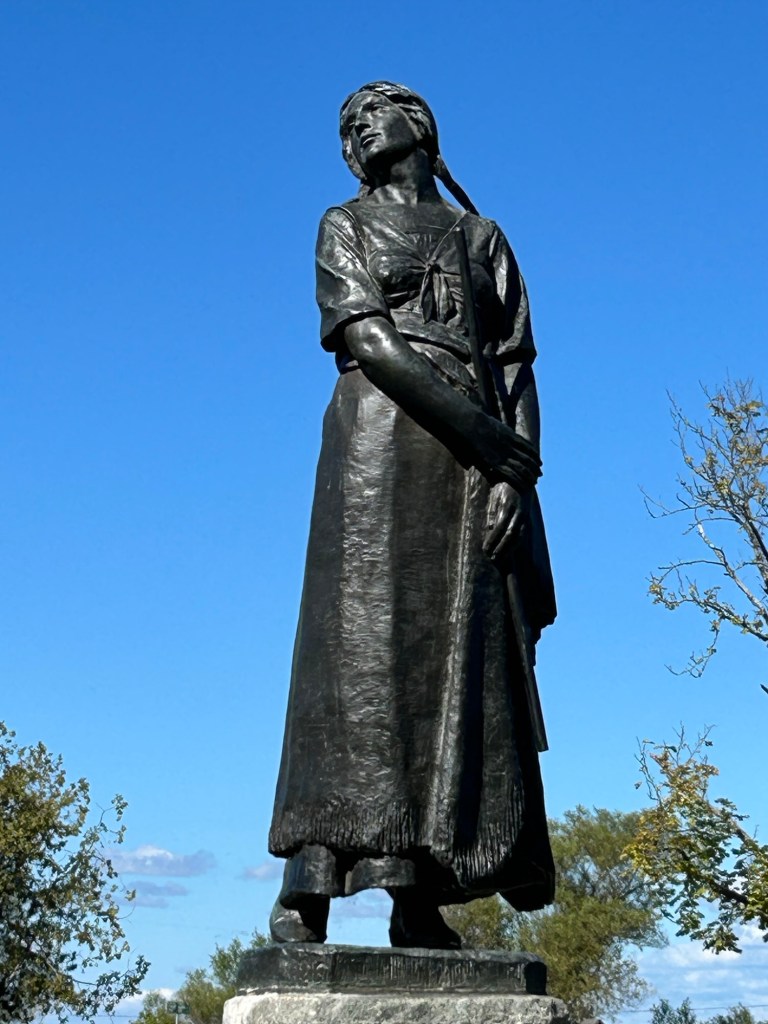
UNESCO chose to emphasize the land reclaimed by the Acadians, but the emotional power of the place is conveyed in Longfellow’s epic poem, Evangeline. The British, often at war with their rivals the French, gathered up thousands of neutral Acadian civilians, many whose families had lived in Nova Scotia (and nearby areas) for a hundred years, loaded them on ships and forcibly deported them to France and various colonies. The Grand Dérangement began in 1755, lasted 9 years, deported over 80% of the 14,000 Acadians, and 5,000 of those died due to shipwrecks, disease and starvation. A cross marks the spot where families were loaded into small boats, often separated, and taken on the dramatic tides out to ships in the bay.
The land is important too. The British certainly wanted control of the productive farming land that the Acadians had reclaimed from the sea using a remarkable system of dykes and aboiteaux or sluice gates. Tens of thousands of acres of farmland lies below high tide here, drained by one way gates in massive 17th century dykes. The replacement English speaking settlers, many from New England, maintained the dykes, and today’s warming climate allows vineyards on the surrounding hills. My cousin kindly showed me a working sluice gate, now operated remotely, and we walked along one of the dykes, appreciating the innovation and contemplating the rich red mud cut in deep channels.
Through our inaction on carbon pollution, we cause the sea to rise and claim our productive land. We cause hundreds of millions to be displaced, forcing refugees to move inland. We cause huge economic costs and more deaths due to disease, heat, pollution, starvation and storms.
It is easy today to say that the British were wrong to deport the Acadians. Yes we must admit that we’re committing a far worse global atrocity through our indifference to our carbon emissions.

 Zero Carbon Travel