Morristown National Historical Park

Couple reasons for choosing this old Colonial $30 note. First, the visitor center/ museum at Morristown has an exceptional collection of Revolutionary War artifacts: Washington’s cane, his inaugural sword, a Ferguson rifle (designed by the British commander killed at Kings Mountain), clothing, household items and numerous books and pamphlets, plus the original note above. I enjoyed the Cross garden, driving through Jockey’s Hollow (where the soldiers camped), the wooded hilltop at Fort Nonsense, and the tour of Washington’s HQ, but the detailed items on display are unique.

The war lasted 8 years, so Washington had as many winter camps and HQs, including at Longfellow’s House in Cambridge and at Valley Forge. But Washington spent three winters here in Morristown, early, mid (worst winter ever) and late war. New Jersey was central to his efforts in the north, with good roads, hills and provisions. Especially after the British Navy helped them take New York, New Jersey was critical to holding the colonies together. New Jersey is a beautiful and historic state, that is often in the shadow of New York. But, especially after Washington’s victories at Trenton and Princeton, New Jersey was the lynchpin of the colonies, and Morristown was at the crossroads of the revolution.

Which brings me to the second reason the note is important. The war dragged on far longer than most realize, and simply feeding and clothing 10,000 troops was a monumental task at the time. Our government was broke, divided, broke and out of money. Congress printed so many dollars, that they lost 70% of their value, and then they simply issued IOUs. Having to wait years for repayment, assuming we won, burdened people and drove some bankrupt. Hamilton cut his teeth for his future as Washington’s Treasury Secretary trying to administer the financial end of the war. Now the ‘full faith and credit’ of the United States is recognized internationally, but when the outcome of the Revolutionary War was in doubt, it took a great leap of faith to accept that dollar above, especially when the enemy was paying in actual gold and silver coins.

One of the key reasons we won the war was because the Marquis de Lafayette used his own money to join Washington’s army. The French noble was on a quest to avenge the death his father at the hands of the British, but the King hadn’t yet authorized direct military assistance. So Lafayette bought his own ship, and joined Washington’s army for free, even paying his staff, aides & junior officers out of his own pocket. Lafayette’s direct connections to the French monarchy helped convince France to join the war, and his negotiations with the balky French forces in Newport led to Washington’s strategic partnership with Rochambeau that helped end the war at Yorktown.

Washington had a knack for recognizing and inspiring talent, including von Steuben, Lafayette, and Hamilton. Those he mentored gave their all for him, and some grew resentful if they didn’t get the recognition they wanted. Benedict Arnold blamed Washington for not helping him enough after Arnold’s court-martial on a profiteering charge, leading Arnold to his infamous act of treason. Hamilton helped defeat a cabal of Washington’s rivals, but quit Washington’s service in a momentary quarrel over respect. Lafayette not only was devoted to Washington, but he helped bring our revolutionary ideals back to France, where he razed the Bastille and brought Washington one of the keys.

Washington’s leadership united our fractious states, overcoming deep distrust between many colonists. Which is why it came as such a shock to me when some of the tourists today interrupted the tour to propose alternate US flags, arguing (falsely) that the 16th Amendment (income taxes) wasn’t ratified and that Washington had created a religious flag (he didn’t) for the ships he sailed (he didn’t). The ranger was making a point about real slaves in actual slavery, when the nutter said that ‘we were all slaves but we didn’t know it’. Given how hard Washington worked to unify the original colonies and hold our country together, so that it could become the United States of America, I found it sad that selfish, misinformed and misguided citizens would be so clueless as to raise this nonsense where he once slept.

Here are my visits to all parks in New Jersey and all Revolutionary War parks.
Independence National Historical Park

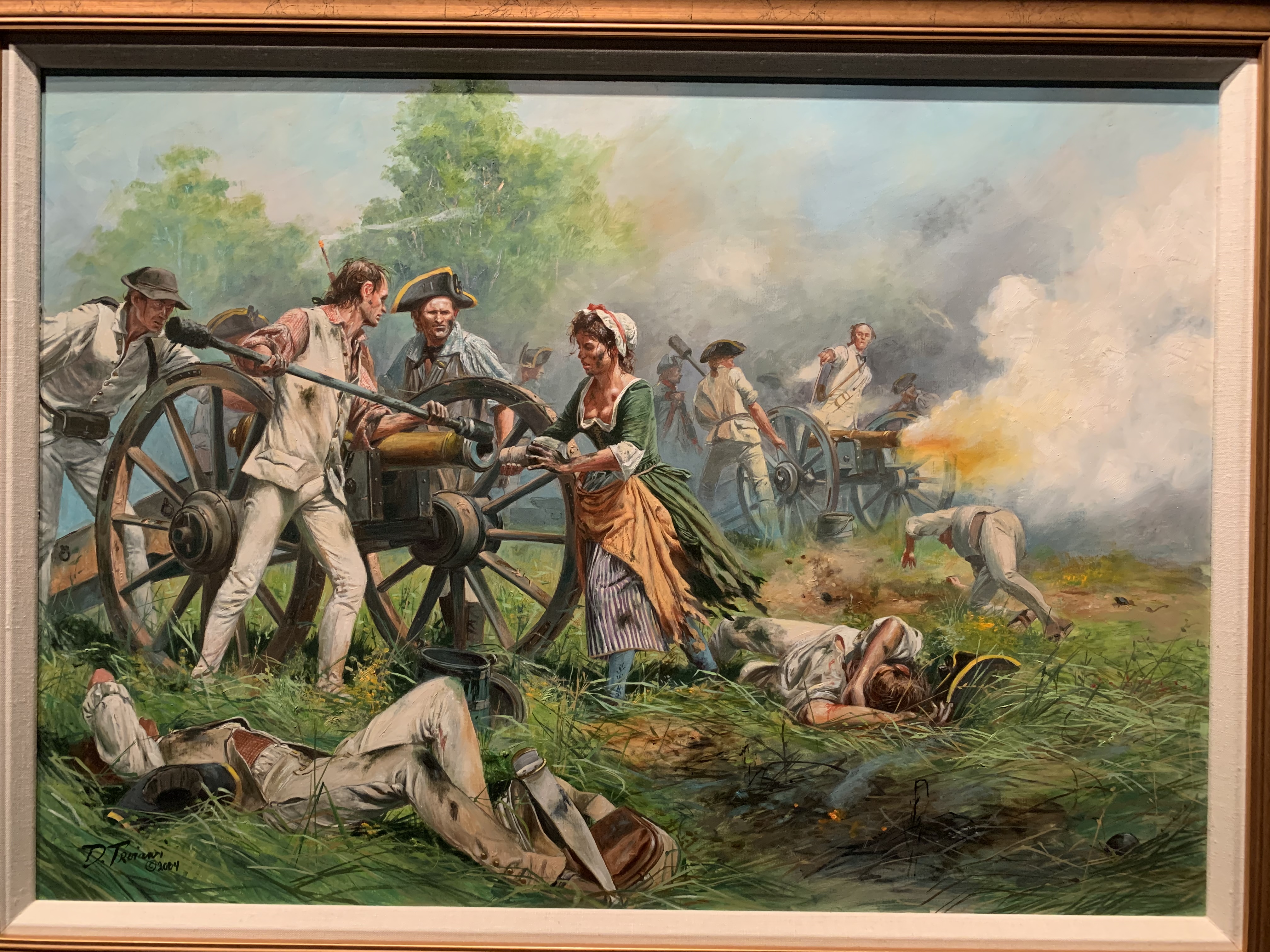
‘Molly Pitcher’ was the moniker for Mary Hays and women like her who helped win our independence. Mrs Hays is portrayed helping her husband’s cannon crew at Monmouth, and after years of service she earned a soldier’s pension. I chose her image over the Liberty Bell or Independence Hall (a World Heritage Site), because I know how easy it is to restrict a visit to those two popular and important sites. She’s on display now along with other illustrations at the Museum of the American Revolution.

In addition to the timed tours of those two famous sites, there’s so much more to do in the park. For all things Constitutional, there’s a museum (see Washington‘s war tent). There’s a Philosophical Museum, the First Bank, the Second Bank, the Merchant’s Exchange, and on and on. There are historic squares, parks, and buildings, including the one where Jefferson drafted the Declaration of Independence. There’s a tomb of the unknown Revolutionary War soldiers in Washington Square. Every corner has a sign celebrating some historic event, I half expected to see that a woman from Philly invented Mother’s Day. (Oh, one did).

It’s difficult to pick a favorite, and I might have decided differently had the portrait gallery been open (next year). But I was fascinated by the Franklin Museum, including the first post office, a print shop and more. Ben was genuinely, enthusiastically curious about everything. I loved seeing his glass armonica, learning about his kite swimming, his travels and the clever writing he did under pseudonyms. In one he wrote to a paper in London as ‘The King of Prussia’ arguing that if Americans had to pay taxes to the British, then the British should pay taxes to him (since the British royalty was German).

So by all means, see the bell and where our forefathers founded our nation. But do more. Learn about the role of African Americans, immigrants, women and even children in our fight for independence. And try to be like Franklin. Be wildly curious, explore the City of Brotherly Love, listen to that Philly Sound playlist, drink their Love City Lager, go to Talula’s Daily & have a picnic, spend the night at a wonderful Inn like Alexander’s, walk the old streets and try to imagine ways to improve our world. This is my favorite city park.

Here are my visits to all parks in Pennsylvania and all Revolutionary War parks.

Fort McHenry National Monument and Historic Shrine

Major Armistead insisted on a much larger flag to boost morale. The one he bought was nine times bigger than the small storm flag above the fort today. So when it was hoisted up at 9 am on September 14th, 1814, everyone could see that Fort McHenry was still in American hands, despite almost 2,000 bombs & rockets fired over the previous 24+ hours, from the grateful city of Baltimore to the frustrated British fleet in the Chesapeake Bay, where a young, detained American civilian negotiator named Francis Scott Key watched hopefully, before writing down the first verses of our National Anthem.

These days, big flags mean car dealerships, but after the British burned DC, whether this particular flag was ours decided the fate of Baltimore and of our nation. The film and ranger tour explain the story in detail. One of the air-bursting, shrapnel bombs, turned dud after flying through the rain, still sits next to the powder magazine in the fort. The fort’s flag had only 15 stars, even though there were more states at the time, because few people were particular about such symbolism at the time. But the multi-year ‘War of 1812’ helped spark America’s national identity, the Battle of Baltimore proved us strong and Key’s anthem stirred a deep, enduring patriotism. This is my favorite patriotic park.

Here’s the link to my visits to all parks in Pennsylvania.

Valley Forge National Historical Park

“In Europe, when the officer commands ‘do this’, the soldier does it.

Here, with Americans, I am obliged to explain,

‘this is why you need to do it that way’, and then they do it.”

Baron von Steuben, Inspector General of Washington’s Continental Army

Valley Forge was chosen for the high ground, not the valley, and the forge had been destroyed by the British before Washington‘s troops arrived. No big battles were fought here, and the most lethal forces encountered were diseases. It was a temporary winter camp, and when Washington returned later, he was happy to see that the farmers had reclaimed the land for crops.

But for Americans, this is where Washington’s leadership created e pluribus unum, ‘out of many one’, by forging 13 different sets of colonial militiamen, African Americans free and slave, Native Americans, immigrants, volunteers, and women into a professional army that could combat the British armed forces. Washington was a practical man, who ordered his troops vaccinated against smallpox, had them build thousands of sturdy log cabins, worked hard to see them well clothed & fed, and who brought a congressional delegation here to see conditions for themselves.

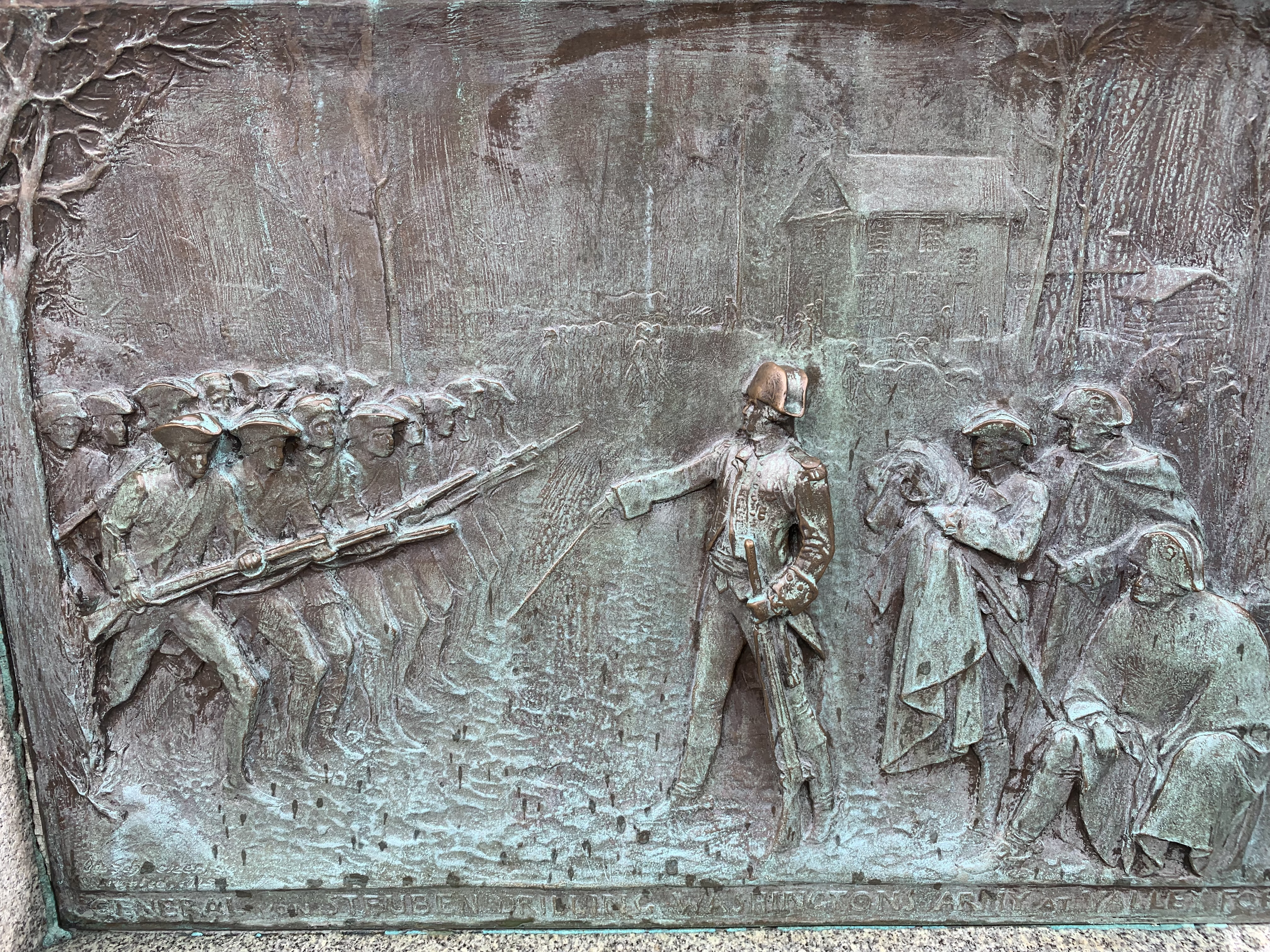
When Ambassador Franklin recommended the German Baron von Steuben (depicted in the bronze relief above), Washington trusted him to train his troops, unconcerned with rumors that he was homosexual or that he didn’t speak English. So, they got by in translated French, and the newly trained soldiers emerged as a credible fighting force to retake Philadelphia in the spring. Washington would not recognize the current generation of anti-vax, immigrant-hating, gay-bashing, misogynistic racists, no matter which flag they wave.

In later years, Americans realized the importance of this proving ground, and preserved it as a beautiful park, with forests, meadows and streams of trout. There’s even a covered bridge, not far from the stone farmhouse Washington rented for his quarters. The driving tour is quite pleasant, but I imaging bicycling to be best. E-bikes and regular bikes can be rented next to the parking lot.

Here are my visits to all parks in Pennsylvania and all Revolutionary War parks.

Hopewell Furnace National Historic Site

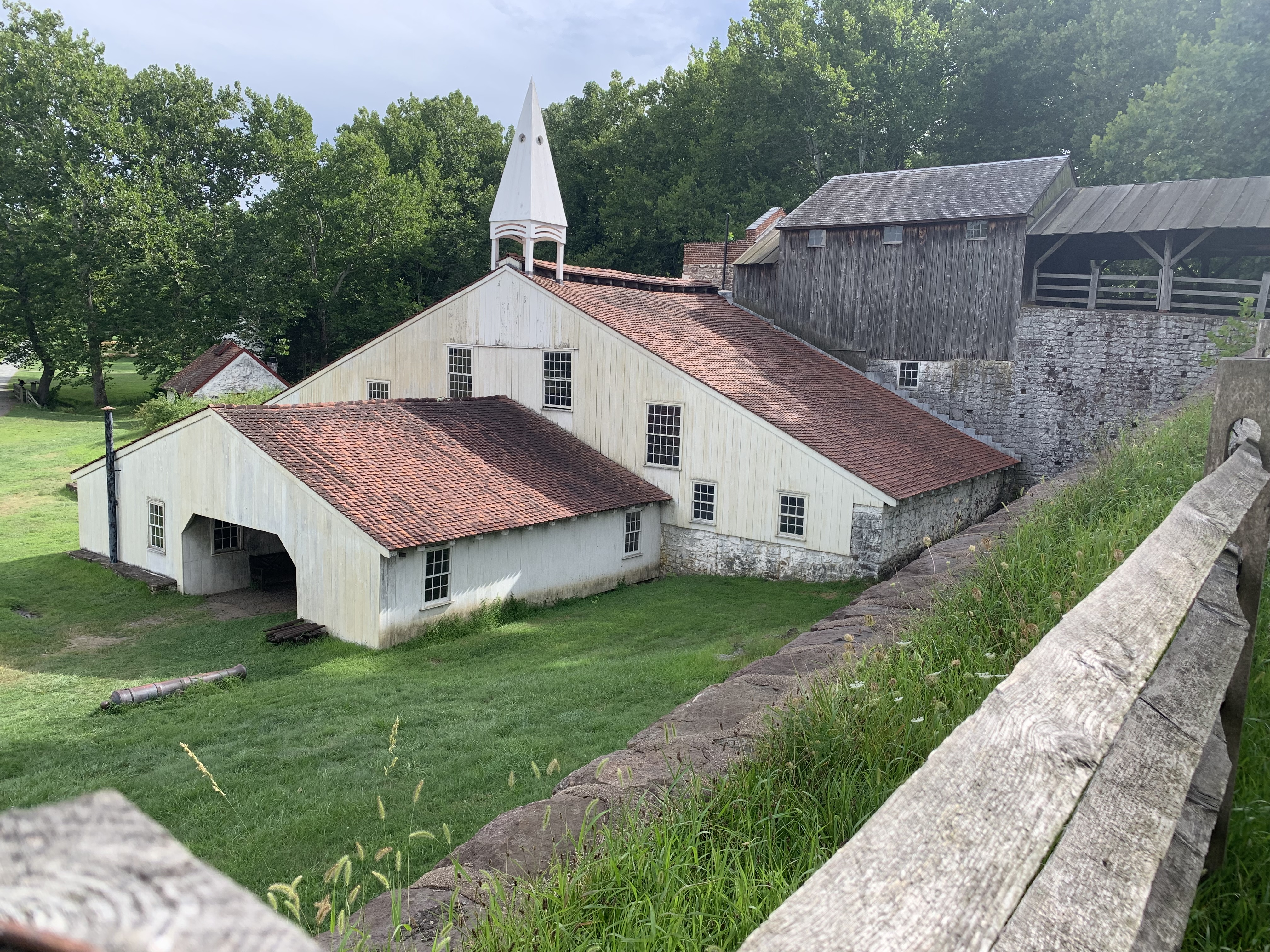
Among the sheep in this bucolic valley is the most complete early ironworks industrial site in America (unrelated to Hopewell Culture). Over 130 years after English settlers built the Saugus Iron Works, a more elaborate and higher volume factory was built here in 1771. Cannon and shot used at Yorktown and in our early Navy were forged here. Inside the red roofed cast house is a giant stone furnace, fed down the chimney by a constant stream of charcoal, limestone and iron ore through the grey wood building above. For over 100 years, the giant water wheel (which still turns today) blasted air into the crucible to pour iron ingots into the floor inside.

Upon arrival, I recalled visiting here at age 12, a number of years ago, on a school trip to Philadelphia and DC. One of my teachers still volunteers at a military park nearby. Each step in the process can be seen here, basically unchanged, from wood pile, to charcoal, worker housing and eventually to pig iron, ready for sale. Many great forests were felled for America to rise to the top of the iron and steel industry, but I notice that the owners kept many of their own fine old trees for shade and beauty. Now that we can harness nearly infinite clean, non-destructive power from the sun, I hope we make progress restoring nature.

Here’s the link to my visits to all parks in Pennsylvania.

Steamtown National Historic Site

Coal-burning transportation? What kind of site is this?!? Well, I rode a steam locomotive, and I liked it. Thankfully, this form of transportation is obsolete, replaced by the diesel-electric hybrid. So, I’m here to celebrate the demise of the historic steam engines, and I hope that coal-burning will soon go the way of the dinosaur. But I’m not driving to these sites by electric vehicle to skip the guided tours and lessons of history. If traveling 3 miles on a multi-million pound vehicle is the only way to learn the difference between local hard anthracite and common soft bituminous coal, then I’ll pay my $6 to get the full historic experience, 45 minutes of carbon fuel be damned. This is my favorite carbon-burning park.

Before visiting Scranton, I didn’t understand why President Joe Biden was such a fan of trains. Well, this place is a fascinating Mecca for rail-fans. The old trains were part of Blount’s Edaville RR amusement parks in New England, before being saved from the scrapyard through donations of train-spotters across the country. Here, our tax dollars are converted to educational opportunities for kids of all ages, to teach about the Gilded Age of RR Barons and the gritty roots of Pennsylvania. (A history echoed, perhaps, in the local Senate campaigns of Dr Oz v. Fetterman).

Scranton is also known as the Electric City, because they skipped the whole “horse-driven trolley” stage and started off first with all-electric trolleys. The best time to adopt future technology is always now. The county runs a museum right next door with electric trolley rides, but, since they’re not part of the National Park Service, I skipped it. (The whole ‘Zero Carbon Travel’ idea can be confusing at times).

This summer, I’ve had people try to tell me that Americans will never give up their loud smelly cars and that EV’s are somehow worse for the economy than gas cars. There’s a whole industry of anti-electric propaganda out there, doubtless funded by folks who would lose out if we all switched to electric vehicles. There’s actually no real economic argument for continuing heading for disaster. The Titanic received seven warnings about icebergs, but refused to either slow down or alter course. The loss of the ship disproved that brand of short-sighted “economics”. We can now see the beginnings of the carbon climate disaster unfolding, so there’s no excuse for inaction.

Here’s the link to my visits to all parks in Pennsylvania.

Fort Stanwix National Monument

Yes, I’m back with a bang! Tesla is still working on my car (Chaco was tough on the springs), but rather than hold me hostage, they’re letting me travel around in a Model S until my car is ready. And the fort celebrates the 1777 victory for two weeks in mid-August with hourly cannon fire!

This fort has it all: drawbridge, sally-port, parapets, ramparts, and meticulously detailed barracks. And it’s open, labeled, extremely photogenic and great fun to climb around and explore. A small crowd gathers just a few yards from the cannon just below the colonial officer walking in the photo, and each step is demonstrated from candle to boom!

Long before we became an independent country, French fur traders gathered at this natural portage between the St Lawrence Seaway and the Hudson River and bought beaver pelts from Native Americans to make hats. I drove up the Hudson River Valley, along the Mohawk River and saw signs for Oneida Lake which drains into Lake Ontario. A short portage here connects the two watersheds, making this a strategic point in the middle of New York State, later connected by the Erie Canal. Control of this portage had international repercussions, as colonial powers divided up the globe.

The British built the original fort after capturing the area during the French & Indian War, and George Washington rebuilt it to defend the territory from the British. The key battle happened when a British Colonel led troops from the Great Lakes to meet with General Burgoyne’s force from Montreal in order to separate New England from the rest of the colonies. Both sides were joined by Native American warriors, and there was a particularly bloody ambush in the woods near the fort. The Patriots defended the fort for about 3 weeks before Benedict Arnold’s reinforcements (when he was still on our side) disrupted the plan, leading to Burgoyne’s surrender at Saratoga. Regardless of which side they fought on, the Native Americans were eventually forced to cede lands in New York, Ohio and Pennsylvania, in return for some annual compensation and limited sovereignty over their remaining land near here.

Here are my visits to all parks in New York and all Revolutionary War parks.

Delay due to fire

Yes, I’ve temporarily moved back in with my Mom.

Why? Well, when I went in early to pick up my Tesla from the shop, there were emergency vehicles on site due to a battery fire.

The good news is that I’ve had a wonderful time here, swimming, eating seafood and relaxing. I’m restricted to the area until Tesla releases my car (not damaged). Fortunately, New Bedford (above) has the best scallops in the world.

Hope to be heading back to California shortly, with a few more posts along the way.

Boy, it’s hot

So, my car is getting a tune-up, new tires and some new parts. Driving over 30,000 miles on some very rough roads has done some damage. Also, it’s really hot everywhere. Fortunately, my Mom is letting me stay in the northeast near the coast until I can get back on the road. After over 150 park units, it’s time to pause the blog for a couple weeks. Ciao.

Thomas Cole National Historic Site

Like the Oklahoma City Memorial and the Touro Synagogue, this is an affiliated site that’s run separately from the park service, so there’s a $15 fee for the house tour. I’m a fan of Cole’s The Course of Empire set of paintings, which depict the same landscape from Nature to height of civilization and to forgotten ruins. The reproduction in his old studio above is from another series called The Voyage of Life.

Cole immigrated from England in 1818 at 17 and settled in the Catskill area of the Hudson River Valley to become a painter in 1825. Witnessing both the natural beauty and its destruction due to rapidly growing industry, Cole created romantic and allegorical landscapes to convey both his love of nature and his sadness at its devastation. He was extremely influential, and there’s a whole Art Trail devoted to the landscape artists who followed his style.

“Nature has spread for us a rich and delightful banquet.
Shall we turn from it?
We are still in Eden;
the wall that shuts us our of the garden
is our own ignorance and folly.”

Thomas Cole

Here’s the link to my visits to all parks in New York.