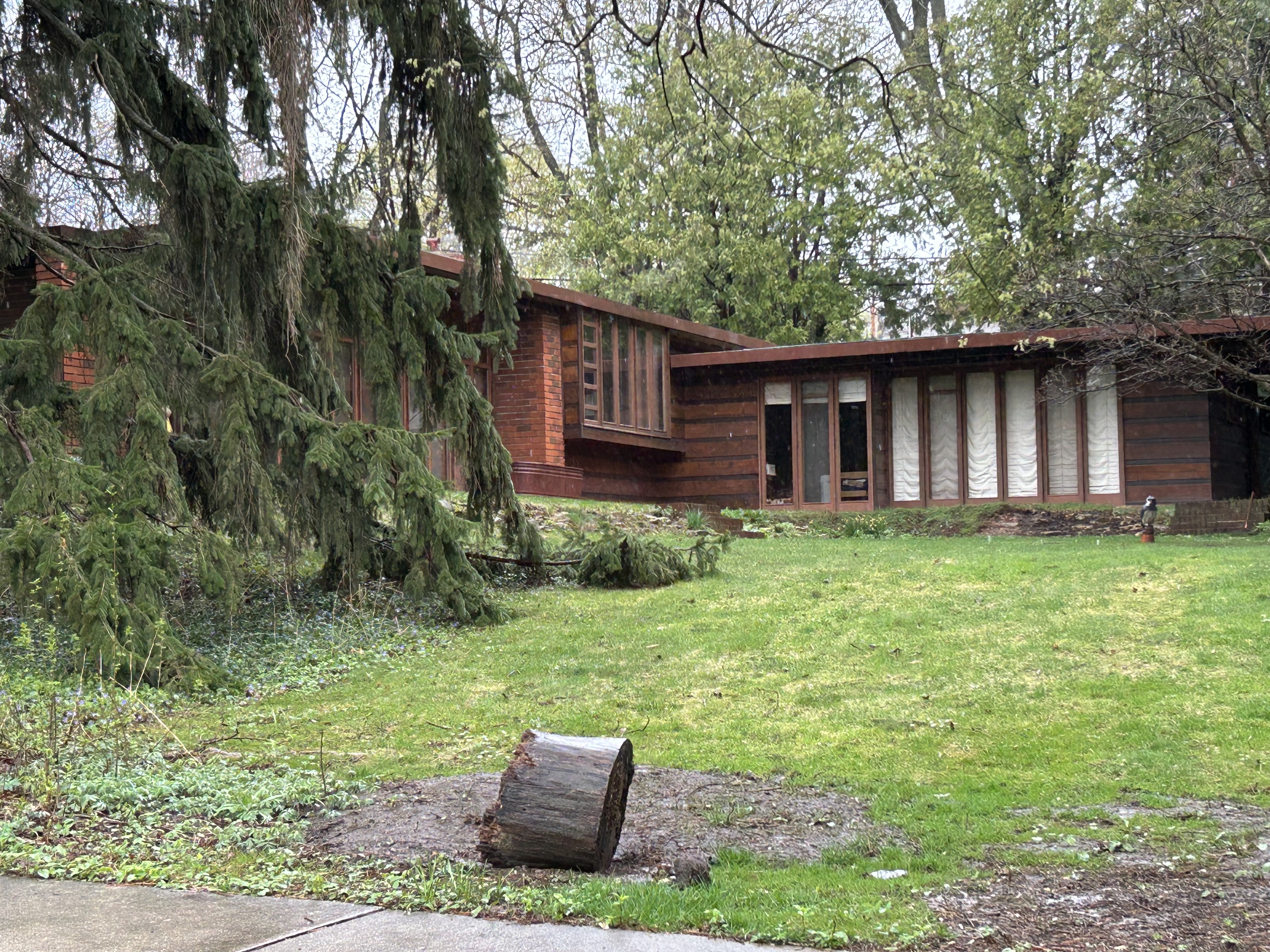
Ronald Reagan’s Boyhood Home

Reagan lived here in Dixon, Illinois, 100 years ago, from 1920 to 1924, as a young boy. Ronnie’s Mother encouraged him to act in church plays, which led to his career in Hollywood, his nick-name ‘the Gipper’ for his role in a movie about Notre Dame football star Knute Rockne, to becoming the President of the Screen Actors Guild and honing a skill set that served him well in politics.

Reagan’s economic policies of cutting top tax rates and deregulation contributed to an immediate economic boom and later increased inequality. Domestically, he favored harsh treatment of drug dealers, although his CIA was secretly involved in the Colombian drug trade which sold crack in US cities. His foreign policies followed his anti-communist views forged in Hollywood during the Blacklist days and contributed to the collapse of the Soviet Union as well as to the rise of some anti-Democratic regimes, especially in Latin America. Many of his team’s efforts were covert, including asking Iran not to release the hostages until Reagan took office, supporting the Mujahideen, etc. Reagan was extremely popular, both when winning a landslide reelection and in polls after leaving office. But there was definitely a dark side to his administration, as seen in the callous disregard for the victims of the AIDS epidemic, which contributed to thousands of deaths.

For many years a private foundation has given free tours here, declining to become an official park site, due to Reagan’s philosophy that “government is the problem”. After the death of their main benefactor, the foundation was reportedly ready to sell the property to the National Park Service, which is the last step needed for it to become an official park site. In 2021, the Young America Foundation, which also runs Reagan’s ranch in California, purchased the property. There are persistent unfounded rumors that Republican Presidents are denied as many park sites as Democratic Presidents, but the truth is that often private foundations choose to manage Republican Presidential sites, either out of disapproval of government management or out of a desire to keep control over the President’s legacy and present their version of the administration’s history. While I made it to his home in time for the last tour of the week, unfortunately, it was closed for a middle school event. Oh well, at least I made it to his door, while touring many historic homes on this trip.
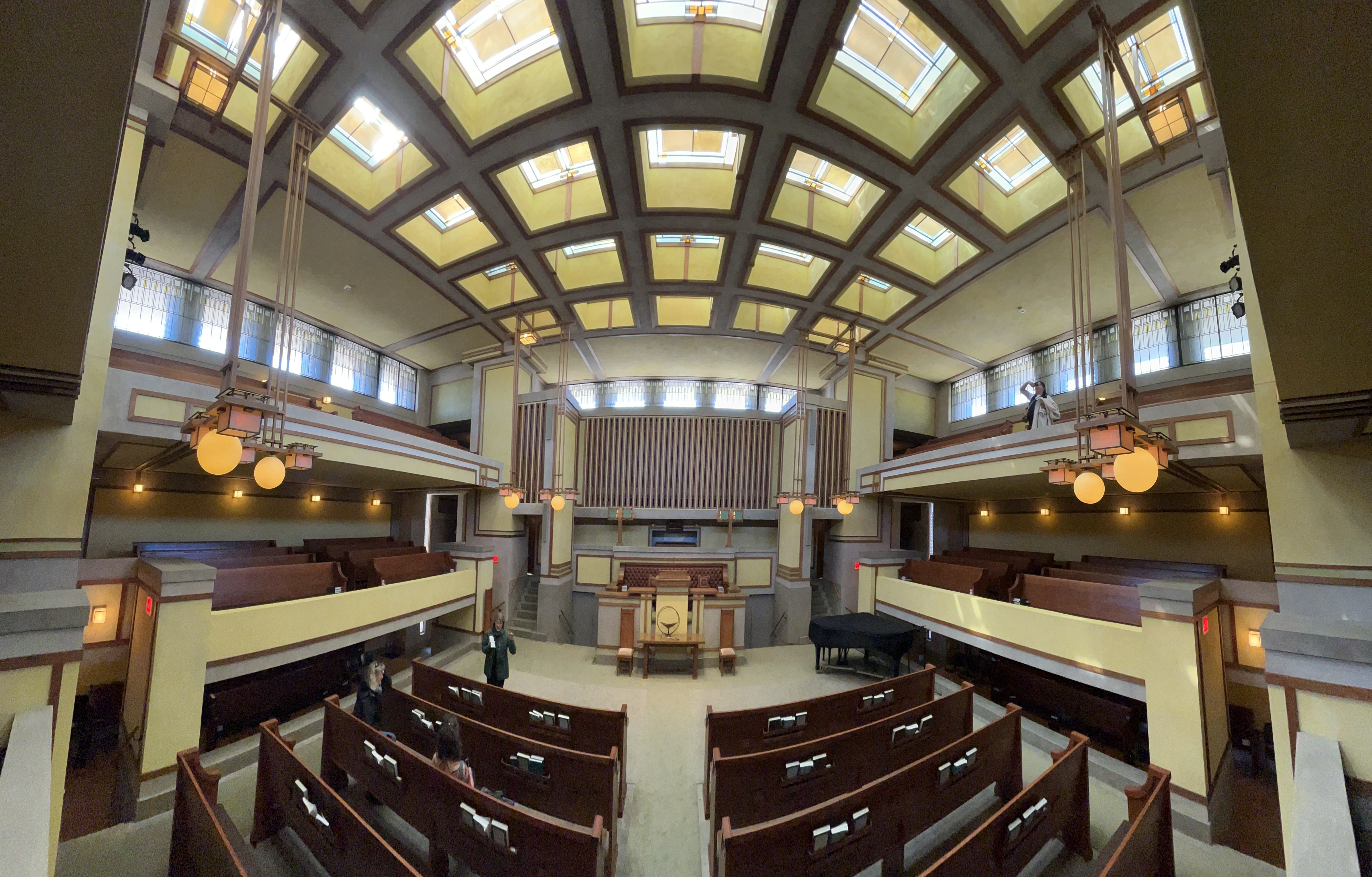
Unity Temple

Frank Lloyd Wright’s mother got him the job of designing a new church for her Unitarian congregation in their Oak Park neighborhood. Still used by the Unitarian Universalists today, this progressive architecture combines Egyptian and Japanese elements in a uniquely American temple. Wright’s signature custom light fixtures, intricate skylights, wheat colorings and guided journey from low, dark compressed spaces into the release of high open space and light from above, all contribute to a sense of awe. This World Heritage Site has been restored to exceptional condition and is open for excellent, detailed tours.

Here are my visits to all of Wright’s heritage sites and to all parks in Illinois.

Robie House

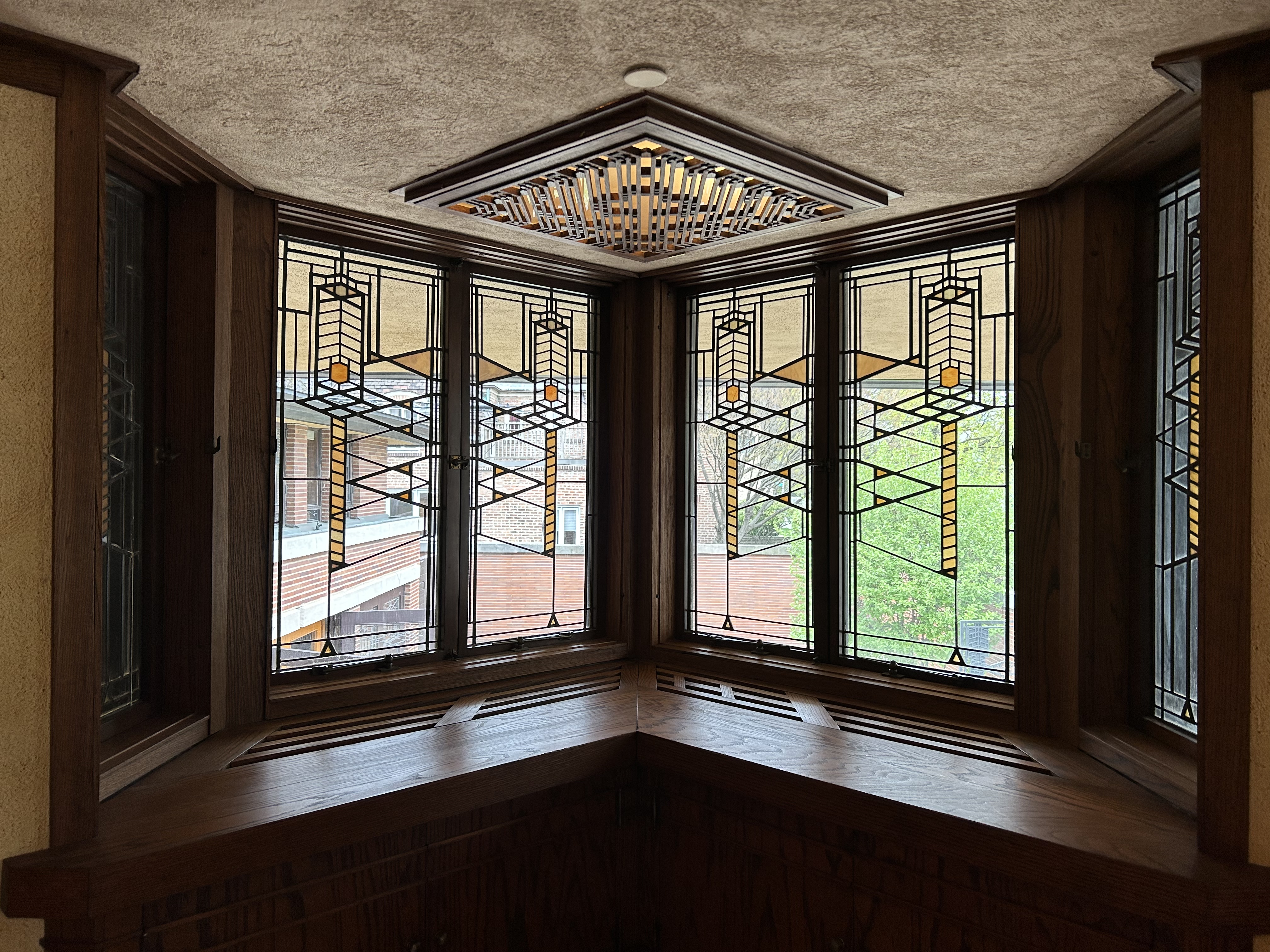
This classic 1910 Frank Lloyd Wright house is in the middle of the University of Chicago. Take the self-guided walking tour to learn about some of the nearby famous buildings. The campus is Oxford style, but Wright shattered traditional norms in this multilayered brilliant home.

The footprint is long and narrow, which Wright used to advantage, capturing light along the long south side, adding pointy ends, like the breakfast nook above on each end, and an open floor plan the length of the home. The colored glass in the window has iridescent multihued glazes on the outside, including pink, purple and lavender. Outside the home emphasizes the horizontal with brick colored mortar up and plain mortar sideways, and inside the vertical. From outside the home appears private, behind walls, with the front door hidden, but from inside, especially upstairs, the home has open views of what were once open fields and are now busy campus structures and spaces.

This World Heritage site is fascinating and is one of the most important architectural works of the 20th century.

Here are my visits to all of Wright’s heritage sites and to all parks in Illinois.

Oak Park Studio Home

OK, this is neither a park unit nor a heritage site, but there are a dozen Frank Lloyd Wright houses within a block or two, well worth a short stroll. And this was his working home, which he built at age 22 in 1889 and where he designed many of his best works. (Suburban Chicago ‘villages’ like this one grew rapidly after the Great Fire in 1871). Until you see the neighborhood with the fancy Victorian homes that were there when Wright began his career, it’s difficult to appreciate what he was competing against. Wright demonstrated that Americans could innovate and not merely copy European styles.

The home is notable for its Egyptian influence. At the time, Americans understood the East—near, mid & far—broadly as ‘Oriental’, and Wright even blended Mayan, Japanese and Egyptian styles together, in his own exotic mythology, not copied but stolen, reimagined and given new interpretation and life. Wright also used the home to experiment with bay windows, recessed lighting and various high ceilings and to display such modern conveniences as indoor plumbing and electricity. The home has been restored to 1907 including some rare pieces of furniture—and a Steinway built into a staircase that you have to see to believe—, to capture more of Wright’s ideas which reappear perfected in his later masterpieces.

Here are my visits to all of Wright’s heritage sites and to all parks in Illinois.

Jacobs House

Not all of Frank Lloyd Wright’s clients were extremely wealthy. He designed many homes for normal people, including this one in a residential neighborhood in Madison. Faced with a client, Mr Jacobs, who demanded a home for only $5,000, Wright also demonstrated that he could keep to a budget, building this for that price in 1936 during the Great Depression. He called this new style Usonian, which meant American Utopia open to the Democratic masses. The World Heritage committee must have been impressed with the full tour inside, but since it is still being lived in, the home is not open to tours.

Here are my visits to all of Wright’s heritage sites and to all parks in Wisconsin.

Taliesin

Frank Lloyd Wright’s Welsh grandparents bought a large parcel of land out here in Wisconsin, and his mother asked Frank to come back from Europe—where he was philandering with the wife of a client—and design a home here. He did and named it Taliesin (say ‘Tally-Essen’), which as I said before, means ‘brow’ in Welsh. To expand on that, it really is named after a 5th century bard of early Britain whose works were partly preserved in a Welsh book, so it takes on the meaning of ‘high-brow’ or ‘highly cultured, scholarly and well-versed in rare interests’. Wright obviously identified with the term positively, as he used it to name his most personal home, where he chose to live longest. In an amusing letter on display in the visitor center, Wright claims to love Wisconsin in part for the lack of ‘high-brows’, although he notes that Wisconsin does have several people who are ‘educated beyond their capacity’.

Unfortunately, his mistress and two of her children moved into the house and were killed in a fire started by a servant, who poured kerosene on the floors, locked the doors and dispatched all but one fire survivors outside with an axe. Wright rebuilt and lived here with his third wife (his second OD’d). The room above was built for a photo shoot in the 1950s, and shows the wooded hills and river valley that reminded his grandparents of Wales. Wright also built a high ‘bird-walk’, or narrow balcony jutting straight out, with phenomenal views that defines the home from the road below. The house is filled with Japanese influences and Asian art. His many students lived and worked in the barn they helped redesign and build, and a few still live here today.

Here are my visits to all of Wright’s heritage sites and to all parks in Wisconsin.

Taos Pueblo

Taos Pueblo has been continuously occupied for over 1,000 years—perhaps far longer—, much older than European settlements, and it is a World Heritage Site. Archaeologists have not extensively excavated the area—because the Red Willow people are still living there—, but there is evidence of trade with Mesa Verde and other early Native American settlements dating back many centuries. The multistory building above is home to many families, and folks on the upper floors climb ladders to access their apartments. While modern doors and windows have been added, the families, community and tribal government preserve the village in its original form, using mostly traditional building materials and avoiding electricity and plumbing anywhere within the village.

The pueblo sits below the Sangre de Cristo Mountains, a significant portion of which were returned to the community by President Nixon, including the Blue Lake and the headwaters of the Red Willow Creek. The creek runs through the middle of the village, is the sole source of water and flows into the Rio Grande. The Rio Grande Gorge southwest of Taos is strikingly beautiful, as are the Palisades near Eagle’s Nest northeast. The pueblos in this area are at the crossroads of ancient trading routes from coast to coast and to Central America.

Taos means Red Willow in the Tiwa language, and it is a town in an area crowded with history. Coronado arrived in 1540, and the Spanish built the first San Geronimo Church in 1620. When their Native dances, songs and worship were prohibited, the people here joined the Pueblo Revolt, which destroyed this any many other churches and forced the Spanish to retreat to what is now Mexico. The Spanish eventually reconquered the area and rebuilt the church. After the Spanish were forced to cede their territory to end the Spanish American War, the US Cavalry eventually was sent to subdue the people, who took refuge in the church. There were no survivors of the artillery bombardment, and the old church grounds are now a cemetery. The new San Geronimo Church contains a statue of the Virgin Mary from the old church, and the villagers practice both their indigenous Nature-focused religion and Catholicism with indigenous elements.

The locals give tours, sell handicrafts and run bakeries and cafes. Al’Thloo’s (grandmother’s) Cafe serves excellent Piñon Coffee and a Taos Pueblo Taco on freshly baked Frybread. The proprietress explained that the creek is currently near record flooding, due to the unnatural heat this Spring, and she informed me about the havoc that the Climate Crisis is having on snowpack, wildfires, drought, irrigation, crops and ranching. Her husband fought in WWII, and her family has been involved in supporting Native American causes for decades from here to Standing Rock. I wish more people were as clear-eyed and passionate as she is.

Here are all my park visits in New Mexico.

What About Charging?

It’s easier than you may think. Does your car tell you when you’re about to drive too far from the nearest gas station? Does it include fuel stops in your itinerary automatically, or let you know the prices before you decide where to fuel up? When was the last time you filled up for free? Can you fuel up overnight while staying at Mesa Verde, in a campground, while eating a burger, drinking a white mocha or watching the base jumpers fly off the bridge into the Snake River Gorge in Twin Falls, Idaho, above?

I have only had a few tricky charging situations so far. One was at the Dairy Queen in Needles, California, where every time the owner updates his seasonal specials, his sign truck blocks 3 of the 4 chargers for much of the day. I asked him why he didn’t tell Tesla in advance, so that the cars would route drivers to a different charger, but that never occurred to him. I also suggested that he could park the truck on the other side of the sign and only block 2 of 12 gas pumps, and he looked at me like I was crazy. I decided not to buy any ice cream while waiting.

Recently, I was unable to contact the owner of a JuiceBox charger in Terlingua, Texas, so I just charged up a little for free. One more tricky situation was at the supercharger in Lamar, Colorado, where the town was celebrating some event and the street was temporarily blocked off. But while I was waiting, a town councilwoman came up to offer me BBQ and asked if I was enjoying the live band. I had a beer to help me survive the wait.

Like any vehicle, you can go further if you slow down or turn off heating/cooling and open the windows. To extend my range while traveling in remote areas, I use the free PlugShare App to scout out my charging options and use my adapters (standard J1772, RV 50v, RV 30v, and rarely CCS). The trick is to remember that you need to sleep somewhere on a long road trip, so just find a campground with electricity or a hotel near a slow charger and plug in over night. Tesla destination chargers can be found in some spectacular areas, and they’re often free to hotel guests. [No, I’m not compensated by Tesla in any way].

A few folks quibble that this is not entirely “zero carbon” travel, but it’s not my fault if the grid isn’t fully renewable yet. The sooner we all switch to electric vehicles, the sooner fossil fuel goes extinct. My vehicle doesn’t burn carbon, and I can’t help exhaling carbon dioxide. And to clarify my rules, I have two different goals: 1) to travel to as many places as I can without burning carbon and 2) to enjoy those places, which sometimes involves burning a little bit of carbon to get around the parks.

Most folks seem to understand that driving EV’s save money compared to gas, but I don’t think people fully appreciate the difference. While I was on my way to the restroom, a guy asked me how much it cost to fill up, so I told him usually less than $20. He said, “just like my truck”, but I know his truck costs $200 to fill up at those gas prices. And both vehicles have comparable range. Math isn’t that hard.

I tried to convince the rangers at Death Valley to do more to encourage visitors to switch to EV’s, but they said that they don’t want to force people to buy “expensive vehicles”. A $100,000 5th Wheel or $200,000 Class A rig only goes a mile or two per dollar of fuel. I go at least ten times that, over 15 miles per dollar. It’s very easy to save $10,000 in fuel costs per year switching to an EV, and even more if you go on long road trips, find free charging or use solar to recharge at home.

But the real reason to switch to EV’s is to save life on Earth. Why wait?

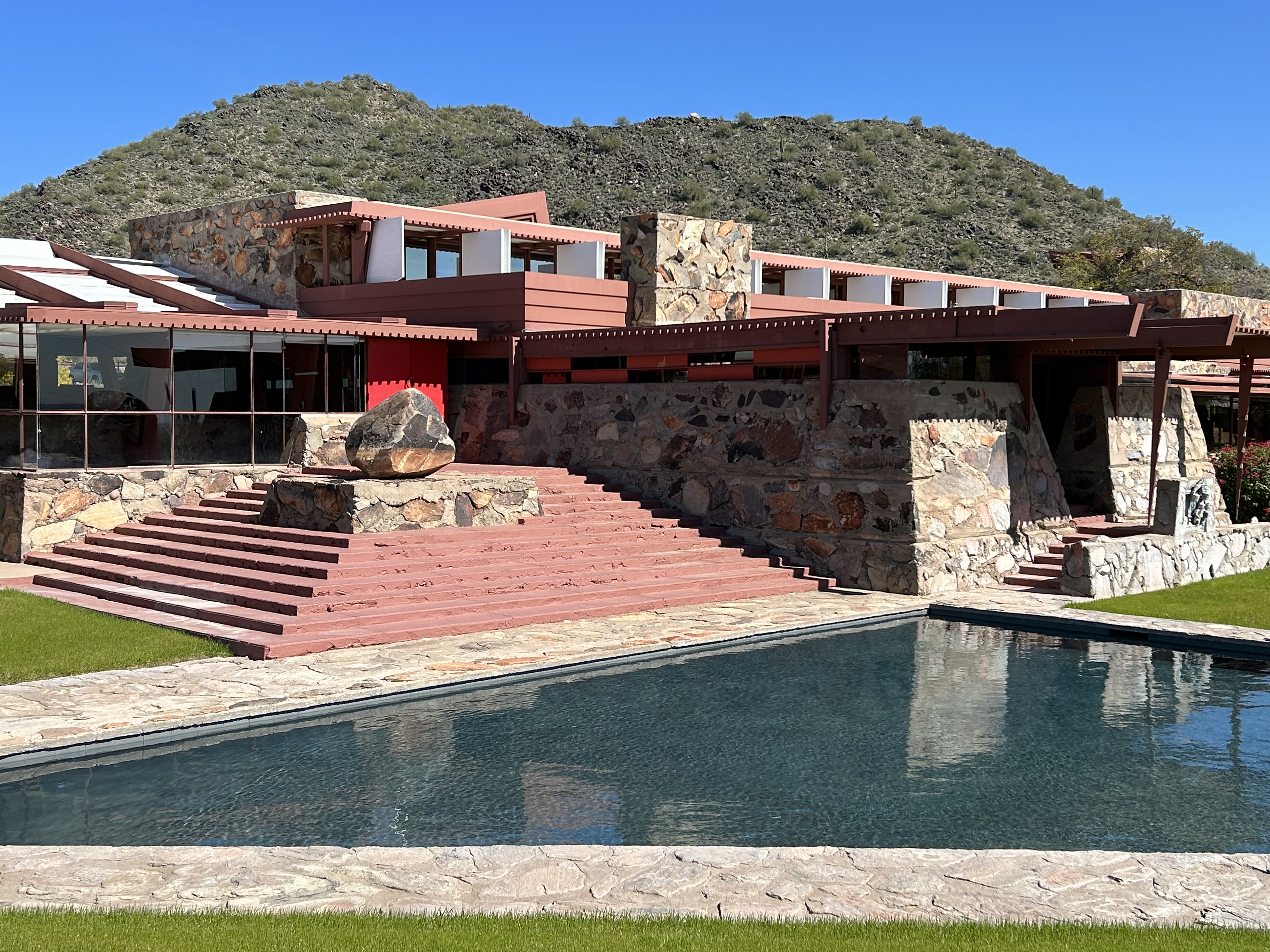
Taliesin West

Frank Lloyd Wright’s winter home until his death in 1959, this World Heritage site is a remarkable example of his architecture. The architect preferred to build just below the top of a hill, on the ‘brow’ or taliesin in Welsh. The triangular pool brings the background mountains into the foreground, and the front walk forms a point like the bow of a ship to admire distant mountains, like islands across the undulating desert landscape where cholla cactus looks like coral. Besides the bright red door behind the rock and the small ornately carved scene to the right, there are Chinese influences throughout, including many more carvings, an elaborate story panel, a round garden door, a bell, a dragon and other architectural touches. Inside you can sit in his origami chairs and study the internal structure of a nautilus or the draft blueprint of the Guggenheim. Wright brought his students and apprentices to live and work, and he established an institute dedicated to his school of architecture. Situated in the tony Scottsdale neighborhood, the audio tour of the property is detailed, takes you around step by step and explains his architectural philosophy. Guided tours are also available, and schedules & numbers are strictly limited to keep a steady flow through the small parking lot and on the tours.

Here’s the link to my visits to the other Taliesin, the rest of Wright’s heritage sites and all parks in Arizona.

Hollyhock House

Frank Lloyd Wright designed this home for a theatrical oil heiress socialist in 1919. While it is not one of the national park units, the National Park Service successfully applied for UNESCO World Heritage status. The architecture is a fascinating mix of Mayan and Japanese influences and Wright’s own distinct style. The fountain outside flowed into the moat in front of the fireplace (above) and out into the garden. From the hollyhock garden outside, there’s a marvelous view of the Griffith Observatory and the Hollywood sign.

Aline Barnsdall grew disenchanted with the over budget project and fired the absent architect before it was completed in 1921 by his son. She gave the property to the city on condition that they let an art club use it for many years. Despite almost being demolished for redevelopment and suffering damage in the Northridge Earthquake, the house is being restored to its 1920s appearance, has an art exhibit inside, and is part of the Barnsdall Art Park, which includes a theater and community art space.

Several buildings and rooms are still off limits, one damaged terrace has been fenced off and there’s some construction chaos outside, as of my visit in February. But it was sunny and 78° F with sun bathers and families enjoying the beautiful hilltop park, and inside the timed ticket limited visitors enjoyed detailed explanations from many knowledgeable guides on the ‘self-guided’ tour. There are currently 8 Frank Lloyd Wright houses in the US on the World Heritage list, and I plan to visit them all this year. [Update: I did it!]

Here’s the link to my visits to all parks in California.