Keweenaw National Historical Park

Reports of a two ton boulder of pure copper lying in a river bank on the Keweenaw peninsula of the upper peninsula of Michigan were dismissed as tall tales, until proven by a geologist in 1840. The boulder wound up at the Smithsonian Natural History Museum, a huge mining boom rush erupted, and the closest port town was named after the geologist, Houghton. Most of the small mines failed, but eventually a large consolidated firm found and mined the largest pure copper lode in the world.

Technically the copper was “rediscovered” (or stolen) as the Native Americans here had been mining it for at least 7,000 years and traded it as far as Effigy Mounds, Hopewell, and other prehistoric sites around the country—so don’t accept the common misconception that Europeans introduced metal work to this continent. However, European immigrants did expand the mines here to an astounding scale. The deepest part of the Quincy Mine above is over 9,000 feet below ground, which is over 6 times deeper than the Empire State Building is high, with huge rooms left behind after the copper seam was excavated (see photo), and 92 levels mostly flooded after the mine closed in 1945 due to competition from western mines.

The huge equipment includes many rare and once record-breaking pieces of industrial machinery, and the Quincy Mine tour is fascinating and essential to understand miners’ lives. Be sure to get a big Cornish Pasty at Roys in Houghton. There are some museums and a visitor center in Calumet, including a magnificent old theater with lovely murals, but since most of those tours are only in the afternoon, it may be smarter to tour the mine in the morning. There are a couple dozen interesting sites on the Keweenaw peninsula, but for me the most haunting exhibit was the description of the Italian Hall disaster at Christmas in 1913.

While capitalists are allowed to organize freely under the law, labor was not. Thousands of copper miners went on strike, and the mine owners hired ruthless, violent strikebreakers. Someone—an anti-unionist according to eight witness who later testified to Congress—yelled ‘fire’ into a crowded Christmas party on the second floor of the Italian Hall in Calumet. There was no fire, but 59 children and 14 adults died. Woody Guthrie explained what happened below.

“The copper boss’ thugs stuck their heads in the door,
One of them yelled and he screamed, “there’s a fire”
A lady she hollered, “there’s no such a thing.
Keep on with your party, there’s no such thing.”

A few people rushed and it was only a few,
“It’s just the thugs and the scabs fooling you, “
A man grabbed his daughter and carried her down,
But the thugs held the door and he could not get out.

And then others followed, a hundred or more,
But most everybody remained on the floor,
The gun thugs they laughed at their murderous joke,
While the children were smothered on the stairs by the door.”

“1913 Massacre” by Woody Guthrie

Here are my visits to all parks in Michigan.
Kings Canyon National Park

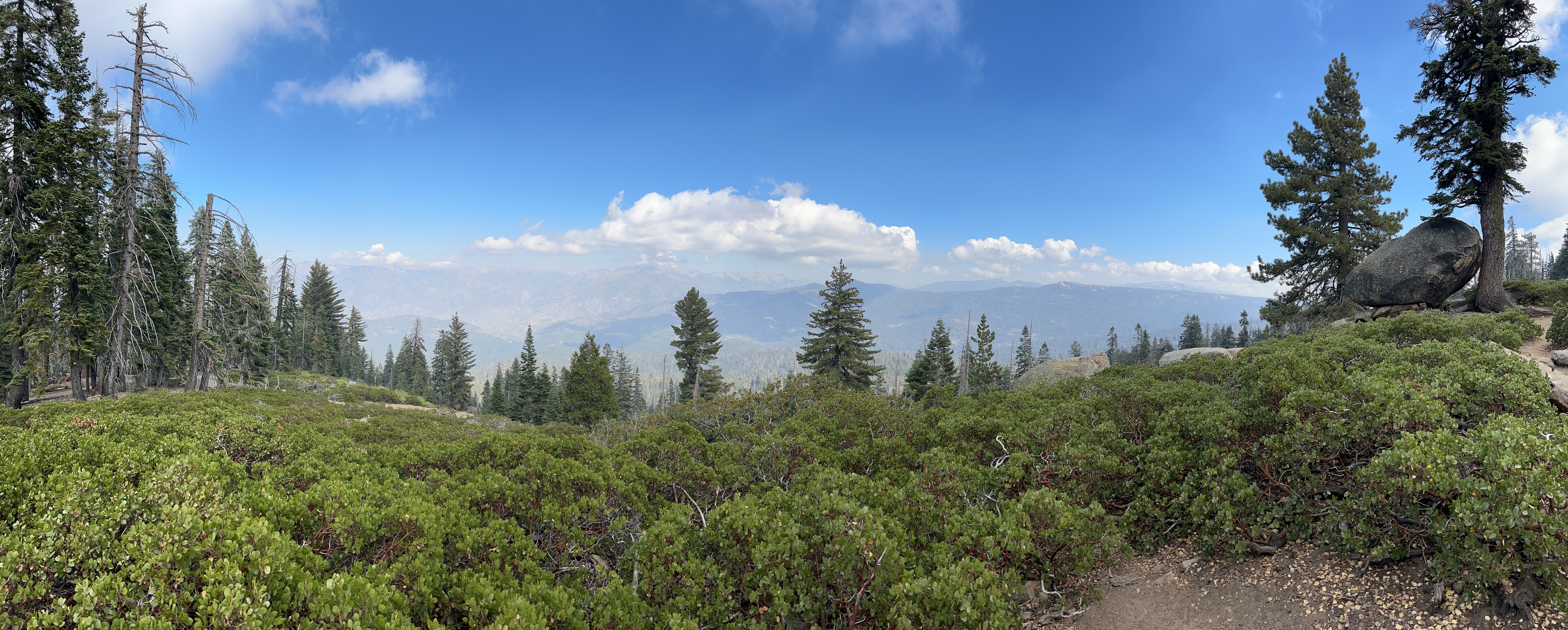
John Muir loved the view from Panoramic Point above, as did Stephen Mather, the first national parks director. I visited the park years ago with my family, and the scenery was stunning. But the view was less inspiring when I visited this summer. Smoke from a wildfire shrouds the view of Kings Canyon in the distance. You can hardly see the lake in the photo above. Behind me stand acres of dead trees burned in the huge wildfires of the past few years, and the main road into the heart of Kings Canyon wilderness was still closed this summer due to fire damage. If Muir & Mather visited now, they would be as heartbroken as I.

Experts employed at this California park have long argued influentially in favor of more fires, have implemented prescribed burns in forests across the west, and they chose to let the wildfire above burn itself out. Their dogma blamed past firefighters for causing today’s wildfires. Even though park rangers are not allowed to smoke, leave campfires unattended, burn out shelters in trees, or use fire to hunt, this park’s scientists used to argue that we needed those ‘Native American burn practices’ for forest health, even though these forests evolved without humans. Too many forest rangers and climate change deniers use this illogical nonsense to ignore and dismiss the danger of carbon. 

This year 46 million acres of wilderness forests burned in Canada in roadless wilderness areas consistently ignored by firefighters in the past. How could these wildfires have been caused by past ‘fire suppression’? The dogma is wrong. After the unprecedented recent wildfires, park scientists here have belatedly begun to recognize the predominant threat of climate change, far worse than any prior suppression errors. 

When Muir & Mather described the area, they did not remark on seeing any large areas of burned trees, made no note about any fires that regularly demolish many thousands or even a million acres every few years, and they did not write about the supposed benefits of Native Americans regularly setting fires while pelt hunting. Instead, they were inspired by the beauty of huge swaths of living forests and pledged to protect them forever. Scheduled fires, tree density limits, species removal, reseeding, and other human intervention are not what Stephen Mather had in mind when he called such places ‘untrammeled wilderness’. Muir would have harsh words against the ~$250 million annual timber sales in the forests he and Teddy Roosevelt protected. 

If Muir & Mather could return, they would notice that the whole forested range has changed dramatically, the air and ground are drier, the temperature is unseasonably hot, the rivers and creeks are dry, and that the snow is gone from the mountaintops. They would be dismayed by the decline of once abundant wildlife. Muir, who never rode in cars, preferring horses or hiking, would see the lines of buses, RVs and cars burning gasoline, and he would shout ‘STOP’!

In the future, doubtless people will be horrified to learn that in the face of climate change fueled wildfires, we chose to burn our remaining forests ourselves, releasing even more carbon into the air. It’s like using leeches to cure people, even though they make the patient weaker. Or like destroying the village to save it.

Forest science must face the future, not misrepresent the past. We need national policies to limit carbon pollution, not taxpayer-funded ‘prescribed burns’ that increase carbon pollution. If new conditions require fire breaks or dead trees need to be removed, then why can’t trees be cut down and buried with sand, instead of being burned? If certain types of trees will no longer survive in the future hotter climate, then we shouldn’t be paying people to plant seedlings for more of the same trees in the same places that burned down two years ago. We need to charge visitors in gas-burning vehicles a carbon surcharge to encourage people to switch to electric vehicles (and to mitigate some of the damage they do). 

We ended wilderness. Our carbon pollution is trammeling every species on earth. We have precious little time remaining to figure out how to save species before they go extinct forever.

Without wilderness, we will eventually lose the capacity to understand America.
Our drive, our ruggedness, our unquenchable optimism and zeal and elan
go back to the challenges of the untrammeled wilderness.

Harvey Broome, founder of the Wilderness Society

Butterfield Overland & Pony Express National Historic Trails

From 1858 to 1861 John Butterfield operated the fastest and most reliable stagecoach route west via the Oxbow Route that bent from the central Mississippi River deep along the Mexican border and up California to San Francisco, before the Civil War put him out of business. The trip took 25 days (or less) and carried mail, passengers and freight. The current parks along that route are below.

From 1860-1861, express mail was carried by young riders—including a young ‘Buffalo’ Bill Cody—who would stop only briefly to switch ponies along the way. That trip took 10 days along the pioneer trail, but the completion of the transcontinental telegraph line later in 1861 put them out of business. Due to the simple nature of the operation, almost all of the original trail and stations are gone, but a few remain. I’ve visited stops and roughly driven the length of the trail by EV, and I recommend the following sites to enthusiasts.

  • Stable & Museum in St Joseph Missouri
  • Hollenberg Station in Hanover Kansas
  • Fort Kearney in Nebraska
  • Scotts Bluff in Nebraska
  • Fort Laramie in Wyoming
  • Heritage Park in Salt Lake City Utah
  • Wells Fargo Bank in Old Town Sacramento California

Redwood National and State Parks

After Yosemite’s magnificent waterfalls, stunning vistas and valleys, Redwood is quieter, with more solitude and an intimate closeness with the trees: less spectacle and more spiritual. This World Heritage Site is a marvelous place to get lost alone among giants, to reminisce as if traversing the great forests of Middle Earth. One of the young hikers strode in full Frodo costume, looking for Ents. As some of the trees living here predate all but the earliest human history, you can’t blame him for getting into the spirit. When Frodo first entered Lothlórien to seek Galadriel’s help, he spent his first night in a treehouse in a giant Mallorn tree. “He felt a delight in the wood and the touch of it, neither as forester nor as carpenter; it was the delight of the living tree itself.”

My favorite park for tall trees, the redwood forest is real and huge, so plan on hiking. The photo above is near Trillium Falls on a highly recommended 3 miles hike in the National Park from Elk Meadow near the south end of the park. I also walked from the Prairie Creek visitor center up to Big Tree—a Giant Sequoia—in the Prairie Creek State Park on the Knapp trail returning on the Cathedral trail on the other side of the scenic drive. There are several ways to do the 3 mile loop, as well as plenty of shorter or longer hikes from many trailheads, flat or up onto ridges or down to the coast. There are also tide pools, fresh water lagoons, beaches, mountains, camping, elk (I saw 12) and more. Best of all, it was 30 degrees cooler than inland in July. The coastal redwood forest is lush and beautiful, safe for now.

“Many of these trees were my friends.
Creatures I had known from nut or acorn.
They had voices of their own.”

—Treebeard

Here are my visits to all parks in California.

Oregon, California & Mormon Pioneer National Historic Trails

The first recorded pioneers to take the trail with wagons were the Whitmans in 1836, who settled in Washington 11 years before the massacre. In 1841, the Whitmans were followed by the Bidwell-Bartleson party, which split midway and settled in both Oregon and in California, after a harrowing journey. In 1843, a thousand pioneers made it to Oregon, finding a safer path through southern Idaho. In 1846, the Donner party got caught in early, heavy snow near Lake Tahoe and engaged in cannibalism before being rescued. That same year Brigham Young led 500 Mormons to Salt Lake City, leaving from Nauvoo, Illinois, two years after a mob broke into jail and killed Joseph Smith.

Gold was discovered near Sacramento in January 1848, and then Mexico ceded the state in February after the Mexican-American War ended. So, there was a flood of migrants to the mountains in California. To be clear, ox-driven wagons were used for gear. Pioneers walked. Many miners did not have wagons. And most Mormons pushed their carts by hand. Cholera and other diseases spread rapidly on the trail. Many of the pioneers were economic migrants or seeking freedom from persecution, and some did not have legal rights to settle where they did. As we celebrate our pioneer heritage, let’s not close the door on today’s migrants.

All three trails were heavily traveled in the 1850s and 1860s, and all passed through Scotts Bluff—see photo above & read how coffee saved lives—and Fort Laramie. The Mormon trail ends at Salt Lake. The Oregon trail goes past Hagerman Fossil Beds in Idaho and on to Fort Vancouver in Washington. The California trail breaks into different routes in Wyoming, with some passing through City of Rocks in Idaho, before the trail joins together to cross central Nevada. And then, the route depends on the destination: some north through Lassen to Whiskeytown, some through Carson City Nevada to Sacramento, and others south near Yosemite to the central valley.

Naturally, the trails only cover the most common routes, and there are pioneer trails all over the west, including some carved into cliffs. But all three main historic trails were used heavily, in both directions, until the railroad was completed in 1869. Our history includes many changes and challenges in transportation. Today, the Climate Crisis demands that we switch to electric vehicles. Compared to the pioneer stories, that should be easy.

Yosemite National Park

In 1859 John Muir built a Sugar Pine cabin some yards from the spot above and lived in the Valley for 2 years. Sugar Pines can live 500 years, so the decades John Muir spent saving this valley are just a fraction of their long lives. Muir saved Yosemite, lost neighboring Hetch Hetchy to a dam, and influenced Teddy Roosevelt who ended up protecting 150 million acres of forests nationally. Now the park is a World Heritage Site, with the Merced Wild & Scenic River running through Yosemite Valley, and it’s my favorite park for waterfalls. But in the near future, the crown jewel of John Muir’s legacy may still be lost forever.

Some species of trees still living here evolved in the Jurassic, long before the Chicxulub asteroid wiped out most dinosaurs and millions of years before humans arrived. Millenia ago, natives started fires for hunting and agriculture, and over a century ago, the timber industry clear cut forests throughout the Sierra Nevadas. But humans now present a threat bigger than any logging or dam. Now the threat is carbon pollution, which dwarfs all others, even logging. Fires burn hotter, more frequently and many times larger, because we have changed our planet’s climate dramatically—and it’s still getting worse. Species here, despite evolving 1000 times earlier than humans, are now threatened with extinction by our vehicle exhaust.

10 years ago, the 250,000+ acre Rim Fire burned over 10% of Yosemite, killing many Sugar Pines and Sequoias that had survived fires for centuries or millennia. At the time, it was the second largest fire in California history. Now it doesn’t even make the top ten. I visited the park with my family before that fire, and the park was undamaged. Now, the park is still beautiful, but it is still scarred badly, with many areas still closed.

Yosemite Falls should not be so glorious in the photo above taken in July. The snow should still be on the mountain tops, melting slowly over many months. Instead, every decade is warmer than the last and the rate of temperature rise in increasing. The Lyell Glacier that Muir saw in Yosemite has lost over 95% of its mass, no longer moves and will be gone in a few years. Man has messed up the climate, and many of the species, including the largest trees, can no longer live here safely. And it’s not the fault of Smoky Bear telling people to put out their campfires, it’s the fault of people who continue to drive gas powered vehicles. And yet the park is full of them, blithely surveying the damage they contributed to and continue to cause. If I were in charge of the park service, I would convert the shuttle buses to electric and ban all fossil fuel vehicles.

Here are my visits to all parks in California.

Pacific Northwest National Scenic Trail

The Forest Service managed trail runs through Glacier in Montana, just below the Canadian border to the north end of Lake Roosevelt in Washington, to Lake Ross, through the north part of the North Cascades, past Ebey’s Landing (see photo) near where it connects to Port Townsend by ferry, and through Olympic to the Pacific. I’ve hiked short sections and roughly driven the length of this 1,200 mile, wild, rugged and beautiful trail.

Here are my visits to all parks in Idaho, Montana and Washington.

Lassen Volcanic National Park

This boiling mud pot in the Sulphur Works area is so close to the road that the shoulder has collapsed. There’s a parking area a minute walk away and the views include many other steamy volcanic features, rough landscapes broken by eruptions and snow in July. The trail to the larger Bumpass Hell area was blocked by snow from the parking lot. I didn’t care, since I’ve been there before with my kids, before the fire. We stayed at Drakesbad Guest Ranch with their amazing natural hot spring pool where we swam and floated under the Milky Way, one of my fondest memories of any national park.

In 2021, the 1 million acre Dixie Fire severely burned 70% of this Northern California park, mostly the wilderness area. With Mount Lassen over 10,000 feet, many of the trees in the park grow extremely slowly, so the fire damage will be visible for up to a century, assuming we don’t have another fire before the forest can recover. Like much of the park, Drakesbad Ranch is still closed, although most buildings were saved. The devastation is terrible to see.

The park newsletter does not mention the Climate Crisis in a complete denial of reality, but it did congratulate itself for ‘30 years of fuel reduction that decreased burn severity’. We now live in the Pyrocene Epoch, the Age of Fire, where man has created conditions for multiple million acre fires each year, when the most beautiful places can be destroyed in a few hours. Once we imagined our parks would be there for future generations to enjoy. Now we wonder if they will still be there for our next vacation.

Here are my visits to all parks in California.

Ice Age National Scenic & Ice Age Floods National Geologic Trails

The Ice Age National Scenic Trail in Wisconsin is now a NPS unit, so I will create a new entry for it. The trail will link most Ice Age National Scientific Reserves in the area, which are NPS affiliates. The Ice Age Floods National Geologic Trail runs from Montana to the Pacific Ocean. I’m keeping this post about all three together here.

Wisconsin’s scenic trail curves around the edge of the last ice age glacier 26,000-10,000 years ago, which covered the north near Lake Superior and east near Lake Michigan with a massive ice sheet. The trail extends from near the confluence of the Mississippi and St Croix Rivers east towards Michigan’s upper peninsula, south to Madison and back up the Door Peninsula between Green Bay and Lake Michigan. South and west of the trail contains both an area that had glaciers before that and a ‘driftless’ area without signs of glaciation. The glaciers stripped the earth of many layers of soil, leaving a flat land of lakes with short forests. The Wisconsin Dells, with its horizontally carved lines in the rock, is at the edge of the last glacier and the driftless area, where the ice sheets pressed and cut into landscapes that had not been glaciated before. From there the Wisconsin River flows down through the gentle driftless area to meet the Mississippi near Effigy Mounds. Frank Lloyd Wright build Taliesin in the driftless area, which reminded him of the verdant rolling hills of Wales, which were similarly carved by glaciers.

The massive glaciers ran west along the Canadian border all the way to the Pacific, past Glacier and Lakes Roosevelt (see photo) and Chelan. The ice covered what is now Seattle and down between Olympic and Mt Rainier. The floods geologic trail refers to the stretch from Grant-Kohr’s Ranch and Big Hole Battlefield in western Montana, through Idaho’s panhandle, across the giant flood plains between the Grand Coulee Dam and the Nez Perce park, down past the Whitman Mission, down the Columbia River Gorge to Fort Vancouver, up the Willamette Valley and finally down past Lewis & Clark’s fort through the wide mouth of the Columbia.

The simple geologic explanation for the vast floodplains and dramatic gorges, is that the ice melted, repeatedly collapsing ice dams between mountains, releasing huge waves of water and reforming the landscape. Much of the rich farming soil we depend on was placed there in a natural climate change event. Washington state produces billions of dollars worth of produce annually on those floodplains, including apples, milk, potatoes, wheat, beef, hops, hay, cherries, grapes and onions.

What some folks don’t seem to understand is that while the end of the last ice age was ‘sudden’ in geologic terms, man-made climate change is exponentially more abrupt. Imagine a deer seeing a hiker slowly approaching on foot and choosing to flee by jumping into the woods. Now imagine a deer seeing a truck approaching at 75 miles an hour and not having time to respond. That’s the difference between natural and man-made climate change. We don’t have time to stare into the headlights.

Crater Lake National Park

The cloaked inhabitants can’t be seen on Wizard Island under Watchman’s Overlook above, nor can the massive moss beds in our nation’s deepest lake. But there’s plenty of evidence of volcanic activity, including lava flows, cinder cones and the caldera itself. The lake is restricted, but there are a few summer boat tours from Cleetwood Cove. The rim road on the far left side is often under construction, but there are many trails and overlooks elsewhere including from the Rim Village off to the right. Due to snow, the Scenic Rim Drive is usually closed from November through June, if not longer. The outside of the mountain is also worth exploring, such as a one mile hike through Godfrey’s Glen in the south. Signs of 2017 wildfires are seen near the north entrance, and the forests of Oregon are getting hotter and drier due to carbon pollution.

I’m finally catching up on my summer travel backlog, just California national parks for the remaining Mondays of the year. Thursday posts will also continue eclectically.

Here are my visits to all parks in Oregon.