For 2026, I resolve to complete all UNESCO sites in half of Canada’s provinces, make a third road trip to Mexico, find even more national monuments and recreation areas in the US, and drive to southeast Alaska. Logistical challenges and new site designations may thwart my plans, but I will do my best.
Weekly Monday posts will continue to be a new visit. Thursdays will still be sporadic summaries and viewpoints. The first Saturday of each month will be park recommendations. And mid-month on Saturdays I will highlight a climate issue. Hope you have a happy New Year!
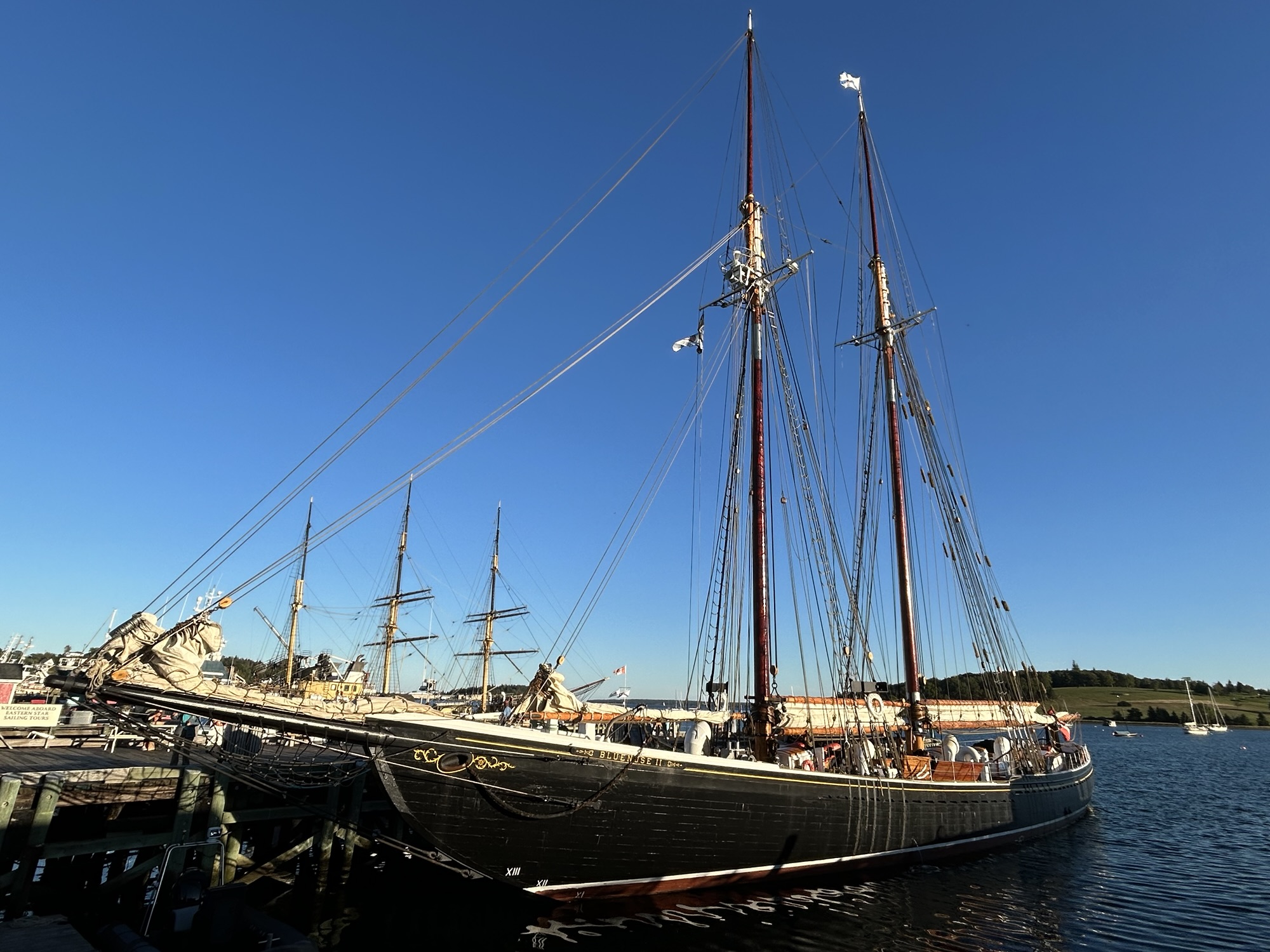
UNESCO recognized Lunenburg Nova Scotia for being a well-preserved example of a British planned town, including many lovely, colorful historic buildings. I think that’s missing the point. The town was a success due to its natural harbor, grew quickly and earned its fine buildings by fishing and trade during the age of sail. Plenty of other towns have grid streets and colorful Victorian architecture. But the beauty of the place is its harbor, where two large sailing ships were docked when I arrived. One, the Picton Castle, is a training ship (in background above), and the other is the Bluenose II (foreground), a replica of one of the fastest fishing sailboats in the world. The Bluenose won 5 consecutive world fishing ship races during the 1920s and 30s, before being lost in the Caribbean in the 40s.
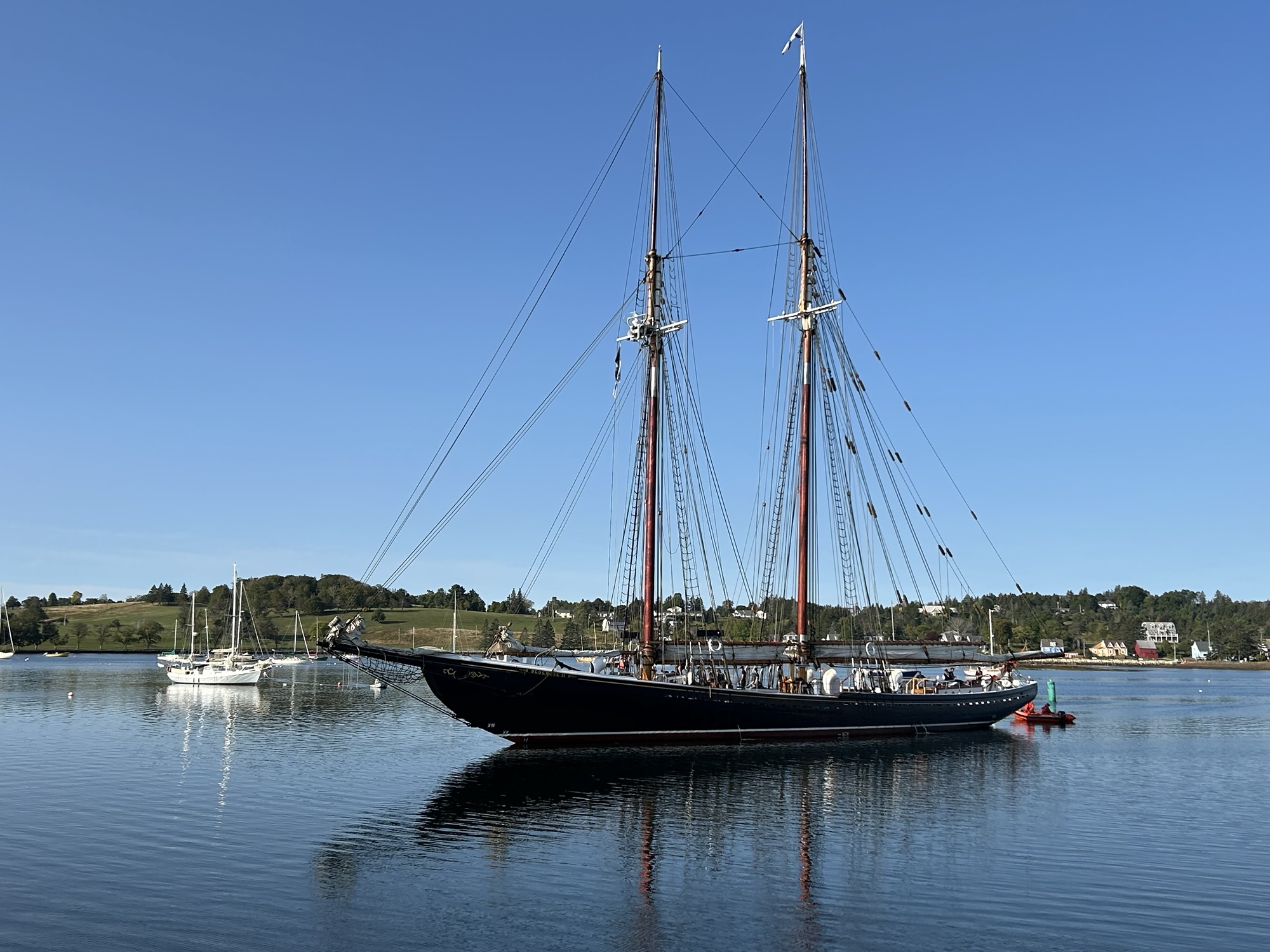
If landlubbers come here to see an old church and some other old buildings, then they’re missing the best of Lunenburg. Sit by the harbor and watch the boats. Eat some locally caught seafood in one of the many harborside restaurants. Go to the maritime museum and learn about fishing during the age of sail. My hotel room had a view of tall ship masts to help me dream of adventures, and I caught the Bluenose II on its way out to sea early in the morning, below. This is one of my favorite places to visit.
Merry Christmas & Happy New Year! I’m introducing two new topics for next year, more at the end.
Nobody wants our climate to destabilize, and yet that is what we’re doing. In my last installment on better thinking, I wrote about how this blog is a product of imaginative thinking, and below are some more specific points.
Rational people base their thinking on logic and knowledge. The Farmer’s Almanac was able to predict the weather for over 200 years with remarkable accuracy simply by carefully recording weather patterns. Seasons used to be stable enough to plan your crops well. But, in a sign of the times, the old Farmer’s Almanac is going out of business. I don’t know whether climate change had anything to do with their decisions, but accurately predicting weather based on past history is now unreliable. (And, now that the National Center for Atmospheric Research is going to be closed, both climate and weather forecasting will suffer.)
In early June of 2022 I visited Theodore Roosevelt National Park in North Dakota, and as I was driving back to California, the weather changed. There was a late season heavy snowfall in the mountains, followed by heavy rain. I remember thinking that the return to warmth and rain would melt all that late snow very quickly, so I decided not to dawdle. A few days later, the Yellowstone River washed out a whole bunch of roads after I passed.
They called the Yellowstone event a ‘500 year flood’, trying to put the event into historic context. But terms like ‘100 year floods’ no longer make sense, because the climate has already changed so much that the floods happen far more frequently either than expected or than they ever did in our written history. A biennial ‘25 year’ flood is oxymoronic.
Bereft of precedents, we need to use our imagination more when we plan the road ahead. You may have planned to retire to some beachfront property like the Outer Banks, but rising seas and more severe storms may make that much riskier than expected. Or maybe you planned a cabin in the woods, but increasing wildfires risk that dream as well. Or maybe you planned to move to a desert retirement community, but rising heat waves and diminished water are making that unsustainable. Or snorkeling coral reefs, now irrevocably damaged. Or seeing glaciers, now disappearing. Of course, there will still be plenty of beautiful places to visit and wonderful experiences to have, but our poor carbon choices are diminishing some of them rapidly. So we need to think ahead.
And it’s not easy. The most arable land in Canada is already farmed for crops like wheat, and much of the rest of the soil is a poor thin layer over the rocky Canadian Shield. So any fertile farms lost to sea level rise in Alabama are not going to be replaced in Labrador. And warmer average global temperatures do not mean an end to winter. Winter is caused by our tilted earth’s angle to the sun, so Greenland will still be dark and mostly uninhabitable for long winter months. Instead, some places in the southwestern US may become practically uninhabitable for long hot summers.
Seasons will continue and will increase in importance as weather becomes more extreme. In the long evolutionary fossil records, the species that are small, light and highly mobile tend to do better than slow moving, heavy creatures that spend all their time in one place, especially in times of climate change. Obviously, being the first species theoretically capable of diverting an asteroid, it’s shameful that we’re not trying harder to avoid the mass extinctions that we’re going to cause with our carbon emissions.
Considering all this I am writing two new monthly series for Saturdays next year. At the beginning of the month I will recommend which national parks to visit in which months, with a few adjustments for the changing climate. And mid-month, I will write about relevant climate consequences. I encourage you to use your imaginative thinking to make the most of your road ahead.
UNESCO chose to emphasize the land reclaimed by the Acadians, but the emotional power of the place is conveyed in Longfellow’s epic poem, Evangeline. The British, often at war with their rivals the French, gathered up thousands of neutral Acadian civilians, many whose families had lived in Nova Scotia (and nearby areas) for a hundred years, loaded them on ships and forcibly deported them to France and various colonies. The Grand Dérangement began in 1755, lasted 9 years, deported over 80% of the 14,000 Acadians, and 5,000 of those died due to shipwrecks, disease and starvation. A cross marks the spot where families were loaded into small boats, often separated, and taken on the dramatic tides out to ships in the bay.
The land is important too. The British certainly wanted control of the productive farming land that the Acadians had reclaimed from the sea using a remarkable system of dykes and aboiteaux or sluice gates. Tens of thousands of acres of farmland lies below high tide here, drained by one way gates in massive 17th century dykes. The replacement English speaking settlers, many from New England, maintained the dykes, and today’s warming climate allows vineyards on the surrounding hills. My cousin kindly showed me a working sluice gate, now operated remotely, and we walked along one of the dykes, appreciating the innovation and contemplating the rich red mud cut in deep channels.
Through our inaction on carbon pollution, we cause the sea to rise and claim our productive land. We cause hundreds of millions to be displaced, forcing refugees to move inland. We cause huge economic costs and more deaths due to disease, heat, pollution, starvation and storms.
It is easy today to say that the British were wrong to deport the Acadians. Yes we must admit that we’re committing a far worse global atrocity through our indifference to our carbon emissions.
Late this year, I visited my 395th park site, earning a rare park stamps award for all official NPS sites in the 48 contiguous states (see map). Plus I drove my EV to 29 NPS affiliates, 60 heritage areas, and 24 national trails (not on map). Read about my favorite sites below.
‘Best’ is subjective, as it depends so much on your individual taste and experience. If you are lucky enough to have great weather, a lucky wildlife sighting, or an inspiring ranger-led tour, that day will be one of your favorites. Click on the links to read my past favorites from 100, 200, and 300 park units visited, and here are favorites from 400 park sites, including affiliates, heritage areas and trails. I have no changes to my previous favorite park units, but I have a few additions.
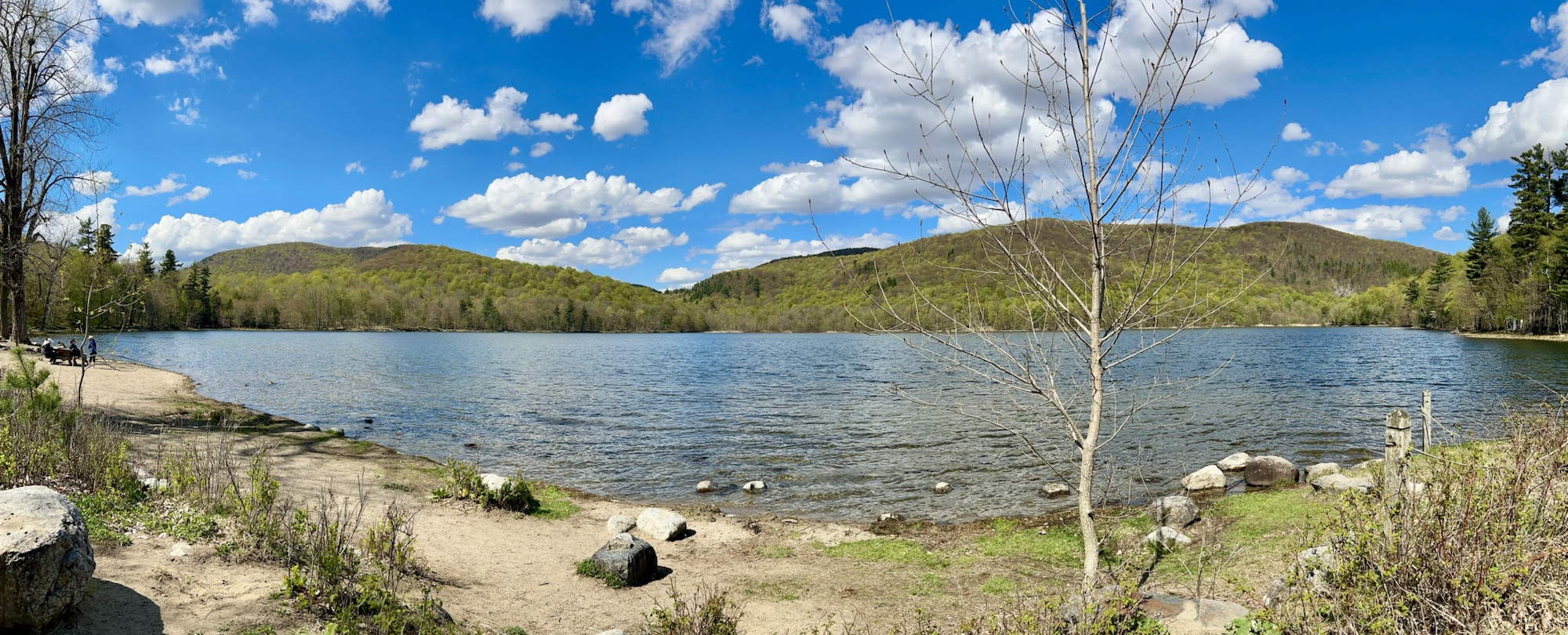
Much of southern Nova Scotia belongs to this UNESCO Biosphere, and the at the center is Kejimkujik Lake, historic site and national park above. My cousin was instrumental in gaining early recognition for the area’s exceptional starlight and dark skies, making it a great place to stargaze. The visitor center has a couple beautiful birchbark canoes and exhibits on the First Nation people who have lived in the area since time immemorial.
Due to extreme fire conditions, the backcountry was closed during my visit, but a few lakeside trails were open. The lake was low, the air and forest dry, but the day was lovely and quiet. The climate change is even more visible to the north, and there were many fires burning in Newfoundland in September. The national park includes a seaside section on the southeast coast with nesting piping plovers on a (closed) beach from April to September, but the biosphere covers far more land, outside the core park, from Yarmouth to both southwest and southeast Nova Scotia.
While the Appalachian Trail passes through the White Mountains, the Granite State has only one national park unit. Fortunately, that is the beautiful Saint-Gaudens NHP, below.
There are 18 NRAs managed by the park service for biking, boating, camping, fishing, hiking, horse riding, swimming and other activities. (I should note that there are also 13 NRAs managed by the US Forest Service, and I plan to visit some of those too.)
Two are in the North Atlantic region: Boston Harbor Islands and Gateway, which is shared with the Mid-Atlantic region. Both are great for birdwatching and hiking along the shorelines.
This UNESCO Biosphere Reserve is in New Brunswick Canada, although the Bay of Fundy is also formed by Nova Scotia to the east. The photo is from the north end at Fort Beauséjour looking south towards where the water comes rushing in with the highest tides in the world. The shape of the bay both funnels the water and creates oscillation that magnifies the tidal surge. The tide is fairly low at this time but already covering some of the vast mudflats that attract thousands of shorebirds, especially sandpipers in mid summer that bulk up on mud shrimp to fly to South America.
Due to the silty water, tidal power has not been harnessed here yet. The Acadians built aboiteaux or sluice gates and dykes here to reclaim some of the nutrient-rich salt marsh land for the fields below. The star fort was taken by the British during one of their conflicts with the French, played a role in the expulsion of the Acadians, and was successfully defended against the Patriots during the American Revolution. But I visited the Bay of Fundy mainly to see the tides, and one of the few places in the world that you can actually see the tide rising is where the rivers empty into the bay. I watched the tidal bore come in near Maitland Nova Scotia, creating waves as the tide forced its way up river.