All of us experience good times and bad, but we handle them differently. Our Myers-Briggs personalities vary, focusing inwards or outwards, gathering facts or relying on intuition, using logic or trying to please others, planning or being spontaneous. So some follow the feelings of others in the moment, while others may insulate themselves in structured reality. Knowing our type helps us make the most of our instinctual thinking.
If your support network is helping you flourish and keeping you happy, that’s nice. But if they’re feeding you bad information or guiding you on the wrong path, then you need to recognize and change that. If you are checking off all of your personal objectives, that’s nice. But if you’re ignoring good advice or are unhappy, then you need to recognize and change that.
Balancing is an act that often requires effort. The ancient philosophers and poets preserved their wise advice for us to use today. When times are good, we need to restrain our optimism before our expectations become too unrealistic. When times are bad, we need to combat pessimism to face adversity with the strength we can muster.
Sadness is normal in many circumstances, and rather than medicate it away, we need to recognize the cause and handle it appropriately. Humans evolved the feeling of sadness to aid us in improving our lives, so we there’s a risk to removing it artificially. Sadness is often a signal that we need to process a feeling, learn from a mistake, make a change, forgive or move forward. Feeling sad is often an opportunity for us to apply our instinctual thinking for our own benefit, if we put in the effort.
But when the circumstances do not justify our negativity, we need to recognize and adjust our attitude. When I drive long distances, I sometimes check the elevations to predict mileage per charge. When I’m in a good or bad mood, sometimes I mistakenly feel like I’m driving uphill or downhill, when I’m not. If your emotions cause you to misjudge reality consistently, then you need to figure out why and how best to handle that.
Remember, your instinctual feelings evolved to try to help you. So think about them and harness them to live your best life.
Earlier this month, I visited El Pinacate y Gran Desierto de Altar [literally ‘the stink beetle and the great high desert’]. It’s a UNESCO Biosphere and World Heritage Site in Sonora Mexico, and it’s a sister park to Organ Pipe Cactus NM across the border in Arizona. A dozen pronghorn scampered through the various cactus, but unfortunately the border wall prevents many species from moving freely in their natural habitat. The main attraction is ten large volcanic craters, including the deep, symmetrical Elegante below. The landscape is extraordinary and otherworldly, with long black lava walls, cinder cones, sand dunes, various cacti, bushes, shrubs and wildflowers. There is enough rainfall to support birds, reptiles and wildlife like big horn sheep. Some folks camp overnight to experience the vast dark skies, far from large human settlements.
A 2018 movie called Sonora was filmed here, and the movie describes the desert as both the middle of nowhere and ‘the devil’s highway’. A few years ago some criminals moved into the area, but they are gone now. The roads are severely washboarded, sandy and sometimes are blocked by local landholders due to disputes over compensation, so I hired a driver, a van and a guide. There are no facilities to speak of, so you need to bring whatever you need in and pack everything out. From the supercharger in Gila Bend, it’s more than a full charge round trip to Puerto Peñasco or Rocky Point where guided tours depart, so I charged at my hotel on the Playa Bonita. The local economy is still recovering from various border shutdowns and Covid, but the onsite park museum is expected to reopen soon, which will bring more visitors. But for my visit, I was happy to have the whole park to myself.
My medium term goal is to visit all the parks in the lower 48 states in my electric car, and that necessarily includes taking an occasional car ferry. I would prefer never to take carbon burning transportation, but I’m neither going to risk my life nor break the law, nor encourage anyone else to do so. Some river roads, coastal highways and islands rely on ferries—such as in the Outer Banks or San Juan Islands above—, without practical alternatives. The only way to visit the Statue of Liberty or Alcatraz is to take the ferry.
My general rule is to arrive at each park by zero emission vehicle but to take park transport as needed to enjoy the park, like at Steamtown. Whenever I can, I encourage park employees to replace their old transport with solar powered electric boats, which would be perfect at Fort Matanzas. And the NPS is slowly converting its transportation to renewable, for example at Zion.
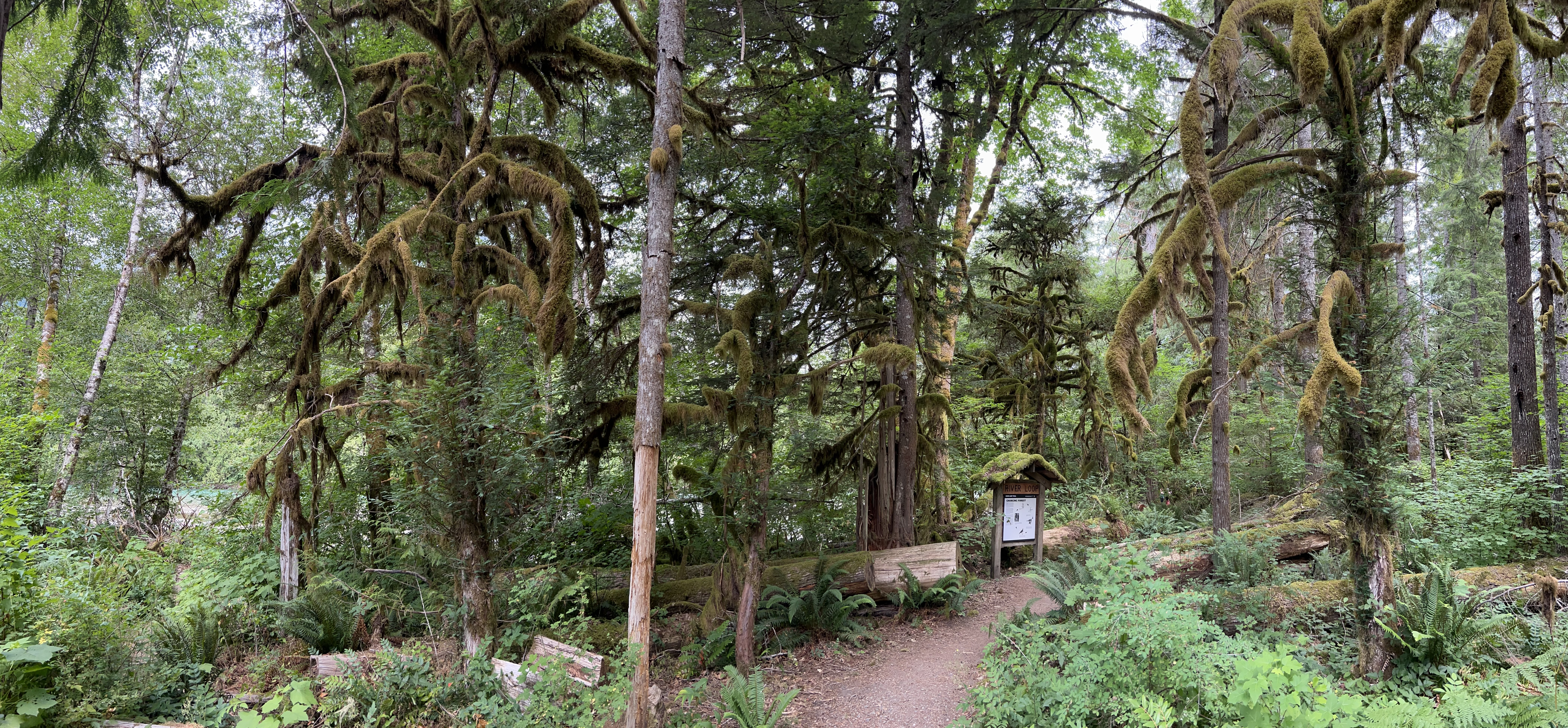
The Salmon River flows into the Pacific just out of sight between the headland and the beach above. The trail up here to the lower viewpoint starts at the boat launch, climbs through a lovely mossy old growth grove and crosses a few small bridges—the cascades were hidden in the brush—before reaching the meadow where a rare flower and butterfly live. There’s an upper viewpoint some 700 feet further up the hill, but I figured the closer view was better.
This UNESCO Biosphere is mostly on Nature Conservancy land, thanks to concerned citizens who rallied to protect it. Definitely needed the birdsong app: white-crowned sparrow, golden-crowned kinglet, chestnut-backed chickadee, pacific wren and a brown creeper, not to mention the usual coastal waterfowl and some raptor I couldn’t identify. Lovely spot on the Oregon coast with about a dozen other hikers on the trail on a beautiful day last fall.
Instinctual thinking is the first of four ways of thinking that we must improve to fix our problem with thinking. The most common way of behaving is instinctually, meaning driven by physiological needs, instincts, and evolved social needs. While often unspoken, instinctual motives are powerful and potentially dangerous. Understanding our instinctual motives and behaviors is the most important and useful way of thinking.
The ancient Greeks inscribed ‘know thyself’ on Apollo’s temple at Delphi, because when we know ourselves well, we can also better understand others and we can think about how to be better humans. Our society is largely determined by how our instinctual behaviors operate in concert with other people’s instinctual desires, expectations and behaviors. Once we realize the instinctual motives at play, we can consciously improve expected behaviors, both our own and others. Those who unwarily ignore their own and others’ instinctual motives are more likely to make social faux pas or to leave themselves open to instinctual manipulation.
Awareness
Wondering why we behaved a particular way—or even denying having an instinctual reaction—is how we become self-aware and begin conscious instinctual thinking. Awareness of our instinctual motives and behaviors enables us to control our reactions. Upon seeing a skunk, a sudden reaction might be unwise. But if you realize it is a baby, without fully developed scent glands, you can override your instinctive reaction and take a close up photo below.
Try to be conscious of your instincts, identify them and understand whether they are inherited or reflect your upbringing. Why are you drawn to certain relationships or work hard to impress others? What causes your anger or embarrassment, joy or sadness? Is the root instinct hard-wired into your DNA or is it merely conventional? Did the instinct evolve from 200,000 years of fighting animals and each other, or did it evolve over the past 10,000 years since humans began living behind the walls at Jericho? Is the instinct useful or should it be obsolete? Is it a reaction from childhood that you should finally deal with as an adult? Is it simply based on some cliché you have frequently observed on screen? Without effort, you might confuse a valuable instinct with a false impression formed unconsciously; the former may keep you alive, but the second may be a costly mistake.
Conscious instinctual thinking helps us understand ourselves, predict our own behaviors, and even through willpower to harness our instinctual motives to improve our behavior. The effort is worthwhile. After we experience trauma, instinctual thinking is often required to process what we unconsciously internalized, so we can recover and progress. At home, you need to be aware of your own moods and those of others. At work, you may choose to emphasize flattering words or numbers, acting on your instinct to ingratiate yourself; awareness of your instinctual motive may allow you to behave more professionally. Be honest and aware of when your instincts drive your thinking. Be suspicious of your own motivations as well as others’; you have the instinct of suspicion, so use it.
Self control
Normally, we follow our instincts. But we also try to control them. We may overcome our fear, enhance our bravery, delay gratification, refrain from violence, or harness our adrenaline. Different situations call for different behaviors, and we adopt different postures with different people. We may smile, laugh, make or avoid eye-contact, grimace, show our unhappiness, or stand up straight and get in someone’s face to intimidate them. Being aware of our instinctual displays makes them more intentional and effective.
If we don’t know why we behave certain ways, then we are at a loss to control them. With experience, we manage our emotions, temper and guide them appropriately. Understanding a trigger may help you process your emotions more effectively, so you can move from shock, past anger, through sadness to be calm. Humans evolved both display and interpretation of emotions; use yours. When observing others, we sense their emotions and choose our response, reflecting both our own emotional experiences and being in similar situations with similar people. Be empathetic, express your feelings nonverbally too, but use your emotional intelligence to respond in the most helpful way, cool or warm, dismissive or supportive, with humor or affection. Our most important acts may need no words.
Some try to deny and suppress their instincts, but instincts need to be acknowledged, understood and dealt with productively. Pretending to be one person, while your instincts want you to be a different person, is a recipe for trouble, potentially shattering. Self-help books and seeking help from others can be worthwhile, but since only you know your true instincts, you need to understand them. Be aware of the instincts at play, and address them appropriately: accept, adapt, choose, discuss, dismiss, forgive, laugh, learn, redirect…. Dealing with our instincts consciously gives us more advanced options to decide what to do: creative, moral and rational. Don’t use your advanced thinking to crush your instincts, but find a way to realign your instincts to drive your life in the best direction. You always have more options than you realize at first.
Pulling the strings
We must not underestimate the power of unconscious learning to influence us. Within us we carry both deeply engrained complex human behaviors that predate our species and newly formed impressions from social media feeds. Changing the first often seems unthinkable, even when ancient tribal behaviors are now obsolete. And changing the second happens constantly, as each new generation now grows up with significantly different technology. A multigenerational family will have distinctly different unconscious behaviors and expectations formed by very different childhood experiences. Many infants today have no opportunity to see fire at home, let alone have deeply impressed memories of fireside chats huddled around a hearth.
Everything that we observe can seep into our unconscious to emerge in our dreams or our behavior, instinctually. Our modern, social media engaged lives are full of conscious campaigns designed to control our instinctual behavior. Whole industries are geared to manipulating our behavior by creating scenes for us to observe. The characters on screen using a product appear happy, strong, attractive, healthy and confident, so, unconsciously, we feel inclined to purchase the product. While you may know that the ad is selling something, you probably are unaware of the PhD level psychological marketing behind the advertising campaign designed to influence your unconscious towards a targeted behavior. Conscious instinctual thinking is also the first defense against manipulation by others.
When we unconsciously follow our instincts, perceptive people may use our instincts to manipulate us, if they are more conscious of what drives us than we are. Once we become aware of what drives us and understand why, then we gain the ability to defend ourselves against those who would control our behavior by pushing our buttons or pulling our strings intentionally. Whole industries exist to take advantage of your emotions and instincts to drive your behavior for their profit. Awareness gives us control, and understanding our instincts lets us decide whether to follow along or refuse to be treated like a puppet.
The goal of instinctual thinking
So the goal of instinctual thinking is to improve our human condition and to avoid misery. Our instincts did not evolve to ruin our lives, bankrupt us or make us miserable. That is lack of instinctual thinking. Instinctual thinking evolved to help us sense, feel, learn and harness our instincts for our benefit. We think this way to avoid pain or embarrassment, to experience pleasure, and feel comfortable. We want to be filled with joy, feel pride, love and be accepted by others. We think this way to gain status, protect our reputation, gain followers, and defeat rivals. If we misread a social cue and people laugh at us, we try not to make that mistake again. If we do not pick up on someone’s emotional state and unintentionally provoke an angry outburst, then we need to improve our instinctual thinking both for our own benefit and for the benefit of those we love. By being more conscious about our instinctual thinking, we can use it more effectively.
We ignore our instincts at our peril, but when an instinct is no longer helping us, we can learn to disregard it. Once we realize that an instinctual reaction is due to a painful childhood experience, we can forgive the long-forgotten act and move forward. Once we become conscious of our instinctual goal, we can take conscious steps to achieve it. Honestly facing a destructive instinct, gives us the chance to redirect it creatively. Understanding that our sweaty palms evolved to grip a weapon before combat, helps us reinterpret stressful social situations as not actually requiring combat. Discerning whether our instincts are driving us where we want to go or whether we are being manipulated by someone, gives us more control over our lives. Instinctual thinking is used to make the most of our instincts, and not just follow them blindly.
Most of our border with Canada is a straight line from Minnesota to the Pacific, except for Canada’s Vancouver Island, which dips below the line. When the border was negotiated, the treaty put the border through the “middle of the channel”, i.e. the Straits of Georgia and Juan de Fuca. Except where the San Juan Islands are in the middle, and then which is the main channel becomes a matter of interpretation. San Juan Island is much closer to Victoria Canada than to the mainland, so the British claimed it. But the Haro Strait is larger than the rest of the channel, so the Americans claimed San Juan Island too. Nobody really cared much about the sparsely populated islands, until an American squatter killed a British pig for rooting in his garden. Then, both sides prepared for war.
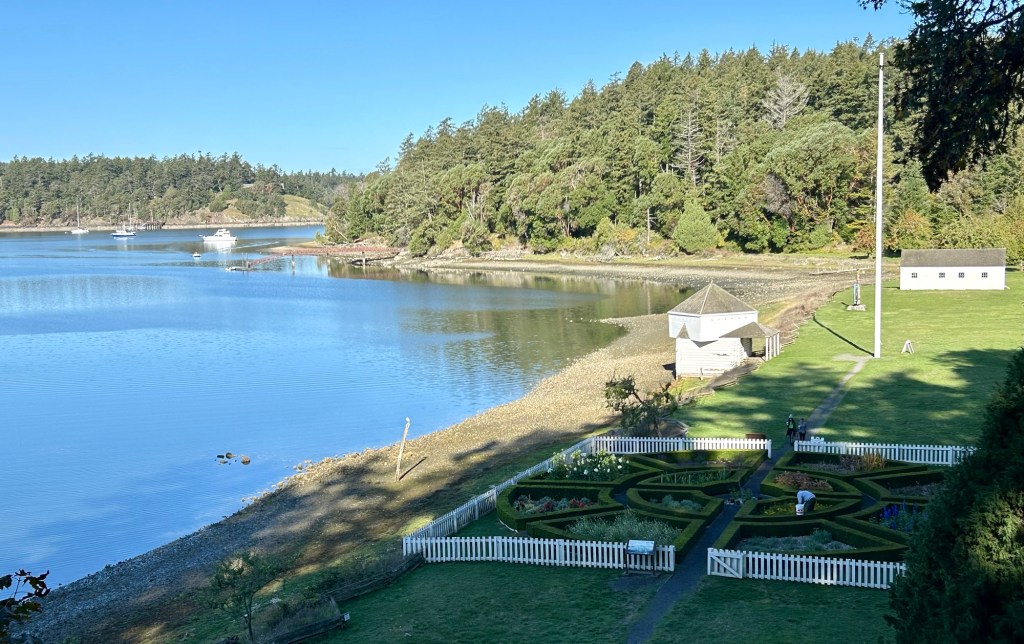
English Camp in the northwest is lovely, set on a well protected bay amidst large oaks, hemlock, and madrona trees. Well supplied from Victoria, the British created a formal garden above, kept calm and carried on. The Americans—actually the Robert’s Rules of Order writer—built a fort on the exposed southeastern point, conducted rigorous drills and maintained strict discipline. Large flag poles were erected at both camps. At the time, the US was entering the Civil War, so the government sent General Scott to negotiate peace. Fortunately, the border dispute was settled diplomatically.
There is an interpretive center at the American camp, while the English camp visitor center was closed when I visited late last September. Regular car ferries run to San Juan Island, with pleasant views along the way. Friday Harbor is between the English and American camps, 9 and 6 miles respectively, and has nice restaurants and more.
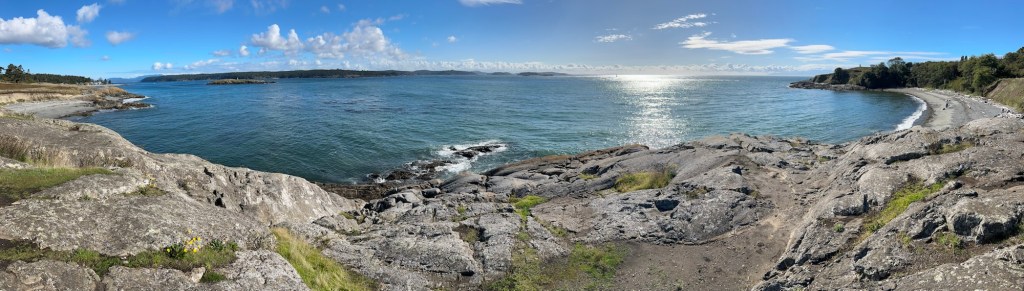
I also stopped at Cattle Point below on the southern tip which is part of a BLM National Monument protecting points, small islands and rocks in the San Juan Islands.
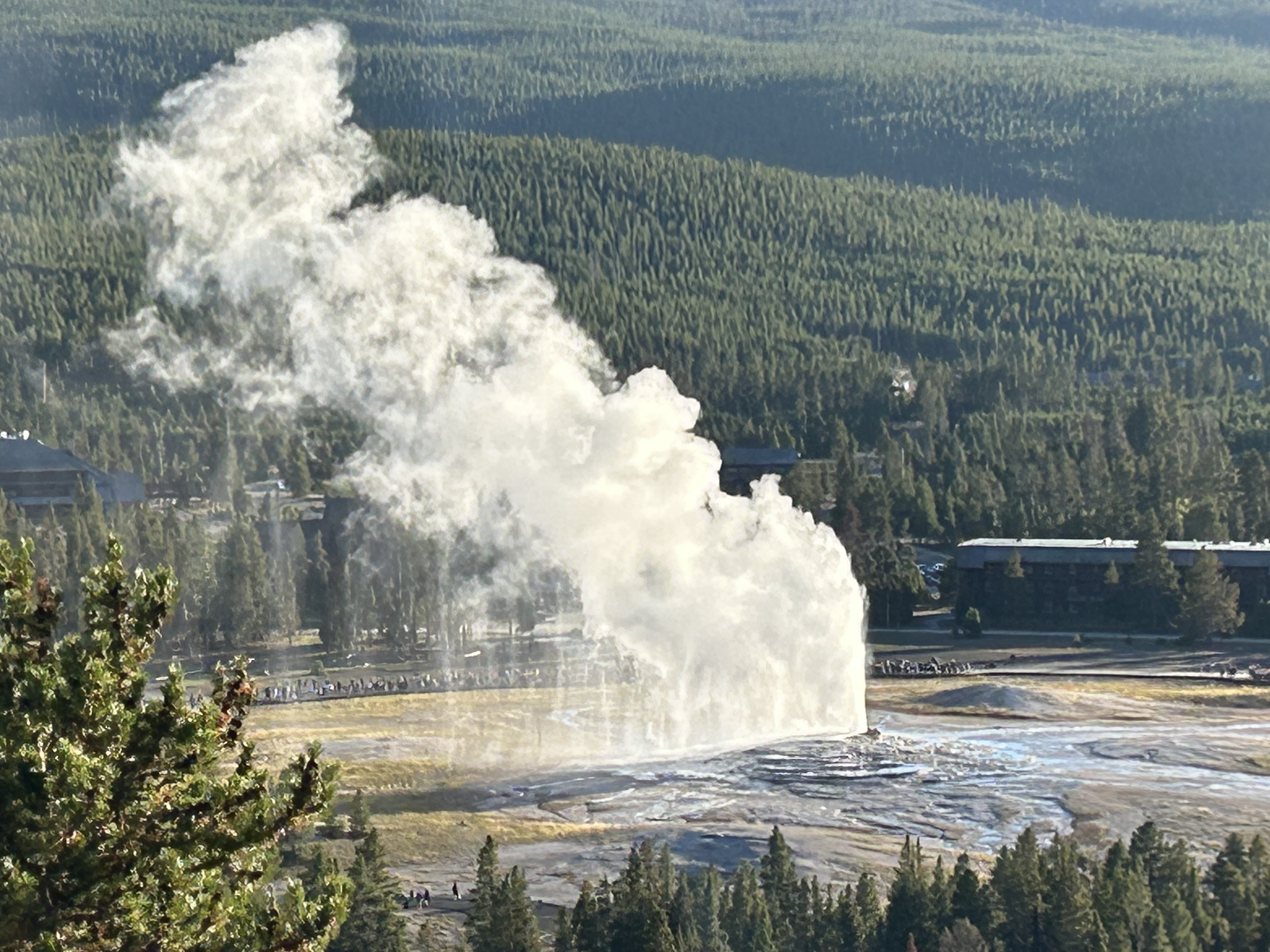
Best Park: Yellowstone. Geysers, wildlife, recreation, lodges, forests, mountains, waters. Yellowstone is spectacular and the best park in many categories.
This large UNESCO biosphere near Edmonton Alberta includes Elk Island National Park, which has hundreds of plains and wood bison. But Elk Island is fenced, so, as important as that park is for restoring the bison population, I came to see beaver. And on the Beaver Hills Biodiversity Trail, I saw several large beaver dens, like the one above.
Beaver are quite destructive, and their homes are surrounded by felled and drowned trees and pointy stumps. But they also create year round dens and dams with ponds and small lakes for many other species. Besides the many waterfowl, blue dragonflies, and chattery squirrels, I saw a magnificent golden eagle circle above the pond. And of course, I saw five or six beaver, swimming far from their dens, playing and occasionally climbing on branches to dry off, scratch or hang out.
When humans create zoos, safari parks or even national parks with fences, it’s not right to call the enclosed animals ‘wild’. Some may have been born wild, but as long as they’re locked up, they’re no longer wild animals. Humans make the rules in those spaces, so, no matter how we try to copy nature, the spaces are artificial. But when beaver fell trees, build dams and create lakes, they make the rules. And the species gather there naturally. Beaver Hills is a natural area, filled with wild animals, and it is delightful to pause here and take in the peaceful balance of life.






 Zero Carbon Travel