California’s Golden Age architect, Edwin Neff, designed a grand ranch, above, for King Gillette of razor blade fame, in the roaring ‘20s, who sold it to Clarence Brown, who directed dozens of successful films, including National Velvet and The Yearling. Later the property had numerous colorful owners, but eventually it was saved by conservationists who won national protection for the stretch of mountains overlooking the Pacific above Malibu. The recreation area includes state and city parks, numerous film locations, horse riding trails, scenic vistas and wildlife, not far from Santa Monica and the LA basin.
This was actually the first park I visited for this blog, on the same day I picked up my EV. But I was so upset by the devastation of Paramount Ranch after the Woolsey Fire, that I neglected to take a photo. So, since I driving by on Thursday, I decided to do this redux visit to get a proper photograph or three. The visitor center is in the old Gillette Ranch carriage house, with the horse stalls and round hayloft now an exhibit space. And if you walk up the hill, you get a grand view of the Santa Monica Mountains below.
The whole recreation area is fascinating, especially if you’re a fan of scouting old TV and film locations: the Rockford Files beachfront home/ office at Paradise Cove, M*A*S*H’s camp in ‘Korea’ and Planet of the Apes, including Zuma Beach where Charlton Heston famously dropped to his knees to curse us all.
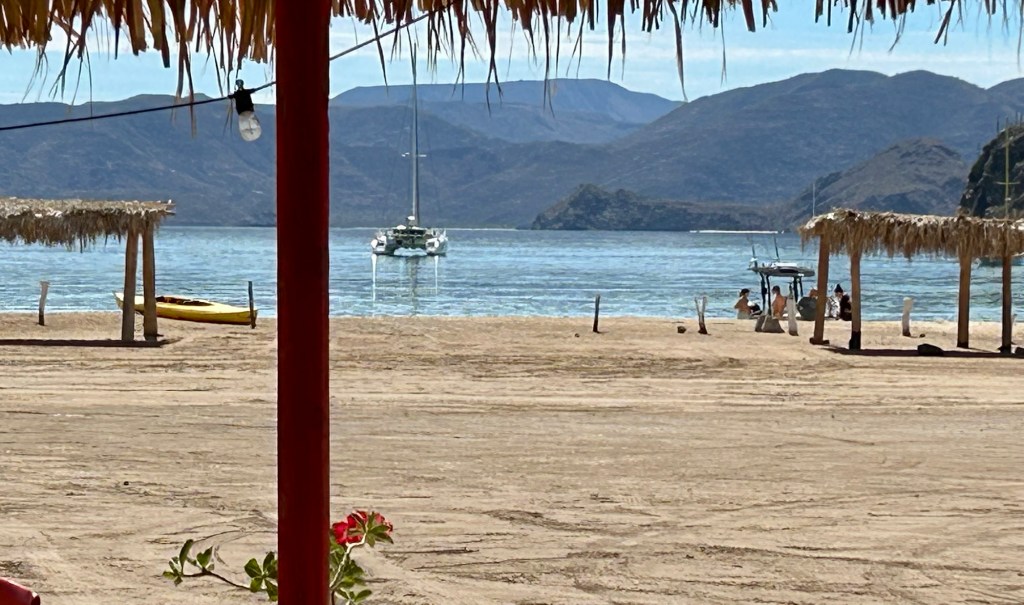
My favorite place in Baja is Loreto, above. It’s a magical town, both Mexican and touristy, with good restaurants, not too big nor crowded, near beautiful beaches and with quality tours to explore the bay. The bay and islands are part of a national park, where I saw blue whales. Simple restaurants on nearby beaches have the freshest seafood: try Vista al Mar.
Winter is the time to see the gray whales in their favorite lagoons, mating and raising their calves. And some of the tour operators offer rock painting and other tours, if it’s too cold or windy for watching whales. Ensenada has vineyards with wine tasting in the surrounding valleys. And folks enjoy biking, fishing, hiking, horseback riding, kayaking and more along the whole peninsula. More folks should make the drive from the US state of Alta—‘upper’—California to the Mexican state of Baja—‘lower’—California and Baja California Sur—‘south’.
Everyone who has driven to Baja has stories, but there’s a lot of BS from people who want to make it sound more rugged and dangerous than it is. Americans often drive big expensive campers with all sorts of extra gear, imagining they’re on some challenging off-road expedition, like one of the Baja races. They talk about camping at some perfect remote cove only accessible with a specialized vehicle and extreme skills, even though many beautiful beaches are on easily driven roads. I saw a van roll over after swerving to avoid a pothole on the highway, so I think the last thing you need is some top-heavy monstrosity. (Driver said he was fine, but I asked the police nearby to check on him).
While I saw several large motorcycle packs of ‘rugged individuals’ staying at comfortable hotels, I drove my Tesla 3, with a low center of gravity that steers well, and I visited some of the most wonderful places in Mexico, without drama. As on my drive to Mexico City, I was neither asked for bribes nor witnessed any crimes. There’s much less traffic in Baja, and there’s no need for a car permit in Baja or neighboring Rocky Point. I crossed the border at Tecate, where I simply drove through without a wait. There are a few checkpoints, but—besides asking questions about my car—they typically just wanted to know my destination, to be sure I wasn’t trying to drive at night. (Due to politics, returning to the US is far more time-consuming than it was last year, as inspections have increased significantly).
50 years ago maybe, you needed a small private plane to stay at Hotel Serenidad, one of John Wayne’s old favorites, but I just drove there. The restaurant still has delicious food, and the atmosphere is tranquil. The road was a little bumpy, but I charged my Tesla 3 at a nearby hotel, while playing with their dogs. Then, down the coast, I had one of my favorite meals, aquachiles mixto, at Ana’s restaurant on Playa Santispac, while mesmerized by the view from my table below.
The plain truth is that Baja is drivable by electric vehicle, and I was surprised to see only two Teslas south of Ensenada. Even the US CBP officer was surprised that I had driven my Tesla 3 all the way to La Paz and asked about road conditions and charging. There are two routes from the last Supercharger in Ensenada, either via Hotel Cataviña and the pacific highway or via San Felipe on the more recently paved ’faster’ route. I took the pacific route, since it’s a few miles shorter. Sure, my car lost signal for the whole round trip between Ensenada and LaPaz, so it missed the time zone change between north and south Baja. But I used my iPhone to navigate, entering my next destination whenever I was in a town large enough to have cell service or at a place with WiFi.
The destination chargers I found on PlugShare are much slower than superchargers: +42 miles/hour, but some are free with lunch or $20 to charge. La Paz to Loreto can be done in one drive, and both ends have hotels with free charging for guests. (Here’s a tip. If you’re charging overnight, don’t set a full charge as ‘one time only’. When I woke up, a power outage during the night had reset my charge level from full back to daily 80%.) I drove Bahía de Los Angeles to Ensenada in one long day, charging in San Quintín. The trick is to obey the speed limits and take your time. Since charging is so slow, there’s no point in saving 40 minutes speeding, only to have to charge for an extra hour when you arrive. Besides, you need time to avoid potholes.
Although too many people have thrown trash along the roads and too many developments and small buildings have been abandoned, Baja is still very scenic, with beautiful beaches, craggy peaks, canyons, deserts, dunes, farms, salt flats, volcanoes, date palms, countless cacti, osprey, and more. OK, it can be dusty and dirty, but not everywhere. Mexico is an informal country, and Baja is even more so, where folks just do things their own way. (Every margarita I drank, tasted different than the last). But if you put a smile on your face, be patient, thoughtful and keep your eyes open, then Baja is a beautiful place to visit, especially in a small electric car!
The highlight of my trip to Baja California last month was seeing Gray Whales (see videos below) in the Ojo de Liebre—hare’s eye—Lagoon, in the northeastern corner of the huge Vizcaíno biosphere and world heritage site in central Baja. I must thank the legendary Shari Bondi for organizing the experience, as there’s an element of magic required to bring people and whales together well. Unlike any whale watching experience I’ve ever had, the gray whales can be quite friendly. One female approached my boat, stuck her nose up and touched my hand.
The rock art mountains are also within the Vizcaíno preserve, along with several other lagoons popular among winter-breeding gray whales and turtles. Since the lagoons are closely regulated, the only way to see these whales is to join a tour. Since the winter season is short, the tour guides typically work with local hotels and add lagoon-side camps. You may find it difficult to book a room in Guerrero Negro around February, unless you book a package tour. Some visitors spend days on site, taking multiple whale watching trips. Enjoy!
I write this on the Sea of Cortez, where sparrows chirp in the palms, brown pelicans splash down to catch their lunch, a whale takes a quick breath before diving down again, and a sign on the beach warns me not to step on stingrays. Most of the time, we live and work in air conditioned buildings, watch fiction on screen, and eat processed foods produced by big agricultural conglomerates. Nature often seems distant, filtered and controlled, which suppresses our natural affinity with other living creatures. Here, I am surrounded by many different forms of life, filling my senses, each living free. Looking out over the ocean is calming, and the smell of salt in the air reminds me that our roots are in the ocean; it’s in our blood. When we are in nature, we feel more connected with all living things that eat, breathe and cheat death, like we do.
But our selfish thoughtlessness now risks mass extinctions, as we unbalance the living world oblivious to the damage done by our pollution. Anger is what I feel most when contemplating the climate crisis, but also despair. People refusing to change, repeating lies, smugly imagining themselves smarter than scientists. Despair about the coming diseases, droughts, mass extinctions, famines, floods, heatwaves, refugees, storms and wildfires. Do we not fear death, like those trapped in their attics during Katrina or engulfed in Lahaina on Maui? Have we lost our survival instinct?
I’ve already seen huge wilderness forests, in areas largely untouched by man, burned over 95% in wildfires 100 or 1000 times larger than normal. I’ve stumbled on the moraine where glaciers once clung to mountaintops. I’ve swum along dead coral reefs that were brimming with fish when I was a teenager. In Mexico last year I heard about the decline in monarch butterflies in their winter refuge after migrating from all across North America. This year I heard about the decline in gray whales, breeding less due to less food, as our carbon pollution is rapidly changing the ocean’s temperature, acidity and salinity, poisoning the lifeblood of the smallest and simplest organisms upon which larger ones rely to survive.
We are betraying our evolution. I feel shock, despair and anger that my fellow humans knew and mostly refused to act. Pain of loss is what I feel when I know that future generations will never again experience the bounty of life we once had, to learn from or appreciate the living natural beauty we could have enjoyed, but recklessly gave up, unwilling to change our behavior.
Next week, I’ll wrap up this trip to Baja, and then we need to work on thinking rationally.
The full name of the world heritage site is ‘Islands and Protected Areas of the Gulf of California’, and the UNESCO site covers much of the old Sea of Cortez which Jacques Cousteau once called ‘the world’s aquarium’. Many of the mountainous islands in the gulf are home to unique species—including a rattle-less rattlesnake—and are protected from development, including the island of Espíritu Santo near La Paz. Last month I visited many of the gulf’s bays on the Baja peninsula, including Bahías de Los Ángeles, Concepción, Loreto and La Paz. In the Loreto national marine park, I saw bottlenose dolphin and fin, humpback and blue whales, including those blues in the videos below.
Daniel Romero marched with César Chávez back in the day, so when a nationwide protest against recent cuts to the national parks & US forest service popped up today at noon, of course, he came wearing his ‘¡Si, Se Puede!’ T-shirt. He knows from experience that predicting turnout is a fool’s game, but instead of the expected 3, there were around 20, even at a very small park in a rural area best known for a loop of track for trains to change elevation to traverse the Tehachapi pass. Another was Fernando Chávez, a grandson of César, who discussed the need for solidarity, coalition building, and activism at the base of the old oak tree next to Martyr’s Garden, where his grandparents lie at rest. “We’ve been protesting forever”, said Romero. “Even though we are sometimes excluded, we have always tried to support each others’ causes”, said Chávez, recounting how spontaneous protests recently broke out after a particularly brutal local raid by ICE. Romero listed the unions that marched with them, describing diverse families and even weddings during the boycott and strike.
This was an early park visit for me, as it’s local. Unlike my quiet visit 3 years ago, folks here today were sad, angry and surprised by the chaotic decisions to cut 1,000 NPS staff and 10% of the USFS. One employee here had just transferred from New Mexico when his job was axed by Elon Musk. Many of those affected were young, promising staffers, full of optimism. Supposedly he is scrambling to get the transfer reversed to stay employed. While there may be some cost savings, in the long run, the work these folks do protects and adds a lot of value to our country, so cutting when hiring is needed is counterproductive. I felt the need to apologize for still driving a Tesla, but folks understood, knowing others who are now trying to unload theirs. I’m keeping mine, as the climate crisis is going to get worse, despite efforts to delete the word climate from government documents.
I know Saturdays are supposed to alternate state photos, so I’ll add another and a video below. But I thought you might like this real time update from a very appropriate park for a protest, with people whose lives were defined by the proud history of protesting in America. Next week will return with another western state. Thanks for reading!
7 trails cross the Southwest region, including 6 National Historic Trails linking multiple sites, plus a National Scenic Trail. Here’s a quick summary in case you are interested in exploring the trails in the region.
Butterfield Overland NHT passed through Arkansas, Oklahoma, Texas and New Mexico (although the photo below is near a stop across the Arizona border in Tombstone).
Earlier this month I visited Sierra de San Francisco in central Baja Mexico to see the prehistoric rock paintings which are a world heritage site. They are spread out over a vast, mountainous area and just to see a few requires a 5 day group trek on burro to reach several different caves. One closer site, El Ratón—called ‘the rat’ but meant to be a cougar—, is a short hike off a long, well-paved road. Unfortunately, it’s not the best of the rock paintings, as the alcove is fairly open and the art has faded. The small free museum in San Ignacio is overseen by an official who provides required passes out of his office next door, when he’s there. Hiring a local guide is required along with paying various government fees. For a solo Baja driver, it’s best to visit El Ratón on the way back north, as the cave road is north of San Ignacio, where you must pay first. Group tours can be reserved from San Ignacio, Loreto, and Guerrero Negro. Frankly, I recommend just going to the museum and making a donation. There you can see some good photographs of several of the best examples, along with a large reproduction, above, to give you a sense of how they are displayed on alcoves and in caves. Traveling through Baja, you see reproductions in many public spaces, proudly reflecting the internationally renowned 2000 year old cave art, the cultural remnants of the Cochimí people.





 Zero Carbon Travel