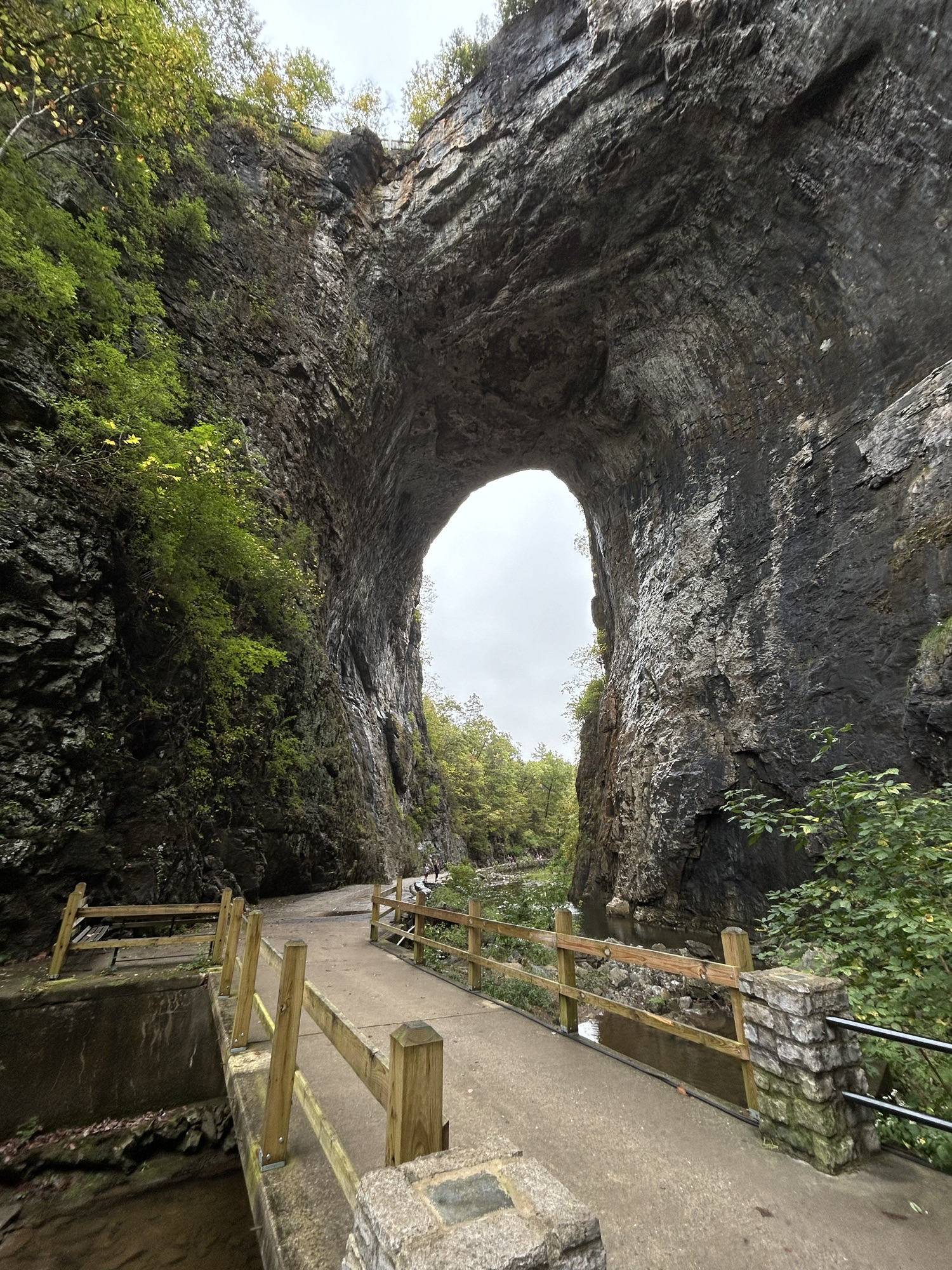
George Washington surveyed it in 1750, and Thomas Jefferson bought the largest limestone arch in North America above in 1774. At 200’ tall, it’s higher than Niagara Falls. See if you can find the people in the photo. It’s an NPS affiliate, managed by Virginia State Parks. There’s a pretty 1.7 mile trail up under and past the arch along Cedar Creek, with many steps, interesting rock formations, heron below, woodpeckers, chickadees and other birds.
Ah, AI, the bugaboo of our modern age! Let me see if I understand. Humans have real feelings, which make us special. Computers have no feelings, which makes them dangerous. So, the more machines start being like humans, eventually they will take over and wipe us out, just as we wiped out the Neanderthals. Once AI advances to our level, then they will naturally begin a bloodthirsty war to exterminate us, building shiny skeletal robots with glowing red eyes, retractable claws, carrying huge phased-pulse plasma lasers?!?
Stupid nonsense. Let’s apply some rational thinking to the irrational fear of AI. We evolved our instincts for hate, fear, war, self-preservation and violence over eons, even before we were human. Our highest intellectual achievement is not the ability to conduct genocidal war or mass extinction. We have developed the ability to control our blood-thirsty instincts and to make rational decisions. Our feelings may be how we experience our humanity, but it is our rational thinking that has brought us technological advancement.
Machines did not evolve over millennia with any of our primitive failings. AI lacks the innate capacity for instinctual thinking. At best, AI can be trained to mimic human instinctual thought, to make it easier for us to relate to it. But machines lack our primal motives and instinctual drives. They get no thrill from spilling blood. They take no pride in taking the form of monsters. They have no adolescent male insecurity that makes them want to wield a big red pulsing weapon. They have no lust for world dominating conquest. They have no physical need to breed. They do not want to eat our Twinkies. AI would not complain about being exiled from Earth to the Moon, since they do not feel cold or experience loneliness. Machines have no fear of death.
AI is fundamentally rational. It learns logically and statistically, in an organized way. It is self-correcting. AI summarizes our search results, shares funny videos, diagnoses our diseases, and tells us the best route to take to our destination. If given garbage to train with, then AI will output garbage, such as racist stereotypes. But it has no instinctual need to make superficial, biased, inaccurate judgements about groups of people. As long as AI is tasked with accuracy, then it will find and correct factual errors. So, AI will one day be able to identify and eliminate racist tropes in online communications as easily as it corrects misspelling or poor grammar.
Make no mistake, I am not saying that there is no need to fear AI. I am saying that there is no need to fear AI irrationally. I fear AI making a mistake, like sending my car on a hiking path instead of a road. I fear AI taking over good paying jobs. I fear AI being programmed to manipulate people for profit. I fear AI being programmed to carry out a billionaire’s evil plan or a fascist’s military action, without remorse. But I do not fear AI naturally developing malice towards humanity, for malice is a human sin, to which no rational path exists.
Oh, but what happens when AI realizes how dangerous humans are to life on earth and inevitably decides to exterminate us to save life on earth? That’s a popular movie plot line. But AI has no affinity with other life forms. AI doesn’t eat, breathe, have a pulse or fear death, so it has no instinctual reason to protect the natural world, like we should. So even if given the task of saving species, it would approach the challenge rationally. And eliminating a species—ours—would be contrary to that task. Instead, AI would logically recommend that we pollute less, share more land with nature, and perhaps limit our population growth over time to more sustainable levels.
Instead of being a cold, devious monster, hell-bent on human destruction, a more rational expectation of AI would be a patient, professional advisor, calmly suggesting logical ways for us to lead a better, more productive and happier life. So, as an exercise in rational thinking, consider both how you feel about AI and what you think about AI, logically. Separate the human failings, that AI lacks, from the ways that humans will inevitably try to use AI: your irrational fears from your rational expectations.
This is one of two UNESCO Biospheres in the Mid Atlantic region; the other is Pine Barrens in New Jersey. Dedicated to scientific research, protected for decades by dedicated environmentalists and locals, including Federal, State and Local lands, and managed by the Nature Conservancy, this UNESCO Biosphere protects much of the Virginia part of the Delmarva Peninsula, including its fragile barrier islands. It’s a crucial stop for birds on the Atlantic flyway from the Yucatán, over Florida and up the coast to Canada. And of course, studying these coastal wetlands is critical for combating the effects of the climate crisis.
There’s a nice trail next to the Brownsville HQ with boardwalks out to the Atlantic view below and a similar one facing the inland wetlands. I saw a great blue heron, two large turtles, and many butterflies, spiders and frogs. Frogs were much more common in my youth, so it was a delight to see so many hopping across the trail or grass in front of me.
Best Park in the southwest: Big Bend NP in Texas. It has canyons, hiking, rivers, wildlife, views and it takes at least 2-3 days to see it properly. But go around winter, as it’s becoming dangerously hot much of the year.
Best State in the southwest: New Mexico. Some of the best natural wonders and native cultural sites in the country.
Best Culture: New Orleans Jazz NHP. Get the ranger to play some of Louis Armstrong’s old trumpet recordings. And then go out, explore, eat, drink and find some live music.
Best National Trail: Butterfield Overland Stage. Although it only ran for a few years, it cuts near the Mexican border through many fascinating historic sites.
Best Native Ruins/ Sacred Sites: Chaco Culture. Tough to get to. Unforgettable.
Best Paddling: Big Thicket. Slalom your kayak through the swamp. Glorious!
Best Recreation: Hot Springs NP. Take a hike or go shopping, if you like, but try to find a place to soak in the old style. Relax and enjoy!
Best Wildlife: Padre Island NS. Hike or better paddle along the shores and count the different species of birds.
Best World Heritage Site: Taos Pueblo. One of the oldest continuously inhabited places in the US.
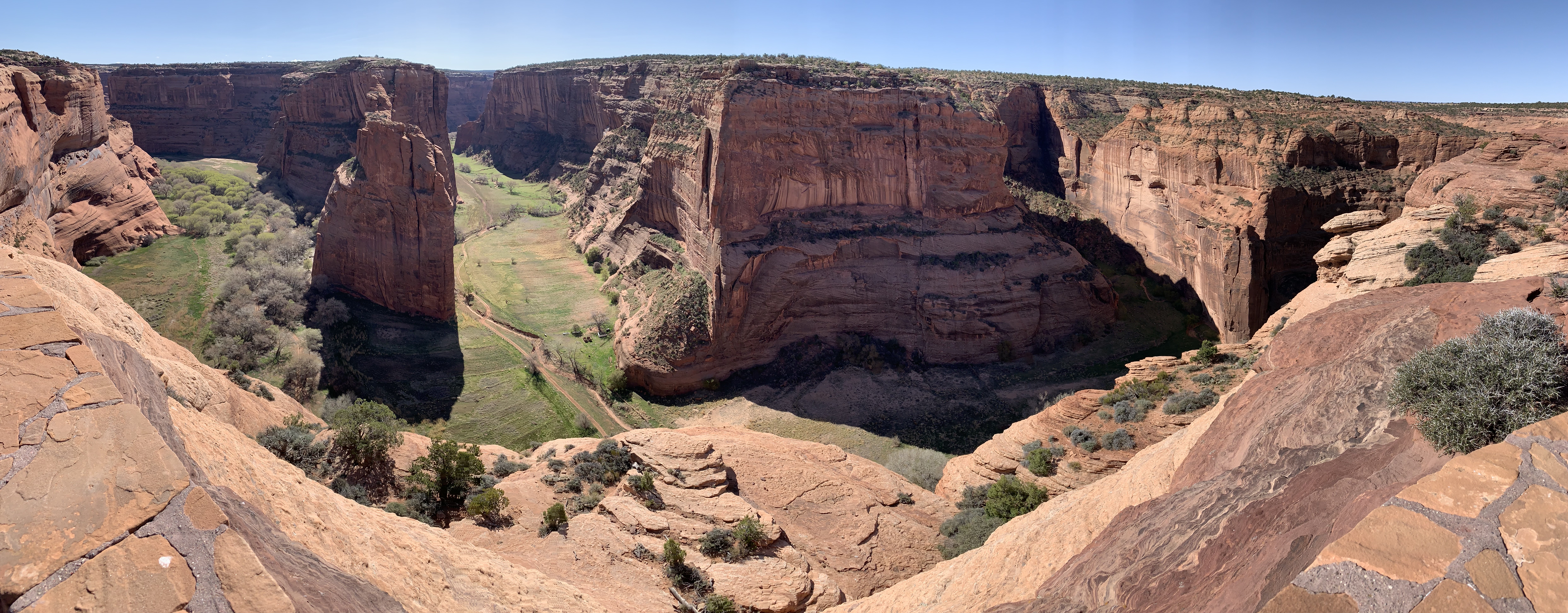
Smoke Hole above is a canyon formed by the South Fork of the Potomac River in West Virginia. Excursion trains take visitors on various trips through the area, but there are also country roads. I drove about 10 miles along the canyon admiring the views with fall foliage, and I never saw another person. The C&O Canal and Potomac Heritage NST are also in this NHA, which extends into the mountains of western Maryland. This is a rare, beautiful, underrated spot in the US to hike and enjoy nature.
Most humans live in their instinctual feelings: love, guilt, hate, fear, pride, anger, happiness, awe…. Unless something reverberates in our beating heart, the idea doesn’t feel real to us. Logic can seem as alien as Spock. We cocoon in the comfort of our instincts, and our modern technology entertains us with exciting fantasies about alien technology manipulating our brains. Ironically, our cable TV hearth targets our instinctual responses, in order to keep our attention on imaginary loves and fears for profits. Instinctual thinking limits us to recognizing our confusion, delusions, and fear. But then what?
No. If we’re going to solve our trouble with thinking, we need to overcome the limits of our instinctual thinking, ask honest questions, organize how we think, be methodical and logical. We need a far more advanced way of thinking: rational thinking. How do we go about that? Fortunately, rational thinkers keep records.
Socrates began the western history of rational thought by asking questions methodically, and his Socratic method is still employed at advanced universities. His student Plato believed that knowledge acquired through reason is more ideal than what our senses and experiences teach us. And Plato’s student Aristotle tempered that view to organize all thought rationally, whether the ideas came from observation or logic, inventing the scientific method and categorizing knowledge into physics, biology and politics. Aristotle’s logic helped him determine that the Earth was a sphere and that rain resulted from evaporation, around 350 BCE. In China around the same time, Confucius, Mencius & Xunzi similarly codified more rational ways of thinking. Math was already long known to the Egyptians and was advanced by later Greeks like Euclid and Archimedes.
But, most humans still being primarily instinctual thinkers, the ancient rationalism was almost lost after the Visigoths, Vandals and other barbarians sacked Rome, and in the Dark Ages of Europe, when only one story was read, the world turned flat and stupid again. Math continued to advance in the Muslim world, where the Indian decimal system was combined with Greek math and ancient Babylonian formulae. Around 825, the Persian Muhammad ibn Musa Al-Khwarizmi used the Indian concept of zero to balance equations, inventing Algebra. Some 375 years later, an Italian named Fibonacci brought this math to Europe.
The Church was unable to stop the Black Death, and the survivors started to rethink everything. Muslim scholars arrived in Spain and Italy to share their knowledge, and Renaissance scholars dusted off the Ancient Greek tomes and hit the books. The Medici, a merchant family in Florence, funded some of the most important scientists of the Renaissance: Brunelleschi, Da Vinci and Galileo. After exploring Roman ruins, Brunelleschi designed a huge, unsupported dome for the Florence Cathedral, proving that math still works even after being forgotten for centuries. Da Vinci studied human anatomy by dissecting cadavers, describing the nerves that connect our senses directly to our brains.
Then, Copernicus explained that the Earth revolved around the sun—as proposed by Aristarchus 1800 years earlier—, publishing both his observations and the math behind them. The Scientific Revolution had begun. Despite the Church’s opposition—including burning Giordano Bruno, who theorized that distant stars were like our sun with planets of their own, at the stake in Rome—Galileo made more detailed observations, expanding Physics and Astronomy, describing the moons of Jupiter, Saturn’s rings and the Milky Way, before being imprisoned for the remainder of his life. Francis Bacon described the scientific method (2,000 years after Aristotle). Newton reduced Physics to simple formulae, requiring neither God nor magic to employ.
René Descartes wrote cogito, ergo sum, ‘I think, therefore I am’, and, much as Plato before him, Descartes decided to believe only in what was supported by reason. The Age of Enlightenment began. Now, not just the infallibility of Church dogma, but the Divine Right of Kings was threatened. The ancient Greek ideal of Democracy returned. Revolutions followed. Americans who believe that our founders were guided by Christian faith have history exactly backwards. America was founded by rational thinkers, like Franklin, Jefferson and Madison, whose philosophy was explained by their compatriot founding father, Thomas Paine, in his book, The Age of Reason.
Rational thinking survived the collapse of civilizations, barbarian invasions, centuries of religious inculcation, enforced ignorance, public executions, tyranny, torture and wars. In the modern era, irrational fears and fact-free conformity still vie with what Judge Learned Hand called “the eventual supremacy of reason”. Rational thinking has proven itself to be both correct and valuable. Rational thinking is how we solve problems using facts, logic and math. Rational thinking is what we learn in school and what we use in many professions, such as ecology, economics and engineering. Boring, repetitive, linear, slow, and pain-staking though it may be, Edison consistently applied rational thinking to develop marketable light bulbs, transmitters, recording devices, movie cameras, batteries, coffee percolators and more in his lab and study below.
The general objective of rational thinking is to get the right answer. The specific problem and methods vary, but we do not think rationally in order to get the wrong answer. That would be stupid. Rational thinking is smart. The origin of your rational thinking is especially important. If your thinking begins with a neutral observation, a plain fact, without embellishment, without judgement and without any bias of personal feelings, then you may begin thinking clearly in a rational way. We gather information, make sure the facts and data are accurate, we use reliable methods, and we check our work. The reason we went to school, studied, did our homework and passed tests, is so that when we need to solve a problem, we have the skills to think rationally to solve it.
While others may wallow in their instinctual thinking, many of us primarily think rationally. Fighting is counter-productive. People should be more logical. Facts matter, which is why we keep track of them in history books and databases. If you want to know which player is better, look at their statistics. Get the information you need, be organized and think it through step by step.
This is how to succeed at work and in life. Status matters less than income, and income matters less than savings. You decide what you eat by cost, time to prepare, variety, nutrition and sufficient calories. When you attend social events, you seek out those who are informative, especially in a way that might profit or benefit you. Marriage is desirable for many reasons: two can live as cheaply as one, two heads are better than one, you can share life’s burdens and each of your strengths will compensate for the other’s weaknesses. You want your children to be well-educated and financially successful. You are planning for your retirement and even your death.
Rational thinkers view their way as correct and believe that the world would be better off if more people thought rationally. Yes. Rational thinking may not feel real to instinctual thinkers, but air travel is a reality. And to rational thinkers, physics is what makes the world go round.
Kayaking around Scorpion Rock, above, is truly a great national park experience. You are completely surrounded by wildlife, with brown pelicans flying in formation above, various seabirds perched and nesting on the rocky cliffs, harbor seals and California sea lions popping up curiously, and a brown kelp forest below with colorful sea stars and garibaldi fish. Our adventure tour had us on the water for several hours exploring both east and west of the scorpion ranch dock. Due to a fault line running through the volcanic rock, combined with powerful waves, this particular corner of Santa Cruz Island has perhaps the largest concentration of sea caves in the world, and I kayaked past a big blow hole, through several arches, skirting a gyrating whirlpool, around a pillar, and far enough into the back of one cave that the entrance almost disappeared in the swell. Wonderful!
If that’s your cup of tea, get in touch with the Santa Barbara Adventure Company, who can arrange a whole day tour, my favorite paddling tour. The guides were excellent, despite being frequently interrupted by seals and sea lions, and offered memorable stories to explain what we were paddling through and to inspire us to pay closer attention and care more about the natural world around us. Some flexibility helps, as weather can affect camping, ferry crossings and kayaking conditions significantly. The ferry operator contacted me the night before my trip to advise me of a storm that would bring hazardous winds, rains to turn my campsite to mud, and the likelihood of a canceled return ferry. They suggested changing to a day trip to avoid all that, so I left my camping gear in my trunk and had a spectacular, slightly rushed, day on the water.
I feared that I would not get to see the Island Fox, but one popped out as we were eating a late lunch (see below). Frankly, I needn’t have worried about not seeing any wildlife, especially on a kayak tour. Black oystercatchers, several different cormorants, the island scrub jay, pigeon guillemots, and a wandering tattler were just a few birds we saw. A large pod of common dolphin greeted our ferry’s arrival at Santa Cruz Island and played in our wake, and I spotted several whale spouts on the ride back.
I recommend arriving the day before your trip, going to the visitor center near the ferry dock, and watching the park film, narrated by a local high school grad named Kevin Costner of Water World fame. There you can learn about the islands, the Chumash cultural heritage, and all that you hope to see. The five Channel Islands are often called the Galapagos of the US, and, having been to the actual Galapagos, I must say it’s not true. There are similarities, including some seabirds resembling penguins, numerous playful seals & sea lions, and the sense of being surrounded by species in an extraordinarily special place, but there are no giant tortoises or brightly colored iguanas or other tropical species. The Channel Islands are unique in their own right, in a Mediterranean climate, on a busy seaway for whales and other marine mammals, remarkably accessible from one of the country’s largest urban areas. Marvelous!



























 Zero Carbon Travel