Beaver Hills Biosphere

This large UNESCO biosphere near Edmonton Alberta includes Elk Island National Park, which has hundreds of plains and wood bison. But Elk Island is fenced, so, as important as that park is for restoring the bison population, I came to see beaver. And on the Beaver Hills Biodiversity Trail, I saw several large beaver dens, like the one above.

Beaver are quite destructive, and their homes are surrounded by felled and drowned trees and pointy stumps. But they also create year round dens and dams with ponds and small lakes for many other species. Besides the many waterfowl, blue dragonflies, and chattery squirrels, I saw a magnificent golden eagle circle above the pond. And of course, I saw five or six beaver, swimming far from their dens, playing and occasionally climbing on branches to dry off, scratch or hang out.

When humans create zoos, safari parks or even national parks with fences, it’s not right to call the enclosed animals ‘wild’. Some may have been born wild, but as long as they’re locked up, they’re no longer wild animals. Humans make the rules in those spaces, so, no matter how we try to copy nature, the spaces are artificial. But when beaver fell trees, build dams and create lakes, they make the rules. And the species gather there naturally. Beaver Hills is a natural area, filled with wild animals, and it is delightful to pause here and take in the peaceful balance of life.

Redberry Lake Biosphere

I saw ducks and geese in the thousands, a flock of whooping cranes, a pair of sharp-tailed grouse, and many other birds, but they kept their distance from me. Saskatchewan has many lakes, and occasionally one will be full of birds. I also saw a young moose walking near the road, and there were bison behind fences. Since I was there during harvest, I could see the giant combines gathering grain. The self-guided driving tour gives several suggestions for exploring the area, which is mostly farms and First Nation communities. I believe there’s a visitor center opening soon.

The lake is at the center of a UNESCO Biosphere Reserve, but there’s also a popular state park camping and recreation area. So there are RVs, cabins, a beach below with a playground, mini golf, a golf course, a boat launch and even a few JetSkis, which hardly seem compatible with an internationally important bird refuge. Humans have trouble sharing our world with all the other species.

Historic District of Old Québec

Québec is my favorite city in North America. I love New Orleans, Philadelphia and San Francisco, but there’s a certain je ne sais quoi. Probably the food. UNESCO may have picked it as a World Heritage Site due to its history, architecture, culture, beauty, fortifications, statues, parks, narrow old streets, churches, magnificent vistas, harbor, citadel, Haute-ville, Basse-ville, museums, galleries, Parliament, battlefield, archaeological discoveries, and all the rest, but it’s really the food.

Although the funicular (above) is fun too, and the old shopping district is colorful, amidst several fine restaurants. There always seem to be festivals in all seasons, concerts, and other excuses to try something new to eat or drink. If you want to get out of the city, you can go to Île d’Orléans, by bridge from the north side of the Seaway. They have farms, berries, cheese, bakeries, jam, chocolatiers, wineries, cideries, sugar shacks with maple syrup treats, and a microbrewery. Basically, much of what you eat in Québec City is from the island. As much as I enjoy going around shops and stands there, I prefer leaving all the work to each restaurant’s wait and cook staff, so I order many different dishes and sample the best of everything. Bon appétit!

Rideau Canal

A series of locks allow small boats through Jones Falls below on the lovely historic river and canal connecting Ottawa to Kingston in Canada. In season from mid-May to mid-October, the boats tie up on the dock to the right and wait their turn, perhaps staying or getting something to eat at the 1870s lakeside Hotel Kenney. Chaffey’s Lock is another of the many pretty, historic locks, and it has a fancy hotel, a lock-master’s fort—in case the Americans try to invade by canal—, and a swing bridge that rotates on a wheel to let tall boats clear the lock.

The canal is recognized by UNESCO as a World Heritage Site. There are a couple dozen locks between Ottawa and Kingston Ontario built almost 200 years ago to facilitate trade and travel between the Great Lakes and the Atlantic Ocean. Today, giant cargo ships stick to the main St Lawrence Seaway, but that shift left a dozen or more adorable “timeless” little villages along the original canal route. Small boats still use this canal to avoid heavy barge traffic, dangerous currents and because it’s beautiful and fun. Much of the canal is short sections that connect a series of lakes, including Lake Rideau. If you visit the town of Westport, I recommend dinner at the atmospheric old Cove Inn, which often has live music.

Niagara Escarpment Biosphere Reserve

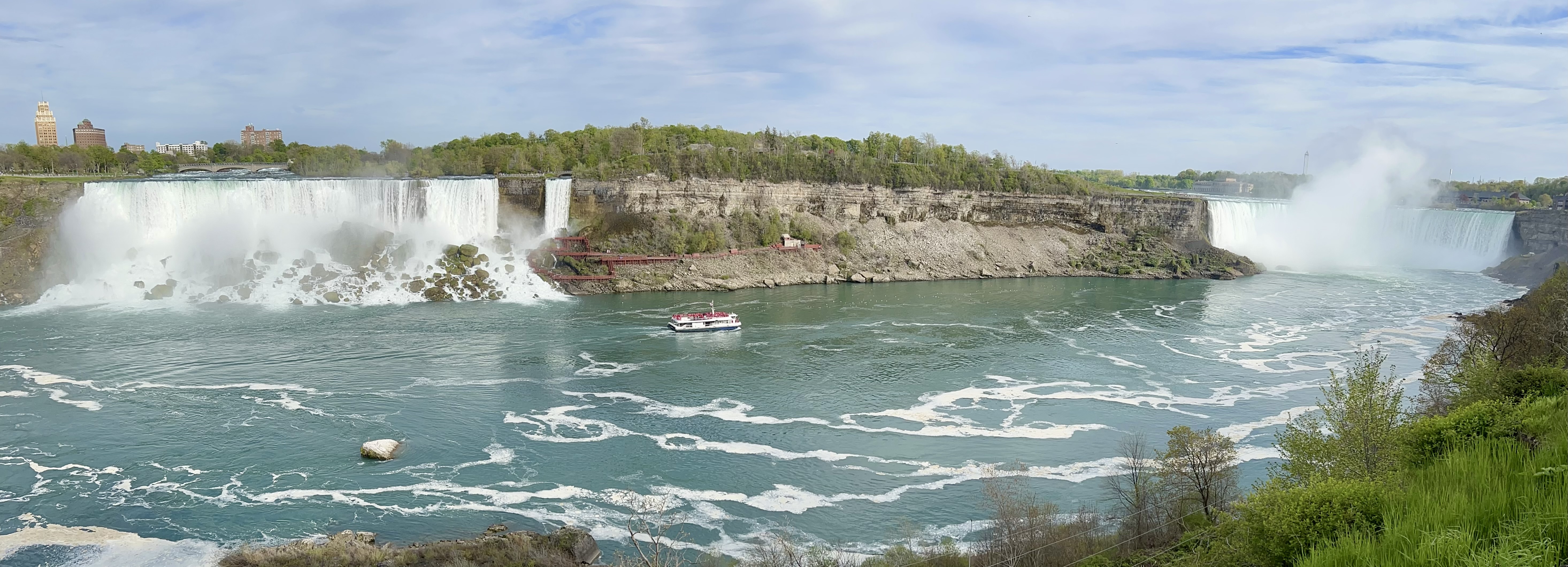
Ignore the famed waterfalls and focus on Goat Island cliff in the middle. That wall is the Niagara Escarpment, caused by relatively hard rocks at the top holding the land underneath together, until it erodes away from the side. This two level land break—all erosion and not earthquake fault—is the key geologic feature to understanding the Great Lakes.

Much of the escarpment is in Canada, and even where it crosses the border to form Niagara Falls, it’s easier to see from the Canadian side as above. It runs along the south shore of Lake Ontario, across Niagara Falls (above) where it sets the level of Lake Erie, northwest through Ontario where it guides the Bruce Trail, up along the north shore of Lake Huron where it splits off Georgian Bay and shapes Lakes Huron and Michigan, along Michigan’s Upper Peninsula where it separates Lake Superior, and down the Door Peninsula past Green Bay in Wisconsin. After driving around the Great Lakes, it’s apparent how the water levels depend on the escarpment: Superior is the highest above both ends, Michigan and Huron are the same level in the middle, and shallow Erie is a little lower, held back at Niagara Falls, before that river drains into the lowest lake, Ontario.

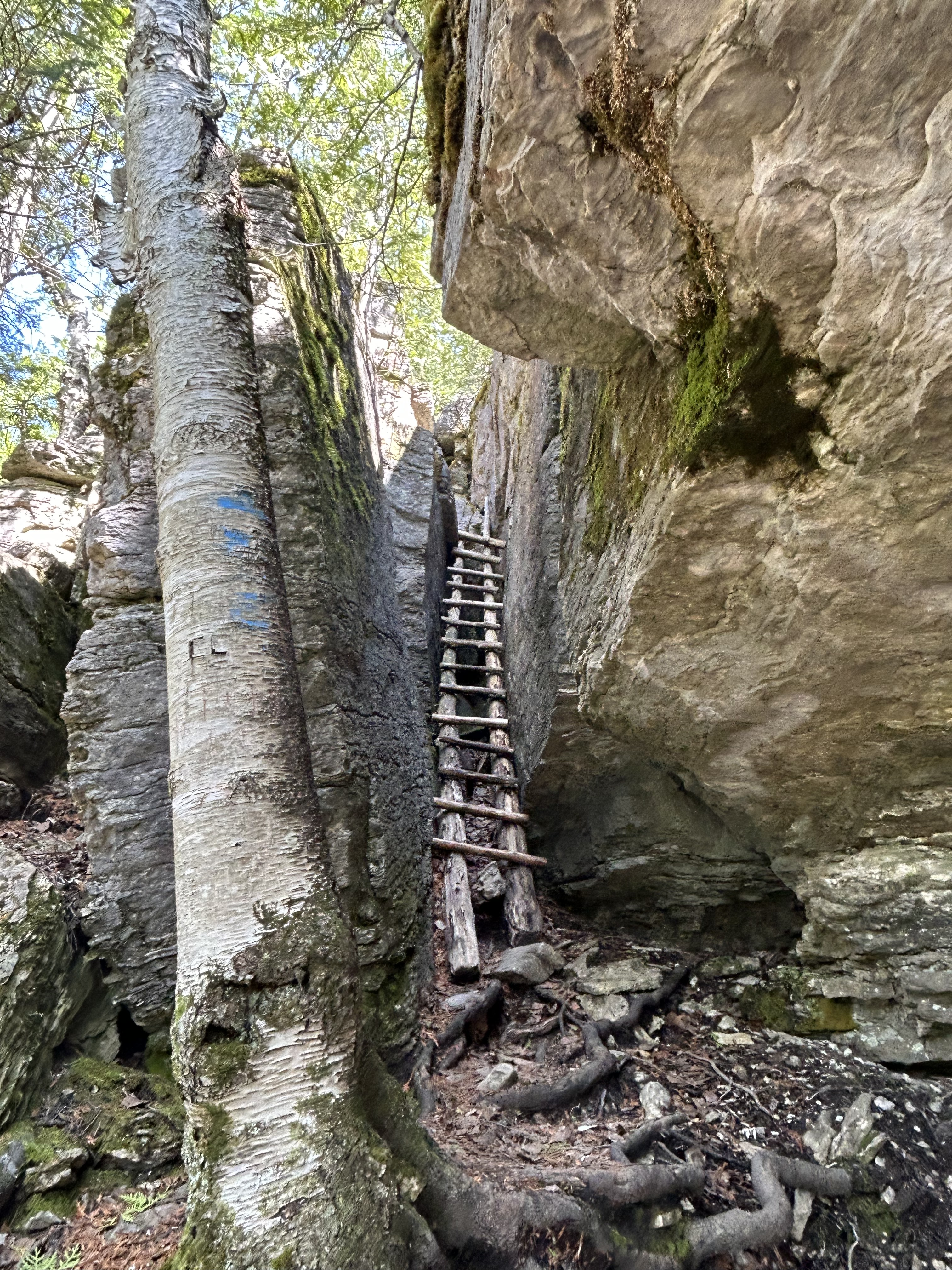
UNESCO defines the Biosphere as the mostly forested area of Ontario between Niagara Falls and Tobermory on the tip of the Bruce Peninsula next to Georgian Bay, roughly 500 miles along the escarpment. The geologically interesting landscape holds great biodiversity in wetlands, coastline, deciduous & conifer forests, and rocky bluffs, perhaps the most in Canada. And there are many opportunities to explore, photograph wildlife, hike, drive or boat nearby. I hiked on the Cup & Saucer Trail on Manitoulin Island, the world’s largest freshwater island, when traveling around the Great Lakes. There, the escarpment is eroded on both sides, providing many views along its edge, including Lake Manitou below.

Waterton Glacier International Peace Park

Canada is to the left of the mountain with the historic Prince of Wales chalet on the far left bluff, and to the right is Glacier National Park in the US. This World Heritage Site includes both parks. Waterton village is accessed from Canada, uses Canadian dollars, but is mostly on US soil. Not that it matters. I saw no border officials here, and it indeed very peaceful. There’s a classy old tour boat which runs down into Montana, as well as camping and lots of interesting trails.

Unfortunately, there was a terrible forest fire here in 2017, and the only glacier above is far off in the distance to the right, a shadow of its former self and a reminder that we all must reduce our carbon footprint. I was happy to spend several hours charging my car at the marina’s destination charger, walking the shoreline, eating, trying the local beer and just soaking in the view above. I enjoyed my detour to Alberta’s five world heritage sites very much, and I didn’t have any trouble charging in Canada. The Tesla even converts the speed limit to mph, so you don’t need to do any math.

Dinosaur

This is the Canadian World Heritage Site in Alberta, not the American Dinosaur National Monument.

Josh guided us into the restricted area, explained how to look for fossils and we sat down on a bone bed to look. I saw something with a pretty pattern, picked it up and showed it to Josh. He confirmed that it was part of a T-Rex—Gorgosaurus libratus—tooth, roughly 75 million years old. I just sat there for a while, stunned to be holding a real fossil like that in my hand after picking it up off the ground.

The park is the most productive dinosaur fossil ground on earth. And it’s also very beautiful, with camping and hiking along the river among the Cottonwood trees, some 200 years old. I saw a family of deer on the trail. Even the Badlands in Canada are nicer than the US.

It’s definitely worth signing up for a guided tour, although there’s also a drive with exhibits and places to look for fossils on your own. The above diorama is in the visitor center. Most of the assembled skeletons are at the Royal Terrell Museum a couple hours drive north, but the field work takes place here, especially in summer. Josh even stopped to mark and protect a new find from another group a week before. Impressive!

Writing-on-Stone

While hiking the Hoodoo Trail, I turned to a view point above the Milk River on top of the steep cliffs above. I stopped suddenly when I heard native singing, resonating beautifully between the sandstone crevices. Not wanting to disturb the prayers, I stood silently, entranced. Eventually I retreated and continued out to the Battle Scene rock art depiction, one of the highlights of this World Heritage Site in Alberta Canada.

Later I took the guided tour of the restricted area where Blair showed and explained the rock art in this spiritual place of the Blackfoot Tribe. The tour started at 5 pm, perhaps to take advantage of the light as well as coolness. While I disagree with those who look for extraterrestrial interpretations of some of the unusual petroglyphs and pictographs, the details and 2500 years represented here are intriguing and fascinating. Still, for me, I will never forget the living voice I heard echoing among the hoodoos.

Head-Smashed-In Buffalo Jump

While the view from cliff trail is impressive, the interpretive center is the best part of this Canadian World Heritage Site. There’s a graphic film depicting a bison hunt and exhibits about the Blackfoot Tribe modern and prehistoric. Tribal records were kept on Winter Count Robes, and a beautiful one is on display. The tribe got its name from walking through the burnt grasses during the hunts. Before they acquired horses from the Shoshone, the tribe used dogs to help carry their belongings (photo). Wonderful place to learn about the fascinating history of Alberta.

Rocky Mountain

This is the Canadian World Heritage Site, not the American Rocky Mountain National Park. If you don’t like this picture of Emerald Lake, my homepage background photo was also taken in the Canadian Rocky Mountains. The site includes many national and provincial parks including Banff, Jasper, Yoho (above), Kootenay, etc. I visited several of the parks with my son a few years ago, before I converted to electric. Maligne Lake in Jasper is a favorite, along with Radium Hot Springs in Kootenay. I also love the dozens of double arched wildlife bridges that allow animals to cross the highways safely.

Near Banff and Lake Louise it gets crowded. Even though I intended to visit Lake Louise to follow my Uncle’s travel log, I had to skip it. One problem is that the Canadian parks reservation system is not foreigner friendly. If you’re Canadian, you simply sign up for the short shuttle ride on a system you’re likely already using. If you don’t have a Canadian bank account, signing up for the shuttle is an overly complex affair involving copious personal information. Of course, if you spend $900 US for a night at the Chalet, then you can visit at your leisure. The other options are equally troublesome, so I chose Emerald Lake instead, which is very similar and maybe slightly larger.