Since each park is unique, I would never be able to say which is my favorite. But this one is.
Here, at the confluence of the Shenandoah and Potomac Rivers, in 1859 the abolitionist John Brown led 18 men to capture the armory, arsenal, and rifle factory here, killing three men, freeing slaves and taking the town’s leaders captive, before being captured by Col. Robert E. Lee and martyred after a brief trial, becoming the first person executed for treason in America. Brown believed he was right, did not intend for anyone to die and argued at trial that “had I interfered on behalf of the rich, the powerful… or any of that class… this court would have deemed it an act worthy of reward.”
Native Americans lost this land to European settlers during the 16th and 17th centuries. Washington explored the area for his canal project and recommended an armory be built here. The armory supplied Lewis & Clark’s expedition, and the arsenal supplied weapons for the Civil War. During which the town changed hands eight times including the destruction of the arsenal, the capture of 12,500 Union soldiers by Stonewall Jackson and the critical resistance to the confederate army marching on DC. Major Delaney, the only African American field officer in that war, came from here, alongside many USCT recruits. Frederick Douglass and W.E.B. DuBois organized and lectured here, where the Freedman’s School and Storer College educated the descendants of slaves.
Thomas Jefferson stood on a rocky overlook and said “this scene is worth a voyage across the Atlantic.” The mountains, rocky cliffs, rivers, swamps, and floodplains here support diverse wildlife, including three species of hawk, a harrier and the bald eagle. There are over 20 miles of hiking trails in the park, including part of the Appalachian Trail (park & hike). And the tavern in town serves a draft amber ale called Almost Heaven.
“Almost heaven, West Virginia Blue Ridge Mountains, Shenandoah River”
This DC area 1700 acre nature reserve and historic park (our nation’s 3rd national park) is chockablock full of wildlife, old buildings and monuments, and its popular attractions for hiking, biking, horseback riding, boating, field trips, sports, picnics, learning and fun are well worth your time. The Sarah Whitby Site and Pierce Mill are recommended historic attractions. The Planetarium was closed, but the park extends to Georgetown, passes the Washington National Cathedral, the National Zoo and includes nearby parks, one with a memorial to Khalil Gibran.
But my brother suggested we go to Fort Stevens, at the edge of the park near the Maryland-DC border, one of many Civil War era forts. We think most people don’t realize that confederate troops attacked DC, but there’s a small cemetery where over 40 fort defenders were buried. As depicted in bronze relief, the only time a US President has been under direct enemy fire was here, when confederate sharpshooters shot at Lincoln as 20,000 troops attempted to take our nation’s Capital. A young officer (long before he joined the Court) issued a sharp order to the easily identifiable President.
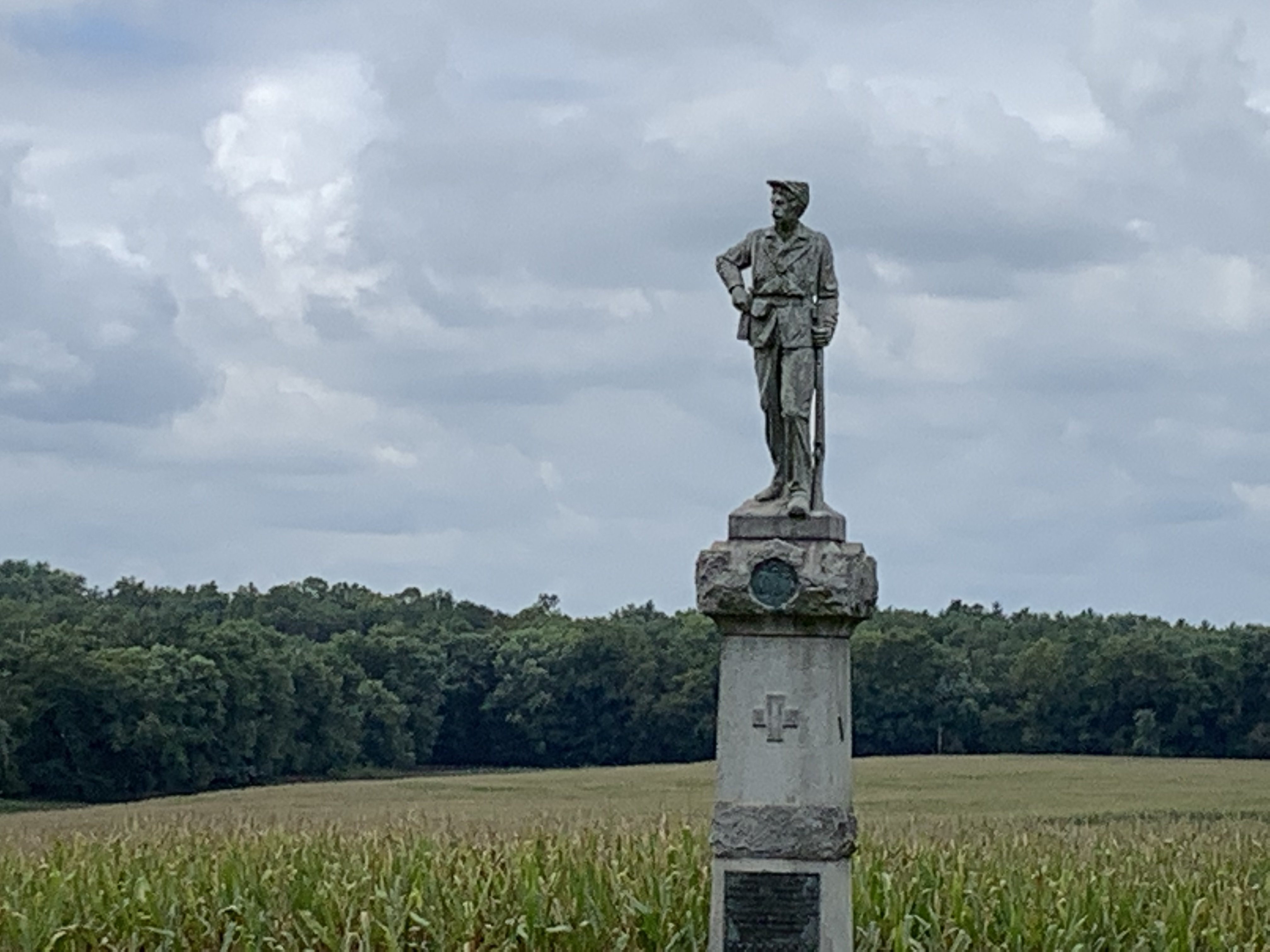
Monocacy (a Native word for river bend) is a junction northeast of DC, and during the Civil War the 14th NJ, later known as the Monocacy Regiment (above), built two blockhouses to defend the road and rail bridges. Early in the war, secret order #191 from Robert E. Lee was discovered here, providing advance warning of his movements and gaining the Union critical time to respond at Antietam. When over 15,000 troops suddenly began marching towards DC in 1864, control of the junction became critically important.
About 6,000 mostly inexperienced soldiers were rushed here to stop the advance, under the command of Lew Wallace. General Wallace had earned both distinction at Fort Donelson and shame at Shiloh, which is why he had been relegated to defensive duties. Now, he had to hold the river crossing outnumbered 3 to 1. In fierce fighting on July 9th, Union troops fought back waves of attacks and held the bridges until the confederates crossed a shallow point a mile downriver. Then Wallace ordered the road bridge burned, recalled his men from the blockhouse across the railroad bridge and launched a counterattack on the new front. After fighting all day with 1,300 casualties, his forces were finally flanked and forced to retreat.
But, as in the case of the secret order, the Union gained time to redeploy troops to defend the Capital. After only a brief skirmish at Fort Stevens, the attack was withdrawn. General Wallace and his men lost the battle, but they saved Washington DC. Wallace went on to preside over the military tribunal for the commandant of Andersonville, but he’s best known for writing Ben Hur in 1880.
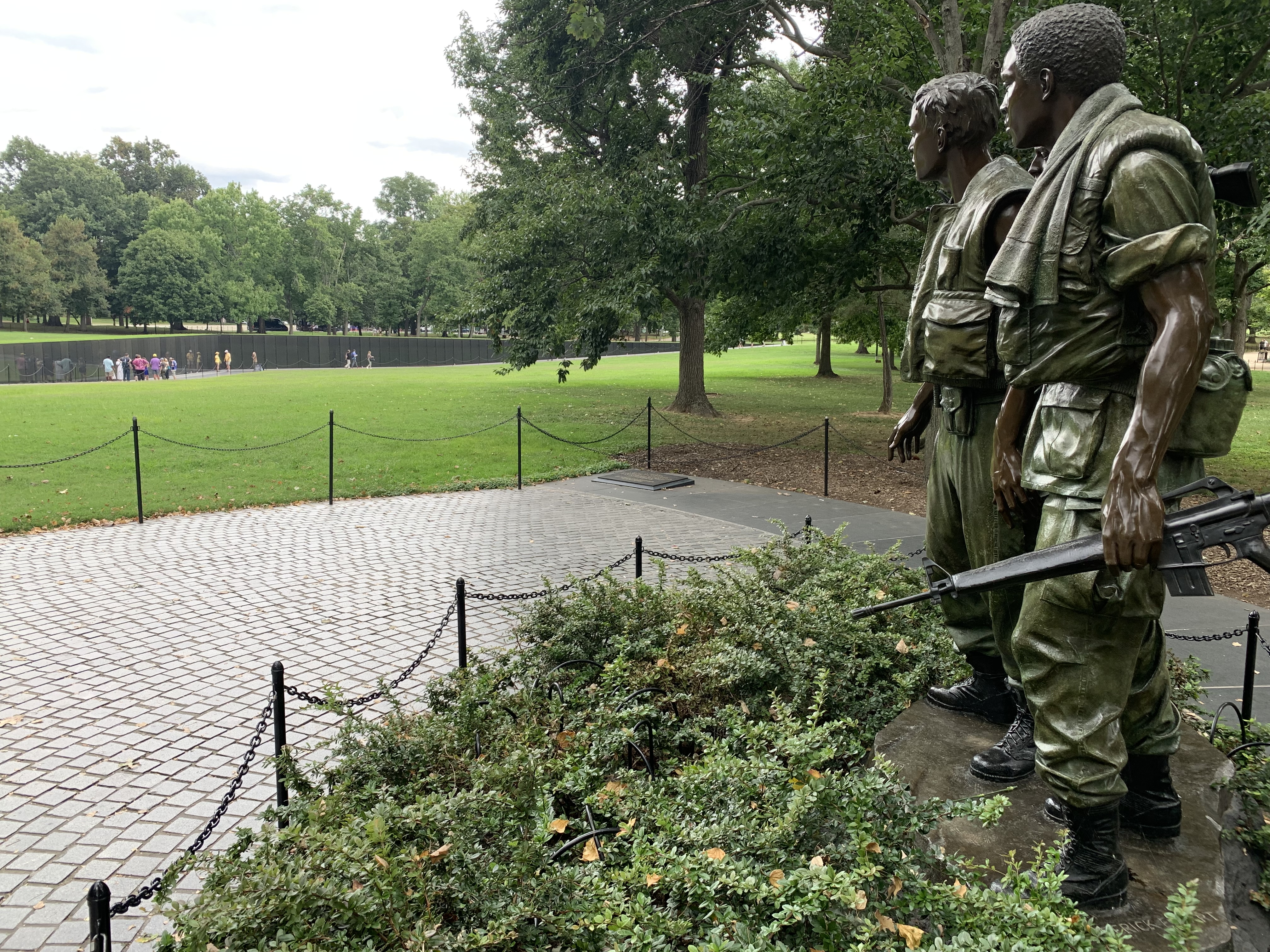
The memorial is effective. As you walk along the wall, gazing at the names engraved chronologically in the reflecting stone wall, you slowly enter the earth like the dead. Visitors can look up names in books, find their panels and etch a copy of a name to bring home with them. Some bring mementos or attend ceremonies if a status changes from MIA to recovered. There’s another statue to women who served and died. The statues of the three servicemen above look over the visitors at the enormous cost of the war. Over 58,000 Americans soldiers died, and over 300,000 were wounded.
Strangely, the memorial’s website doesn’t describe the war itself in any way, so I guess I have to try. Vietnam was both a civil war between the Vietnamese and a proxy war among the great powers at the time. The North, under Ho Chi Minh, had overthrown the French colonial government and wanted to unify the country under Communism. They were supported by China and Russia. The South was set up by France and allies to resist Communism, and we supported them with money, material, and military. Eventually, the weaker, more corrupt and incompetent South Vietnamese government failed, despite our extraordinary efforts to prop them up.
Robert McNamara, the architect of the US war in Vietnam, called the war a mistake in 1995 and said “we were wrong. I believe we were terribly wrong”. In retrospect, Kennedy’s effort to keep Vietnam from being the next ‘domino’ to fall to Communism, Johnson’s stubborn expansion of the war, and Nixon’s machinations were all failures. I have never read a credible analysis of how we could have won the war. Besides US casualties, millions of Vietnamese died and were crippled by Napalm and Agent Orange. About a decade after we left, the Communists had ruined the economy, and the Vietnamese abandoned that system on their own.
The park service has a responsibility to educate the public about history, in addition to memorializing the dead and remembering the sacrifice of veterans, regardless of controversy. Publishing the history of the Vietnam War on their site would be a good start.
Korea wasn’t just one war. After the North Koreans launched their surprise attack, the allies only controlled one major city, Pusan, and its surroundings in southeastern Korea, near Japan. MacArthur brilliantly counterattacked with an amphibious assault at Inchon to liberate Seoul, and then he swept north as the allies had reinforced South Korea. But then China sent hundreds of thousands of troops across the border, which MacArthur described as an entirely new war.
That second war, with China, almost became a nuclear war, as MacArthur supported using nukes tactically, including using nuclear waste to create an uncrossable border and against (presumably) military targets across the North Korean border in China. President Truman, who had authorized the bombings of Hiroshima & Nagasaki, at first seemed inclined to allow MacArthur to make those calls. Instead, he relieved MacArthur of command and fought the war to achieve a stalemate, which still holds in the armistice (under Eisenhower) and at the (heavily armed) ‘demilitarized zone’ between the two Koreas today.
Each of the 4,048 stars on the wall represent 100 American military deaths. 16 million served in the US Armed Forces, and many millions more supported the war effort directly. Appropriately, this classical memorial occupies center ground in the National Mall next to the Washington Monument. There were many veterans (of more recent wars) visiting, as well as international visitors and families all admiring the fountains, statues, monuments and inscriptions.
There are many detailed tributes, especially the bas-relief sculptures of both Atlantic and Pacific theaters. In the Atlantic, the memorial illustrates the Lend-Lease program that supported our allies before we entered the war, the military contributions of women, the industrial contributions of women, the code-breakers, the flying fortresses (later protected by the Tuskegee Airmen), the paratroopers, Normandy, Sherman tanks, medics, the Battle of the Bulge where the allies stopped Hitler’s last gasp advance, and meeting the Russians at the Elbe River as the allies stormed into Germany. In the Pacific, the memorial sculptures show Pearl Harbor, the massive enlistment and mobilization for war, battleships, submarines, aircraft carriers, amphibious assaults, jungle warfare, prison camps, and V-J Day.
“Today the guns are silent. A great tragedy has ended. A great victory has been won. The skies no longer rain death – the seas bear only commerce – men everywhere walk upright in the sunlight. The entire world is quietly at peace.”
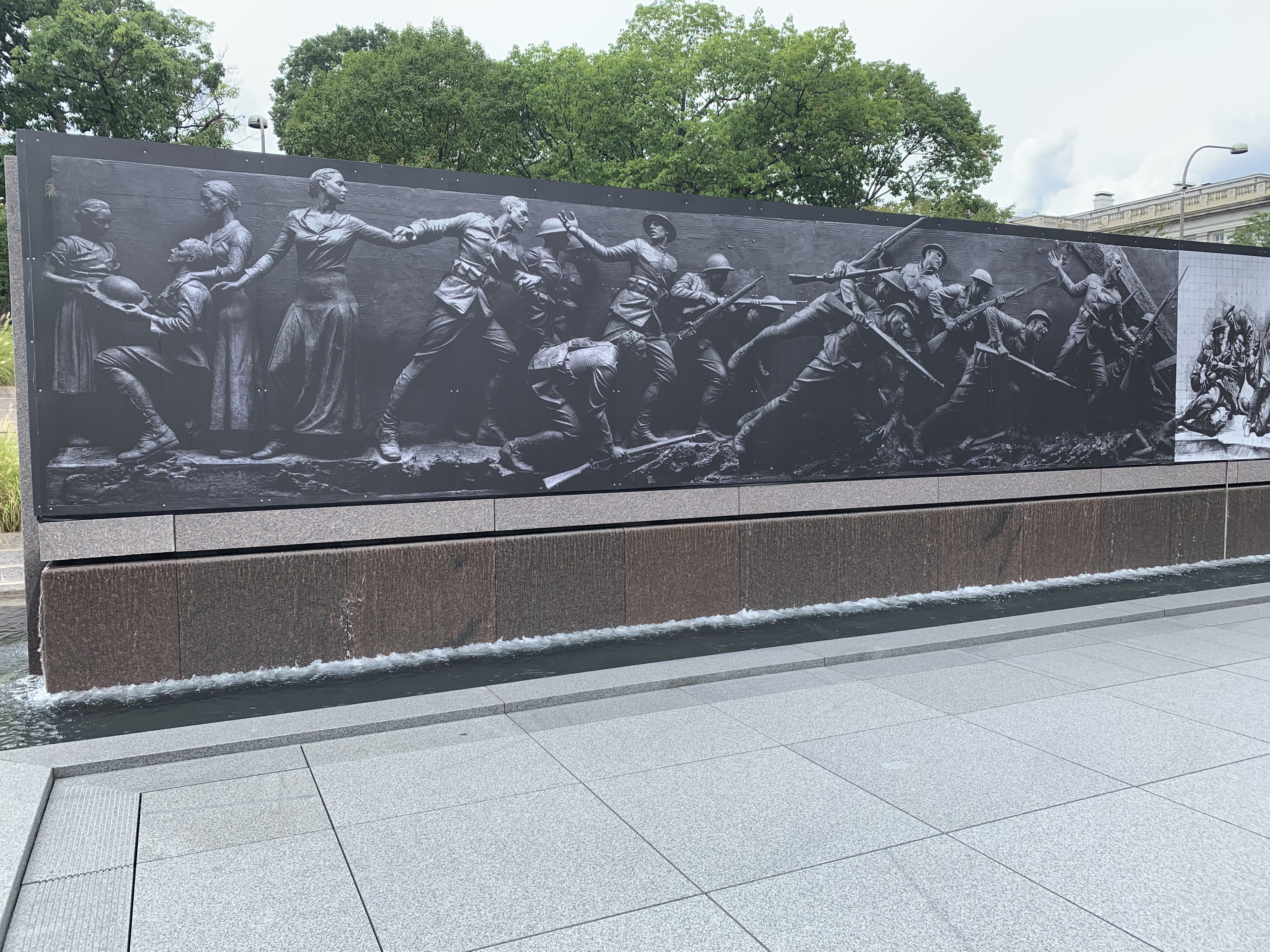
The artwork, “A Soldier’s Journey”, is not yet complete and “will not be installed before 2024”, so what you see above is a photo of the first half of the journey which continues as a drawing to the right. There is a statue of General Pershing in his park too with quotes and maps of the Western Front and the Meuse-Argonne Campaign. Nearby is an outline of L’Enfant’s plan for DC.
Pershing is the one general, besides Washington, to be named as “General of the Armies of the United States” after his success in WWI. He kept our forces together, instead of blending with allied forces, to increase their impact, and they broke the stalemate to win the war. Over the course of his career, the West Point grad commanded the next generation of leaders, including MacArthur, Marshall, Patton and Truman. Many of his earlier commands were much more problematic, including setting the perimeter at Wounded Knee, being called “Black Jack” because he led the 10th cavalry of “Buffalo Soldiers” (African Americans), fighting the Moros in the Philippines and his failed search for Pancho Villa. In all cases, he distinguished himself for his exceptional effort to understand his opponents.
As General, U.S. Grant won the Civil War, and as President, he saved the Union. He created the Justice Department, supported the 15th Amendment and fought the Ku Klux Klan. Over a million people gathered to watch his funeral procession in 1885, and his mausoleum became one of the top tourist destinations in the nation.
Racists like President Johnson were determined to resist letting African Americans vote, and Grant agreed to run for President in large part to protect those rights. This divide of bigotry, which festered after the Civil War, continues to divide our country. After Grant’s death, the descendants of traitors promulgated the big lie (known as the Lost Cause) that the confederates were honorable, benevolent to slaves, and were the moral victors of the Civil War. To do so, they maligned Grant as a drunk, ignoring his reform efforts and associating him with corrupt officials. The campaign was effective, and Grant was often ranked among the worst Presidents.
Grant’s Indian policy illustrates the problem. Grant appointed the first Native American to be Commissioner of Indian Affairs, and Grant pledged “proper treatment of the original occupants of this land—the Indians.” Supporting peaceful reconciliation, his administration allowed many Quakers and Episcopalians to “help” the natives, instead of continuing genocide. Grant was a firm believer in the separation of church and state, but the religious people believed that converting the Natives was the best way to help them and thus erased so much of their culture. And many people still wanted to take Native American land, so well-intended land policies were similarly corrupted.
Like most of the park rangers I’ve spoken with, I’m a fan of Grant. We believe he was, generally for his time, on the right side of history and does not deserve the vitriol he received in life and death from those on the wrong side of history. I wish he had better understood the depths of and had proposed better solutions against systemic racism, but he was an ally of the Americans who were denied their rights by many white Americans. The struggle to secure the voting rights of African Americans and to restore justice to Native American communities continues over 150 years later. Grant recognized both his own failures of judgement and the moral sins of our nation. But Grant also said victory goes to those who keep fighting.
“Nations, like individuals, are punished for their transgressions.”
Couple reasons for choosing this old Colonial $30 note. First, the visitor center/ museum at Morristown has an exceptional collection of Revolutionary War artifacts: Washington’s cane, his inaugural sword, a Ferguson rifle (designed by the British commander killed at Kings Mountain), clothing, household items and numerous books and pamphlets, plus the original note above. I enjoyed the Cross garden, driving through Jockey’s Hollow (where the soldiers camped), the wooded hilltop at Fort Nonsense, and the tour of Washington’s HQ, but the detailed items on display are unique.
The war lasted 8 years, so Washington had as many winter camps and HQs, including at Longfellow’s House in Cambridge and at Valley Forge. But Washington spent three winters here in Morristown, early, mid (worst winter ever) and late war. New Jersey was central to his efforts in the north, with good roads, hills and provisions. Especially after the British Navy helped them take New York, New Jersey was critical to holding the colonies together. New Jersey is a beautiful and historic state, that is often in the shadow of New York. But, especially after Washington’s victories at Trenton and Princeton, New Jersey was the lynchpin of the colonies, and Morristown was at the crossroads of the revolution.
Which brings me to the second reason the note is important. The war dragged on far longer than most realize, and simply feeding and clothing 10,000 troops was a monumental task at the time. Our government was broke, divided, broke and out of money. Congress printed so many dollars, that they lost 70% of their value, and then they simply issued IOUs. Having to wait years for repayment, assuming we won, burdened people and drove some bankrupt. Hamilton cut his teeth for his future as Washington’s Treasury Secretary trying to administer the financial end of the war. Now the ‘full faith and credit’ of the United States is recognized internationally, but when the outcome of the Revolutionary War was in doubt, it took a great leap of faith to accept that dollar above, especially when the enemy was paying in actual gold and silver coins.
One of the key reasons we won the war was because the Marquis de Lafayette used his own money to join Washington’s army. The French noble was on a quest to avenge the death his father at the hands of the British, but the King hadn’t yet authorized direct military assistance. So Lafayette bought his own ship, and joined Washington’s army for free, even paying his staff, aides & junior officers out of his own pocket. Lafayette’s direct connections to the French monarchy helped convince France to join the war, and his negotiations with the balky French forces in Newport led to Washington’s strategic partnership with Rochambeau that helped end the war at Yorktown.
Washington had a knack for recognizing and inspiring talent, including von Steuben, Lafayette, and Hamilton. Those he mentored gave their all for him, and some grew resentful if they didn’t get the recognition they wanted. Benedict Arnold blamed Washington for not helping him enough after Arnold’s court-martial on a profiteering charge, leading Arnold to his infamous act of treason. Hamilton helped defeat a cabal of Washington’s rivals, but quit Washington’s service in a momentary quarrel over respect. Lafayette not only was devoted to Washington, but he helped bring our revolutionary ideals back to France, where he razed the Bastille and brought Washington one of the keys.
Washington’s leadership united our fractious states, overcoming deep distrust between many colonists. Which is why it came as such a shock to me when some of the tourists today interrupted the tour to propose alternate US flags, arguing (falsely) that the 16th Amendment (income taxes) wasn’t ratified and that Washington had created a religious flag (he didn’t) for the ships he sailed (he didn’t). The ranger was making a point about real slaves in actual slavery, when the nutter said that ‘we were all slaves but we didn’t know it’. Given how hard Washington worked to unify the original colonies and hold our country together, so that it could become the United States of America, I found it sad that selfish, misinformed and misguided citizens would be so clueless as to raise this nonsense where he once slept.
Major Armistead insisted on a much larger flag to boost morale. The one he bought was nine times bigger than the small storm flag above the fort today. So when it was hoisted up at 9 am on September 14th, 1814, everyone could see that Fort McHenry was still in American hands, despite almost 2,000 bombs & rockets fired over the previous 24+ hours, from the grateful city of Baltimore to the frustrated British fleet in the Chesapeake Bay, where a young, detained American civilian negotiator named Francis Scott Key watched hopefully, before writing down the first verses of our National Anthem.
These days, big flags mean car dealerships, but after the British burned DC, whether this particular flag was ours decided the fate of Baltimore and of our nation. The film and ranger tour explain the story in detail. One of the air-bursting, shrapnel bombs, turned dud after flying through the rain, still sits next to the powder magazine in the fort. The fort’s flag had only 15 stars, even though there were more states at the time, because few people were particular about such symbolism at the time. But the multi-year ‘War of 1812’ helped spark America’s national identity, the Battle of Baltimore proved us strong and Key’s anthem stirred a deep, enduring patriotism. This is my favorite patriotic park.






 Zero Carbon Travel