Fort Frederica National Monument

Upon arrival, I remembered visiting by small boat as a teen many years ago. All along the southeast coast, displaced Native Americans and escaped slaves endeavored to remain free in these low-lying delta barrier islands. Although threatened, the evocative old oaks, the Spanish Moss and the shell-filled archaeological ruins are still hauntingly beautiful.

In the 1730’s the British built a pair of forts, both named after Frederick, Prince of Wales, to develop and defend their colonies against the Spanish. Fort Frederick’s ruins are 125 miles north, next the Reconstruction Era Camp Saxton in South Carolina. Fort Frederica here in Georgia, defined the southern boundary of their colonies, north of Spanish Florida.

The British commander Oglethorpe was considered enlightened (for the time) and enthusiastic. Rather than slavery, he proposed work be done by indentured servants mostly from debtors prisons in England, making Georgia a type of penal colony where workers could gain their freedom over time. The Methodist founder John Wesley and his brother Charles first attempted a church under one of the large, mossy oaks here, and the settlement had various tradespeople, including a Native American interpreter, a blacksmith and a doctor/barkeep.

In a remarkable historical echo of the French colonial experience at Fort Catherine, Oglethorpe also tried to seize St. Augustine in Florida, besieging the Castillo de San Marco and being stopped at Matanzas. Again, the Spanish counterattacked, but faring better than the French, Oglethorpe successfully defended this fort and cleverly routed the Spanish in Bloody Marsh, despite being outnumbered. After the Spanish retreated and conceded Georgia, the British cut their military presence here and the remote island village faded away in a decade or two.

Now, while driving through these remote islands, I can’t help but be amazed by the fancy houses. Not because they’re decadently ostentatious, but because they’re so close to sea level. It is astonishing to think that many of America’s most successful retirees choose to develop luxurious estates within the zone that is most certainly going to be erased by the climate crisis. The collapse of Thwaites ‘Doomsday’ Glacier is accelerating, and rising seas will take all the land here. They may have inherited much wealth, but they won’t be leaving these houses to future generations. Apparently, you don’t need much intelligence to be rich.
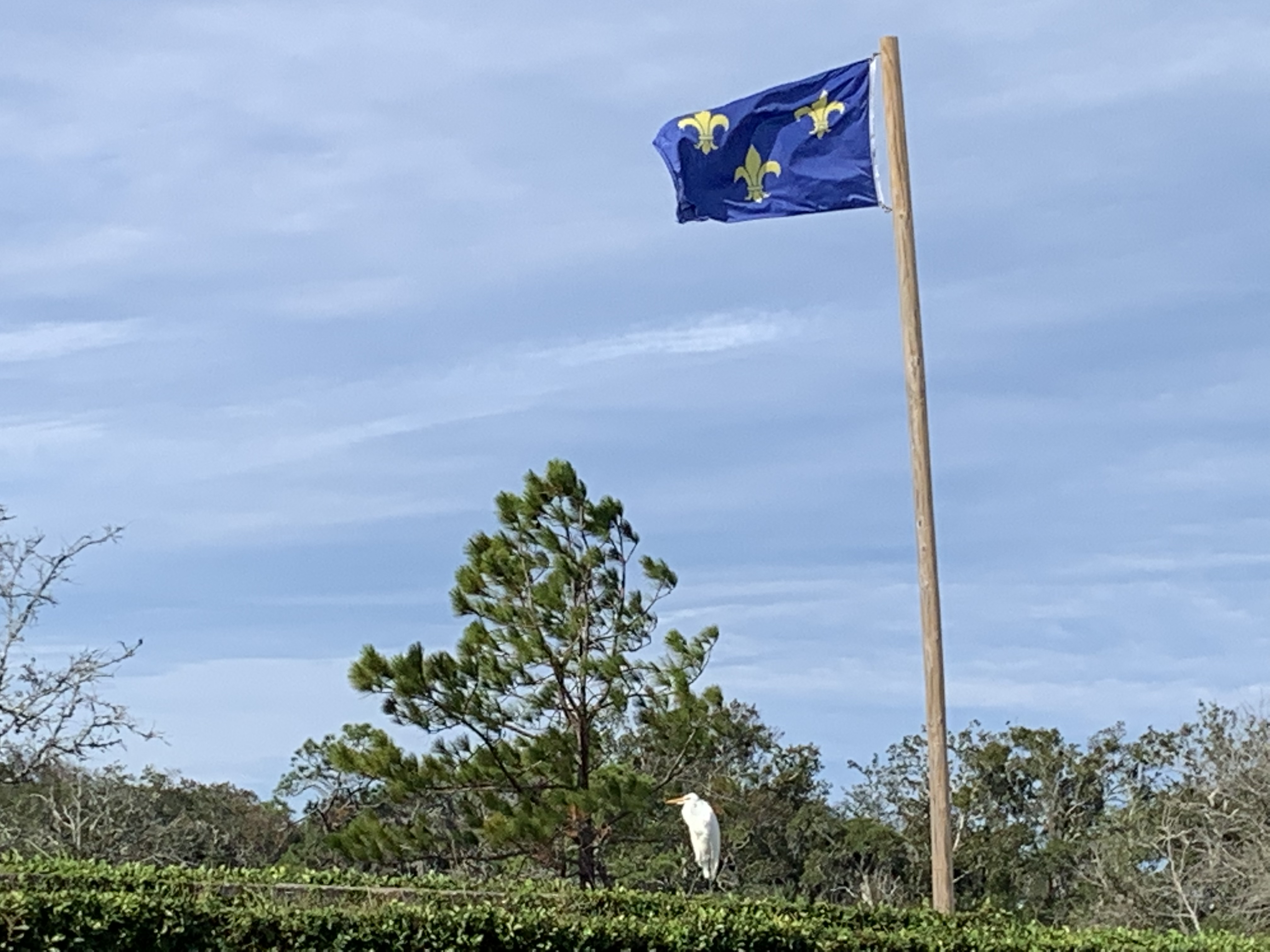
Fort Caroline National Memorial

The French settled on the Atlantic coast of Florida in 1564, a year before the Spanish established the Castillo de San Marco in St Augustine. The French built a fort, but their settlement had fewer soldiers and more crafts people, as they intended to trade with the natives, rather than conquer them. Their relations with the Timucuan people were peaceful and friendly.

But the French intended to stamp out the Spanish newcomers, and the fort sent its troops by sea to take St Augustine. That didn’t end well: see Matanzas. Even worse for the French, the Spanish had the same idea and attacked Fort Catherine while its troops were away. The Spanish sacked the fort, killing 140 civilians and taking over the settlement. Only a few French survivors were spared to serve the Spanish.

The natives didn’t intervene when the Spanish attacked, but when another French force arrived for revenge three years later, the natives sided with the French. In the fighting, Fort Catherine burned down. The current fort is a replica created from old plans, drawings and descriptions, but roughly 1/3 the original’s size. The French lost their foothold in Florida to the Spanish.

In settling colonial claims at the Treaty of Paris in 1763, the Spanish traded Florida to the British for the return of Cuba and the Philippines. With American independence, Florida reverted to Spain, before eventually becoming a US territory in 1821, a state in 1845, then seceding in 1861, and then re-joining the Union in 1868. Florida was part of Spain longer than it has been part of the USA.

My eyes used to glaze over in history class, especially with all the dates, places and people long ago. But now, when I think about how the French differed from the Spanish and British, I realize how those battles centuries ago determined who lived & died, who survived and who thrived. I wonder what could our history have been, if only our ancestors had cooperated peacefully, instead of fighting.

For example, the Timucuan natives were wiped out within 150 years or so, some because the Spanish took revenge on them, some by disease, some who joined neighboring tribes and some who were converted and perhaps assimilated. My DNA is 5% Neanderthal, and I’m glad some of the natives survived somehow and assimilated, rather than disappearing without any trace.

Fort Matanzas National Monument

The shaded grove interests me, more so than the fort. In the southeastern US, a grove like this is called a hammock, a Native American word that entered European languages with two meanings shortly after Columbus visited around 1500. Hammocks, the sleeping nets hung between trees, date back to the Maya civilization in Central America, and the Taino in the Caribbean would have been the first to introduce those as ‘hammocks’ to Columbus. Perhaps the grove meaning stems from ‘net’ as a way to describe the interlaced canopy of branches. Or, perhaps an explorer pointed at a grove asking what it was, and a native answered “that’s my hammock”. The wonderful brief boardwalk hike covers a great variety of species. I saw a great horned owl, ghost crabs, eastern red cedar, sand live oak, holly & myrtle and the burrow of a gopher tortoise.

458 years ago and long before any fort, the inlet here—with its strategic opening to the Atlantic—was named Bahía de Matanzas, or ‘Slaughter Bay’. The French had settled on the Florida coast just before the Spanish, and in 1565 Fort Catherine sent 250 French soldiers down here to seize St Augustine, 15 miles up the inland waterway. But a storm intervened as their ships were crossing the bar, and they were shipwrecked. When they were discovered, the Spanish slaughtered them.

283 years ago, the British, under Governor Oglethorpe of Georgia, also tried to seize St Augustine, laying siege to to Castillo de San Marco for 39 days in 1740. The Spanish improved their defenses in 1742, including building Fort Matanzas to guard the southern approach. That same year, the British returned and the fort fulfilled its mission by firing warning shots across the inland waterway, helping prevent another sneak attack on St Augustine.

The fort itself is small and unremarkable, but it has a commanding view of the narrow channel. Unless you have your own kayak, you have to take a gasoline-powered ferry to get there (no ferry Monday or Tuesday). Of all the places to convert a boat to electric, this seems perfect. The ferry has a large flat roof that could charge up by solar and it only runs a short distance on a limited schedule. But for all the talk about “saving nature forever”, not enough practical steps are being taken to protect wonderful natural habitats like this from the climate crisis.

Castillo de San Marco National Monument

As you approach St Augustine, you may see the signs proclaiming it to be the nation’s oldest city. That’s not true, of course, there are several older, continuously occupied Native American settlements, including Acoma’s Sky City, Taos, Zuni and Oraibi. St Augustine is the oldest continuously occupied city in the US which was founded by Europeans. This euro-centric bias is even more inappropriate when you realize that the fort was used repeatedly by the US military to imprison many Seminole, 74 survivors of the Sand Creek Massacre, and many Apache.

This is my favorite fortress park. Still, too many Americans still haven’t heard of St Augustine, don’t know that the first thanksgiving mass with natives occurred here, that the fort was unsuccessfully besieged by the English (twice) and by the French, and didn’t know that the Spanish were here two hundred years before the US declared independence from England. So, a visit here is bound to be educational. The programs here sometimes include costumed re-enactors, gun firing demonstrations and tours of the various rooms, walkways and defensive lookouts, so it’s fun for kids of all ages. The fort’s strategic location means that it has a beautiful view of the boats traveling through, and years ago my kids enjoyed seeing a nearby museum with pirate treasure.

De Soto National Memorial

While the park unit is small, it is excellent, with knowledgeable rangers, many of these photographic outdoor displays, and an easy nature trail with beautiful birds along the Manatee River. There are frequent interactive events here, and the film in the visitor center is particularly well done, covering the important history of De Soto’s exploration and conflict with Native Americans.

The Spanish expedition from 1539 to 1543 was a brutal failure that cost De Soto his life and fortune, and it was his fault. After helping plunder the Incan Empire (Peru) in 1533, De Soto used his stolen gold to bring more Spanish soldiers to Florida to look for more gold. Some of the natives had recent run-ins with similar Spaniards, so they kept telling him, ‘sure, there’s more gold, but it’s a little further north’. Guides who failed to deliver the promised gold were killed. (Coronado was on a similar mission at the same time further west). De Soto took hundreds of natives captive as slaves, gave the women to his men, slaughtered thousands and told the natives that he was a deity, oh, and he brought a Catholic priest (see far right). For years, they marched through the southeast, killing, burning, pillaging, enslaving, raping and spreading disease. Many of the natives fought back, mimicking some of their brutal tactics, including the Chickasaw, who later owned slaves and fought for the Confederacy. After De Soto died of fever, his men gave up on his fruitless hunt for gold and maybe half made it back.

As horrific as that all was, several of the survivors wrote accounts of their first contact with the natives, and some of those accounts provide rare descriptions of the native cultures that existed (until the Spanish arrived). De Soto actually found an interpreter from Seville who had been adopted by a local tribe after his expedition starved to death, but he later died on this new expedition. One survivor’s record clearly states that a nearby shell mound was the foundation for the local chief’s dwelling, proving that the mounds in Florida were not simply middens but were built intentionally as elevated platforms for important people and functions, contradicting the park film at Canaveral. A large mound on this site was removed for building roads, before the park service began protecting them. After all the death and destruction inflicted on the natives, it feels especially cruel to erase the last remaining remnants of their culture without acknowledgement.

Washita Battlefield National Historic Site

No veteran wants to realize that their command lied to get them to commit war crimes. In the film The Last Samurai, Tom Cruise plays a Civil War veteran haunted by his part in the Washita Battle. In my view, honoring veterans begins by honoring the truth, the rules of military engagement and heroism. And it’s important to get it right, not just for the veterans, but so we get it right in future conflicts.

The US Cavalry here were told inaccurate stories about the Cheyenne, that they were all savage warriors, that they had killed more settlers than they had, and that they must all be punished for their crimes. They were ordered to attack a peaceful village of non-combatant elderly men, women & children while they slept and to destroy their possessions so the survivors would starve during winter. Despite inferior weapons, the Native Americans defended themselves bravely.

The village Chief, Black Kettle, survived the Sand Creek Massacre, and still counseled peace with the US, until the US Cavalry killed him here. Yes, some of the Cheyenne were angry over that earlier massacre, and they raided settlements. But most of the raids were thefts of food and cattle and destroying property, after the US government reneged on its treaty promises to provide food, land and compensation. Yes, some white settlers were killed by renegades, including women and children, but for every settler killed, hundreds of natives were killed, for ever cow stolen, tens of thousands of bison were killed. Three months before the massacre here, Chief Little Rock agreed to turn over those responsible for raids, but he was also killed protecting women and children as they escaped down the Washita River.

Generals Sheridan and Sherman exaggerated the number of white settlers killed to justify declaring war on the entire tribe. No culture is entirely comprised of warriors, but Sheridan and Sherman promoted that lie to encourage the troops to commit war crimes against peaceful non-combatants, including women and children. Custer was unconcerned about whether the village was peaceful or harboring fugitives. He was just interested in surrounding the village and killing all the men, some of the women and children and taking hostages. He showed the same disinterest in sizing up his target at Little Bighorn.

The US government repeatedly lied to the Native Americans, broke treaties, ignored Supreme Court orders, forcibly deported tribes, ordered troops to war against allied and peaceful tribes, stole lands, burned homes and possessions, drove the bison to the edge of extinction (50 million to 500), destroyed crops, introduced diseases, forced children into re-education centers, and tried to destroy native culture, language and religion, all to promote a near-genocidal racist policy of populating most of the country primarily with white settlers.

Those US military and government acts and policies were wrong, and we should honor our veterans and flag by admitting the truth, so that we can act correctly in the future. We do not teach our children that if they want something, they should take it by force and then lie about it. We do not believe that declaring war justifies intentionally killing civilian non-combatants, including women and children. And we should not lie to our children to excuse the mistakes of our ancestors.

Unfortunately, rather than confront the one-sided and disproportionately violent history against Native Americans, the old excuses for US war crimes still continue today, funded by your tax dollars. The pamphlet for this site blames Native American raids for the Sand Creek Massacre, the film describes the Cheyenne as a hostile warrior culture (because they eat bison?!?), and the site presents the “battle” as a necessary victory to achieve peace and open the west. No. Without justice, there is no peace. And the west was already open: California had been a state since 1850.

That our ancestors engaged in avoidable, brutal massacres out of racism and greed is upsetting, albeit truthful. Our veterans deserve to live in a truthful country. The Native Americans who contributed to this site are doing a public service in telling us the truth, and we owe it to them to listen. That some people today, 150 years later, still whitewash history with dishonest racist pseudo-justifications is unacceptable. That the park service here misinforms visitors and believes 1/2 of its mission is to excuse tragic avoidable war crimes is profoundly wrong.

Port Chicago Naval Magazine National Memorial

At 10:15 pm on 17 July 1944, 320 people were vaporized in a munitions explosion while loading two ships simultaneously. The blast registered 3.4 on the Richter scale, disintegrated the docks above, blew one ship into small pieces, threw other ships hundreds of yards away, and injured people on the other side of Suisun Bay above. Most of the victims were young African Americans, and the Navy blamed the poorly trained black workers rather than the white officers in charge. When 50 survivors refused to return to work, they were sentenced to 8 to 15 years in prison and others were threatened with firing squad for mutiny. Despite the efforts of Thurgood Marshall to defend them and focus the blame on the Navy’s negligence, the ‘mutineers’ spent the rest of the war in prison, and the story was lost to history until a Cal professor named Robert Allen found a pamphlet, interviewed a dozen survivors and wrote a book in 1989.

The story is powerful, and the ranger and volunteer did an excellent job of painting a detailed picture of racism, dereliction of duty (among the officers who bet on load rates), the lies that the enlisted workers were told (that the bombs were inert), and the trial. Photographs, oral accounts and actually visiting the spot where it happened, including touring the revetments where munitions were transferred from boxcars and out to the docks, bring the impact home. The volunteer, Diana, noted that the Navy suffered an even more deadly munitions loading accident less than 4 months later, when the USS Mt Hood exploded in New Guinea on 10 November 1944, obviously not learning the lessons of Port Chicago. The ranger, Eric, made a persuasive case that the negligence and racism uncovered and protested, while officially unpunished, likely prompted the Navy to be the first branch of the military to desegregate completely in February 1946, two years before the other branches.

This park unit is dedicated to preventing this unjust tragedy from being forgotten. Tours must be reserved at least two weeks in advance for Thursday through Saturday when the Army, who took over the base, allows visitors. Although the tour met at the Muir home, I was able to drive my EV to the site above. Fortunately, the park service is working on improving access by building a visitor center nearby.

Rosie the Riveter / World War II Home Front National Historical Park

FDR said, “we can’t afford to indulge in prejudice now”, and with that, the “Rosie” in the lower part of the collage above suddenly was able to qualify for a job that previously hired neither blacks nor women nor LGBTQ+ nor any other minority. Note that she is riveting aircraft grade aluminum while wearing lipstick, nail polish, a large wedding ring and a classic “Rosie” red bandana. Many women were surprised how easy riveting was and didn’t understand why men said they couldn’t do it. By 1944, women were about 1/3 of the workforce, and 10,000 African Americans worked here in Richmond during the war along with all other minorities (except Japanese Americans). Leadership is required to change society’s prejudices and discriminatory practices, and once the door was opened, many women decided to continue working after the war.

The visitor center is next to the Ford Assembly Plant, which is still full of industrial activity. Check in at the gate on Harbor, then drive around back and all the way down to the right. There are ChargePoint stations in the lot, and a good restaurant next to the visitor center. The factory used to make tanks, and across Marina Bay was Shipyard #2 which produced a new ship every 4 days, loaded with tanks and sent off immediately. Walk a bit of the SF Bay Trail along the waterfront to a fine memorial to the Rosies in Marina Bay Park, next to the yachts and fancy condos. Shipyards #1 and #4 were up the channel on the other side, along with the Prefab Yard. And Shipyard #3 still has the SS Red Oak Victory Ship, launched in November 1944, with worthwhile tours. This was the beating heart of America’s “Arsenal of Democracy”, and it was a unified effort of all hands on deck which changed the course of labor and civil rights overnight.

Fort Point National Historic Site

The Civil War era fort was obsolete as soon as it was built, since rifled cannon penetrated brick walls, and the one threat it faced, the CSS Shenandoah via the Indian and Pacific, called off their mission when they learned the war had ended months earlier. (They spent their round the world voyage attacking whaling ships out of New Bedford, since they often had escaped slaves on their crews.) Before that, there was a Spanish fort here, which was taken over by the Mexicans and then by a band of Americans including Capt. Fremont and Kit Carson, shortly before California became a state.

These days, it’s best used as a place to get a nice photo of the Golden Gate Bridge (when it’s less foggy). The fort is open on weekends, and you can get a good photo from the roof. I walked down from Battery East, but walking or biking from Crissy Field is nicer. There is parking at the fort, although it requires persistence navigating, since more roads are open to bikes than cars around here.

Fort Necessity National Battlefield

“In 1753 a young George Washington crossed the Allegheny Mountains on missions he hoped would lead to a career as a British Officer and land holdings that would make him wealthy. He was unsuccessful in both goals and his actions sparked a war that spread across the globe.”

— National Park Service

We really need a better name than the “French & Indian War”. It sounds like some colonial conflict in South Asia. Indians Native Americans were only reluctantly drawn into fighting on both sides. I suggest the “Colonial Rivers War”, because that explains who, why and where. British and French colonial forces fought over control of rivers, portages and passes linking the St. Lawrence Seaway, the Gulf of Mexico and the Mid-Atlantic Eastern Seaboard.

At the beginning, the French & British were building roads, riverside forts and sending small armed groups into the passes to scout. Washington was in charge of a British force, found a French force, and someone fired a shot precipitating a slaughter that killed the French leader named Jumonville. Jumonville’s brother, Captain Villiers, then led a much larger force seeking revenge.

So Washington’s necessity was to defend his camp, which had been chosen in a pleasant, open meadow, good for grazing animals. As you can see in the photo, the fort was built under a hill, so Washington lost quickly and badly. (Fortunately, he improved tactics later). The French accepted his surrender, but the war over the colonial rivers continued for years, as part of a broader Seven Years’ War between the French and British globally.