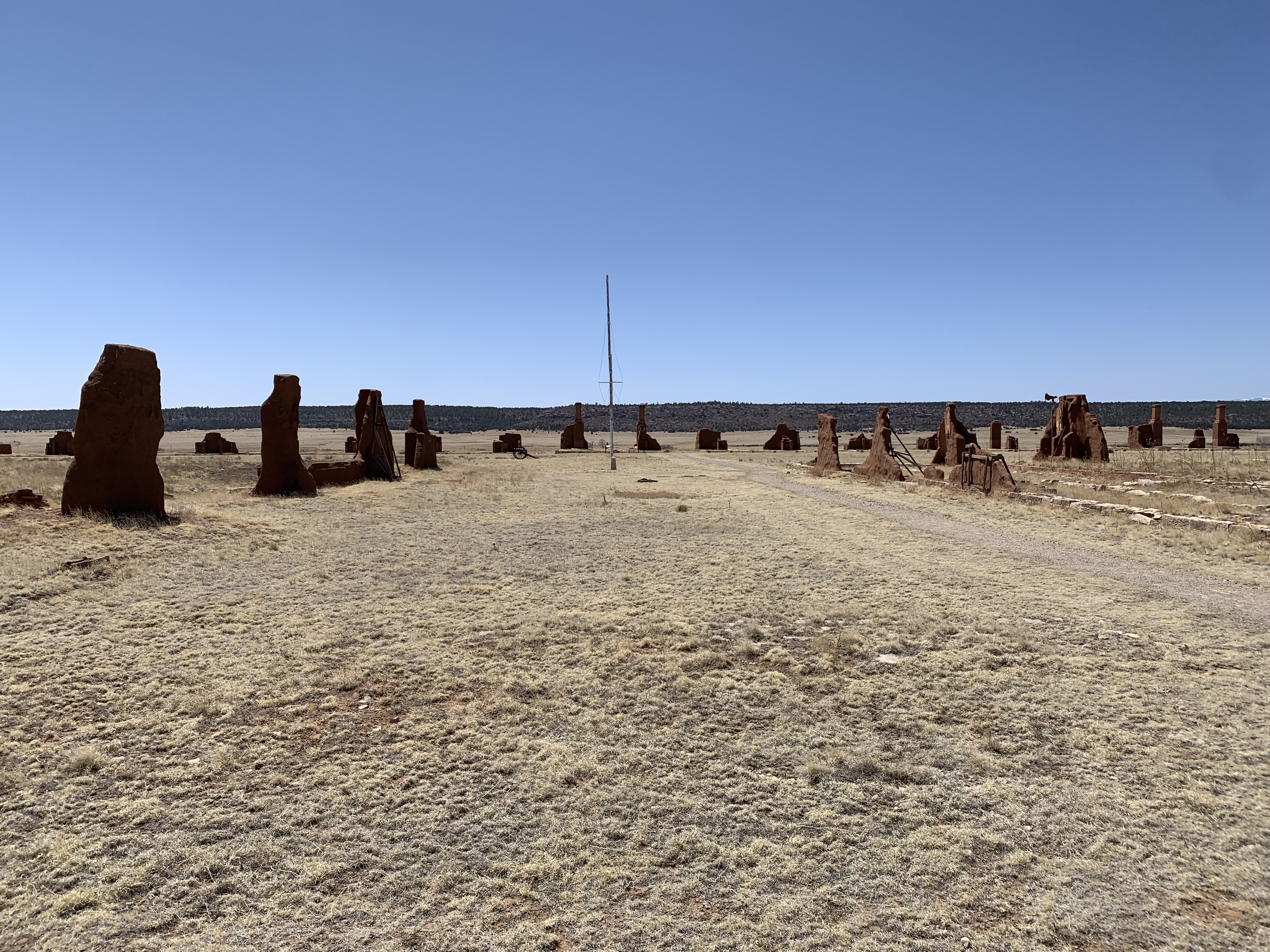
This large US military base was built to end “the Indian problem” permanently. How? I direct your attention to the ammunition and gunpowder in the room above. The problem that the Native Americans had was that their land was being systematically stolen, often in violation of US treaties. The “problem” the US government had was how to stop the Native Americans from defending their illegally-seized territory.
After the Civil War, the US military moved against the Native Americans. Near this fort in 1867, General Hancock’s troops massed near a large Cheyenne village, which evacuated quickly, and then, on the General’s suspicions and order, burned it to the ground, prompting a widespread escalation of conflict across Kansas that summer. Perhaps realizing his mistake, the General hired an interpreter, signed a treaty and paid several tribes to move away. The terms were unfair, but the fighting moved away from Kansas as the military fortified this base and increased troops here over the next year.
Make no mistake. The Native Americans were forced from their lands at gunpoint, while the US government repeatedly broke its own treaties.
On a completely coincidental point, today’s conservative political folks are extremely afraid of undocumented foreigners coming in with guns and taking over America. Think about that.
Not much remains of the largest Union fort in the west. But there’s plenty of history here. This was a critical supply base to keep the Confederacy from expanding into the southwest. Some of the Navajo who were driven from their homes during the Long Walk were imprisoned here. Here was the largest and most advanced hospital in the west. Soldiers and cavalry guarded both branches of the Santa Fe trail from here, once trading and migration routes for Natives, then for settlers whose wagon ruts can still be seen in the earth, then for the mail, and finally for the railroad, which still bears the name in the logo BNSF.
On the drive out to the site, a pronghorn stood in the road and stared at me, perhaps not frightened by my relatively quiet and zero emission electric car. Although I didn’t get a photo, I got a careful look at it and confirmed its identity with the park volunteer. Turns out they’re not antelope but related to giraffe. Again, everything I learned about the west, where “the antelope play” was wrong. There aren’t any antelope in North America. The pronghorn are the last survivors of human hunting among similar species in North America, due to their speed. Humans are increasingly lethal to all other species, and by changing our climate so quickly, we will make most species on earth extinct within a few decades. I wonder what our ancestors who traveled this trail would say if they could see how quickly we are devastating the planet.
Yes, I know this is another Kiva photo. But I learned something important on the ranger tour down here. One of the visitors was an engineer, and he explained that one reason that the Native Americans built round buildings below ground level and square buildings above ground, even within the same pueblo, is that circular walls are the most efficient way to hold back the pressure of the dirt. When building up above ground, it’s easier to balance walls using right angles. That’s one reason why I saw round ball courts at Wupatki, round pit dwellings at more primitive sites and round kivas at important ceremonial sites, even as the majority of buildings at the same sites are rectangular.
Pecos is fascinating for multiple reasons, which explains why it was promoted to a historic park. One being that the archaeologists who excavated the pueblo roughly 100 years ago sent many human remains to Harvard University and Andover Academy for study, and they were repatriated in 1999, mainly reburied near relatives at a nearby pueblo community. Another is that here is where the Pueblo Revolt against the Spanish was planned and executed in 1680. Furious over their treatment by the domineering missionaries, the Native Americans orchestrated simultaneous uprisings across the southwest in the largest and only truly successful Native uprising against a colonial power in North America. And if that wasn’t enough, Pecos is also the site of the Civil War battle of Glorieta Pass, which prevented the Confederacy from taking over the southwest. As the Russians are belatedly learning in Ukraine, it all came down to supply line logistics. Kudos to the park ranger for explaining everything.
This is the third park unit right near Los Alamos, the others being the last two visits at Bandelier and Valles Caldera. There are Los Alamos National Labs units all around the area, and I was even stopped at a security checkpoint when Tesla’s navigation misdirected me (not the first time). I stayed in the neighboring town of Española, and there’s a Native American community right next door too. I got a bit of culture shock again seeing how different lives are between communities that are so close to each other physically.
Los Alamos is very strange. First, according to a local, most of the science workers are introverts and the other workers spend the weekends in Santa Fe nearby. So the town has all these big shopping plazas with a variety of (often Asian) restaurants, but they’re all virtually empty on weekends. The place is beautifully landscaped with flowering trees, manicured lawns, pristine sidewalks and a lovely park next to the visitor centers. If it weren’t so American, I would suspect it of being a Potemkin village. There are actually two small visitor centers practically right next door to each other, one for the park service and one for the town, so I visited both. They both recommended the exact same attractions in the same helpful and enthusiastic, smiling way with almost identical maps.
Also strangely, although it was atomic scientists who invented the atomic clock as a way to standardize time across all different clocks, the Bradbury Science Museum mobile website ironically doesn’t display its hours of operation (they said they would fix that). They have an incredible amount of information, but they won’t tell visitors when they’re open. Now that my trip is over, I can see the hours on my desktop computer: Tues-Sat 10am to 5pm and Sun 1 to 5pm. And while the museum had an exhibit on wildfires and an exhibit on climate change, they almost seemed to be avoiding making a connection between the two. The climate exhibit was all about Arctic research, implying that climate change was going on there, but the wildfire exhibit was about fire safety, implying that fires were simply natural and avoidable events. As I write this, the Cerro Pelado fire is six miles from the Lab and is over 20,000 acres, so they might want to reprioritize how they assess the threat of climate change.
And finally, I’m going to break my own rule and add a second picture. Dr Oppenheimer and several of the other top scientists lived in converted scouts’ cabins after the government confiscated an elite boys camp to build nuclear weapons. In his neighbor’s cabin, next to the kitchen, is a realistic display of a miniature version created in the 1980’s: the scariest thing I’ve seen besides the climate crisis, a nuclear bomb designed to be carried in a backpack.
Three of the graves in the fort’s cemetery are of captured Native American children. The center one belongs to a three-year-old Apache girl, buried under a Christian name given to her by her captors. The one on the right is of an Apache child unnamed with no age, buried like the others in the manner of his or her captors. And the left grave belongs to the two-year-old son of Chief Geronimo, Little Robe, who likely died of a disease spread by his captors, and whose father’s name will be remembered as synonymous with bravery, long after everyone else here is long-forgotten.



 Zero Carbon Travel