Fort Matanzas National Monument

The shaded grove interests me, more so than the fort. In the southeastern US, a grove like this is called a hammock, a Native American word that entered European languages with two meanings shortly after Columbus visited around 1500. Hammocks, the sleeping nets hung between trees, date back to the Maya civilization in Central America, and the Taino in the Caribbean would have been the first to introduce those as ‘hammocks’ to Columbus. Perhaps the grove meaning stems from ‘net’ as a way to describe the interlaced canopy of branches. Or, perhaps an explorer pointed at a grove asking what it was, and a native answered “that’s my hammock”. The wonderful brief boardwalk hike covers a great variety of species. I saw a great horned owl, ghost crabs, eastern red cedar, sand live oak, holly & myrtle and the burrow of a gopher tortoise.

458 years ago and long before any fort, the inlet here—with its strategic opening to the Atlantic—was named Bahía de Matanzas, or ‘Slaughter Bay’. The French had settled on the Florida coast just before the Spanish, and in 1565 Fort Catherine sent 250 French soldiers down here to seize St Augustine, 15 miles up the inland waterway. But a storm intervened as their ships were crossing the bar, and they were shipwrecked. When they were discovered, the Spanish slaughtered them.

283 years ago, the British, under Governor Oglethorpe of Georgia, also tried to seize St Augustine, laying siege to to Castillo de San Marco for 39 days in 1740. The Spanish improved their defenses in 1742, including building Fort Matanzas to guard the southern approach. That same year, the British returned and the fort fulfilled its mission by firing warning shots across the inland waterway, helping prevent another sneak attack on St Augustine.

The fort itself is small and unremarkable, but it has a commanding view of the narrow channel. Unless you have your own kayak, you have to take a gasoline-powered ferry to get there (no ferry Monday or Tuesday). Of all the places to convert a boat to electric, this seems perfect. The ferry has a large flat roof that could charge up by solar and it only runs a short distance on a limited schedule. But for all the talk about “saving nature forever”, not enough practical steps are being taken to protect wonderful natural habitats like this from the climate crisis.

Castillo de San Marco National Monument

As you approach St Augustine, you may see the signs proclaiming it to be the nation’s oldest city. That’s not true, of course, there are several older, continuously occupied Native American settlements, including Acoma’s Sky City, Taos, Zuni and Oraibi. St Augustine is the oldest continuously occupied city in the US which was founded by Europeans. This euro-centric bias is even more inappropriate when you realize that the fort was used repeatedly by the US military to imprison many Seminole, 74 survivors of the Sand Creek Massacre, and many Apache.

This is my favorite fortress park. Still, too many Americans still haven’t heard of St Augustine, don’t know that the first thanksgiving mass with natives occurred here, that the fort was unsuccessfully besieged by the English (twice) and by the French, and didn’t know that the Spanish were here two hundred years before the US declared independence from England. So, a visit here is bound to be educational. The programs here sometimes include costumed re-enactors, gun firing demonstrations and tours of the various rooms, walkways and defensive lookouts, so it’s fun for kids of all ages. The fort’s strategic location means that it has a beautiful view of the boats traveling through, and years ago my kids enjoyed seeing a nearby museum with pirate treasure.

Fort Necessity National Battlefield

“In 1753 a young George Washington crossed the Allegheny Mountains on missions he hoped would lead to a career as a British Officer and land holdings that would make him wealthy. He was unsuccessful in both goals and his actions sparked a war that spread across the globe.”

— National Park Service

We really need a better name than the “French & Indian War”. It sounds like some colonial conflict in South Asia. Indians Native Americans were only reluctantly drawn into fighting on both sides. I suggest the “Colonial Rivers War”, because that explains who, why and where. British and French colonial forces fought over control of rivers, portages and passes linking the St. Lawrence Seaway, the Gulf of Mexico and the Mid-Atlantic Eastern Seaboard.

At the beginning, the French & British were building roads, riverside forts and sending small armed groups into the passes to scout. Washington was in charge of a British force, found a French force, and someone fired a shot precipitating a slaughter that killed the French leader named Jumonville. Jumonville’s brother, Captain Villiers, then led a much larger force seeking revenge.

So Washington’s necessity was to defend his camp, which had been chosen in a pleasant, open meadow, good for grazing animals. As you can see in the photo, the fort was built under a hill, so Washington lost quickly and badly. (Fortunately, he improved tactics later). The French accepted his surrender, but the war over the colonial rivers continued for years, as part of a broader Seven Years’ War between the French and British globally.

Morristown National Historical Park

Couple reasons for choosing this old Colonial $30 note. First, the visitor center/ museum at Morristown has an exceptional collection of Revolutionary War artifacts: Washington’s cane, his inaugural sword, a Ferguson rifle (designed by the British commander killed at Kings Mountain), clothing, household items and numerous books and pamphlets, plus the original note above. I enjoyed the Cross garden, driving through Jockey’s Hollow (where the soldiers camped), the wooded hilltop at Fort Nonsense, and the tour of Washington’s HQ, but the detailed items on display are unique.

The war lasted 8 years, so Washington had as many winter camps and HQs, including at Longfellow’s House in Cambridge and at Valley Forge. But Washington spent three winters here in Morristown, early, mid (worst winter ever) and late war. New Jersey was central to his efforts in the north, with good roads, hills and provisions. Especially after the British Navy helped them take New York, New Jersey was critical to holding the colonies together. New Jersey is a beautiful and historic state, that is often in the shadow of New York. But, especially after Washington’s victories at Trenton and Princeton, New Jersey was the lynchpin of the colonies, and Morristown was at the crossroads of the revolution.

Which brings me to the second reason the note is important. The war dragged on far longer than most realize, and simply feeding and clothing 10,000 troops was a monumental task at the time. Our government was broke, divided, broke and out of money. Congress printed so many dollars, that they lost 70% of their value, and then they simply issued IOUs. Having to wait years for repayment, assuming we won, burdened people and drove some bankrupt. Hamilton cut his teeth for his future as Washington’s Treasury Secretary trying to administer the financial end of the war. Now the ‘full faith and credit’ of the United States is recognized internationally, but when the outcome of the Revolutionary War was in doubt, it took a great leap of faith to accept that dollar above, especially when the enemy was paying in actual gold and silver coins.

One of the key reasons we won the war was because the Marquis de Lafayette used his own money to join Washington’s army. The French noble was on a quest to avenge the death his father at the hands of the British, but the King hadn’t yet authorized direct military assistance. So Lafayette bought his own ship, and joined Washington’s army for free, even paying his staff, aides & junior officers out of his own pocket. Lafayette’s direct connections to the French monarchy helped convince France to join the war, and his negotiations with the balky French forces in Newport led to Washington’s strategic partnership with Rochambeau that helped end the war at Yorktown.

Washington had a knack for recognizing and inspiring talent, including von Steuben, Lafayette, and Hamilton. Those he mentored gave their all for him, and some grew resentful if they didn’t get the recognition they wanted. Benedict Arnold blamed Washington for not helping him enough after Arnold’s court-martial on a profiteering charge, leading Arnold to his infamous act of treason. Hamilton helped defeat a cabal of Washington’s rivals, but quit Washington’s service in a momentary quarrel over respect. Lafayette not only was devoted to Washington, but he helped bring our revolutionary ideals back to France, where he razed the Bastille and brought Washington one of the keys.

Washington’s leadership united our fractious states, overcoming deep distrust between many colonists. Which is why it came as such a shock to me when some of the tourists today interrupted the tour to propose alternate US flags, arguing (falsely) that the 16th Amendment (income taxes) wasn’t ratified and that Washington had created a religious flag (he didn’t) for the ships he sailed (he didn’t). The ranger was making a point about real slaves in actual slavery, when the nutter said that ‘we were all slaves but we didn’t know it’. Given how hard Washington worked to unify the original colonies and hold our country together, so that it could become the United States of America, I found it sad that selfish, misinformed and misguided citizens would be so clueless as to raise this nonsense where he once slept.

Fort McHenry National Monument and Historic Shrine

Major Armistead insisted on a much larger flag to boost morale. The one he bought was nine times bigger than the small storm flag above the fort today. So when it was hoisted up at 9 am on September 14th, 1814, everyone could see that Fort McHenry was still in American hands, despite almost 2,000 bombs & rockets fired over the previous 24+ hours, from the grateful city of Baltimore to the frustrated British fleet in the Chesapeake Bay, where a young, detained American civilian negotiator named Francis Scott Key watched hopefully, before writing down the first verses of our National Anthem.

These days, big flags mean car dealerships, but after the British burned DC, whether this particular flag was ours decided the fate of Baltimore and of our nation. The film and ranger tour explain the story in detail. One of the air-bursting, shrapnel bombs, turned dud after flying through the rain, still sits next to the powder magazine in the fort. The fort’s flag had only 15 stars, even though there were more states at the time, because few people were particular about such symbolism at the time. But the multi-year ‘War of 1812’ helped spark America’s national identity, the Battle of Baltimore proved us strong and Key’s anthem stirred a deep, enduring patriotism. This is my favorite patriotic park.

Valley Forge National Historical Park

“In Europe, when the officer commands ‘do this’, the soldier does it.

Here, with Americans, I am obliged to explain,

‘this is why you need to do it that way’, and then they do it.”

Baron von Steuben, Inspector General of Washington’s Continental Army

Valley Forge was chosen for the high ground, not the valley, and the forge had been destroyed by the British before Washington’s troops arrived. No big battles were fought here, and the most lethal forces encountered were diseases. It was a temporary winter camp, and when Washington returned later, he was happy to see that the farmers had reclaimed the land for crops.

But for Americans, this is where Washington’s leadership created e pluribus unum, ‘out of many one’, by forging 13 different sets of colonial militiamen, African Americans free and slave, Native Americans, immigrants, volunteers, and women into a professional army that could combat the British armed forces. Washington was a practical man, who ordered his troops vaccinated against smallpox, had them build thousands of sturdy log cabins, worked hard to see them well clothed & fed, and who brought a congressional delegation here to see conditions for themselves.

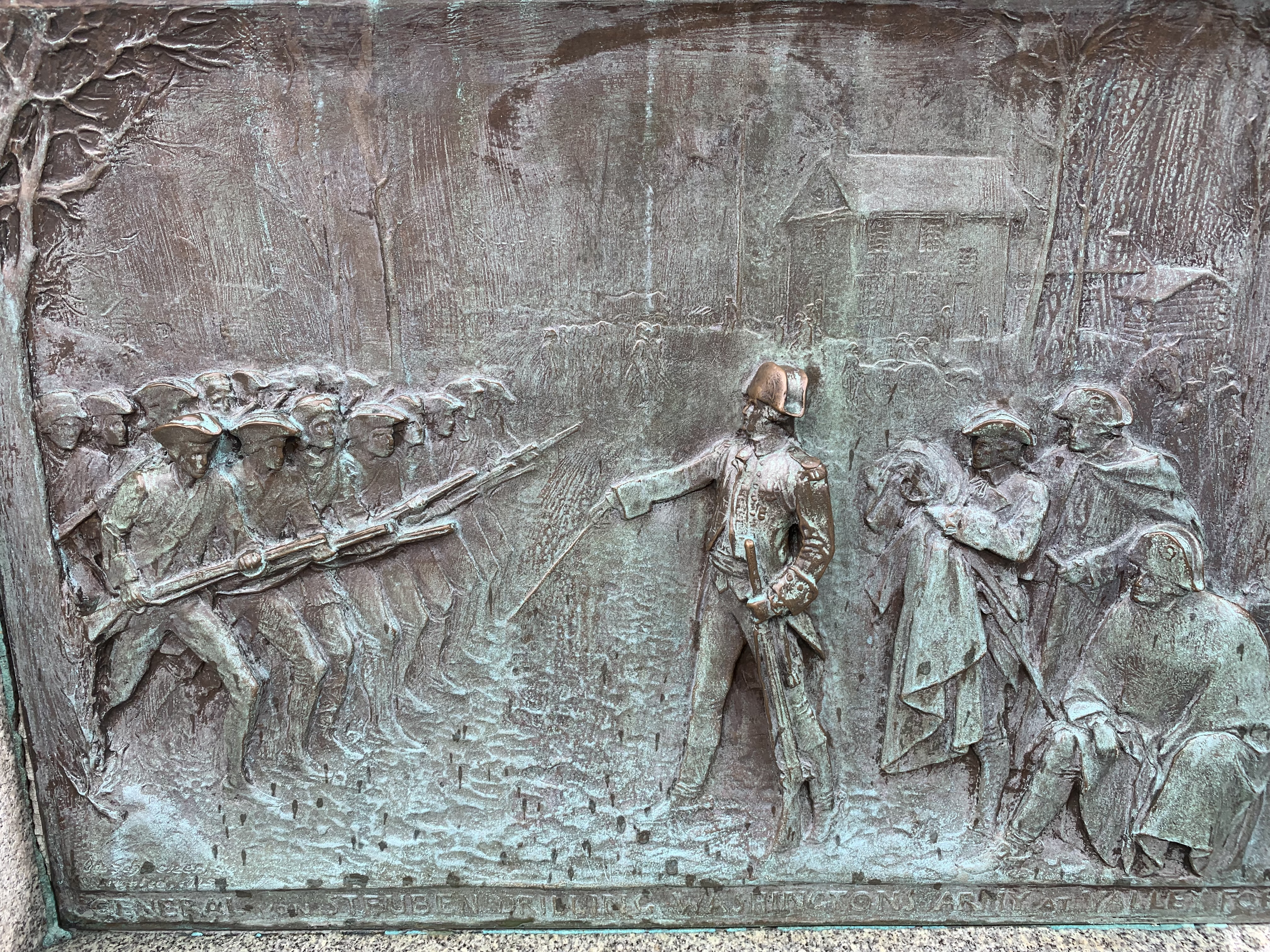
When Ambassador Franklin recommended the German Baron von Steuben (depicted in the bronze relief above), Washington trusted him to train his troops, unconcerned with rumors that he was homosexual or that he didn’t speak English. So, they got by in translated French, and the newly trained soldiers emerged as a credible fighting force to retake Philadelphia in the spring. Washington would not recognize the current generation of anti-vax, immigrant-hating, gay-bashing, misogynistic racists, no matter which flag they wave.

In later years, Americans realized the importance of this proving ground, and preserved it as a beautiful park, with forests, meadows and streams of trout. There’s even a covered bridge, not far from the stone farmhouse Washington rented for his quarters. The driving tour is quite pleasant, but I imaging bicycling to be best. E-bikes and regular bikes can be rented next to the parking lot.

Fort Stanwix National Monument

Yes, I’m back with a bang! Tesla is still working on my car (Chaco was tough on the springs), but rather than hold me hostage, they’re letting me travel around in a Model S until my car is ready. And the fort celebrates the 1777 victory for two weeks in mid-August with hourly cannon fire!

This fort has it all: drawbridge, sally-port, parapets, ramparts, and meticulously detailed barracks. And it’s open, labeled, extremely photogenic and great fun to climb around and explore. A small crowd gathers just a few yards from the cannon just below the colonial officer walking in the photo, and each step is demonstrated from candle to boom!

Long before we became an independent country, French fur traders gathered at this natural portage between the St Lawrence Seaway and the Hudson River and bought beaver pelts from Native Americans to make hats. I drove up the Hudson River Valley, along the Mohawk River and saw signs for Oneida Lake which drains into Lake Ontario. A short portage here connects the two watersheds, making this a strategic point in the middle of New York State, later connected by the Erie Canal. Control of this portage had international repercussions, as colonial powers divided up the globe.

The British built the original fort after capturing the area during the French & Indian War, and George Washington rebuilt it to defend the territory from the British. The key battle happened when a British Colonel led troops from the Great Lakes to meet with General Burgoyne’s force from Montreal in order to separate New England from the rest of the colonies. Both sides were joined by Native American warriors, and there was a particularly bloody ambush in the woods near the fort. The Patriots defended the fort for about 3 weeks before Benedict Arnold’s reinforcements (when he was still on our side) disrupted the plan, leading to Burgoyne’s surrender at Saratoga. Regardless of which side they fought on, the Native Americans were eventually forced to cede lands in New York, Ohio and Pennsylvania, in return for some annual compensation and limited sovereignty over their remaining land near here.

Saratoga National Historical Park

This boot monument may be the park’s most famous, but let me quickly set the scene. In 1777, General Burgoyne led his British Army from Canada down the Hudson River Valley to New York City (captured by the British fleet the year before), planning to separate New England from the rest of the colonies. After recapturing Fort Ticonderoga, the British marched confidently further south.

General Gates led the colonists who dug in at Saratoga to stop them. The British advance troops had marched into some fields to gather wheat, and the Americans surprised and flanked them. The British took heavy losses retreating to their own fortifications on two hills, and the Americans took the hill with the monument before night fell. The British continued retreating, became surrounded and soon surrendered.

The boot monument was for an American officer who was wounded in the leg taking that hill. It was the officer’s third leg wound in one year. He was a sometimes brilliant, extremely aggressive, apparently fearless, greedy, back-talking, insubordinate veteran, who was hated by other officers and loved by his men. He had led an unsuccessful assault on one hill, and then switched to this hill in the middle of the battle. The officer wasn’t supposed to be leading troops in the battle at all, since Gates had taken away his command. Actually, he had tried to resign, but Washington refused after learning that Fort Ticonderoga had fallen, insisting that the officer (who had helped capture Fort Ticonderoga originally) march north again. Angry at being mistreated by the army and in pain over his wounds (one leg became 2 inches shorter than the other), Benedict Arnold ended up betraying our country.

The museum also has a fascinating exhibit on the fallout of the British defeat at Saratoga. The French allied with the Americans first, followed by the Spanish & the Dutch, leading to attacks on British colonies in Central America, the Caribbean, South America, Africa, India, and Indonesia.

Minute Man National Historical Park

OK. First thing you need to know is to avoid Lexington; nothing to see or do there. Sure, the first shot of the day (4/19/1775) may have been fired there (unknown who or why), but the untrained militia scattered immediately. Next, unless you’re interested in walking through the woods along the Battle Road and imagining the battle scenes, you can probably skip the Minute Man visitor center too. They have a film, in case you don’t know who the Minute Men were, but the action is all at the North Bridge in Concord.

“By the rude bridge that arched the flood,
Their flag to April’s breeze unfurled,
Here once the embattled farmers stood,
And fired the shot heard round the world.”

Ralph Waldo Emerson

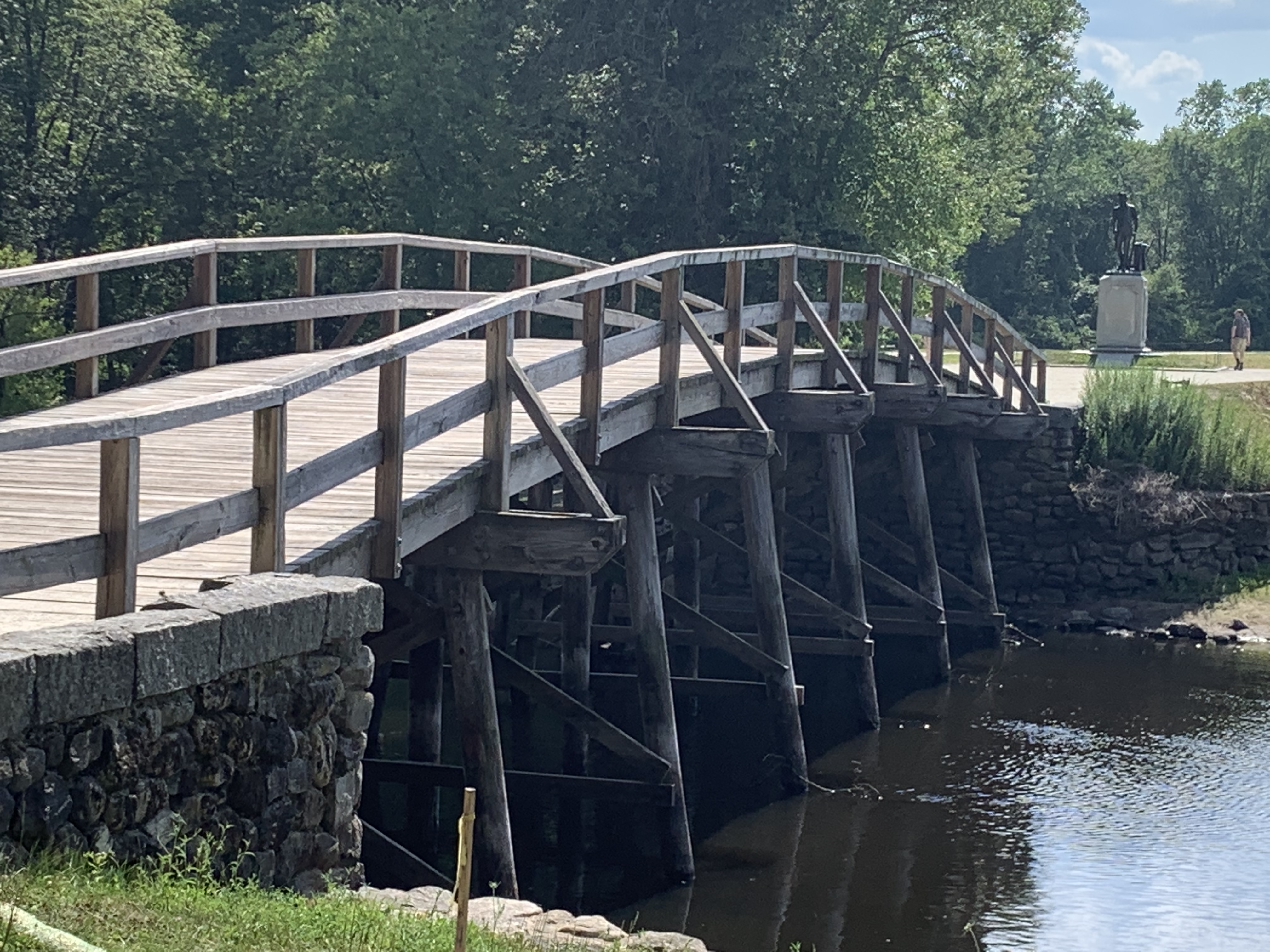
Emerson was standing at the Old North Bridge in Concord when he read that line to commemorate when the Minute Men (militia with extra training) were ordered to fire the first shots of what became the Revolutionary War. The British were thwarted from crossing the bridge and taking the arsenal on the hill behind the statue, and they were forced to retreat to Boston pursued by small groups of Minute Men engaging them in small skirmishes along the way. The quote is carved in the base of the famous Daniel Chester French statue across the bridge above.

Emerson’s grandfather witnessed the battle from The Old Manse, which is part of the site and later was home to Nathaniel Hawthorne. Emerson was also friends with the Alcott’s, and another part of the park is the Wayside where Louisa May Alcott lived. And, since you’re in Concord, you really should visit the Concord Museum, where you can see Paul Revere’s lantern, learn about Emerson’s other friend Henry David Thoreau, and see the excellent new exhibit that describes the battle in detail. All four literary luminaries are buried on Author’s Ridge in Concord.

Again, any propaganda you may have heard suggesting that Lexington was somehow historically important is nonsense. (And I should add that a group of cowardly Lexingtonians snuck into Concord to vandalize and destroy an early monument built around the 50th anniversary in a pique of petty jealousy). ‘The shot heard round the world’ was fired in Concord, likely by Minute Men from Acton, who were in the front and suffered the first casualties, because that order to fire on the British was understood to be an act of open rebellion that could lead to war. Soldiers on both sides blamed the other for firing first. There’s another visitor center over the bridge and past the statue that describes the day’s action. If you get a chance to hear the ranger talk “Monuments & Memories” about how the meaning of the battle has changed over time, I highly recommend it. Obviously, this is my favorite Revolutionary War site.

Springfield Armory National Historic Site

America has a gun problem. No other country on earth has anywhere near as many gun deaths per capita as we do. Australia banned guns after a mass shooting in 1996, and they have had one mass shooting in the past 26 years. Many Americans worship guns (see “organ of muskets” above), and mass shootings are a daily occurrence.

George Washington started the Armory for the Revolutionary War, and it continued making guns until 1968. The Armory did an excellent job preserving its history, and their extensive collection covers the evolution of guns in exceptional detail. Smith (of Smith & Wesson) and his father worked here, as did William Ruger. The Colt factory was another of the precision gun manufacturers in the Connecticut River Valley, and the town of Coltsville will likely open as a new national historical park someday soon.

On this visit, I also learned that most of the ammunition for at least the Civil War was produced by women and children, and that the work was extremely dangerous. 178 women and girls were killed when the Allegheny Arsenal in Pittsburgh exploded in 1862, due to sparks from iron horseshoes & iron wheels on a flinty cobblestone road covered with sawdust and gunpowder. Actually, the lawn in the center is contaminated with lead, so kids shouldn’t play on it (like I did when I first visited decades ago).