Fort Scott National Historic Site

Built in 1842 to defend the “permanent” frontier with Native American territory, the fort quickly fell behind events. Settlers were already moving west on the Santa Fe Trail. Within four years the actual frontier was being taken from Mexico, with cavalry “dragoons” riding a thousand miles west from here to fight in that war. The fort was abandoned in 1853 and the buildings auctioned. But the military withdrawal set the stage here for Bleeding Kansas, the conflict that presaged the Civil War. Turns out the military wasn’t needed here to keep peace between the settlers and the “warlike” Natives, but rather between the slavers and the abolitionists.

When the Supreme Court overturned the Missouri Compromise and the government passed the Kansas-Nebraska Act, the US government officially decided that it was best to just let the states decide on slavery by themselves. Here, the pro-slavery townspeople– and “border ruffians”–took over the fort to defend against militant abolitionists in the surrounding countryside who were determined to prevent the expansion of the moral abomination of slavery. Around 60 people were killed, including a pro-slavery former deputy marshal, whose widow is remembered for swearing revenge.

The US military returned to use the fort during the Civil War and defended it from guerrilla attacks. Both African American and Native American regiments were formed here. And after the war, soldiers were again sent west to defend the railroads against squatters who protested being cheated out of the land stolen from the natives.

While educational, I believe the park service has a responsibility to do more than simply illustrate the views of both sides. The Civil War was not “a controversy over states’ rights” nor was Bleeding Kansas merely “growing pains” as park exhibits say. The only states’ “right” being contested was the “right” to chain and breed people, on the basis of race, in perpetual ignorance and slavery, including women and children, forever. By any standard of human rights, that is not a right, but a profound moral crime. There is no legitimate justification of slavery. Perpetuating traitorous and racist views that there was any honor in fighting for slavery is dangerous to society and deeply offensive, to those held in bondage, to their descendants and to those who fought and died to end slavery in America.

Fort Union National Monument

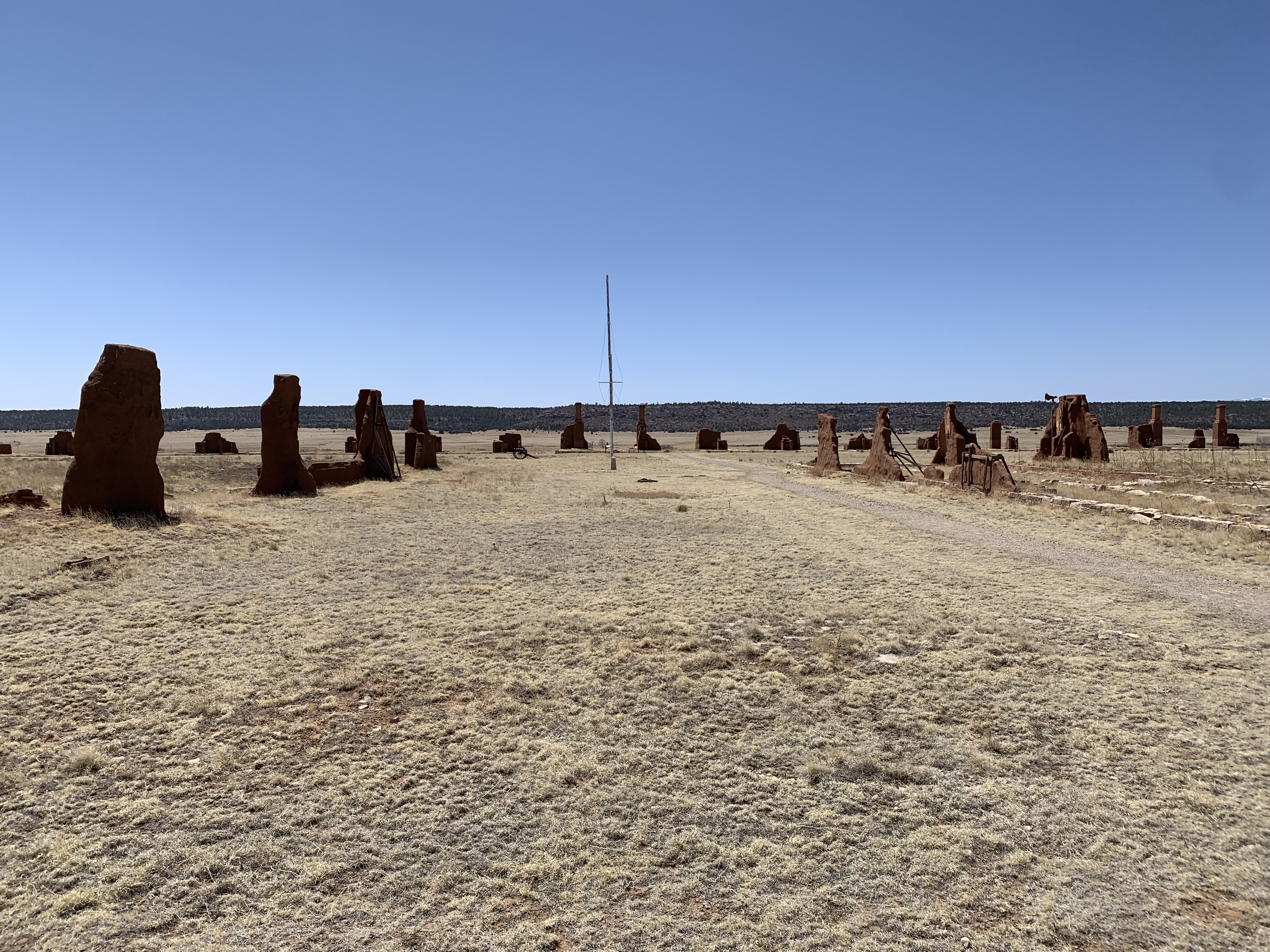
Not much remains of the largest Union fort in the west. But there’s plenty of history here. This was a critical supply base to keep the Confederacy from expanding into the southwest. Some of the Navajo who were driven from their homes during the Long Walk were imprisoned here. Here was the largest and most advanced hospital in the west. Soldiers and cavalry guarded both branches of the Santa Fe trail from here, once trading and migration routes for Natives, then for settlers whose wagon ruts can still be seen in the earth, then for the mail, and finally for the railroad, which still bears the name in the logo BNSF.

On the drive out to the site, a pronghorn stood in the road and stared at me, perhaps not frightened by my relatively quiet and zero emission electric car. Although I didn’t get a photo, I got a careful look at it and confirmed its identity with the park volunteer. Turns out they’re not antelope but related to giraffe. Again, everything I learned about the west, where “the antelope play” was wrong. There aren’t any antelope in North America. The pronghorn are the last survivors of human hunting among similar species in North America, due to their speed. Humans are increasingly lethal to all other species, and by changing our climate so quickly, we will make most species on earth extinct within a few decades. I wonder what our ancestors who traveled this trail would say if they could see how quickly we are devastating the planet.

Pecos National Historical Park

Yes, I know this is another Kiva photo. But I learned something important on the ranger tour down here. One of the visitors was an engineer, and he explained that one reason that the Native Americans built round buildings below ground level and square buildings above ground, even within the same pueblo, is that circular walls are the most efficient way to hold back the pressure of the dirt. When building up above ground, it’s easier to balance walls using right angles. That’s one reason why I saw round ball courts at Wupatki, round pit dwellings at more primitive sites and round kivas at important ceremonial sites, even as the majority of buildings at the same sites are rectangular.

Pecos is fascinating for multiple reasons, which explains why it was promoted to a historic park. One being that the archaeologists who excavated the pueblo roughly 100 years ago sent many human remains to Harvard University and Andover Academy for study, and they were repatriated in 1999, mainly reburied near relatives at a nearby pueblo community. Another is that here is where the Pueblo Revolt against the Spanish was planned and executed in 1680. Furious over their treatment by the domineering missionaries, the Native Americans orchestrated simultaneous uprisings across the southwest in the largest and only truly successful Native uprising against a colonial power in North America. And if that wasn’t enough, Pecos is also the site of the Civil War battle of Glorieta Pass, which prevented the Confederacy from taking over the southwest. As the Russians are belatedly learning in Ukraine, it all came down to supply line logistics. Kudos to the park ranger for explaining everything.