Minuteman Missile National Historic Site

There are three sites along the interstate: a visitor center, a missile silo and a launch control facility for multiple silos. Apparently the whole area was like a prairie dog town of silos. For decades, all the sites were manned and secured continuously, so that we could annihilate our enemies many times over, as they could to us. The cost of this ludicrous overkill capacity was staggering.

But what interests me most is the claim made in Life magazine above that only 3% would die. Actually, we’d be lucky if 3% survived. How could we have been so wrong? We listened to the wrong scientists. Physicists designed the nuclear bomb, so they had the full attention of the military. They analyzed the problem by describing payload, flash of light, shockwave and fallout. Only when someone asked whether nuclear war would blot out the sun for years did we realize that the physicists completely underestimated the risk to life on earth. Why? Because the study of life on earth isn’t physicists’ job. That’s the job of biologists. We were listening to the wrong scientists.

Our public understanding of the climate crisis is very similar. We’re still not listening to the right scientists. Whenever I ask a physics expert about global warming, I always get the same answer: ”the planet will be fine”. They mean that it will continue spinning. Geologists answer that temperatures vary naturally within large ranges over eons. Meteorologists say that it won’t tell you if you need to bring an umbrella today. Again we are listening to the wrong scientists.

Biologists study life on earth, so they will tell you that the climate crisis will extinguish most forms of life on earth, either directly, by changing their environment more quickly than they can adapt, or indirectly, by collapsing some critical part of the ecological networks they rely on for food, reproduction, or any other part of their existence. These are the scientists who study whether life on earth will survive, and they’re the ones who are telling us that the risks are too great to continue carbon pollution. As living, supposedly sentient beings on this planet, we naturally should be interested in the survival of life here. We need to listen to the right scientists who know and are telling us what we need to do to avert the coming catastrophe.
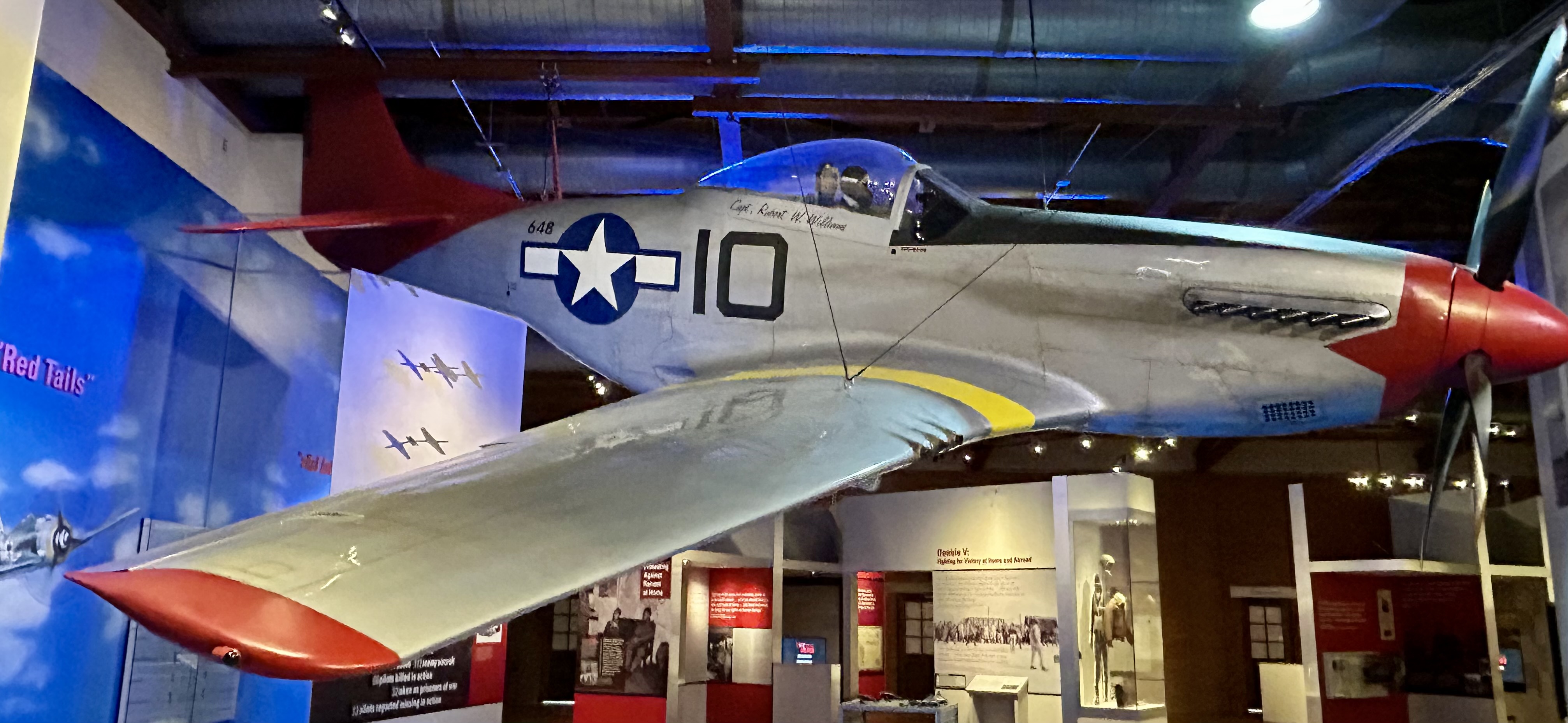
Tuskegee Airmen National Historic Site

[Updated after touring the hangars.] Like at Tuskegee Institute, I admit to being frustrated by not being able to tour inside earlier and ranting about unequal funding. But all is forgiven now.

The P-51 Mustang above, known as Duchess Arlene, is just one of the planes on display, along with training planes. The first Tuskegee Airmen fighter group sent to North Africa was the 99th, which proved itself with a record-breaking number of air combat kills in short order. Later, additional units were combined into the 332nd Fighter Group, the famed Red Tails that protected the Flying Fortress bombers to help win the war in Europe. I recommend watching the Tuskegee Airmen movie, starring Laurence Fishburne, to learn more. (For the record, although Fishburne also starred in Miss Evers Boys, none of the Tuskegee airmen were involved in the Tuskegee experiment.)

The park film and exhibits also tell another important story about the Tuskegee Airmen: the Double V. Victory was needed both abroad against Hitler and at home against discrimination. When the decorated pilots and experienced mechanics returned after the war, they were not allowed jobs at US airline companies, despite their proven qualifications, nor were they allowed to vote in many states. Even during the war, a group of over 100 airmen were denied admission to an officer’s club on the basis of their race in direct contradiction with US military regulations against segregated facilities. They refused a direct order to sign away their rights, which, during wartime, potentially risked their execution. The Black Press, a group of newspapers and newsletters that closely followed the Tuskegee Airmen, broke the story of the Tuskegee officers being held prisoner and given less rights than Nazi prisoners of war at the same base. The Freeman Field ‘Mutiny’ became a national scandal, and the commanding officer was eventually removed and the officers freed. Truman eventually ordered complete desegregation of the military. We owe a great debt to these brave men, who fought for our country, despite the discrimination they faced.

Manhattan Project National Historical Park

This is the third park unit right near Los Alamos, the others being the last two visits at Bandelier and Valles Caldera. There are Los Alamos National Labs units all around the area, and I was even stopped at a security checkpoint when Tesla’s navigation misdirected me (not the first time). I stayed in the neighboring town of Española, and there’s a Native American community right next door too. I got a bit of culture shock again seeing how different lives are between communities that are so close to each other physically.

Los Alamos is very strange. First, according to a local, most of the science workers are introverts and the other workers spend the weekends in Santa Fe nearby. So the town has all these big shopping plazas with a variety of (often Asian) restaurants, but they’re all virtually empty on weekends. The place is beautifully landscaped with flowering trees, manicured lawns, pristine sidewalks and a lovely park next to the visitor centers. If it weren’t so American, I would suspect it of being a Potemkin village. There are actually two small visitor centers practically right next door to each other, one for the park service and one for the town, so I visited both. They both recommended the exact same attractions in the same helpful and enthusiastic, smiling way with almost identical maps.

Also strangely, although it was atomic scientists who invented the atomic clock as a way to standardize time across all different clocks, the Bradbury Science Museum mobile website ironically doesn’t display its hours of operation (they said they would fix that). They have an incredible amount of information, but they won’t tell visitors when they’re open. Now that my trip is over, I can see the hours on my desktop computer: Tues-Sat 10am to 5pm and Sun 1 to 5pm. And while the museum had an exhibit on wildfires and an exhibit on climate change, they almost seemed to be avoiding making a connection between the two. The climate exhibit was all about Arctic research, implying that climate change was going on there, but the wildfire exhibit was about fire safety, implying that fires were simply natural and avoidable events. As I write this, the Cerro Pelado fire is six miles from the Lab and is over 20,000 acres, so they might want to reprioritize how they assess the threat of climate change.

And finally, I’m going to break my own rule and add a second picture. Dr Oppenheimer and several of the other top scientists lived in converted scouts’ cabins after the government confiscated an elite boys camp to build nuclear weapons. In his neighbor’s cabin, next to the kitchen, is a realistic display of a miniature version created in the 1980’s: the scariest thing I’ve seen besides the climate crisis, a nuclear bomb designed to be carried in a backpack.