Tule Lake National Monument

Sometimes the story is more important than the scenery, and Ranger Danny told it well. In April 1942, US citizens of Japanese descent on the west coast were given 2 days to pack 2 suitcases and check in to temporary relocation centers, losing their freedom and property in violation of the 4th Amendment. They were not given due process in violation of the 5th Amendment. FDR’s order was popular—especially among those who planned to take their property—, and the wartime Supreme Court partly upheld it, in the infamous Korematsu decision, while simultaneously partly dismantling it, in Endo. Reagan apologized and offered survivors small compensation.

Many Americans grew up either not knowing much about this or believing it justified by war. The Japanese military attacked Pearl Harbor without warning, after invading their neighbors, occupying Shanghai and committing atrocities in Nanjing. When FDR’s order went into effect, Japan had taken Hong Kong and Singapore, and they held several thousand American civilians as prisoners for the duration of the war, with insufficient food, forced labor and a high death rate. Americans did not want to prove themselves better; they wanted revenge.

And yet the Germans had acted similarly, with sneak attacks, invading neighbors and taking prisoners, but the US issued no similar order to imprison US citizens of German descent. Americans lost relatives in battle to both foes. Both aggressive countries employed spies. Japanese Americans do not appear different from other Asian Americans, so Japanese spies could still operate on the west coast. There is no justification for abrogating the rights of Japanese Americans, not expediency, not greed, and certainly not racism.

These ten American Concentration Camps were a failure of leadership, imagination, morality, of our government and of rational behavior. Having dispensed with our Constitution, the rules were arbitrarily made up on the fly. The US military defined a huge ‘exclusion zone’ from Washington state to New Mexico, fearing another naval assault in Arizona?!? Hawaii, despite being the location of Pearl Harbor, detained few Americans of Japanese descent. Japanese Americans who already lived in Idaho, Utah, Wyoming, Colorado or Arkansas witnessed their fellow citizens arriving in their states and being imprisoned for having the same cultural background as they did.

The US military still wanted to draft soldiers from the citizens they detained, so they created a loyalty questionnaire to invite them to fight in Europe. The government then started using the questionnaire to divide the incarcerated into loyal or not. The questions were convoluted, rewritten in some camps and many were misadvised on how to respond. Since Tule Lake only used the original version, they had a higher ‘failure’ rate, so they got a reputation for disloyalty. Inmates exercised their 1st Amendment right to protest, and the military sent in tanks. Then they had the inmates build a concrete jail inside the barbed wire, machine gun manned watchtower prison. One man was interrogated for 12 days because his mother accidentally played a borrowed radio. Many inmates here were pressured into renouncing their US citizenship.

One reason that most Americans don’t know much about this history, or have mistaken views, is that the US government intentionally misled the public about conditions here. The press was invited in to see the one barracks in Tule Lake where everyone was happy and would receive steak for dinner in return for cooperating, while the remainder of the massive camp was suffering from basic food & water shortages. The image of the ‘happy Japanese interns’ was amplified as propaganda, which some visitors still repeat today.

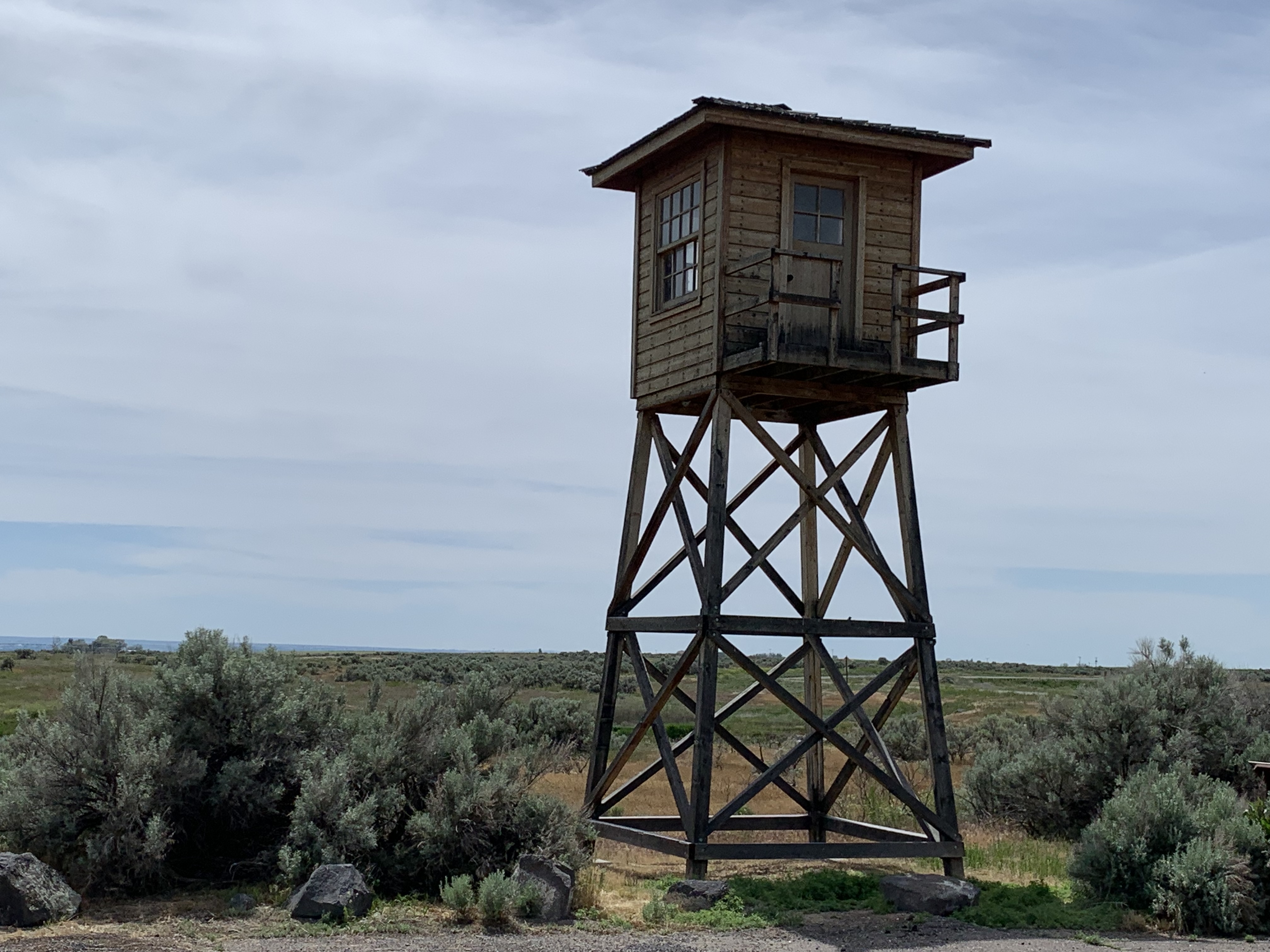
The highly recommended ranger tour is given on summer weekends out in the field (above) and in the jail, complete with jail cell bars saved by a local to preserve the real story. The camp is 10 miles outside town, per military requirement, and there are a few original buildings, the top of a watchtower and a stone monument, besides the small visitor center. The site is in the far northeast corner of California, in the reclaimed lake bed, quite close to Lava Beds. It’s remote, but important to visit.

Port Chicago Naval Magazine National Memorial

At 10:15 pm on 17 July 1944, 320 people were vaporized in a munitions explosion while loading two ships simultaneously. The blast registered 3.4 on the Richter scale, disintegrated the docks above, blew one ship into small pieces, threw other ships hundreds of yards away, and injured people on the other side of Suisun Bay above. Most of the victims were young African Americans, and the Navy blamed the poorly trained black workers rather than the white officers in charge. When 50 survivors refused to return to work, they were sentenced to 8 to 15 years in prison and others were threatened with firing squad for mutiny. Despite the efforts of Thurgood Marshall to defend them and focus the blame on the Navy’s negligence, the ‘mutineers’ spent the rest of the war in prison, and the story was lost to history until a Cal professor named Robert Allen found a pamphlet, interviewed a dozen survivors and wrote a book in 1989.

The story is powerful, and the ranger and volunteer did an excellent job of painting a detailed picture of racism, dereliction of duty (among the officers who bet on load rates), the lies that the enlisted workers were told (that the bombs were inert), and the trial. Photographs, oral accounts and actually visiting the spot where it happened, including touring the revetments where munitions were transferred from boxcars and out to the docks, bring the impact home. The volunteer, Diana, noted that the Navy suffered an even more deadly munitions loading accident less than 4 months later, when the USS Mt Hood exploded in New Guinea on 10 November 1944, obviously not learning the lessons of Port Chicago. The ranger, Eric, made a persuasive case that the negligence and racism uncovered and protested, while officially unpunished, likely prompted the Navy to be the first branch of the military to desegregate completely in February 1946, two years before the other branches.

This park unit is dedicated to preventing this unjust tragedy from being forgotten. Tours must be reserved at least two weeks in advance for Thursday through Saturday when the Army, who took over the base, allows visitors. Although the tour met at the Muir home, I was able to drive my EV to the site above. Fortunately, the park service is working on improving access by building a visitor center nearby.

Rosie the Riveter / World War II Home Front National Historical Park

FDR said, “we can’t afford to indulge in prejudice now”, and with that, the “Rosie” in the lower part of the collage above suddenly was able to qualify for a job that previously hired neither blacks nor women nor LGBTQ+ nor any other minority. Note that she is riveting aircraft grade aluminum while wearing lipstick, nail polish, a large wedding ring and a classic “Rosie” red bandana. Many women were surprised how easy riveting was and didn’t understand why men said they couldn’t do it. By 1944, women were about 1/3 of the workforce, and 10,000 African Americans worked here in Richmond during the war along with all other minorities (except Japanese Americans). Leadership is required to change society’s prejudices and discriminatory practices, and once the door was opened, many women decided to continue working after the war.

The visitor center is next to the Ford Assembly Plant, which is still full of industrial activity. Check in at the gate on Harbor, then drive around back and all the way down to the right. There are ChargePoint stations in the lot, and a good restaurant next to the visitor center. The factory used to make tanks, and across Marina Bay was Shipyard #2 which produced a new ship every 4 days, loaded with tanks and sent off immediately. Walk a bit of the SF Bay Trail along the waterfront to a fine memorial to the Rosies in Marina Bay Park, next to the yachts and fancy condos. Shipyards #1 and #4 were up the channel on the other side, along with the Prefab Yard. And Shipyard #3 still has the SS Red Oak Victory Ship, launched in November 1944, with worthwhile tours. This was the beating heart of America’s “Arsenal of Democracy”, and it was a unified effort of all hands on deck which changed the course of labor and civil rights overnight.

Vietnam Veterans Memorial

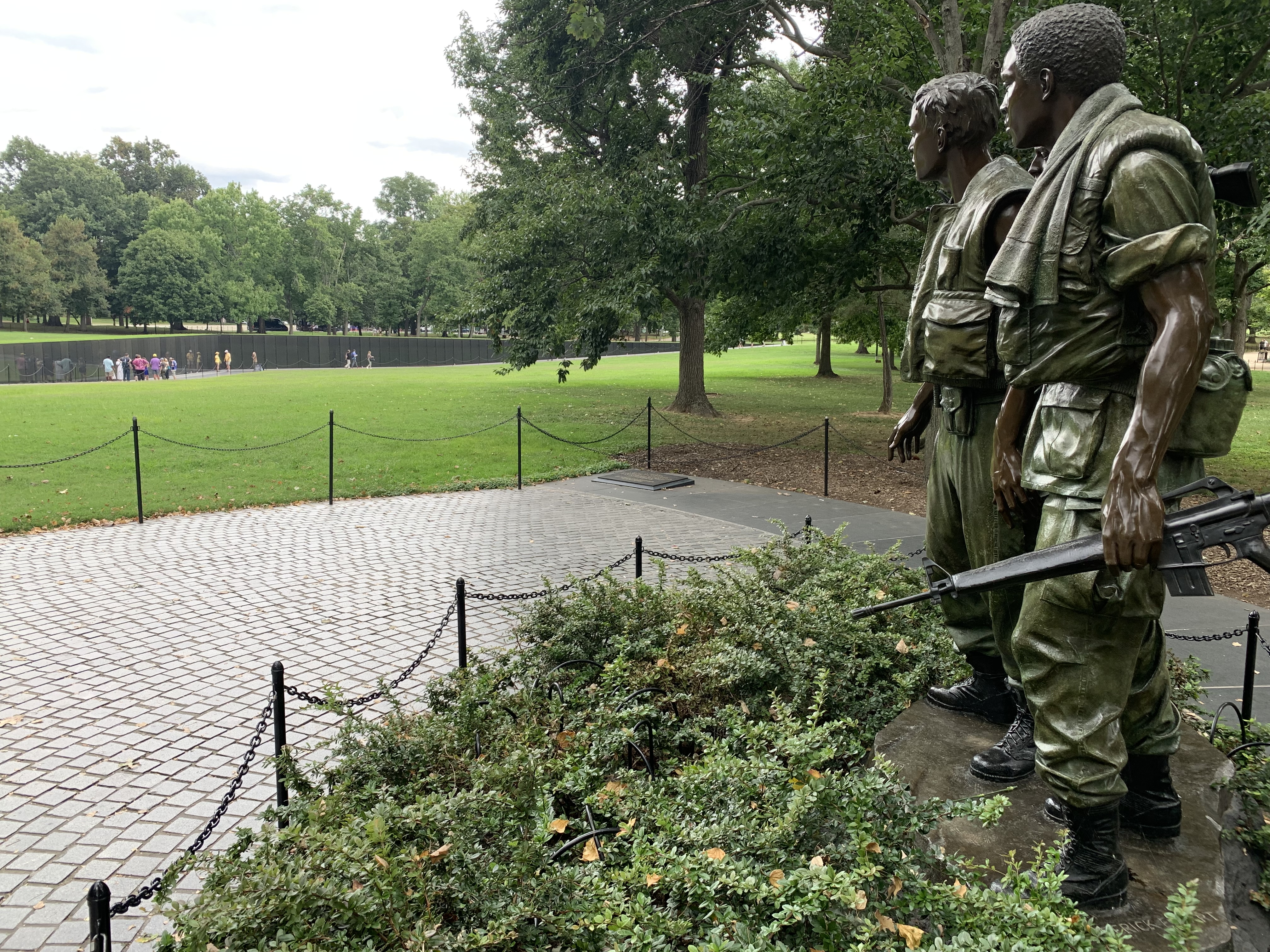
The memorial is effective. As you walk along the wall, gazing at the names engraved chronologically in the reflecting stone wall, you slowly enter the earth like the dead. Visitors can look up names in books, find their panels and etch a copy of a name to bring home with them. Some bring mementos or attend ceremonies if a status changes from MIA to recovered. There’s another statue to women who served and died. The statues of the three servicemen above look over the visitors at the enormous cost of the war. Over 58,000 Americans soldiers died, and over 300,000 were wounded.

Strangely, the memorial’s website doesn’t describe the war itself in any way, so I guess I have to try. Vietnam was both a civil war between the Vietnamese and a proxy war among the great powers at the time. The North, under Ho Chi Minh, had overthrown the French colonial government and wanted to unify the country under Communism. They were supported by China and Russia. The South was set up by France and allies to resist Communism, and we supported them with money, material, and military. Eventually, the weaker, more corrupt and incompetent South Vietnamese government failed, despite our extraordinary efforts to prop them up.

Robert McNamara, the architect of the US war in Vietnam, called the war a mistake in 1995 and said “we were wrong. I believe we were terribly wrong”. In retrospect, Kennedy’s effort to keep Vietnam from being the next ‘domino’ to fall to Communism, Johnson’s stubborn expansion of the war, and Nixon’s machinations were all failures. I have never read a credible analysis of how we could have won the war. Besides US casualties, millions of Vietnamese died and were crippled by Napalm and Agent Orange. About a decade after we left, the Communists had ruined the economy, and the Vietnamese abandoned that system on their own.

The park service has a responsibility to educate the public about history, in addition to memorializing the dead and remembering the sacrifice of veterans, regardless of controversy. Publishing the history of the Vietnam War on their site would be a good start.

Korean War Veterans Memorial

Korea wasn’t just one war. After the North Koreans launched their surprise attack, the allies only controlled one major city, Pusan, and its surroundings in southeastern Korea, near Japan. MacArthur brilliantly counterattacked with an amphibious assault at Inchon to liberate Seoul, and then he swept north as the allies had reinforced South Korea. But then China sent hundreds of thousands of troops across the border, which MacArthur described as an entirely new war.

That second war, with China, almost became a nuclear war, as MacArthur supported using nukes tactically, including using nuclear waste to create an uncrossable border and against (presumably) military targets across the North Korean border in China. President Truman, who had authorized the bombings of Hiroshima & Nagasaki, at first seemed inclined to allow MacArthur to make those calls. Instead, he relieved MacArthur of command and fought the war to achieve a stalemate, which still holds in the armistice (under Eisenhower) and at the (heavily armed) ‘demilitarized zone’ between the two Koreas today.

Freedom Is Not Free

Major Kelly Strong

World War II Memorial

Each of the 4,048 stars on the wall represent 100 American military deaths. 16 million served in the US Armed Forces, and many millions more supported the war effort directly. Appropriately, this classical memorial occupies center ground in the National Mall next to the Washington Monument. There were many veterans (of more recent wars) visiting, as well as international visitors and families all admiring the fountains, statues, monuments and inscriptions.

There are many detailed tributes, especially the bas-relief sculptures of both Atlantic and Pacific theaters. In the Atlantic, the memorial illustrates the Lend-Lease program that supported our allies before we entered the war, the military contributions of women, the industrial contributions of women, the code-breakers, the flying fortresses (later protected by the Tuskegee Airmen), the paratroopers, Normandy, Sherman tanks, medics, the Battle of the Bulge where the allies stopped Hitler’s last gasp advance, and meeting the Russians at the Elbe River as the allies stormed into Germany. In the Pacific, the memorial sculptures show Pearl Harbor, the massive enlistment and mobilization for war, battleships, submarines, aircraft carriers, amphibious assaults, jungle warfare, prison camps, and V-J Day.

“Today the guns are silent. A great tragedy has ended. A great victory has been won.
The skies no longer rain death – the seas bear only commerce –
men everywhere walk upright in the sunlight.
The entire world is quietly at peace.”

General Douglas MacArthur

World War I Memorial

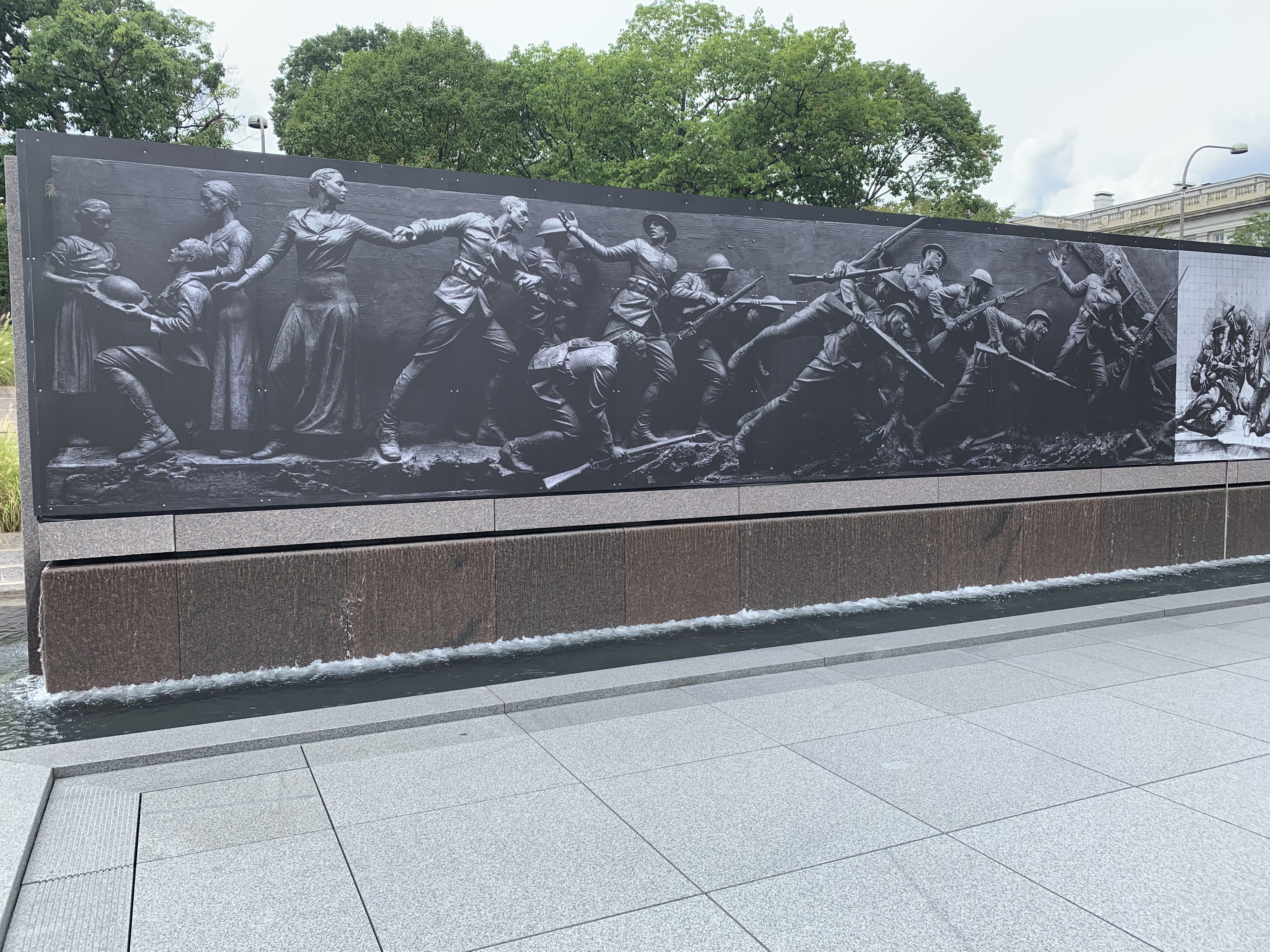
The artwork, “A Soldier’s Journey”, is not yet complete and “will not be installed before 2024”, so what you see above is a photo of the first half of the journey which continues as a drawing to the right. There is a statue of General Pershing in his park too with quotes and maps of the Western Front and the Meuse-Argonne Campaign. Nearby is an outline of L’Enfant’s plan for DC.

Pershing is the one general, besides Washington, to be named as “General of the Armies of the United States” after his success in WWI. He kept our forces together, instead of blending with allied forces, to increase their impact, and they broke the stalemate to win the war. Over the course of his career, the West Point grad commanded the next generation of leaders, including MacArthur, Marshall, Patton and Truman. Many of his earlier commands were much more problematic, including setting the perimeter at Wounded Knee, being called “Black Jack” because he led the 10th cavalry of “Buffalo Soldiers” (African Americans), fighting the Moros in the Philippines and his failed search for Pancho Villa. In all cases, he distinguished himself for his exceptional effort to understand his opponents.

Springfield Armory National Historic Site

America has a gun problem. No other country on earth has anywhere near as many gun deaths per capita as we do. Australia banned guns after a mass shooting in 1996, and they have had one mass shooting in the past 26 years. Many Americans worship guns (see “organ of muskets” above), and mass shootings are a daily occurrence.

George Washington started the Armory for the Revolutionary War, and it continued making guns until 1968. The Armory did an excellent job preserving its history, and their extensive collection covers the evolution of guns in exceptional detail. Smith (of Smith & Wesson) and his father worked here, as did William Ruger. The Colt factory was another of the precision gun manufacturers in the Connecticut River Valley, and the town of Coltsville will likely open as a new national historical park someday soon.

On this visit, I also learned that most of the ammunition for at least the Civil War was produced by women and children, and that the work was extremely dangerous. 178 women and girls were killed when the Allegheny Arsenal in Pittsburgh exploded in 1862, due to sparks from iron horseshoes & iron wheels on a flinty cobblestone road covered with sawdust and gunpowder. Actually, the lawn in the center is contaminated with lead, so kids shouldn’t play on it (like I did when I first visited decades ago).

Boston National Historical Park

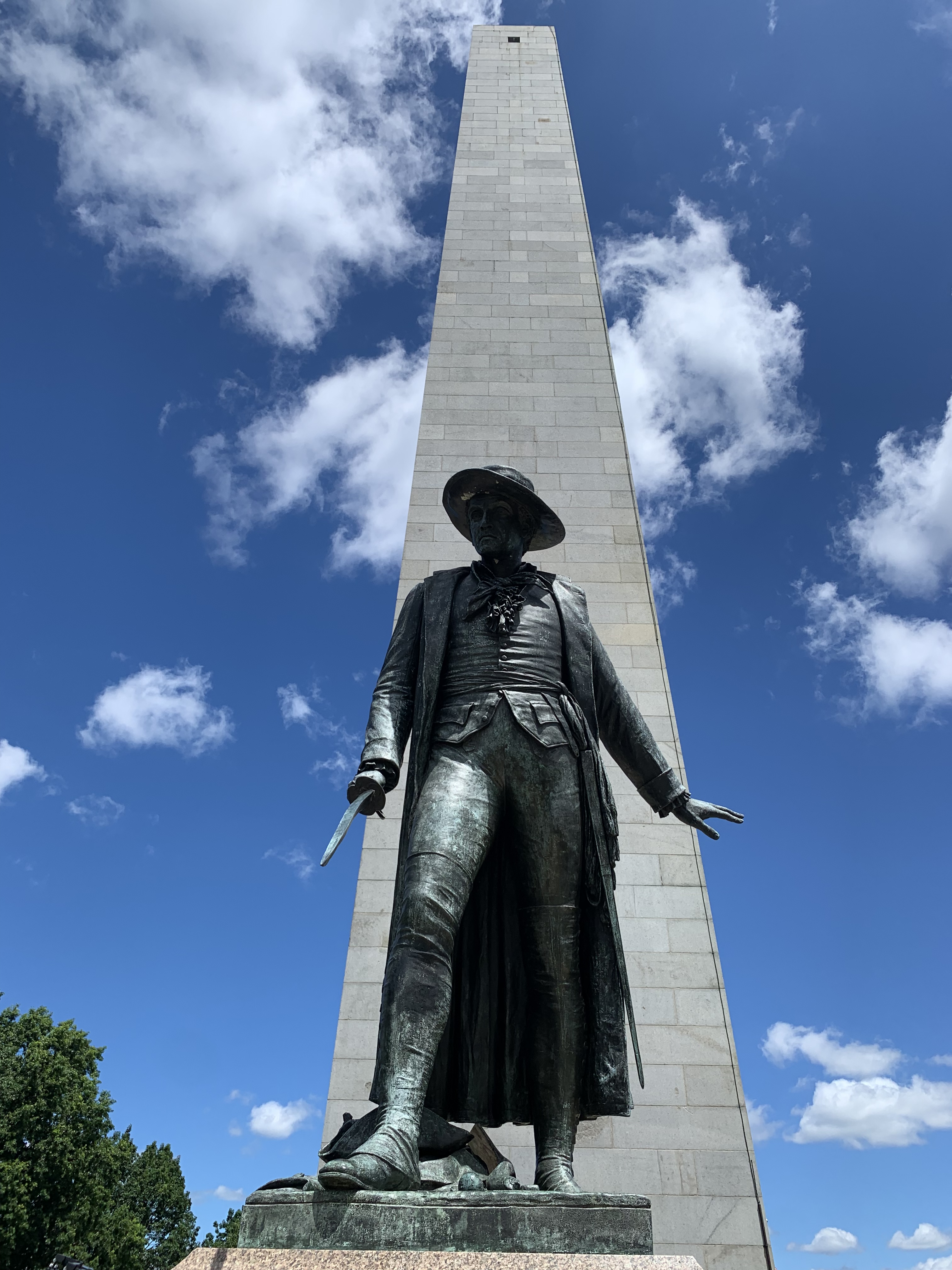
“Do not fire until you see the whites of their eyes.”

Colonel William Prescott, 1775

While the way to the top of the Bunker Hill Monument is currently closed, there is a live webcam. The monument is at the top of Breeds Hill, which the colonial soldiers defended against repeated attacks, before retreating to Bunker Hill. There’s a free museum facing Prescott’s statue across the street.

Boston has an embarrassment of historic sites in this park: the USS Constitution, Paul Revere’s house, the Old South Meeting House, the Old North Church, the Old State House, and Faneuil Hall. Each one is worth exploring to learn how we became independent, how we developed our democracy in town hall meetings, and how we debated our rights as Americans. Oh, and I’ve forgotten another historic ship (WWII), another historic battlefield (not open), another museum, a historic navy yard, living history exhibits, and other fascinating sites on the popular Freedom Trail.

Since the traffic and parking are even more horrendous than I remember, I definitely recommend taking the subway (electric and also historic) and walking. Many of the sites are clustered together, and the Rose Kennedy Greenway has beautiful art, flowers, and fountains along the way. Faneuil Hall is a great place to try local foods, and I recommend the thin cheesy Regina Pizzeria slices.

Minidoka National Historic Site

Named for the Dakota Sioux word for a spring, this concentration camp is along an irrigation canal, where the Japanese-American prisoners built a swimming hole and tried to fish. The sincere efforts to try to improve their confinement somehow make the circumstances even sadder. Thousands of Americans were cut off from their homes, neighbors and country, due to their national origin and race. Most German and Italian Americans were not incarcerated during WWII. Neither were most Japanese-Americans in Hawaii. Most of those kept here were from the Pacific Northwest and had lived in the US for a generation or more. Many also found their property had been stolen when they tried to go home. Under Carter and Reagan the survivors were paid $20,000 compensation for “race prejudice, war hysteria and a failure of political leadership”.