The photo above shows the park, but you’ll need to zoom in to see the following details left to right. The dock to the far left belongs to the Sea Scouts. The island to the left above the municipal pier is Alcatraz, part of the Golden Gate NRA. There are swimmers in the cold water between the small blue and red boats in Aquatic Cove. The three masted square rigger on the left is the Balclutha, and the three masted schooner on the right is the C. A. Thayer, both late 19th century cargo ships. Also on Hyde Street Pier is the Eureka, an old ferry boat recently restored, along with a number of smaller vessels, which are typically open for tours ($15). On weekends there’s a ranger led waterfront walk from the Argonaut Hotel near the pier entrance. Be sure to ask what it meant to get Shanghaied, how and where it allegedly happened, and why sailors were initially exempt from the 13th Amendment. On the far right, there’s an Art Deco style building resembling a ship outside, with murals and maritime exhibits inside. And above that is the sign for Ghirardelli Square (‘gear-a-deli’) which serves delectable old fashioned hot fudge sundaes, after you’ve explored the park.
The Civil War era fort was obsolete as soon as it was built, since rifled cannon penetrated brick walls, and the one threat it faced, the CSS Shenandoah via the Indian and Pacific, called off their mission when they learned the war had ended months earlier. (They spent their round the world voyage attacking whaling ships out of New Bedford, since they often had escaped slaves on their crews.) Before that, there was a Spanish fort here, which was taken over by the Mexicans and then by a band of Americans including Capt. Fremont and Kit Carson, shortly before California became a state.
These days, it’s best used as a place to get a nice photo of the Golden Gate Bridge (when it’s less foggy). The fort is open on weekends, and you can get a good photo from the roof. I walked down from Battery East, but walking or biking from Crissy Field is nicer. There is parking at the fort, although it requires persistence navigating, since more roads are open to bikes than cars around here.
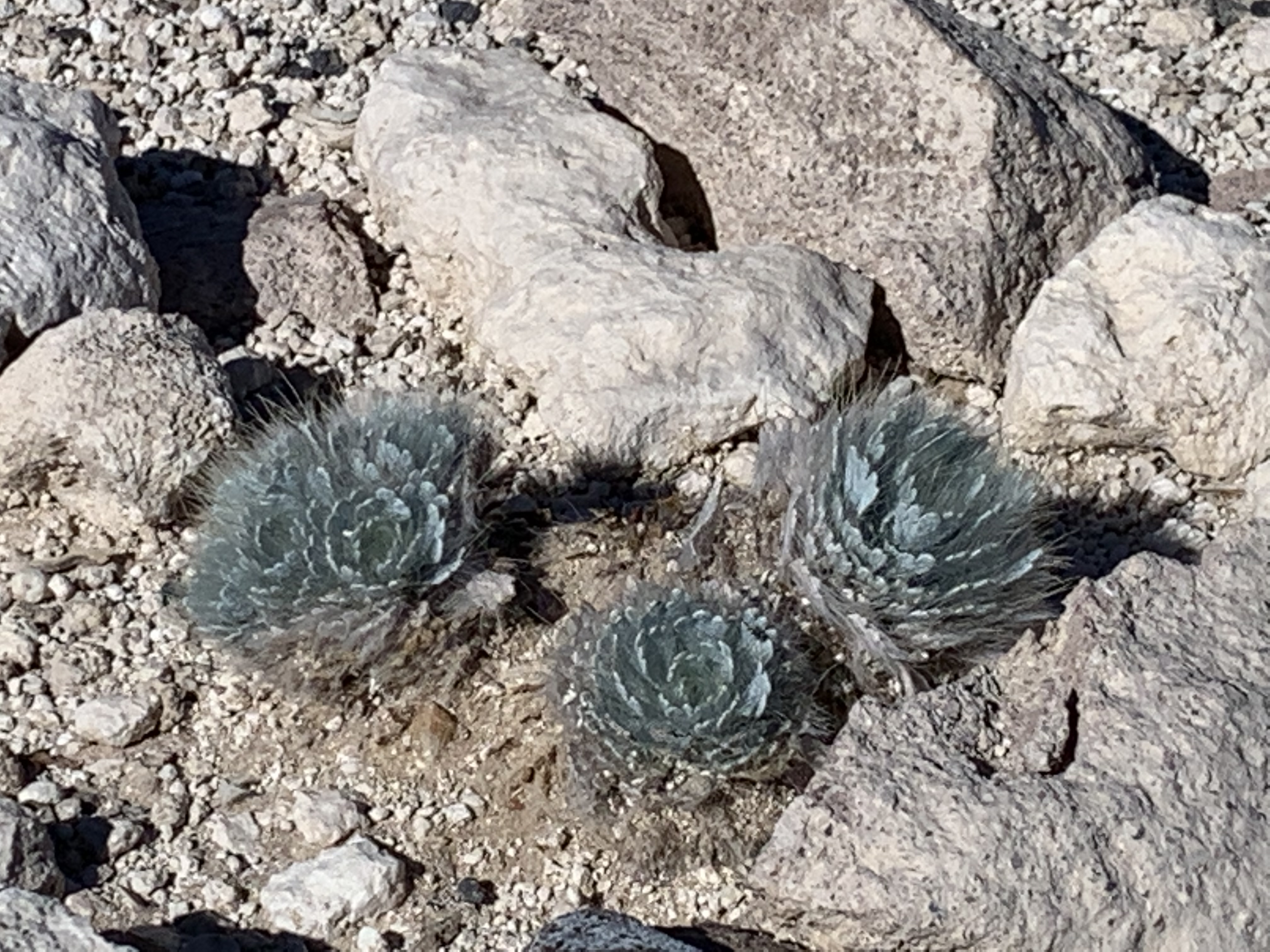
I’m pretty sure these are the endangered Las Vegas Bearpoppy with yellow flowers in spring. Endangered, because Vegas sprawl exceeds monumental. Honestly, there wasn’t much else to see in this “still in planning stage” park site. There’s a temporary 3.25 mile Alicante Loop Trail and parking on North Aliante Parkway at West Moonlight Falls Ave, but the desert is subtle in natural features. There are mats of desert mistletoe in the acacia and mesquite, but they’re parasitic plants best appreciated by the rare silky flycatcher. Despite free dog waste bags and signs, the locals use this place to let their pets run off leash and much of the brush has poop and trash stuck in it. The park extends for miles from North Vegas up 95 northwest, and hopefully they will soon be employing a ranger to protect the park from the residents and pets of the lushly landscaped neighborhoods across the street. Vegas isn’t known for keeping realistic boundaries.
The white peak on top of the center red rock is Mount Hayden, 5000’ above the canyon floor, viewed from Point Imperial, North Rim, looking east. The Colorado River is down there somewhere, along with the Painted Desert and Marble Canyon to the left. Everyone should visit the Grand Canyon, and the grandest, widest and most awe inspiring views are from the popular South Rim. I took my family there years ago, and I’ll never forget ‘Ooh, Aah’ point, which was so windy that the name required exclamation marks of terror.
But the North Rim is more conducive to contemplation than the South Rim, because instead of development and crowds, there are bright yellow and gold Aspen forests, meadows and quieter vistas. The yellow Cliffrose was in bloom along the trail, and a large coyote crossed the road in front of me. Angels Window makes for a nice photo and has a great overlook on top. Bright Angel Point is just a few steps from the Grand Canyon Lodge, and it is one of several overlooks nearby that have spectacular panoramic views.
The season is shorter on the higher altitude North Rim, but fall is beautiful. There was wildfire damage and some smoldering burns in the Kaibab Forest, but overall the forests still look healthy. The ranger gave a talk trying to explain how difficult it is for them to respond to climate change locally, let alone nationally or globally. Logistically, my long range EV can visit the North Rim from Page AZ, where there’s a supercharger, round trip, but getting all the way out to Cape Royal would have been too far. The nearest destination chargers are at Cliff Dwellers Lodge at Lees Ferry (mean steak & eggs) and at Days Inn in Kanab Utah. I used both and continued northwest.
In the center of the alcove across the canyon is the cliff dwelling of Betatakin. Due to Covid, the five mile guided hiking tour is currently suspended, but a 1.3 mile round trip hike to the the view above is open and beautiful. There’s also normally a 17 mile permitted hike to Keet Seel, a large and well preserved village, where guided tours are also currently suspended. Navajo Nation is taking a cautious approach to the pandemic, and masks are required. Please respect their wishes and culture.
Many visitors confuse this site with Monument Valley Navajo Tribal Park, which has been featured in many western films, but that site is northwest of here and run by Navajo Nation, not the park service. This park service site is in the Tsegi Canyon area and preserves Ancestral Puebloan dwellings, culture and homeland. As well as builders, they were great traders of tools, pottery, turquoise, shells, parrots and macaws. The Hopi, Navajo, Paiute and Zuni are some of the tribes that trace their roots back to this site. The visitor center has some trade items on exhibit and a gift store.
First, if you can’t get a reservation in time to visit Lehman Caves, just visit the park anyway. I took the virtual cave tour, and, I suspect that Timpanogos in Utah is better and less damaged. Besides, the park isn’t a cave park, it’s the highlight of the Great Basin area, which includes most of Nevada, western Utah and parts of three other states, and has a glacial basin of its own at the top of a 13,500 foot mountain.
Second, stop at Mather Overlook to admire the views and fall foliage of yellow and orange Aspen amid the dark green conifers. There’s a bronze model there that shows the structure of the basin, which is helpful orientation, since it is a long winding road.
Third, understand that the glacier here, “the only glacier in Nevada”, is gone. In theory, there might be some subterranean ice under some of the rocks for another couple years, but climate change has wiped this glacier off the face of the earth. The park maps showing a “rock glacier” in white are out of date. Any snow you see up there is seasonal.
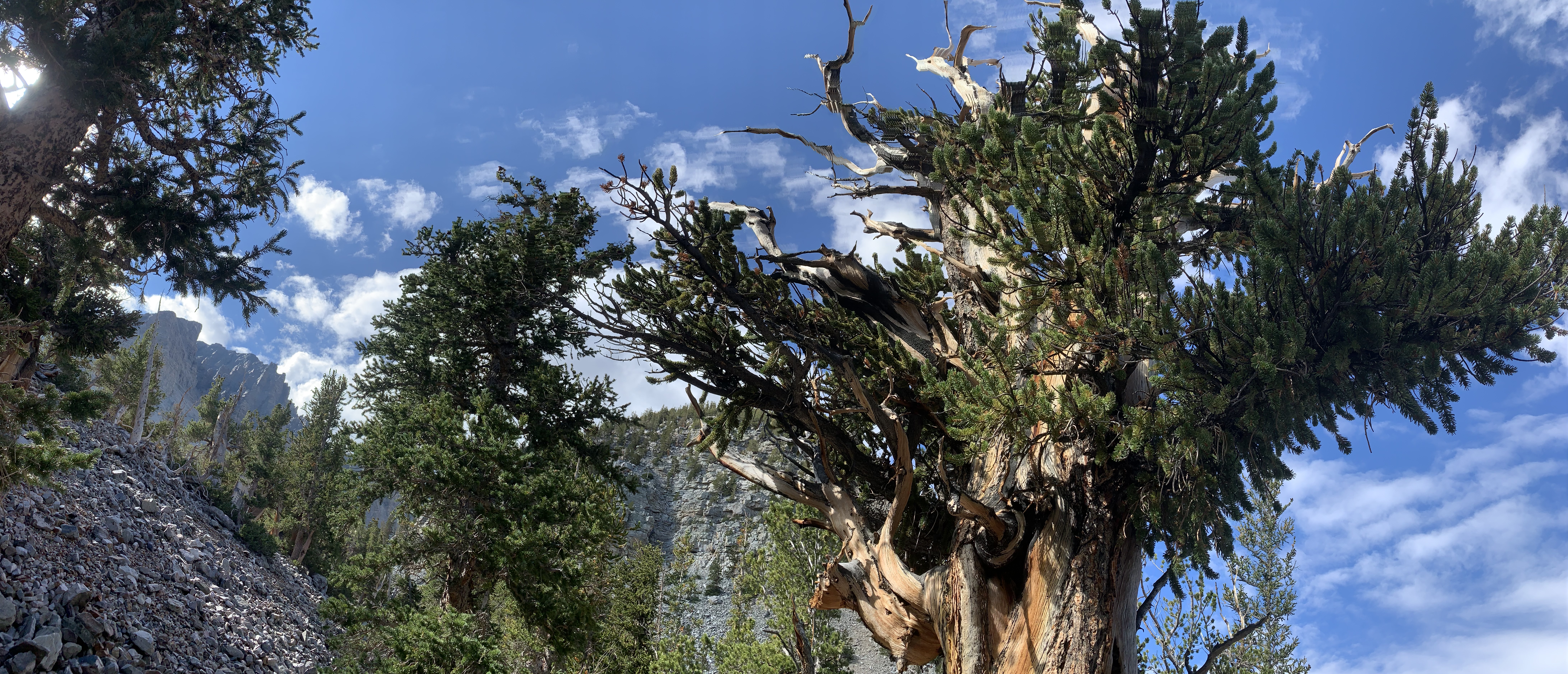
Fourth, take the Glacier Trail anyway, since it goes through the Bristlecone Pine grove and up into the basin. If you only get as far as the grove (2.8 miles roundtrip), that’s what I felt was the highlight of the park. The other two Bristlecone Pine groves are in very remote areas of the park. There are also some trails to pretty alpine lakes, but be careful, as many of the hikes are over 10,000 feet. Spending the night at altitude can help, as well as give you lovely views of the Milky Way.
Finally, this is my favorite park for old trees. The Bristlecone Pine, far from merely eking out a bleak minimal survival, is a gold resinous Adonis, shining in the bright Alpine sun, with luxurious thickly packed bright green bristles. We don’t know how long they can live. One that was removed from here in 1964 was over 4,900 years old. Unfortunately, climate change will likely make them extinct, as other trees will grow at higher elevations, crowding them and subjecting them to more wildfire damage.
The park is only accessible for zero carbon travel for a few weeks after the required shuttle service ends (mid September) and before the road closes (early to mid October). Shuttle buses are useful for reducing carbon pollution, but unless they’re sustainably fueled, they’re out of bounds to me. Red’s Meadow Cafe was still open, but the resort was closed when I arrived late September.
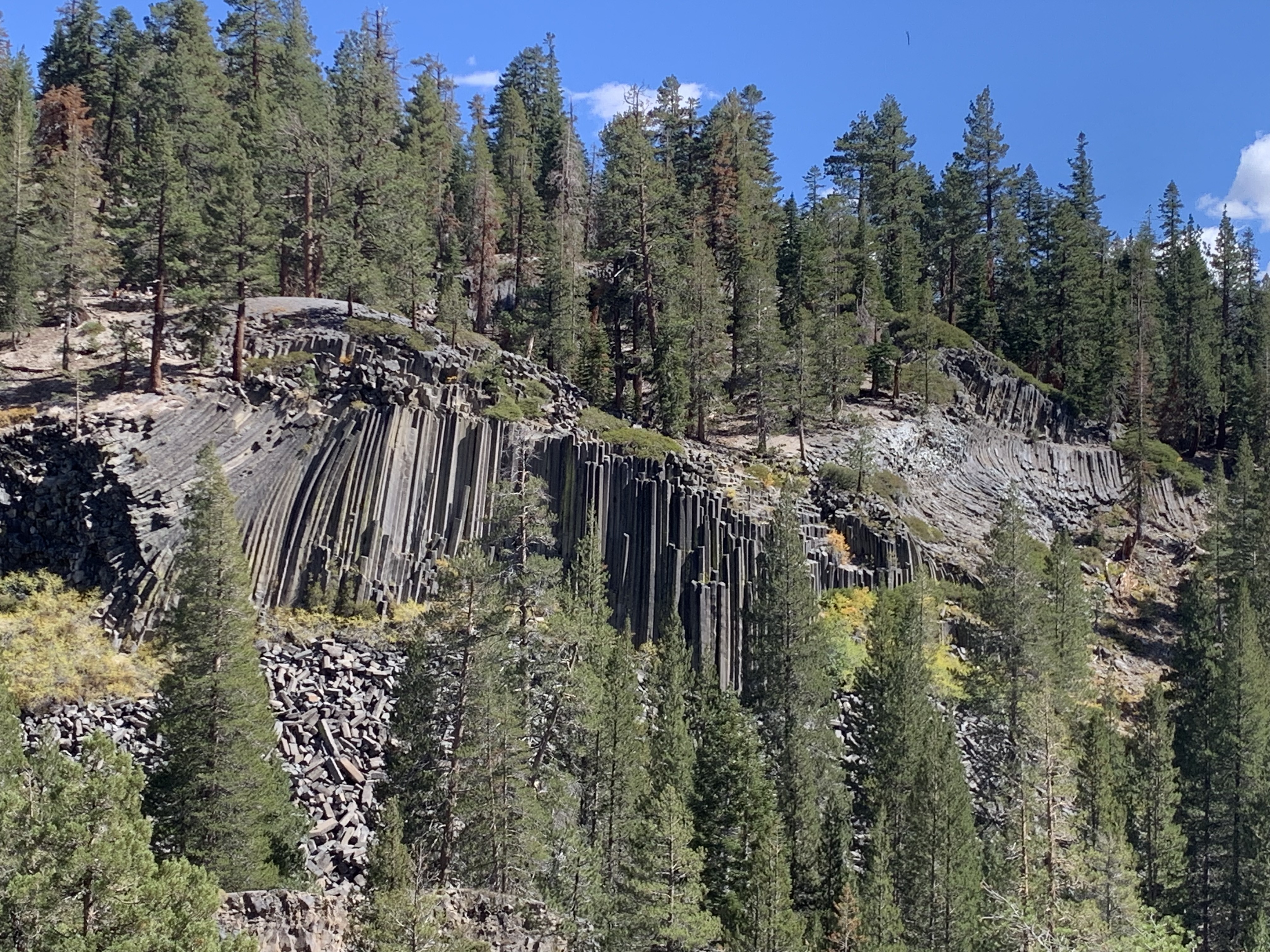
Since both the John Muir and Pacific Crest Trails run together through the park, I recommend you hike in a loop around the base of the broken basalt columns, across one of the two bridges across the Middle Fork of the San Joaquin River, along the combined JMT & PCT trail ridge where I got the photo, and back across the other bridge. There are also pretty waterfalls at both the north and especially south ends of the monument, but be careful hiking as the park is at around 7,500 feet in altitude up near the Mammoth Mountain ski area. There’s also a trail up through the trees to the top of the columns, which were formed 80,000 years ago when a diabolically molten lake cooled and cracked deeply in hexagonal and similar shapes and which were revealed by glaciation 15,000 years ago. Enjoy!
Manzanar was the first of ten internment camps incarceration sites for Japanese-American citizens (and some non-citizens) to be recognized as a park unit in 1992, symbolizing the whole program fiasco. Minidoka was enacted in 2001, Tule Lake in 2008 and Amache in 2022.
Unconstitutional incarceration, while a Federal program ordered by FDR, varied by state: Hawaii incarcerated few and west coast states many. Rules regarding how much Japanese ancestry got a US citizen locked up without trial also varied by state. No other group was incarcerated en masse. Popular sentiment (racism) generally backed incarcerating Japanese-American US citizens during the war.
George Takei spent his “boyhood behind the barbed wire fences” in Arkansas. He remembers that after his family was imprisoned, his neighbors “came to our house and took everything”. He recounts how after Pearl Harbor, many young Japanese Americans tried to enlist, were refused and were incarcerated. His experiences were common, and in many cases homes and all belongings were permanently lost during internment.
It was an egregious violation of the American Constitution. We were innocent American citizens, and we were imprisoned simply because we happened to look like the people who bombed Pearl Harbor. It shows us just how fragile our Constitution is.
George Takei
Many of the citizens imprisoned here were teachers, doctors, skilled craftsmen, farmers, community leaders and otherwise productive members of our society. (One was a Mexican-Irish-American who got locked up here in solidarity). They sued for their rights and in 1944, the Supreme Court declared that a loyal citizen could not be detained under the Constitution. The executive order was rescinded the next day.
In this blog, I try to encourage people to look at mistakes in history and imagine a better course of action, because if we can’t fix our mistakes, then we have no hope of solving the climate crisis. It’s morally wrong to visit this site and think, “well, I suppose there was no other way”. Some have argued that it was for the protection of Japanese Americans or to stop espionage. But there were better ways available at the time to accomplish those objectives.
FDR clearly failed in his oath as President when he did not uphold the Constitution and imprisoned these citizens without cause. He also suffered a failure of imagination. Instead of internment, FDR could have established voluntary Japanese-American citizens councils, led by Japanese Americans to meet regularly among themselves, with civil defense, local law enforcement, and with government representatives to propose ways of supporting their communities and the war effort. The councils could have addressed both safety and spying allegations.
Instead of being locked up, these citizens could have spent the war teaching, working in hospitals or factories, growing food and supporting our war effort. Instead of being an American example of “concentration camps” like those of our enemies, FDR missed his opportunity to stand up for the freedom of these Americans as a positive example of our Constitutional liberties for the world.
When I visited this park with my kids, we went to the east unit. Both units are in the greater Tucson area, but both are a decent drive away from the center of town in different directions. So, I was glad to have a chance to see the other side. Although the visitor center is a bit nicer in the west, the east unit has a scenic cactus forest drive where you can easily get out and take a closer look. Both have plenty of saguaro (suh-Wah-ro) to see.
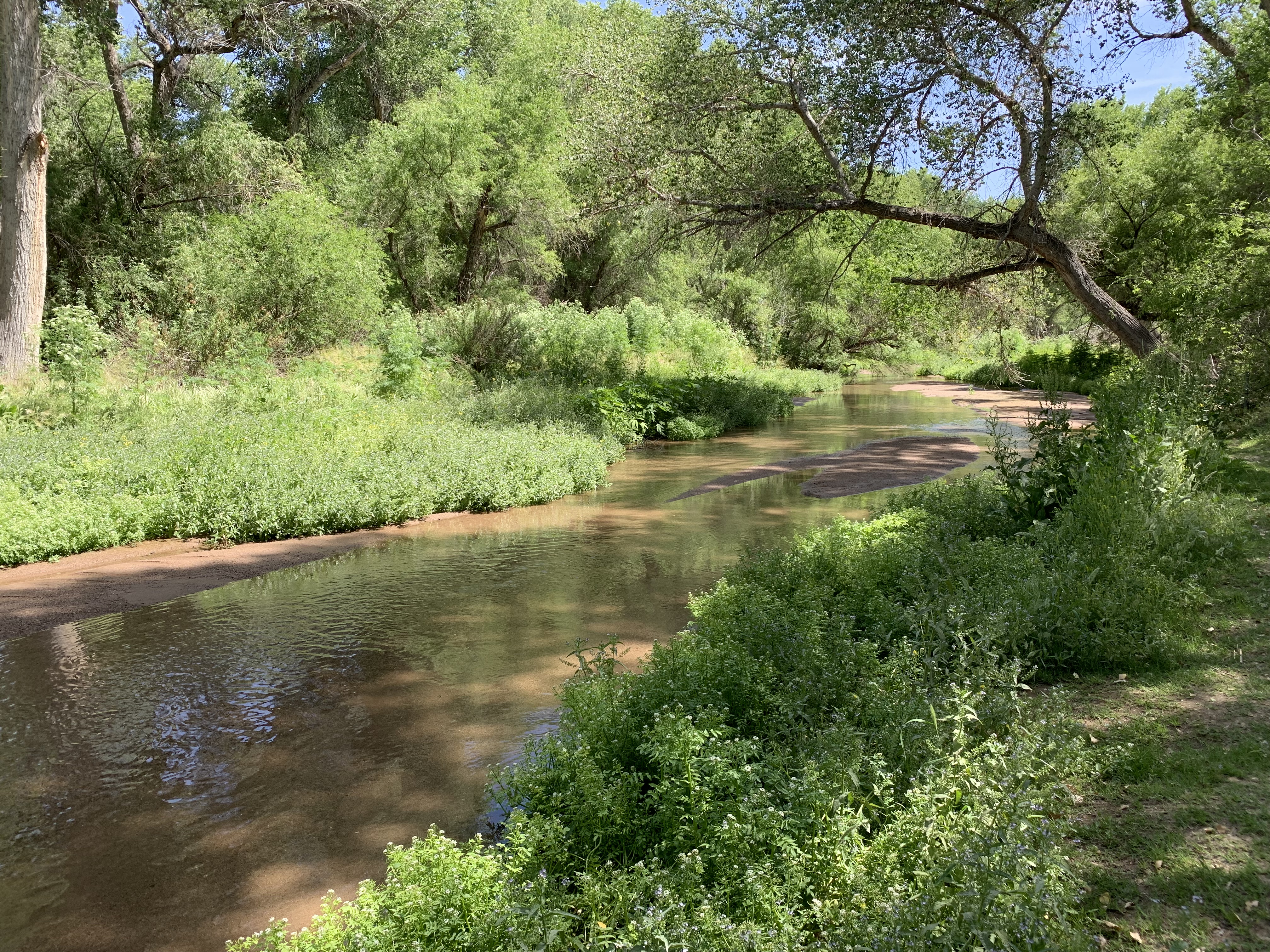
The Spanish Mission is not far from the banks of the Santa Cruz River, where I came upon this beautiful spot. The trail near here has more hoof prints than footprints and is supported by the active local equestrians. A lovely broad-billed hummingbird swooped down to see what I was doing, but I almost never have time to take decent wildlife photos.
The church grounds are impressive, with a large orchard cultivated with help from a local university, a courtyard garden, a small museum with a long pair of moccasins, and the old church in an evocative state of decay. But, in a sign of our ecologically vulnerable times, the most rare part of the park is the lush riparian area pictured.






 Zero Carbon Travel