Coronado National Memorial

They’re not exactly sure which river valley Coronado walked up with his plumed helmet, shining cuirass, retinue, soldiers and slaves on his way to find the seven cities of gold, but from the bluff here, you can see both. Apparently, a couple natives convinced him to walk as far as Kansas, before he realized it was a ruse and executed them.

The park is near the Mexican border, and someday there’s hope that there will be a sister park on the other side. Of course these days, some people are paranoid about migrants crossing illegally, so there were plenty of warnings and border patrol operations nearby. I can’t see anybody climbing all the way up here without a vehicle. The road up is unpaved and there’s parking a short hike from where I took the photo. Although the road is rough, it presented a scenic shortcut to my next destination.

Canyon de Chelly National Monument

The canyon is sacred to the Navajo. As is too often the case with Native American places, the name is confusing. De Chelly (pronounced ‘du Shay’) is from a Spanish borrowing of a Navajo word meaning “canyon”. So, many people out there are mispronouncing a word in two languages in order to try to say “Canyon Canyon”. This is my favorite canyon.

I only made a brief stop at Antelope House Overlook on the north rim to get a photo of this spectacular canyon. Fortunately, I toured the canyon a few years ago with my kids. That’s really required to experience the history, culture and beauty. Our guide was a Navajo who explained some of the history and beliefs of her people who still live in the canyon. Although Kit Carson’s troops cut down the peach orchards and modern people have diverted water, the bottom of the canyon is still both productive land and a protected ecosystem. If you have the time and money, a horseback tour would be incomparable.

I don’t normally talk about traveling between park units, but the drive from the canyon to Farmington was spectacular. The combination of green forests, snow, and red & tan rock formations in the winding mountain pass is stunning, as was the view of Shiprock on the other side. I feel some sense of culture shock when passing through Navajo Nation, accentuated by the stark differences between communities on each side, and this time felt acute.

Hubbell Trading Post National Historic Site

The post is still in use today, selling jewelry, blankets and other handcrafted goods. Navajo Nation spans a large part of northeast Arizona, and its border extends into Utah and New Mexico. Note well that they follow daylight savings time (unlike the rest of Arizona).

In the 1860’s, US troops under Kit Carson “burned villages, slaughtered livestock, destroyed water sources” and force marched thousands of Navajo to internment camps in New Mexico. The Long Walk and subsequent re-education programs damaged Navajo culture, breaking ancient familial bonds of language and traditions.

America has not dealt with this tragic history nor its consequences. And I’m not talking about Kit Carson’s legacy or that his name is ubiquitous in the west. I mean the US government’s responsibility for ordering people like Carson to execute this atrocity, against his personal views. We need to understand the mistakes of the past, atone and choose more wisely in the future.

Chiricahua National Monument

This hiking paradise of rocks left me feeling inadequate. Something about the vast number of enormous towering spires of hard rock made me feel like a tired old man. Sure, the view of any one of these mighty columns pointing skyward for ages is impressive, and the variety of sizes, shapes and textures of these huge protruding knobs is remarkable, but the well-endowed phallus-shaped columns left me feeling cold and small by comparison. On the other hand, a bevy of older ladies were very excited and pleased to view the tall and stout structures from Massai Point Nature Trail, as they laughed and reminisced about their youth.

One would be remiss for not explaining that the Chiricahua are the tribe of the Apache Chief Cochise and the feared raider Geronimo, who conducted guerrilla warfare against the US in this territory. For 24 years, the Apache skirmished with and hid from the US Cavalry, attacking stagecoaches, wagons, Mexico and even Union troops in 1862. The rugged and remote territory (below) shows the difficulty the US had in tracking them down. Eventually both were forced onto reservations. 

Click to see my photos of all national park units in Arizona.

Fort Bowie National Historic Site

Three of the graves in the fort’s cemetery are of captured Native American children. The center one belongs to a three-year-old Apache girl, buried under a Christian name given to her by her captors. The one on the right is of an Apache child unnamed with no age, buried like the others in the manner of his or her captors. And the left grave belongs to the two-year-old son of Chief Geronimo, Little Robe, who likely died of a disease spread by his captors, and whose father’s name will be remembered as synonymous with bravery, long after everyone else here is long-forgotten.

Click to see my photos of all national park units in Arizona.

Petrified Forest National Park

The Triassic forests are gone, and all that remains are fossils like these. Our climate changes frequently, but extremely slowly. Sudden change is a crisis, because plants and animals lack the ability to adapt or evolve quickly. Hundreds of millions of years ago, this area was an equatorial jungle. The trees were buried by volcanic ash and sediment and soaked in mineral rich waters to fossilize, offering a rare glimpse back before the Jurassic dinosaurs.

The park film explains the distant past, the recent past and current attractions. I hope they improve their camping opportunities, so that visitors spend more time here. I enjoyed my brief time here. But it was difficult to find a car-camping campground in the area, so I moved on too quickly.

Our carbon emissions since the industrial revolution are like an asteroid strike against all life on earth. The Anthropocene, or human dominated age, has been very short, but it will be characterized by extensive global mass extinctions. And unlike a meteor, this time the devastation is entirely by choice. We know that we’re killing the plants & animals that we claim to love. But most of us apparently don’t care enough about the future to make any significant changes to save life on earth.

Click to see my photos of all national park units in Arizona.

Tonto National Monument

This cliff dwelling was protected by President Theodore Roosevelt, and the lake in the distance bears his name. My maternal grandfather used to read The Roosevelt Bears to me, and he loved the west, wildlife and birds in particular. So it was especially meaningful for me to wake up beside Apache Lake, spot a hooded oriole, and then drive up to the monument in the morning. Despite a wildfire and protective burns in 2019, the wildflowers were beautiful. Unlike Montezuma Castle, visitors can climb up to and stand in the main alcove to inspect the ruins.

Click to see my photos of all national park units in Arizona.

Wupatki National Monument

The lower part of the Wupatki Pueblo including ball court.

I have mad respect for the ancient people who built these pueblos and traversed this land for centuries. Their descendants are still here, and often they remind the rest of us to protect the land and the wildlife that lives here. Climate change is already creating environmental refugees, more each year. Fossil fuel firm executives continue to make millions, despite the incredible hardships they foist upon our futures. And yet most of us still refuse to take action.

Click to see my photos of all national park units in Arizona.

Walnut Canyon National Monument

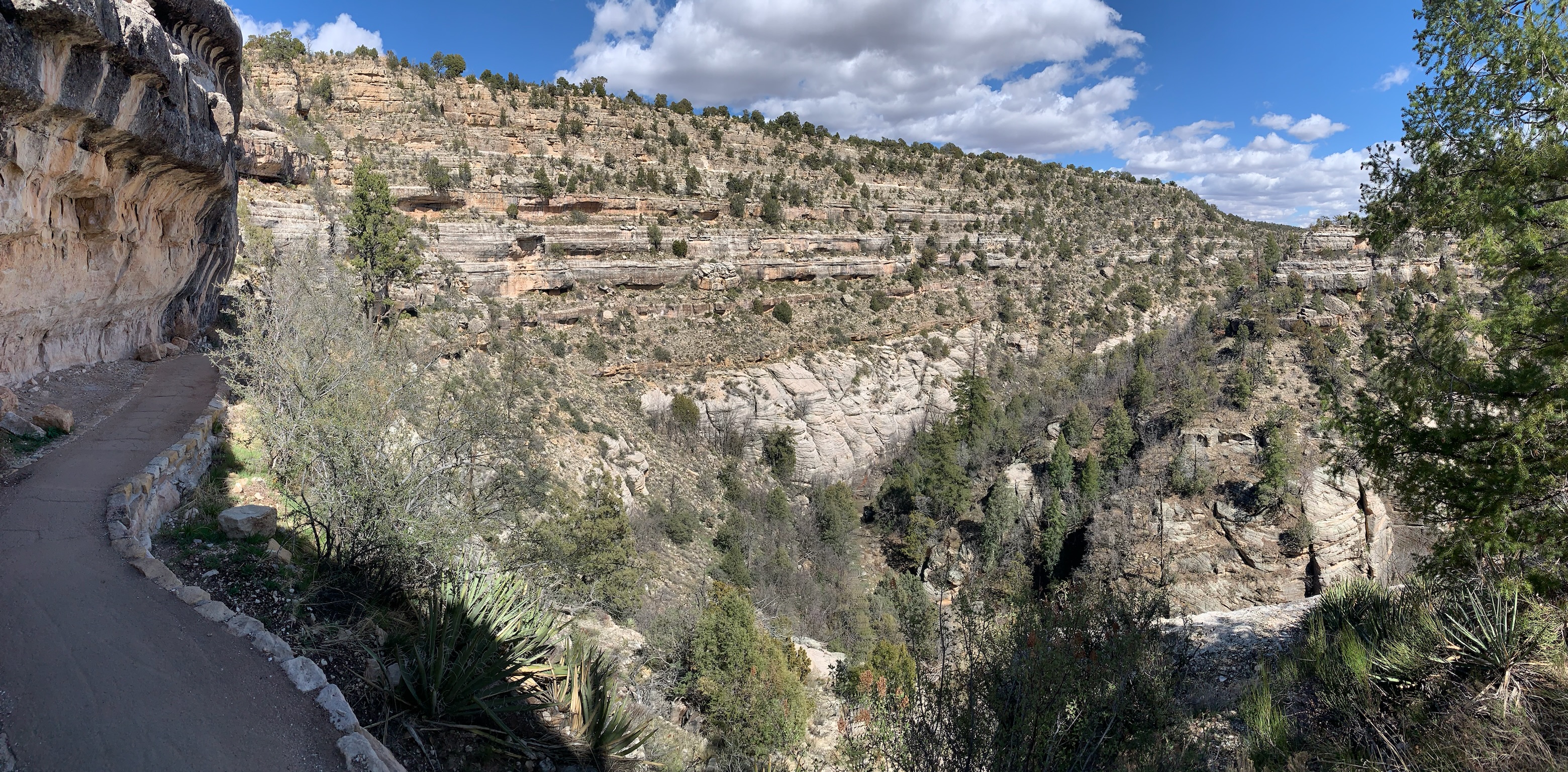
With a bit of hiking down into the canyon, you can walk right alongside many cliff dwellings and look across the canyon at more. The steps bring on a bit of vertigo and require extra breathing at around 6,500′, but the views are extraordinary. Plan ahead, since the Island Trail closes at 3:30 pm.

Both the alcoves along the trail and in the distance contain many cliff dwellings.

Click to see my photos of all national park units in Arizona.