Unlike any other park, Chamizal memorializes diplomacy. When the Rio Grande shifted course at the end of the 1800’s, it created an island and a seven decade long border dispute with Mexico. President Kennedy went to Mexico to finalize an agreement, and LBJ later participated in the joint ceremony at the border here. There’s a beautiful mural on the visitor’s center, and I remember from a previous visit that there’s a film that explains the importance inside.
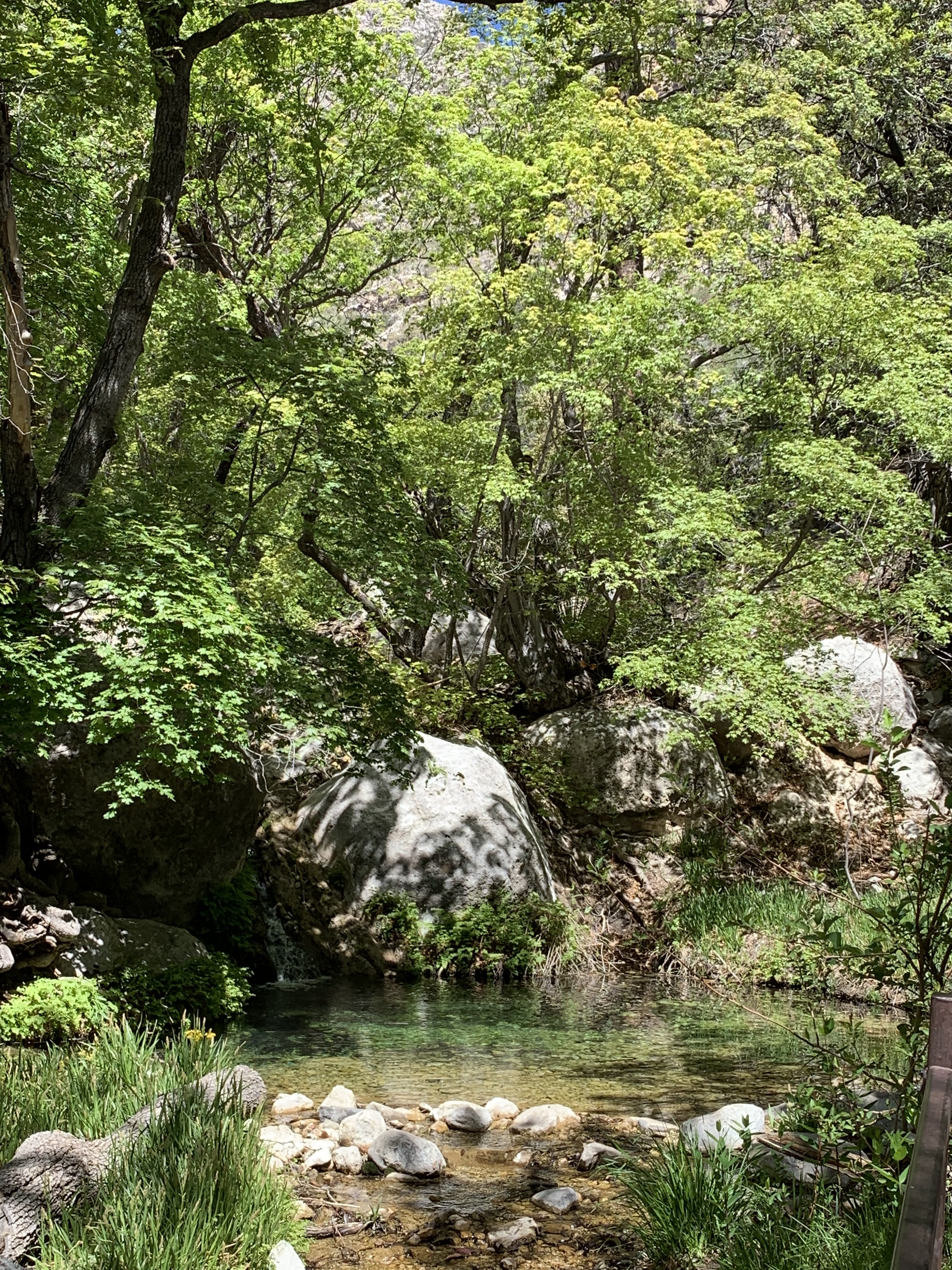
Even after planning, I still check with the rangers for suggestions on good hikes and photo ops. I originally planned to hike McKittrick Canyon, but the ranger suggested the trail at Frijoles Ranch instead, as its shorter and quite similar this time of year. The trail passes two different springs, including the mountainside one pictured.
Guadalupe is large, mountainous and mostly dry, which makes it both difficult to explore and also more barren than many other parks. But that’s what makes the occasional oasis above especially sweet.
This is an Indian Native American War era fort. Soldiers from here, including African American Buffalo Soldiers, fought Geronimo and the Apaches in Arizona, the Kiowas and the Comanche, patrolling the San Antonio-El Paso road against raids. President Andrew Jackson predicted it would take a thousand years for white settlers to replace the Native Americans in the west. In reality, the process only took a few decades.
I believe the goal of history should not be a recitation of events. I believe the point of history should be to learn from the past in order to make better decisions in the future. The people are dead. They don’t care whether we praise them or criticize them; that’s not the point. We need to evaluate past actions in the context of the times.
Columbus was an innovative navigator, whose initial voyage went against common sense at the time and changed people’s understanding of the world. He was also wrong about who the Natives were, and he treated them viciously. But he didn’t create racism or slavery. Those were taught in European universities, supported by the church and were the official policy of European governments. Those institutions, which still exist today, bear the responsibility for atoning for the evils of racism and slavery of colonialism.
Kit Carson was an accomplished explorer, who developed strong relationships with the Native Americans he met and traded with. He did what others did not dare and changed people’s understanding of the west. He also carried out a brutal scorched-earth campaign against the Navajo and marched them into internment camps. He neither created racism nor invented the policy of removing Native Americans from their land.
Andrew Jackson was an American hero for defeating the British in the Battle of New Orleans in 1815. He also fought many wars against the Native Americans, broke treaties and even defied Supreme Court orders to remove Native Americans along the Trail of Tears, leading to a legacy of depressed, poverty-stricken reservations. He should have chosen a different path, leading to greater education, cultural exchange, technology transfer, integration and cooperation. The US Presidency, Congress and the military, which still exist today, bear the responsibility for atoning for the evils of the wars and forced removal of Native Americans.
History must be studied to make these judgements and to recommend corrective actions whenever possible, otherwise we doom ourselves to carry the burden and even repeat our past mistakes.
Above the fireplace mantle in the sitting room where LBJ’s mother used to entertain guests is this rather macabre image of a skull. Only after the ranger told me that it was an optical illusion, could I see the image of a young woman looking at her reflection in her dresser mirror. The lesson for Lyndon was to look deeper and try to see things differently. His father was a state representative and taught him the art of politics. His wife, Ladybird, financed his campaign, and under tragic circumstances he becomes President.
The park film on LBJ’s legacy is a bit old but excellent, with recordings from Ladybird Johnson, Vernon Jordan and others. It’s difficult to imagine a time when a Democratic President could win in a landslide on a campaign based on Civil Rights and government spending to alleviate poverty. It also seems strange now to think that his downfall would be being too hawkish militarily in Vietnam. How much the country has changed since then. I wonder what would have been his legacy if LBJ had looked at things differently and decided to abandon the war instead of escalate. Perhaps he would not have withdrawn his candidacy and could have continued his ‘great society’ initiatives.
The first and most famous mission on the San Antonio River was San Antonio de Valero, better known as the Alamo, which is owned by Texas and managed by a non-profit. I grew up thinking of the Alamo as a fort, but it was a Franciscan mission, first of a chain built along the river with irrigation aqueducts, ranches, orchards, farms and homes. The riverwalk that connects the World Heritage missions is a pleasant place to explore the architecture, history, and culture of the area that’s known as the heart of Texas. Alamo actually means ‘poplar’ and refers to the Cottonwood trees along the banks.
Unlike their experience with the Pueblo Revolt at Pecos and across what’s now New Mexico and Arizona, here the Spanish missionaries largely completed their religious conversion and integration of most local Native Americans, aided by intermarriage over time. In return for Catholicism, disease and obedience to the crown, Native Americans built these missions, worked in the fields and defended their new communities. In the early 1800’s Napoleon invaded Spain and put his brother on the throne, opening the door to the independence of Mexico. By 1824, Mexico was a federal Republic and the missions were secularized.
General Santa Anna had trouble maintaining control of Mexico’s northern states. American merchants sold guns to the Comanche, and then the American settlers blamed the Mexican government for not defending against Comanche raids. The Mexican government insisted that settlers convert to Catholicism and tried to ban slavery, but American colonizers like Stephen Austin promised 80 acres of land for each slave new settlers brought. Slavery was an underlying reason for the Texas Revolution, as the settlers could use them to grow cotton and didn’t want the Mexican government to halt the immoral practice. Texas statehood legalized slavery, which subsequently boomed, and then they seceded and joined the confederacy.
While I grew up hearing heroic stories of Davy Crockett, it’s impossible to ignore the legacy of both Native American and slave exploitation represented by the Alamo, first as a Spanish mission and then as a rallying cry for Texas and for slavery. The Alamo website portrays pro-slavery Texan founders Stephen Austin and Sam Houston as freedom fighters for liberty and ignores the people they enslaved. Lying to our children about the dark truth of the founding of Texas is deeply wrong, perpetuates the injustice of racism, and prevents atonement and reparations. I did not visit the Alamo.
While not quite as large as the mammoth site in South Dakota, this is the largest fossil nursery of mammoths in North America. Unearthed by creek erosion, the first bone brought to nearby Baylor University confirmed the mammoth find. There’s now an active dig site enclosed inside a lab building. The rangers answer questions outside, due to Covid. The city of Waco extracts a small management fee, despite this also being a NPS unit.
The ranger explained that there’s some confusion over the term used to describe the mammoths, “Columbian”. First, it’s not Colombian, meaning from the South American country of Colombia. Second, it’s not “pre-Columbian” which is used by anthropologists to describe Native American civilizations in the Americas before the arrival of Columbus. It’s Columbian, meaning found in the Americans, either before or after Columbus visited. It’s not known exactly when the last mammoth was extinguished by humans, but we do know that humans will drive a massive wave of species to extinction with our carbon pollution, unless we confront the crisis now.





 Zero Carbon Travel