Best paddling day yet! I took the Cooks Lake to Scatterman Paddling Trail, and the middle section is like a slalom through the trees. A local canoe guide told me about the old trees above, several of which are over a hundred and fifty years old. The loop is about 5 miles and goes up through some low current dead ends and back downstream via the Naches River, so it’s not a difficult paddle. The only trick is to explore the flat water, try to get a close up of the snapping turtles before they jump back in the water and try to quietly sneak up on the wood ducks before they take flight. Blue skies, green leaves and muddy water. Glorious.
After so much frustration trying to kayak the Rio Grande, this has been a slice of paradise in the Big Thicket, supported by another excellent Texas State Park (Village Creek) and an exceptional local restaurant (Tia Juanita’s Fish Camp). Remind me to winter here for the rest of my life. My main suggestion is to budget more time for this area. There are roughly eight different sections of Big Thicket to explore, miles of paddling trails and nearby state parks including beaches. My final Texas park unit is one of my favorite parks for paddling.
I joined a few kayakers at Bird Island Basin to explore the Laguna Madre on the calm inland side of Padre Island in perfect conditions and enjoyed close up views of well over a dozen bird species fishing in the murky salty water, resting on the muddy beach and hopping around in the low grasses & brush. As usual, I wasn’t able to take good photos while bobbing along in my kayak, so here’s one I took from my car window of a Laughing Gull. With a number of birders in my family, I tried to identify at least a few of the endangered species: Reddish Egret, Least Tern, Brown Pelican, White Tailed Hawk, and at least two of their three endangered Plovers. Including the ocean side and sprawling grassland, there were Ruddy Turnstones, Curlews, Willets, a Tricolored Heron, and various ducks, sparrows, and raptors, and who knew there were so many different types of terns?
After the birds, Padre Island belonged to Native Americans first, and the visitor center and beach nearby are named after the Malaquite. The Spanish claimed it next, and silver treasure was found from one of their shipwrecks. Then the Republic of Texas claimed it, and finally the US won it in the Mexican American War. A Padre who collected funds for Rio Grande missions built a home here, prompting the name as well as the companion name for the lagoon. The Laguna Madre stretches into Tamaulipas Mexico and is the largest hypersaline coastal lagoon in the world, a critical stop on the flyways for many migratory birds in the Americas.
Prior ranching, military use and driving on the beach make the island less than pristine, but the park service has helped recover Ridley and other sea turtle populations here. There are specially adapted birds, fish, crabs, shellfish, reptiles, bugs, and other animals here, some of which live nowhere else. Unfortunately, fossil fuel drilling is still allowed in this area, which threatens all species in many ways, especially by climate change and rising seas.
[Note: Starting today, I’m switching to Monday, Wednesday & Friday posts to keep more up to date.]
The strange elk in the background are actually Nilgai, an Asian Antelope that escaped from a ranching project and now live in the park. In a way, it’s appropriate to start with an invasive species, since this park marks the start of the Mexican American War. In the 1840’s President Polk campaigned on expanding the country westward and as President sent troops to the Rio Grande, even though Mexico viewed it as their territory. Mexico, having only recently won its independence in 1821, was having trouble managing its northernmost territories, and lost control of much of Texas during a revolt by American settlers in the 1830’s. When Mexico’s army crossed the Rio Grande to expel the interlopers, Polk claimed that America was under attack and the war was on.
Mexico laid siege to a small fort on the north bank of the Rio Grande, and US troops were rushed in from up the coast to reinforce it. The two forces met in the middle here in a dry part of the delta. The US had better artillery, and the Mexicans had more men. The US troops were under command of Zachary Taylor, who later turned his war fame into a successful run for President, and many veterans of this battle would go on to serve in the Civil War. Lt. US Grant, who opposed war with Mexico personally, engaged in his first battle here. Between heavier guns firing more deadly shells, light guns quickly turned to face flanking attacks, and well trained US troops who engaged in hand to hand combat between here and the fort, the Mexican Army was forced to retreat. Around 100 Mexican troops and 10 US troops died in battle here.
Today the field is marked with flags and cannon to show the positions of the two sides and ‘interpretive exhibits’—small signs—to explain what happened in different places where the troops faced off. Closer to Brownsville, there’s a much smaller battlefield, the Resaca de la Palma, where the Mexican Army bravely made a stand to protect their retreat. There is a viewing platform of the resaca, meaning ‘often dry river delta channel’ (and not ‘hangover’, as the word means today). The siege of the fort was lifted, but the fort’s leader Major Brown and one other US soldier were killed in action. The fort and eventual city, Brownsville, were later named for the young officer.
Although the site only covers the first week of the war that took place in what’s now the US, the war raged on for two more years with US troops taking cities deep into Mexico, until Mexico agreed to cede Texas and sell its rights west all the way to the Pacific. Mexico lost 1/2 its territory and the US doubled in size. As interesting and consequential as the history is, the site is a well-marked field with a path for each army, so it requires some imagination and curiosity to appreciate. The small visitor center is educational, bilingual, has an informative film, and has enthusiastic and knowledgeable rangers and volunteers. But by all means go out on the battlefield, if only to see the wildlife. I saw over a dozen Nilgai, several hawks hunting in the tall grasses, a crested caracara, and more. This is a well-known area for birders.
In 1969, just below the confluence of the Rio Grande, Devils and Pecos Rivers, a dam was built, creating Lake Amistad (friendship en Español). The lake caused the mouths of the Pecos River and Seminole Creek (above) to silt up, and now that the water level has fallen (like Lake Mead and Lake Powell) they’re cut off from the Rio Grande (see far right). Most of the boat ramps, like the small dock at the cave above, are no longer accessible. The lake is far below minimum expectations, because the US diverts virtually all the Rio Grande water before it even reaches Big Bend. From there most of the river comes from Mexico’s Río Conchos. The park is run in partnership with many agencies, and the two towns that share the border are friendly and have joint cultural festivals annually. Mexico maintains a small fishery, US residents enjoy bass fishing, and the border is marked with buoys. I took one of the old highway ‘spurs’ straight down to the water, but it was too hot to kayak in winter.
Panther Cave, across the canyon above, is on the far western park boundary. While the park film absurdly claims that “no Native Americans have any ties to the area”, the canyon is Seminole Canyon, and the cave is an important site for prehistoric cave art. The Amistad visitor center has information and large reproductions of the cave art, and the excellent Seminole Canyon State Park has morning ranger-led tours to another similar cave and a few miles of hiking trails to see the view above. Before man dammed and drained the rivers and destroyed the riparian ecosystems, Native Americans must have traveled up the Rio Grande to Albuquerque, where some of the oldest petroglyph art was created at the same time as the art here. Sitting on the cliff above observing the wildlife, I imagined prehistoric people hunting, traveling by canoe, drawing on the cave walls and protecting their families from panthers, until thunder warned me to seek shelter.
Santa Elena Canyon, like many of the sights here, is majestic with 1500’ cliffs, with Canyon Wren staccato song echoing back and forth, and elusive beavers hiding along the banks. The Rio Grande enters the park through here, departing through Boquillas Canyon. They don’t make it easy to get a river pass, apparently preferring guides. I wasn’t allowed to kayak without two PFD’s?!? But the views from the trail are spectacular.
The middle of the park is dominated by the chiseled Chisos Mountains which have impressive wildlife including bears, mountain lions and rare birds, challenging hikes and a good restaurant. And the views stretch for miles in all directions across desert, scrub, dry creeks, gullies, plateaus and rocky outcroppings of all shapes to more distant hills, mountains, mesas and empty space. Sunset is best from up here, and the lodge has a bar and large patio with a great view of the basin. There are some ranger activities each week, but mostly you’re on your own out here, with terrain, heat, wildlife and distances that make hiking potentially dangerous. So take care.
A trip here needs 3 days just to visit all four corners, and there’s only one electric campground (Rio Grande Village RV) which was booked solid. Still, I was determined to avoid burning carbon, so no guided tours. I charged outside the park at the classy Gage Hotel and in Terlingua, at a Juicebox behind a brick wall in a construction site that rents Jeeps. I spotted three other Teslas and a Volt in the park, but you need to be thoughtful about charging (and not forget your hotel key and have to drive back to return it). I needn’t have worried. Since the park speed limit is 45, my range was better than expected, especially after turning off the climate control and opening my windows.
People are seriously damaging nature, as seen in both the devastating 2019 Castalon Wildfire, which destroyed the historic visitor center and store, and the drastically reduced water volume of the Rio Grande. Large gas vehicles with bad mpg should be named “Chevy Smoker” or “Ford Smog” and their drivers need bumper stickers like “I ❤️ Wildfires” & “I ❤️ Hurricanes”, because that’s what they’re exacerbating. Folks who live in western communities with golf courses, water features and ornamental plants, should name their neighborhoods “Wildlife’s End” or “Extinction Junction”, because they’re diverting rivers from our public parks, destroying ecosystems. Too many folks live in denial of the Climate Crisis, while driving a ‘Denali’ and living in ‘Ocotillo’. If you’re still using wasting gas and water in the west, then you shouldn’t pretend you like nature. You obviously don’t care enough.
The Rio Pequeño (not grande with this low water) enters the Boquillas Canyon here and continues down to Amistad. Hiking into the canyon along the border, there are few signs of the modern world, and I suddenly felt like I was in a classic western movie when I heard horses approaching. Three horse riders offered handcrafted souvenirs and chicken tamales as they passed, and when one was crossing back to Boquillas Mexico on horseback, his horse had to bend down to knee level to drink from the middle of the river. Hardly worth crossing by rowboat at the port of entry, when folks were wading across the river. (Yeah, yeah rules, but no harm no foul with kids just playing in the water).
The Climate Crisis is playing havoc with my plans. Not sure when I’ll get the kayak wet this trip. A few days ago, I was trudging through the snow in Zion, and here in winter the temperature hit over 100 degrees on the trail. Best to visit in February, and always bring plenty of water. Last year I just carried a water bottle, but now I use a 3L hydration pack with another 5 gallon container in my car. The heat is no joke; a hiker died here just a few days ago, one more of many.
Due to low water and logistics, I’m only exploring the river from the dusty trails and grand overlooks within Big Bend. The US and Mexico protect 200 miles of land alongside the river, including the canyon above, another at Santa Elena and a big reserve on the south bank opposite Big Bend. In particular, there’s a nature trail at Rio Grande Village, where I spotted a half dozen bird species in minutes, including a Great Blue Heron and my first sighting of a Black Phoebe flycatcher. It’s unfortunate that so many communities take most of the river water without considering the downstream impact on birds and other species. I know people pay extra for golf courses, ornamental plants and water features, but national nature reserves suffer directly as a result. Americans need to invest in solar desalination facilities and leave rivers alone.
From 1889 to 1965, the school was segregated, separate but equal by ‘social pressure’ (i.e. racism) in Texas: Hispanic only. Our diversity is a great strength and should be celebrated, not used to divide us. When the Civil Rights movement integrated Marfa’s schools, Blackwell closed. Later some of the proud alumni organized to preserve their school building and grounds, and President Biden has now designated it an official park site, joining other schools in the system, such as Abiel Smith, Penn, Brown, and Little Rock, and joining César Chávez in covering modern Latino history.
[Updated] On 17 July 2024, Blackwell became the 430th park unit, after completing acquisition of property from Marfa’s school district. When I visited, Blackwell was only open noon to 4pm on weekends—not the same time zone as El Paso—, and restoration plans were being decided. Inside are personal photos that bring back the old days, describing Principal Blackwell, teachers, students, athletes and community events. Hopefully, future exhibits will help bring those stories to life with a park film.
In 1955, Hollywood came to Marfa to film James Dean, Elizabeth Taylor and Rock Hudson in Giant. Before that the biggest thing to happen in Marfa was their baseball team, the Indians, competing for the championship in ‘29 and ‘48. Nowadays, Marfa is known for eclectic art exhibits and UFO’s. Just outside of town is a Prada display by the roadside, and if you go the other way, people watch the mysterious lights on the horizon that just have to be aliens. (Really, there’s no other explanation possible!).
I passed nearby Marfa when visiting Fort Davis, and it’s fascinating to me that the original stone school here was built while the fort was still in operation. I recommend staying at one of the quirky campgrounds like El Cósmico which has Tesla engineer designed Jupe shelters and getting local wine and pizza at Para Llevar (to go en Español). And just wander around this weird town that defies becoming a ghost.
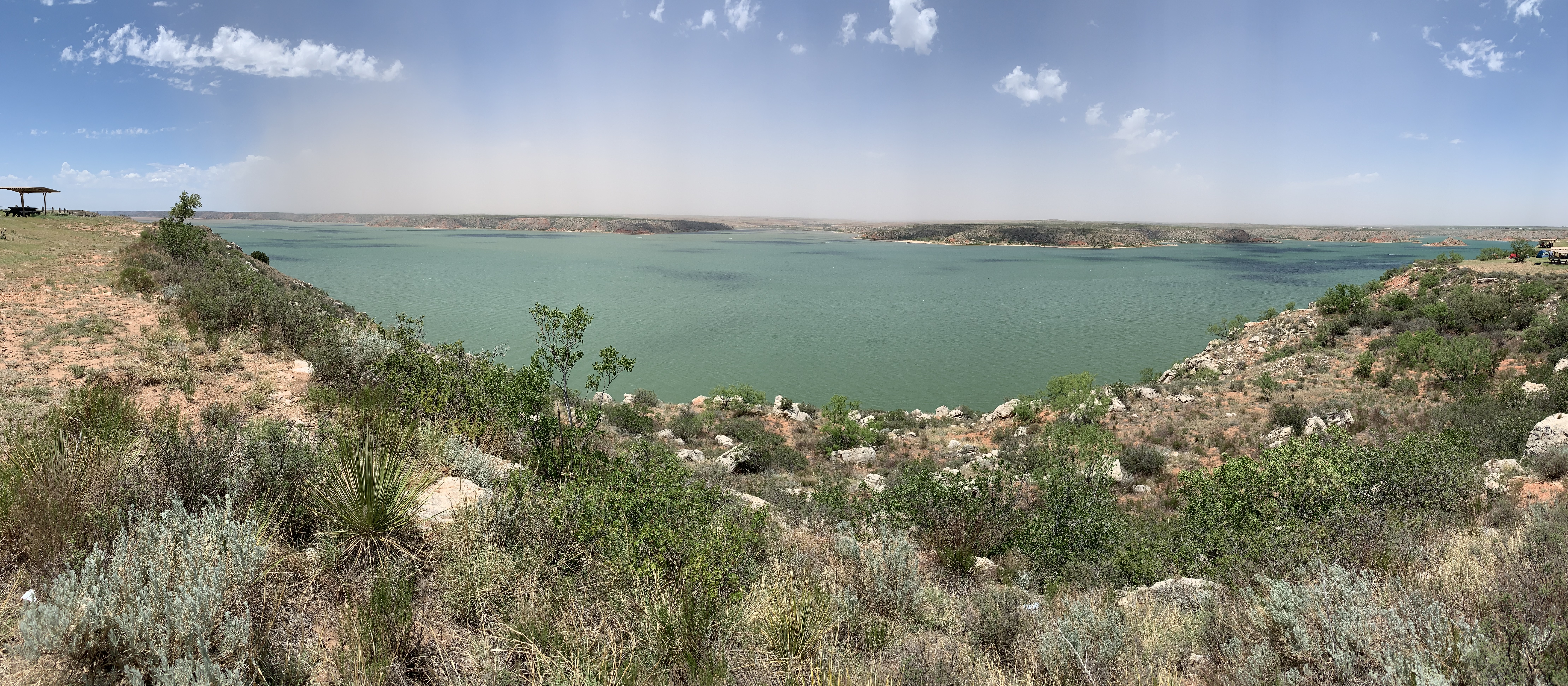
The Canadian River flows from the Colorado/ New Mexico border through Texas and joins the Arkansas River in eastern Oklahoma, but a dam here creates Lake Meredith. I had planned to kayak here next year, but I think I’ve decided against it. Most of the water craft are loud, fast, gas-guzzling powerboats, the lake has shrunk dramatically due to water diversion to cities, and Spring Canyon where the park service once had wildlife paddling tours is now more of a separate small pond.
When Congress sets aside these areas for recreation, there’s some effort made to protect the natural beauty, but it’s mostly done for the benefit of only one species: us. There’s a garden in this NRA for the monarch butterfly migration at the visitor center for the neighboring Alibates Flint Quarries, but it is ridiculously tiny. I can’t see how migrating birds could use the lake with all the motorboats. The lake is more of an artificial water park, rather than a wildlife refuge. On the interstates, I see signs for “wildlife parks”, which are basically zoos. But once animals are locked up in cages and fed, they are no longer wildlife.
I don’t think people understand (or care) that once the real wildlife is gone, it will be gone forever. Our government needs to prioritize saving species, due to the climate crisis, and that requires leadership to make significant changes right now. There should be a cabinet-level biologist directing policies across government to make sure we maximize the chances for species to survive. Water parks and zoos can be built anywhere with recycled water, but natural ecosystems need to be protected, especially along our western rivers.
This little lady is an Eastern Collared Lizard, and she’s sitting on Alibates flint, which is an extremely hard and unusual type of flint used by Native Americans for sharp edged tools. These flints were used to hunt Mammoths (possibly to extinction) by the Clovis people over ten thousand years ago. (Clovis is the New Mexican town where they were studied). Successive groups of natives used these flints, notably the Antelope Creek tribe, who dug hundreds of quarry pits around here to dig out the best quality, unweathered flint, and traded them as far as Montana, California, Mexico and Alabama.
I’m not particularly interested in geology, but this was the funniest parks tour I’ve taken. The ranger, Ben, somehow got ten strangers roaring with laughter in ~100 degree heat while climbing a hill to look at rocks and taught us all lots of interesting facts along the way. He even got a Texas Horned Lizard (or “horned frog” or “horny toad”) to scramble in front of us, so we could all get a good look at the official lizard of the state. Actually, the only way into the park is by guided tour, and the only tour during the heat of summer is at 10am. Better to call and make a reservation.
If you are into geology, then this park is fascinating. There’s petrified algae, iron rich red beds, fossilized dolomite, salty gypsum, and of course the multi-colored, sometimes sparkly, agatized dolomite, known as Alibates flint. That name came from a cowboy guide named “Allie Bates”. Mysteriously, perhaps from Valles Caldera or Yellowstone volcanic activity, there was an abundance of silica-rich water that seeped into the dolomite and crystalized into a dense quartz along with an array of other colorful minerals. The flints have many of the rich colors and patterns of the mineralized trees found in the Petrified Forest.
I stayed the night in Palo Duro Canyon (2nd in size to the Grand Canyon) which is another great location for views of the colorful red, white, orange, and yellow rocks under a blue sky with lots of different green trees and plants. The night sky was also brilliant. Any recent rain can close roads though. There was a summer musical playing there for Texans about how wonderful the history of Texas is, but of course, it glosses over the theft of native lands and doesn’t mention slavery at all. It never occurred to me that Texans would be so insecure.




 Zero Carbon Travel