Like several of the Revolutionary War sites in the south, the park is closed Sunday through Tuesday, but I was able to enter the reconstructed stockade above. The patriots briefly captured it in 1775 but failed to take the star shaped fort nearby. The earthwork remains are still preserved after centuries. The star fort design was used by the Spanish in St Augustine, the British here and by both the Union and the confederates. With just a few troops needed to defend it, the design provides overlapping fields of fire protected by crossfire gauntlets.
Popular among war buffs, here the patriots won an impressive victory against the British. The British commander was a young hothead named “Bloody” Tarleton who had recently killed over 100 men flying a flag of truce at Waxhaws. The patriot commander was 45 year old veteran Daniel Morgan. Morgan chose the site due to thick woods and canebrakes (sugar cane thickets) that would make flanking difficult for the advancing British. His light skirmishers volleyed and fell back, and then his next line was to do similarly. They muffed it, and the British rushed forward, expecting a rout. The patriots about-faced and fired point blank. The British front line faltered while the back was still advancing, and then William Washington’s cavalry, which had emerged from a low spot to keep the enemy cavalry at bay, turned and flanked from the other side. This classic pincer or double envelopment movement is difficult and rare, yet it has won victories for thousands of years.
Tarleton was forced to retreat with his cavalry, reporting over 100 dead and 700 captured. He blamed his troops. After the war he served in the House of Commons, where he argued for continuing the slave trade.
The Mel Gibson movie “Patriot” is based in part on the battle between Morgan and Tarleton here.
After the British took Charleston, they moved inland trying to gain momentum and more loyalists. Here, they lined this narrow ridge with skilled marksmen prepared to defend the high ground. The patriots had troops moving overland from the northwest and local milita massing on the other side. Using Native American tactics of advancing from tree to tree, the patriots were able to get close on both sides and catch the defenders in a deadly crossfire. Having learned that the British commander was wearing a checkered jacket, they targeted and eliminated him, winning a decisive battle here.
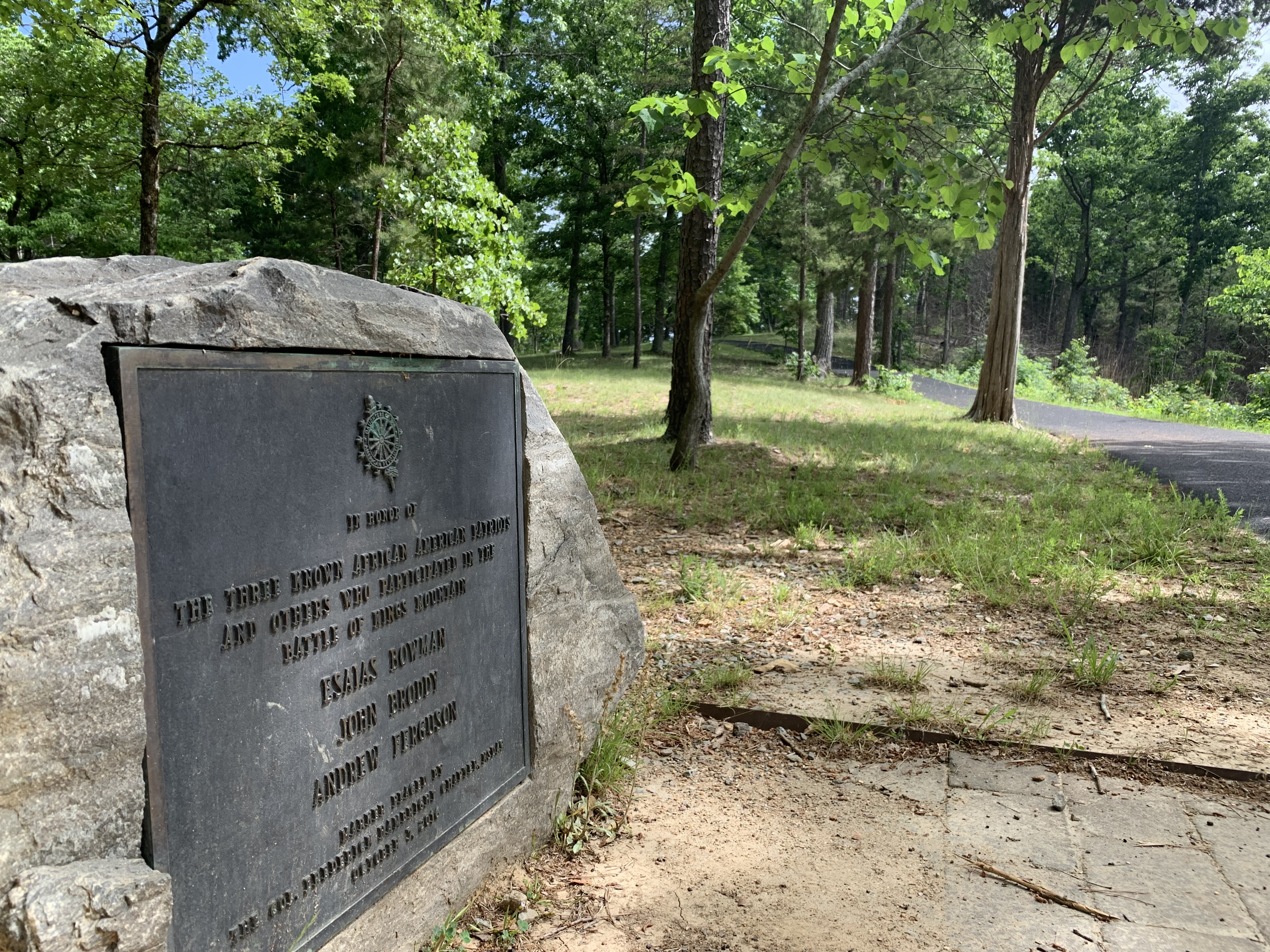
The first of the three African American patriots memorialized above, Elaias Bowman, was a free militiaman, one of several who shot the British commander. For some reason that I can’t fathom, there’s a far bigger memorial to the British commander, a Scot named Ferguson, and local visitors speak of him fondly, often leaving stones near his marker. I left a stone for the patriot Bowman instead.

 Zero Carbon Travel