Selma to Montgomery National Historic Trail

Dallas County Alabama systematically denied its 15,000 African American residents from registering to vote, using poll taxes, literacy tests, white-only primaries, and grandfather clauses, which made registration easier for those whose ancestors voted when only whites could vote. In 1963, with older people intimidated by murderous KKK raids or being fired for speaking out, organizers asked local high school students to protest. They did, meeting in churches—the only places they could safely assemble—and they were trained in non-violent protesting. Students marched by the thousands, staged lunch counter sit-ins, were beaten and arrested. All civil rights meetings were then banned by a local judge in 1964. Then, the Reverend Dr Martin Luther King, Jr came to Selma to speak in defiance of that ban, bringing national media attention. The contrast between black citizens, old and young, assembling peacefully to try to register to vote, and the police who denied their rights violently—criminals with badges—was to play out on TV. 

The teachers marched with their students. The police filled the jails with hundreds of students. Beatings outside churches turned uglier, and on 18 February 1965, while protecting his family, Jimmy Lee Jackson was shot to death by a police officer who was not punished. In response, the people decided to march 54 miles to the state capital in Montgomery. The police responded at the Edmund Pettus Bridge—the first step in the march—with billy clubs, horses and tear gas. Bloody Sunday, 7 March 1965. The TV coverage made the protest national overnight. Dr King organized a second march, but stopped on the bridge to avoid violence and due to a federal injunction. Rev James Reeb was killed on 11 March. LBJ called out the national guard, saying “we shall overcome” in a major speech 15 March. On 17 March, a judge cleared the injunction. Then Dr King led a third march, all the way from Selma to Montgomery from 21 to 25 March. Singers like Sammy Davis Jr, Nina Simone, and Harry Belafonte encouraged 25,000 marchers along the route. Upon arrival at the statehouse, Dr King gave his “How Long, Not Long” speech, including the phrase, “the arc of the moral universe is long, but it bends toward justice”. LBJ signed the Voting Rights Act on 6 August 1965. 

Selma may have been the turning point that enfranchised millions of African Americans, but the city and surrounding ‘black belt’ in central Alabama has suffered economic exclusion. Burned out buildings are common there today. The national park service is currently renovating several historic buildings in Selma including an interpretive center, and there’s also a Voting Rights Museum just across the Edmund Pettus Bridge which has an excellent, detailed display. Selma’s sights include the churches, lodgings and offices used by the organizers, and the jail where they were incarcerated. Halfway on the trail, near where Viola Liuzzo was murdered by the KKK, the park service has another interpretive center with an excellent multimedia film. Along US 80 are the four campsites used by the marchers.  And on the campus of Alabama State University in Montgomery, there’s another interpretive center with a different, also excellent film. And Montgomery sights include the state Capitol, a memorial designed by Maya Lin, and the Rosa Parks Museum, along with various archives and gathering areas. The drive is easy, and I recommend all three stops for the complete experience. 

The King Center in Atlanta gives a broad and deep view into the life and works of Dr King, as well as the ongoing non-violent international justice movement. The Birmingham Civil Rights Institute explores how deeply segregation divided society, how violent the oppression became both across the street in the park and at the 16th Street Baptist Church where four young girls were killed by the KKK in a bombing, and how strong the Civil Rights Movement became. But the Selma to Montgomery trail, with its searing photos and video testimony of foot soldiers, brings history to life. The open racism (see photo) is shocking and revealing. In one of the films, a white woman argues that since Jefferson Davis was their president, Lincoln’s Emancipation Proclamation has no effect, that slavery is still the law. Such vile hatred does not dissipate overnight. Indeed, in both subtle and ugly ways, racism still divides our society. So we must feel this history again to continue fighting more effectively. 
Emmett Till and Mamie Till-Mobley National Monument

”Let the people see what they did to my boy.”

Mamie Till-Mobley

The animosity against African Americans, especially in the Deep South, is hard to comprehend, but it is deep, real, persistent and extremely dangerous. Emmett Till’s mother warned him, but even she underestimated the risk. In late August of 1955, Emmett Till was kidnapped from his great uncle’s home by a shopkeeper’s husband and his half-brother, who accused Emmett of whistling at the shopkeeper, a white woman. From past midnight to pre-dawn, the two men, along with several others, held Emmett, aged 14, in the back of a pickup truck, drove around the county, terrorized him, tortured him, shot him and dumped his body in the river. Witnesses reported hearing Emmett’s screams all over town for hours. His great uncle reported the kidnapping, the men were arrested, and the body was found a few days later. His mother, saying “let the world see what I see”, insisted on an open casket at the funeral in Chicago. Jet magazine published photos of his brutalized body. His mother became a lifetime activist, author and motivational speaker on education, poverty and Civil Rights with the NAACP. Many consider Emmett Till’s killing to be the beginning of the Civil Rights Movement, not least because Rosa Parks cited Emmett as the reason she kept her seat on the bus in Montgomery on 1 December 1955. 

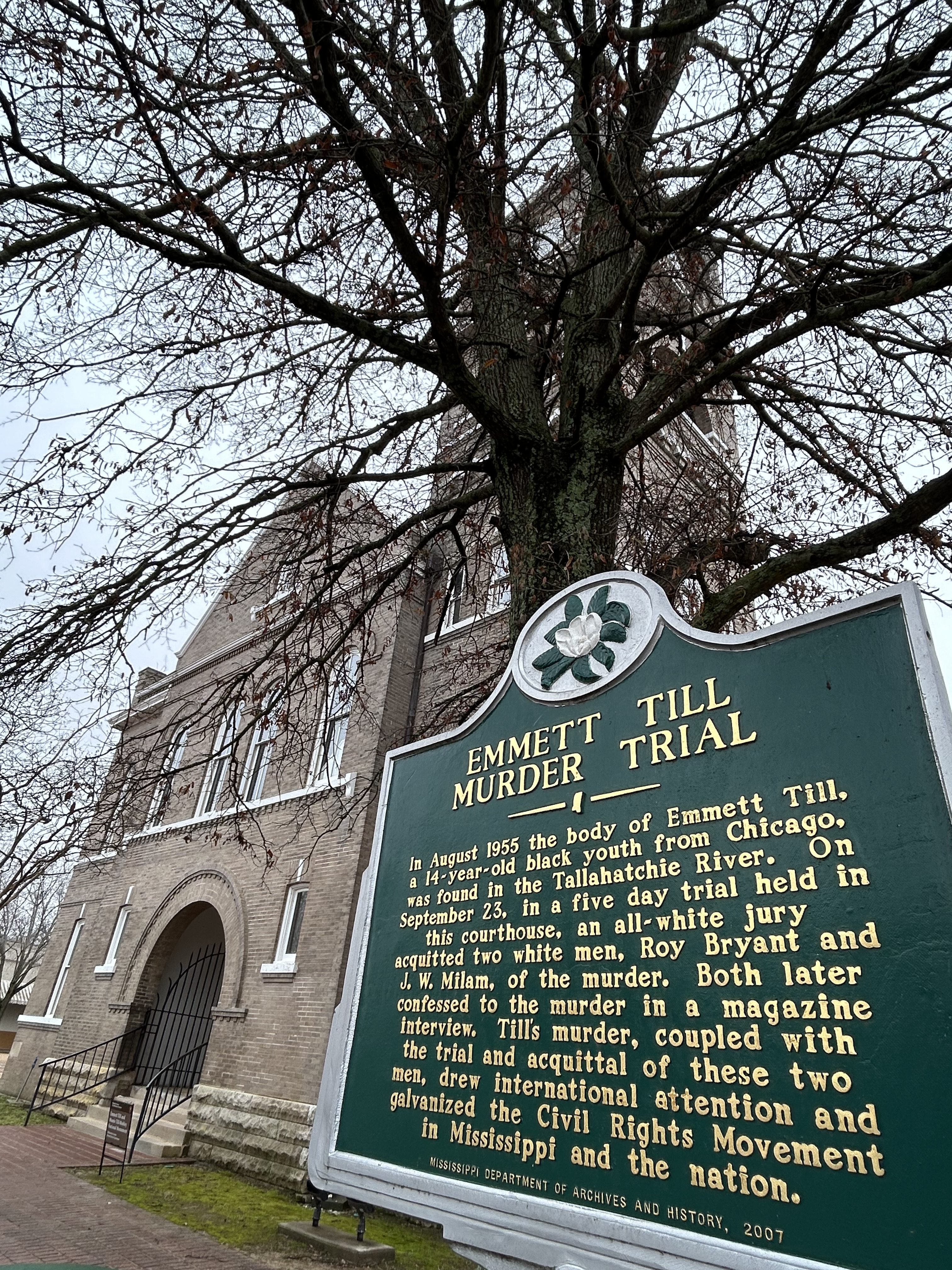
The trial was a foregone conclusion. Outside the courthouse (below) stood a statue dedicated to the “Heroes” of the Confederacy. Inside there was no justice. Instead of jurors, police, court officers and elected officials defending the Law, the courthouse became the focal point of a deep criminal conspiracy, based on racism. Witnesses were intimidated, hidden, immunized and silenced. Emmett’s great uncle testified at the trial, pointing out the kidnappers and murderers, and then he left town immediately and went into hiding under a false name. And for many years afterwards, there has been a concerted effort to conceal the truth. Evidence lost. Signs have been repeatedly shot and torn down. Historic artifacts and structures intentionally left to ruin or demolished. One witness, in hiding for decades under another name, still received death threats demanding silence. The confederate statue still stands in front of the courthouse, just left of the photo. 

But despite the legacy of lies, terror and violence, people still work to tell the truth about Emmett Till. Especially if you’re exploring the new monument’s sites in Illinois and Mississippi, I recommend reading the darkly fascinating stories in the Emmett Till Memory Project app, after being introduced to it by one of the contributors at the Emmett Till Interpretive Center across from the courthouse in Sumner, MS. Emmett Till’s coffin is on display at the National Museum of African American History and Culture in Washington DC. His name was given to the Anti-Lynching Act of 2022. And this new national monument was established by President Biden on 25 July 2023, on what would have been Emmett Till’s 82nd birthday. 

Gulf Islands National Seashore (& Admiral Farragut)

While I like the park and plan to visit it again in warmer weather, the seashore skips over the most important section in the middle. In Mississippi, the park includes the Davis Bayou (photo below) with a nice visitor center and park film, and from mid-March to October you can take a ferry out to Ship Island, look for bottlenose dolphins, explore the beaches and visit a Civil War fort. In the Florida section of the park, there are also birds, long stretches of storm-swept and once segregated beaches, old forts first built by the Spanish and later used by the Confederacy, and another visitor center (closed when I tried to visit) to explore near Pensacola. But the Gulf Islands of Alabama are not part of the national park unit. Forts Gaines and Morgan, the guardians of Mobile Bay, are Alabama State Parks. But that’s where the action was. 

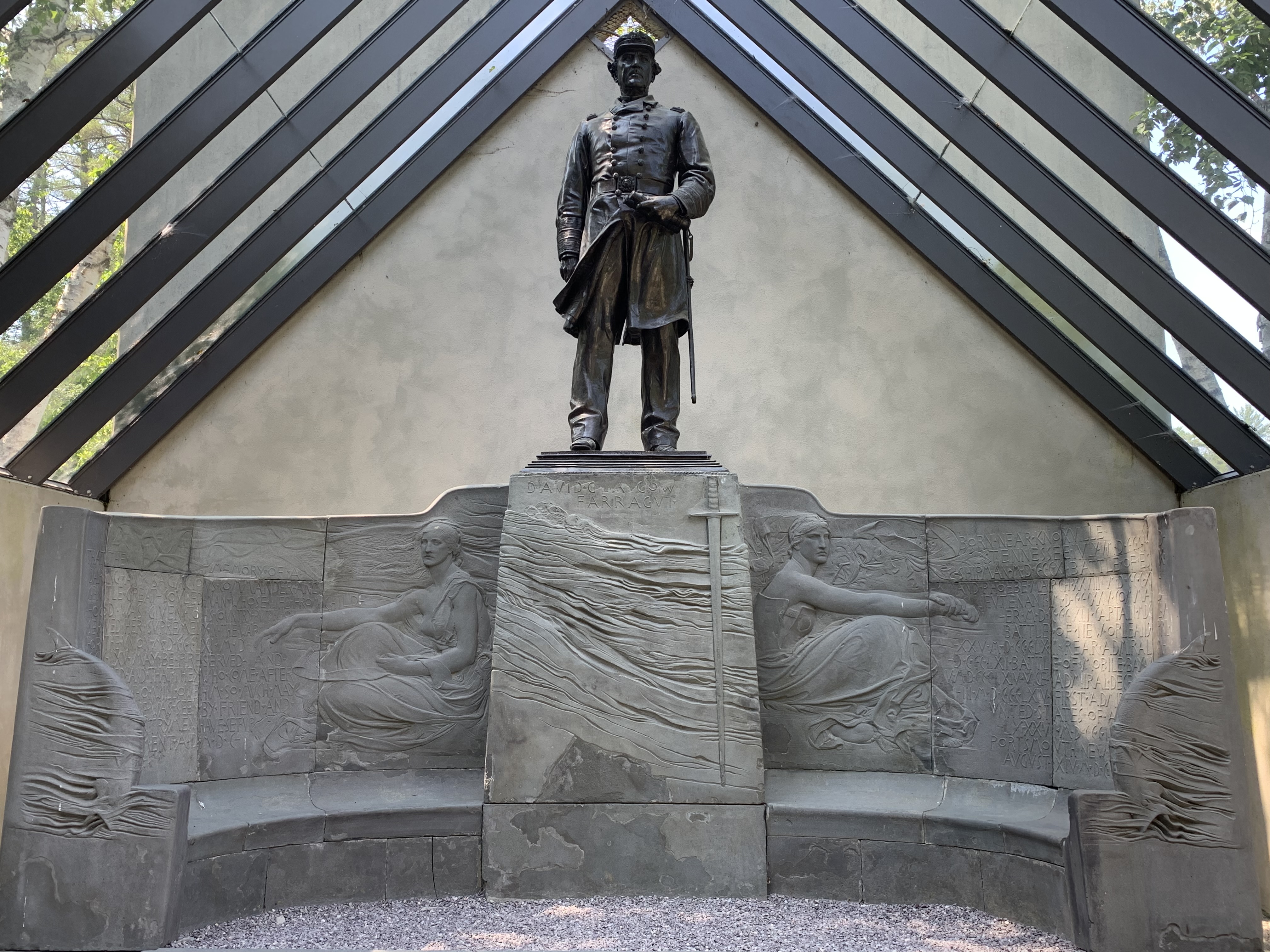
General Grant relied on combined naval and land forces to take Fort Donelson in February 1862, which cut off the Cumberland River from the Mississippi. In April, Flag-Officer David Farragut (depicted by Gaudens above) began his gulf coast campaign by sailing up past the forts guarding the Mississippi and taking New Orleans. After the Union freed the city, three regiments of African American troops were quickly organized, and many of those men first served on the Gulf Islands, helping retake the forts along the gulf coast. In June, Farragut was wounded near Vicksburg. 

The Confederacy’s last large port was Mobile Bay. In 1863 the Union took Vicksburg, but to speed the end the war, now Rear Admiral Farragut needed to sail past the forts guarding Mobile Bay. In 1864, the Confederacy, having learned from their mistakes in New Orleans, had heavily reinforced Mobile Bay’s naval defenses among the many fortifications along the Gulf Coast. Fort Gaines guarded the shallower west side of the bay, and Fort Morgan guarded the deep water ship channel from the east side. The gaps were filled with floating sea-mines, called ‘torpedoes’ at the time. And the port was guarded by the massive ironclad CSS Tennessee, the most powerful warship in the world. 

Farragut had four small new ironclad ‘monitors’ leading his fleet: the Chickasaw, Manhattan, Tecumseh, and Winnebago. He decided to run the gauntlet up the main channel into the large bay, boldly trying to move fast and far enough to get out of range of Fort Morgan’s guns. Under fire from the fort, the Union navy advanced with its ships lashed in pairs with the monitors on the side taking the heaviest fire. Farragut climbed into the rigging to get a view above the thick smoke. The Tecumseh crossed a mine field to engage the Tennessee, exploded one and sank immediately with 93 lost. 

Seeing his fleet hesitating and the Tennessee closing in, Farragut yelled down something to the effect of “damn the torpedoes, full speed ahead!” The remaining monitors surrounded the Tennessee, disabled her and eventually blasted a hole, injuring the Confederate Admiral. The rest of the fleet entered the bay, got behind the forts, and shelled them. The Army, including African American regiments from New Orleans, approached the forts, which surrendered, first Gaines without much of a fight, and then Morgan after a heavy siege. 

Mobile Bay was closed, cutting off supplies to the Confederacy. And the Confederate Army was tied down defending the city, helping open up Sherman’s march to Atlanta. While Alabama’s Gulf Islands are not part of the national park service site, they are in the middle of the line of hurricane barrier islands and sandy peninsulas where this major Civil War battle was fought on land and sea. Admiral Farragut and the Union Navy’s contributions to ending the Civil War must not be forgotten. 

Big South Fork National River & Recreation Area

The Big South Fork is a 76 mile tributary from the Cumberland Plateau in Tennessee that joins the Cumberland River between Cumberland Falls and Lake Cumberland in Kentucky. The Falls are the second largest east of the Rockies and are the best place to see a moonbow on this side of the planet. Unfortunately, Kentucky has a littering problem, so Cumberland Falls State Park is also a place you will see trash in and along the river.

The Big South Fork looked better when I kayaked from Blue Heron to Yamacraw above (Sheltowee Trace Adventure Resort has a shuttle). Non-native insects killed many pine trees years ago, so the forest has more hardwoods now. Pollution upstream still degrades the water, but Appalachia is recovering from the damage done by coal mining. Blue Heron campground made a good base to charge my car and explore the old mine exhibit there, even though the tourist rail line to town is under repair.

The gorges and remote roads make it difficult to get around, so I recommend paddling if there’s enough water. I saw a young deer and a bald eagle on the river and enjoyed looking up at the cliffs. The hiking is excellent too, and my favorite was hiking under the huge rock shelter behind 113’ Yahoo Falls. There’s also a large natural bridge called Twin Arches. The area is thick with trees, which makes it difficult to see all the geological features of the gorges, but the lush dense foliage gives the river a primordial feel, especially since I saw not a single person while kayaking.

Obed Wild and Scenic River

Lilly Bridge is down to the left from the Lilly Bluff Overlook above. There’s a short trail from the small parking lot, a medium trail down to the bridge and longer trails too. The timing didn’t work out for me, but in theory on weekends you can ask at the Lilly Pad Hopyard near the bridge to help shuttle you to a kayak launch or pick you up. There’s a 2 mile class II trip on Daddy’s Creek and several longer and more challenging trips on the Obed & Emory Rivers and on Clear Creek, all depending on river flow levels, of course, and understanding the limited put in/ take outs available in these protected waters.

The park film showcases the paddling, climbing, hiking and wildlife, with a Tennessee ‘mountain dew’ vibe, and the area feels remote, with hog hunting permitted in the area. Moonshine distilleries must have operated around here for centuries (which may explain why I prefer Tennessee moonshine to their rye whiskey). The US also secretly enriched uranium nearby in Oak Ridge for the Manhattan Project. It’s a lovely area, and I should have budgeted more time to visit.

Cape Hatteras National Seashore

There are three main outer banks—‘OBX’—islands in the park: Bodie, Hatteras and Ocracoke, from north to south. Each has a lighthouse: Bodie is currently open for climbing, Hatteras is tallest and Ocracoke is oldest. I brought my kayak and stayed at Oregon Inlet campground across from the Bodie harbor which has a kayak launch, but there was some construction, commercial traffic, and strong, cold winds in May. Also, since the islands are so long and thin, it’s easiest to see the main sights by driving the 70 miles, including the free vehicle ferry to Ocracoke.

Hatteras island is the biggest, with several year round towns and thousands of residents outside summer, when hundreds of thousands visit the OBX. The road gets damaged in storms, and wind often blows huge drifts of sand onto the road. Many of the residents have anti-Biden signs, which is counter intuitive, since he is trying to defend them from the Climate Crisis, which will steal their land, take over their businesses and even invade their homes. But they ignore the science, the melting glaciers and ice caps, the strengthening storms, the sea level rise and the increasing erosion. The lighthouse has already been moved many times. The OBX is one of the fastest growing real estate markets on the NC coast, worth tens of billions of dollars, even as homes are falling into the sea. Money appears inversely related to intelligence.

The delightful nature walk above is Springer’s Point Trail at the southern tip of Ocracoke nearer Cape Lookout, the northern tip of which can be visited by passenger ferry leaving from Ocracoke’s picturesque Silver Lake Harbor. There are some ‘banker’ (OBX) horses on Ocracoke, but they’re penned, not really wild.

Wright Brothers National Memorial

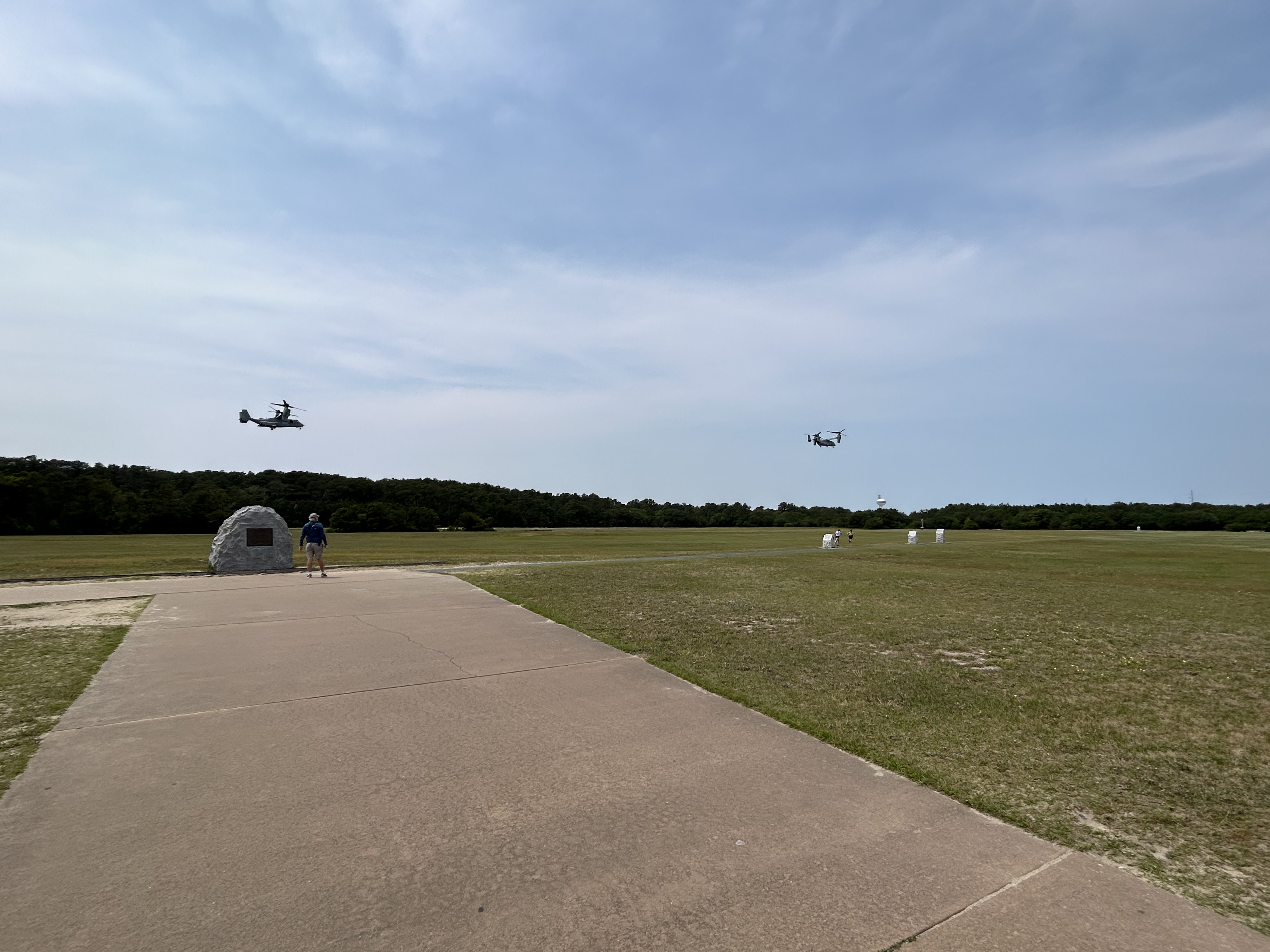
The boulder under the Osprey to the left marks the first flight takeoff, and the three stone markers under the right Osprey mark the first three landings. The fourth landing is marked by the white stone marker visible to the far right.

While the first flight happened here in North Carolina—at Kill Devil Hill near Kitty Hawk—due to favorable wind conditions and relatively soft sand, most of the work and final testing of a workable aircraft that could turn was done in Dayton. Inside the museum here you can see a full scale reproduction of the 1903 Flyer, and outside there’s a sculpture depicting the first flight. It’s a beautiful spot with a huge monument on the hill where they conducted gliding tests, and, yes, it’s still very windy.

Fort Raleigh National Historic Site

As befits any mystery, little remains of the fabled Lost Colony of Roanoke Island NC. There is a map, a cross and “CRO” carved in a post, archaeological remains, and various accounts, both trustworthy and not. The fort above is a reconstruction. The English brought explorers, scientists, soldiers and settlers here in a few journeys in the late 16th century, but the location was deemed a failure. There was little metal, poor soil and no deep water port, and several supply ships were lost in the shallows & storms. Most of the expedition returned to England.

It was however an excellent location for piracy with many hidden coves and inlets behind the barrier islands to wait for the Spanish treasure galleons riding the Gulf Stream back to Spain with stolen Aztec and Incan gold. Many of the last colonists here had wanted to land near Jamestown, but their pirate captain dropped them here instead. When war broke out between England and Spain, Queen Elizabeth kept all English ships at home to protect against the Spanish Armada invasion of 1588. So the colonists were abandoned by the Queen for years, while they were expecting supplies within months.

Likely, they became desperate and split up with a group traveling north and others initially staying behind to wait for help. There are reports that some armed men were killed in Native American skirmishes north of here, so those remaining must have decided to go to a nearby island to seek help from the Croatoans whose chief spoke some English and had been a guest of Sir Walter Raleigh in England for 6 months. The colonists were presumed dead by the English at the time, but much later reports of a few blue-eyed Croatoans suggest at least a few survived. And the cross and letters were likely a shorthand way of letting the English know where they were without letting the Spanish know.

I arrived too early to see the stage performance here which starts in June, and I declined to pay admission to tour the Elizabethan Gardens. But the rangers and museum tell the story, along with more stories about piracy—Sir Francis Drake raided St Augustine in 1586 and brought back some Roanoke colonists on his way home—, about the Freedman’s Colony of 1862 and more modern ventures. Coming from New England, I appreciate the efforts to honor our English heritage, such as the monument here to the first English child born in the Americas. Virginia deserves more credit for being the first English colony, after all, Captain John Smith named ‘New England’ after leaving Jamestown and mapping the north east coast. Still, it would be nice to have more information about what happened to the other ethnicities who lived here, especially the Native Americans.

Reconstruction Era National Historical Park

Reconstruction began in November of 1861, when US Navy & Army forces destroyed two forts and took Port Royal, because when all the white planters fled in the Confederate retreat, 10,000 slaves took over their sea island plantations. Union policy at the time was to declare the former slaves “contraband” or illegal property seized by the military. But the pressure was on President Lincoln to resolve their status permanently. First, he quietly authorized the Union’s first black regiment—the 1st South Carolina Volunteer Infantry which by November of 1862 mustered 1000 men and engaged in battle—, and then he finalized his executive order to free the slaves.

“all persons held as slaves within any State…
in rebellion against the United States,
shall be then, thenceforward, and forever free”

Emancipation Proclamation of President Abraham Lincoln

Among the great mossy oaks here at Camp Saxton on the 1st day of January in 1863, our nation’s first black regiment gathered here with their friends and families to all become the first people freed by Lincoln’s Emancipation Proclamation. Then the 1st SC Volunteers received their regimental colors as proud soldiers of the Union Army, under the command of one of John Brown’s conspirators in the raid on Harpers Ferry. Harriet Tubman was also here as a volunteer spy and liberator, and in June she guided three gunboats and the 2nd SC Volunteers up the Combahee River 25 miles north in a dangerous raid that freed 700 slaves. Other African American regiments from Kansas, Massachusetts and other states in both the north and south soon followed, and by the end of the war, 200,000 African Americans enlisted to make up 10% of the Union Army.

As soon as Port Royal was liberated, Philadelphian abolitionists Laura Towne, Ellen Murray and Charlotte Forten, who was African American, arrived and began the most important part of reconstruction: teaching. While not the first African American school, in 1862 they founded the Penn School to teach people who had been denied formal education for generations. The Gullah Geechee people had created their own language and had kept many cultural traditions alive, including the delicious Lowcountry boil or Frogmore stew, and, when given the opportunity for formal education, they began learning basic, practical skills to live independently, everything from shoemaking and auto repair to cooking and nursing. At the Penn Center, I met a Gullah Geechee woman who still speaks the language and who was treated as a child by one of the first physicians to graduate from the Penn School.

The Gullah Geechee sea islands remained in Union hands throughout the war and became central to the Union “anaconda” naval blockade. The hero Robert Smalls (see Fort Sumter), after helping convince Lincoln to enlist African Americans, purchased the home of his previous owner here, using his congressionally awarded bounty for the Planter, and represented this district in Congress for five terms. The beautiful, historic neighborhoods of Beaufort were retained by the descendants of freed slaves by strict preservation laws, resulting in a sharp contrast with nearby predominantly white golfing communities like Hilton Head. In a historic echo, 100 years after the Union used Beaufort as a base to fight the Confederacy, the Reverend Dr Martin Luther King, Jr and the Southern Christian Leadership Conference chose the Penn Center as a base for their Civil Rights campaigns, including planning the March on Washington and the Poor People’s Campaign. Dr King wrote his I Have A Dream speech here in Gantt cabin on the Penn Center campus.

Plan your visit thoughtfully. To the west, Camp Saxton is hidden at the water’s edge between a navy base, the ruins of Fort Frederick and a residential neighborhood. In town, the visitor center in the historic zone’s old firehouse has very knowledgeable rangers who skillfully and kindly disabused me of my misconceptions. To the east, the Penn Center has exhibits (for a donation) on the school, the Gullah Geechee community and the important Civil Rights work done here. There are two dozen historic building on campus including a dock and a Rosenwald school. Many, such as the Brick Baptist Church, aren’t presently open to the public, but Darrah Hall is open with park staff, information and exhibits. A wonderful volunteer discussed whether the Reconstruction Era ever really ended. Plan more time for the Penn Center partner exhibits, less time for the downtown Beaufort visitor center and enough time at Camp Saxton to stand under the Emancipation Oaks (and take a better photo than I did).

Fort Pulaski National Monument

This Civil War era fort still shows the pockmarked scars from Union artillery. A later famous Lt Robert E Lee helped design the tidal sluice gates and canal for the moat which circumscribes the fort, and he had assured the commander that the walls would hold. And it did hold for 112 days against a Union siege in April of 1862. But despite the impressive moat, drawbridges, masonry, and reinforced internal structures, the invention of rifled artillery made the fort obsolete, as this test of the experimental weapons demonstrated. The wall on the left end had to be rebuilt after the spinning explosive shells opened huge gaps. After 30 hours bombardment, the fort surrendered and the port of Savannah was blocked by the Union’s anaconda. Otherwise, the fort is in good condition, with good views from the tops of the walls, and walking around the inside makes for an interesting visit.