All Southeast Sites *

The southeast region has more park units (70) than any other region, and I have visited all the units—*except 6 in US Caribbean territories—including all the affiliates, heritage areas and trails in Alabama, Florida, Georgia, Kentucky, Mississippi, North Carolina, South Carolina and Tennessee. Given the large number of states and parks involved, the summary below is organized by theme.

Natural Areas

All of the National Parks in the southeast preserve natural areas, including the reef area of the Florida Keys from Biscayne to the Dry Tortugas, the lowlands of Congaree and the Everglades, the Great Smoky Mountains, and even underground at Mammoth Cave. Other park units, Canaveral, Cape Hatteras, Cape Lookout, Cumberland Island and the Gulf Islands, protect barrier islands. Big Cypress, Big South Fork, Chattahoochee River, Little River Canyon and Obed River all protect diverse riparian areas.

Pre Civil War

Ocmulgee Mounds, Russell Cave and Timucuan stretch back before history, but Horseshoe Bend covers a tragic event in Native American history. Several sites cover early colonial history, including Castillo de San Marcos, De Soto, and Forts Caroline, Frederica, Matanzas and Raleigh. Cowpens, Guilford Courthouse, Kings Mountain, Moores Creek and Ninety-Six cover the Revolution. Blue Ridge, Cumberland Gap, Lincoln Birthplace, Natchez HistoricParkwayTrace, and Pinckney, trace the path of history in the southeast, culminating in the war to abolish slavery.

Civil War and beyond

Andersonville, Brices Cross Roads, Camp Nelson, Chattanooga, Forts Donelson, Pulaski and Sumter, Kennesaw Mountain, Mill Springs, Shiloh, Stones River, Tupelo and Vicksburg are Civil War sites. Johnson, Reconstruction, and Tuskegee Institute cover post war struggles. Carter, Sandburg & Wright Brothers are historic highlights. Birmingham Civil Rights & Freedom Riders, Emmett Till, MLK, Medgar Evers, and Tuskegee Airmen reveal the continuing struggle for Civil Rights.

I learned more traveling in the southeast than any other region, as the area is so rich in history and culture. And the preserved natural areas include some of my favorite park experiences, from underwater and underground, to rivers and shores, and to wildlife experiences in mountain forests. And they can all be explored without traveling in a carbon-burning vehicle.

National Heritage Areas of Alabama

Alabama has two national heritage areas, the Black Belt and Muscle Shoals, neither related to a gym.

Alabama Black Belt NHA includes many Civil Rights sites, reflecting the progress forged by the large African American community that descended from the people brought here and bred against their will to work the rich black soil extending in a belt from the Mississippi River across Alabama. Several of these sites are run by the national park service, including Tuskegee Institute, Selma to Montgomery NHT, and Freedom Riders NM. Two other sites I recommend highly are the National Voting Rights Museum and Institute in Selma and the Legacy Sites in Montgomery. The first is an authentic old place filled with memorabilia, well illustrated stories and contains many important exhibits from the Civil Rights struggle, carefully preserved near where the marchers began their march for voting rights. The second is a much newer series of bold exhibits, perhaps most importantly featuring an artistic memorial dedicated to the victims of lynching.

Muscle Shoals NHA is dedicated to the rhythm & blues soundtrack of many of our lives. In 1959 a local music promoter who failed to make it in Nashville took a big risk and opened the small Florence Alabama Music Enterprises studio across the river from Florence in a less developed area called Muscle Shoals. Rick Hall hired some local talent to who lived closely enough to come in as needed to be the studio band for visiting artists. They were joined by Duane Allman, who just showed up and lived in the parking lot until he got a job there. They recorded a few songs there you may know, including Mustang Sally by Wilson Pickett. Etta James went to FAME to try to revitalize her career and recorded her album, Tell Mama, in which she sang I’d Rather Go Blind just a couple miles away from Helen Keller’s birthplace and childhood home, which is another great place to tour. A trumpet player got a little fresh with a young singer, and her husband was pissed. Rick went to their hotel after, but he got in a new fight with her husband. Rick lost the singer and her label (Atlantic) as a result. Still, Aretha Franklin recorded I Never Loved a Man and Do Right Woman, before she walked out never to return. FAME did pretty well nevertheless, especially with a Mormon family called the Osmonds.

In 1969, Hall’s best house band bought a casket shop nearby and opened their own place, Muscle Shoals Sound Studio. Run by these experienced artists, they also wrote songs and ended up producing more hits than almost any other studio in the world, with most of the work done on the first take. They wrote a song called Old Fashioned Rock and Roll and eventually got Bob Seger to record the vocals over their track, although they accidentally duped the intro. A band called The Rolling Stones illegally recorded Sticky Fingers there, before going to a riotous concert with Hells Angels where they sang Brown Sugar. Another time Lynyrd Skynyrd was stuck with a song until a roadie suddenly announced he could play the piano and gave them the opening to Freebird (demo version). They went on to make the house band famous as the ‘Swampers’ in their song Sweet Home Alabama. Newer singers like Lana Del Rey sometimes just walk in and ask to record there too. The list of songs is too long to mention, so take the tours, maybe watch the Muscle Shoals documentary, enjoy the music and listen to the stories.

I should mention that American Music has its roots along the Natchez Trace and nearby rivers: New Orleans, Nashville, Memphis and Muscle Shoals. The songs of the enslaved, French & Spanish trader influences, back country pickers, gospel music and travelers singing for their supper all came together to form the Blues, Jazz and all the rest. WC Handy was born and grew up in Florence below, before being inspired to write down classic blues songs like St Louis Blues and Beale Street Blues. He preserved his log cabin, and there’s a small but excellent museum there now. This is a fascinating and emotionally moving area of the country to visit, and, if I can mention one more, the Jesse Owens Museum is worth a stop too.

Selma to Montgomery National Historic Trail

Dallas County Alabama systematically denied its 15,000 African American residents from registering to vote, using poll taxes, literacy tests, white-only primaries, and grandfather clauses, which made registration easier for those whose ancestors voted when only whites could vote. In 1963, with older people intimidated by murderous KKK raids or being fired for speaking out, organizers asked local high school students to protest. They did, meeting in churches—the only places they could safely assemble—and they were trained in non-violent protesting. Students marched by the thousands, staged lunch counter sit-ins, were beaten and arrested. All civil rights meetings were then banned by a local judge in 1964. Then, the Reverend Dr Martin Luther King, Jr came to Selma to speak in defiance of that ban, bringing national media attention. The contrast between black citizens, old and young, assembling peacefully to try to register to vote, and the police who denied their rights violently—criminals with badges—was to play out on TV. 

The teachers marched with their students. The police filled the jails with hundreds of students. Beatings outside churches turned uglier, and on 18 February 1965, while protecting his family, Jimmy Lee Jackson was shot to death by a police officer who was not punished. In response, the people decided to march 54 miles to the state capital in Montgomery. The police responded at the Edmund Pettus Bridge—the first step in the march—with billy clubs, horses and tear gas. Bloody Sunday, 7 March 1965. The TV coverage made the protest national overnight. Dr King organized a second march, but stopped on the bridge to avoid violence and due to a federal injunction. Rev James Reeb was killed on 11 March. LBJ called out the national guard, saying “we shall overcome” in a major speech 15 March. On 17 March, a judge cleared the injunction. Then Dr King led a third march, all the way from Selma to Montgomery from 21 to 25 March. Singers like Sammy Davis Jr, Nina Simone, and Harry Belafonte encouraged 25,000 marchers along the route. Upon arrival at the statehouse, Dr King gave his “How Long, Not Long” speech, including the phrase, “the arc of the moral universe is long, but it bends toward justice”. LBJ signed the Voting Rights Act on 6 August 1965. 

Selma may have been the turning point that enfranchised millions of African Americans, but the city and surrounding ‘black belt’ in central Alabama has suffered economic exclusion. Burned out buildings are common there today. The national park service is currently renovating several historic buildings in Selma including an interpretive center, and there’s also a Voting Rights Museum just across the Edmund Pettus Bridge which has an excellent, detailed display. Selma’s sights include the churches, lodgings and offices used by the organizers, and the jail where they were incarcerated. Halfway on the trail, near where Viola Liuzzo was murdered by the KKK, the park service has another interpretive center with an excellent multimedia film. Along US 80 are the four campsites used by the marchers.  And on the campus of Alabama State University in Montgomery, there’s another interpretive center with a different, also excellent film. And Montgomery sights include the state Capitol, a memorial designed by Maya Lin, and the Rosa Parks Museum, along with various archives and gathering areas. The drive is easy, and I recommend all three stops for the complete experience. 

The King Center in Atlanta gives a broad and deep view into the life and works of Dr King, as well as the ongoing non-violent international justice movement. The Birmingham Civil Rights Institute explores how deeply segregation divided society, how violent the oppression became both across the street in the park and at the 16th Street Baptist Church where four young girls were killed by the KKK in a bombing, and how strong the Civil Rights Movement became. But the Selma to Montgomery trail, with its searing photos and video testimony of foot soldiers, brings history to life. The open racism (see photo) is shocking and revealing. In one of the films, a white woman argues that since Jefferson Davis was their president, Lincoln’s Emancipation Proclamation has no effect, that slavery is still the law. Such vile hatred does not dissipate overnight. Indeed, in both subtle and ugly ways, racism still divides our society. So we must feel this history again to continue fighting more effectively. 

Little River Canyon National Preserve

One popular question is itinerary planning, which is essential, although my plans never survive contact with the road. The same trails must be picked up again in different seasons, and inevitably, they retrace the steps of early Americans. The old hunting grounds, early trade routes, forts and battlegrounds often overlap in places like this, and, especially when they’re preserved in a more natural state, it’s easier to imagine those who came this way before us.

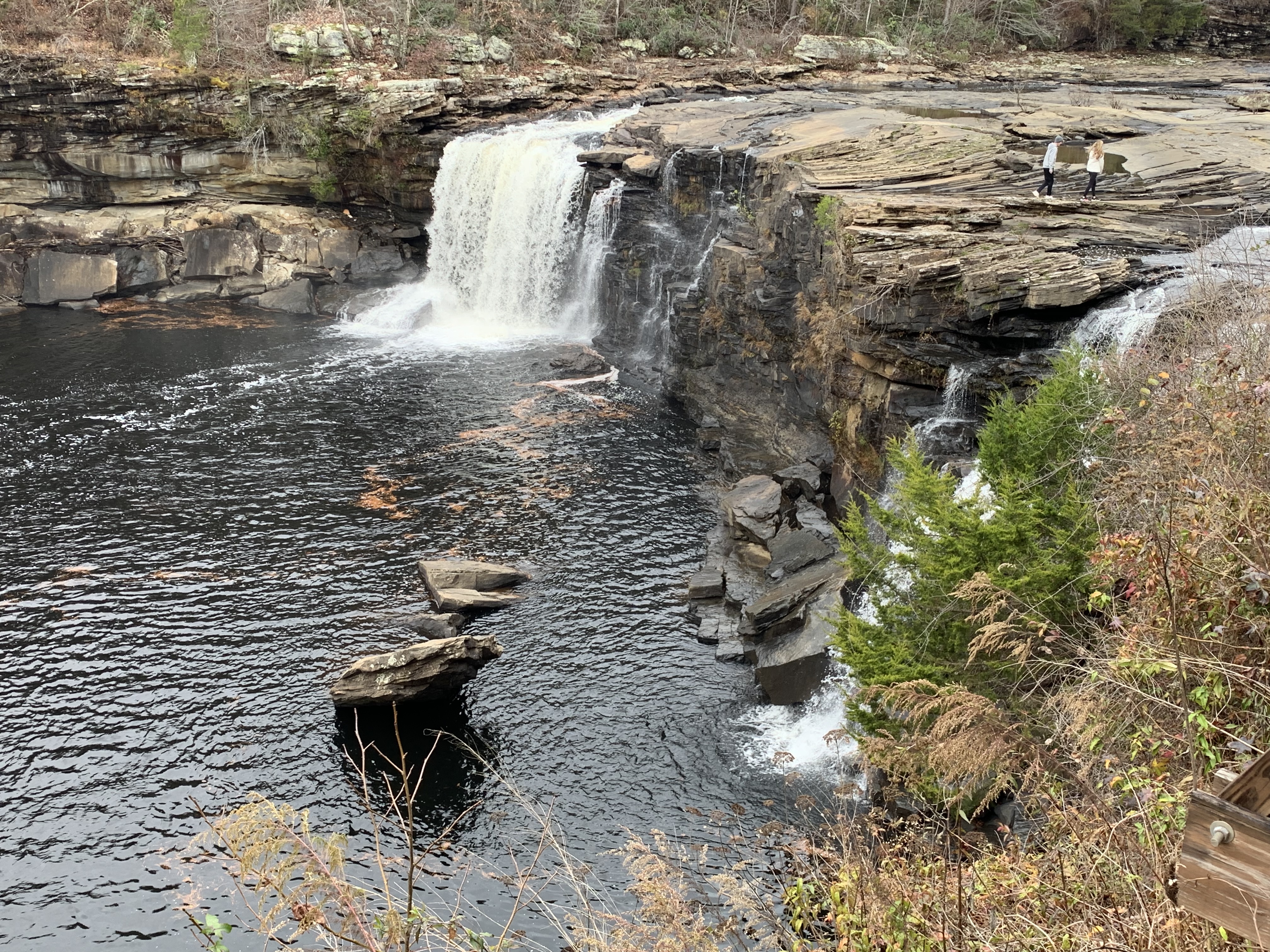
After their long history of interacting with the Spanish, French and British in the southeast, five tribes had become accustomed to European ways enough to be called “civilized”: the Choctaw, Chickasaw, Creek, Seminole and Cherokee. But the US government forcibly removed them to Oklahoma anyway. Most crossed the Mississippi near Memphis, as I did. The Cherokee were split into three groups: the old settlers who moved west before the removal, those forced to walk the Trail of Tears, and those who escaped removal and still live east of Great Smoky. Here, at a natural crossing point through the canyon palisades, the couple in the photo above walk on the Trail of Tears, near where Cherokee families were rounded up into a wooden palisade known as Fort Payne.

The park helps preserve that history, although the primary mission is to protect the many species that live in this important nature sanctuary. The canyon is known among rock climbers for the challenging cliffs, and if you hike downstream there’s a swimming hole near Martha’s Falls. The river isn’t runnable by amateurs, so stick to the scenic drive along the rim, admire the views from a half dozen overlooks and try not to miss the peak foliage like I did. The road isn’t wide enough for both bikes and cars, and, as usual, the former lose out. There’s a park film at the friendly visitor center and an Ol’ Tymer’s BBQ nearby.

Time for me to get back on the road. I passed through Muscle Shoals on my way here, but now I have Georgia on my mind. Places like this are bittersweet, when you reflect on the past or consider the future, but that’s what enriches travel. And our choices make a difference too. Supporting Native American businesses, for example, seems the least we should do to recognize past wrongs. And unless we stop our carbon pollution, these small sanctuaries will prove insufficient to preserve diverse species for any who may follow us.

Russell Cave National Monument

Local archaeologists started digging here under the overhang, but soon the Smithsonian took over, finding evidence of over ten thousand years of continuous use by Native Americans. There’s a particular style of stone spear point found here that old and named after the site. There’s a also a nature trail along the creek that flows from underground, with birds and lush vegetation.

I wonder how our country could have evolved more peacefully, with more respect of different cultures and more generous sharing of technology. If not expelled from this place, perhaps Native American guides could be teaching stories from their oral traditions here and could be conducting their own research, instead of having their culture irrevocably damaged and their societies misunderstood.

Isolation and homogenization slow the progress of new ideas and retard civilization. Many of the towns I drive through appear almost identical, with people wearing the same clothes from the same chain stores and eating at the same restaurants. A few corporations own the most popular national brands. The sameness isn’t strength; it’s weakness. Diversity and integration take more effort, but they pay off in vibrancy, new ideas, and healthier, more resilient communities. We impoverish ourselves by rejecting differences.

Freedom Riders National Monument

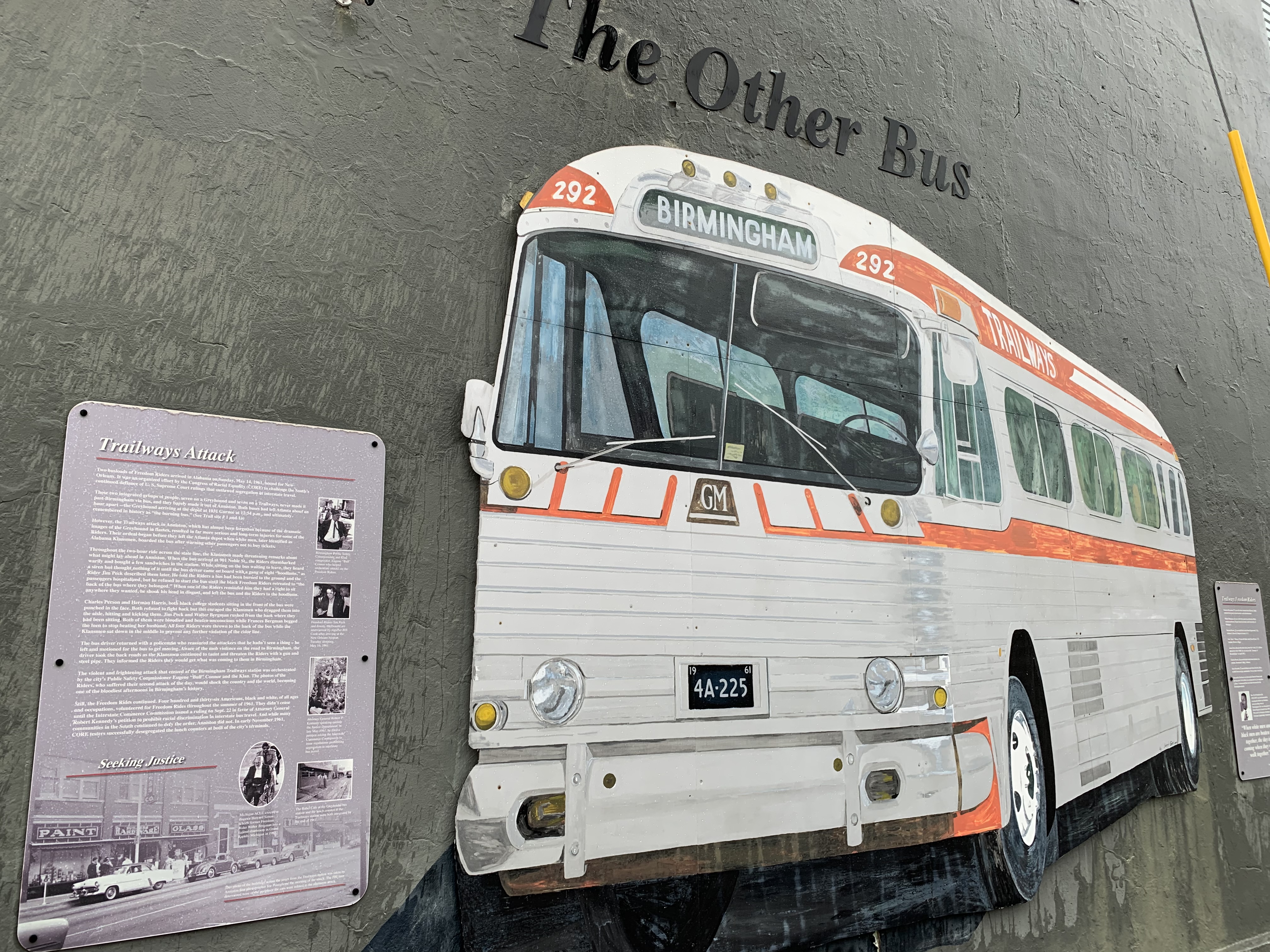
This is another underfunded Civil Rights site. The mural above is one of the few sights I found to see. As part of a systematic campaign to dismantle segregation, a small group of regular people rode buses between states in the south, where race mixing was not allowed under local laws. Since the federal government regulates interstate commerce and travel, they had jurisdiction. The activists exposed the racism, the NAACP lawyers brought cases to court, and eventually the Supreme Court outlawed segregation. Rosa Parks may have started the bus strikes, but it was the Court that integrated buses legally. The freedom riders were brutalized by the Klan, but their cause eventually won.

This may be the worst transition ever, but RV’s get about the same mileage as buses and some are even bus conversions. At a campsite near here, I was asked whether I was afraid of running out of electricity. We compared ”range anxiety” and realized that even with large fuel tanks, the rigs in the campground have less range than my long range model 3 Tesla’s 350 miles. Once loaded, they simply get such bad mileage that they have to go to gas stations more often than I need to charge.

Birmingham Civil Rights National Monument

I had forgotten that it was a children’s march on Palm Sunday that was assaulted by dogs and water cannon. Under city ordinance, it was illegal for children of different races to play together. In my view, the longer a system of injustice is allowed to stand, the more deeply engrained it becomes. The Civil Rights Institute does a powerful job of setting the scene, where African Americans worked in the steel mills and mines and lived in the city behind a color line. People like Bull Connor and the mayor grew up believing that segregation was normal, right and beneficial. They didn’t play with African American children as kids, and as adults they attacked them, peacefully assembled, wearing Sunday clothes, in a park, outside the 16th St Baptist Church, singing songs. The children had learned from Dr King not to fear jail when doing no wrong, but the assault against them was brutal, and televised.

At the time, America was shocked and voiced outrage. This week children were slaughtered in yet another episode of gun violence. I wonder if we’re sufficiently outraged to change the system as those kids in Birmingham did.

“A man dies when he doesn’t stand up for injustice.”

Rev Dr Martin Luther King, Jr. in Selma

Horseshoe Bend National Military Park

If I were to choose one turning point in American history, I would choose what happened here in March of 1814. After many consecutive treaties with the Creek were broken and great parts of their land were taken, some Creek warriors tried to defend their nation, which had survived contact with the Spanish, French & British. Andrew Jackson invaded the heart of the Creek Nation, surrounded 1000 warriors armed with 300 guns with 3000 soldiers in the bend of the river here. 800 of the Creek warriors were killed, 300 while trying to swim to safety. The village was burned and the women and children with them were captured. By any fair accounting, a ten to one advantage that results in 80% killed is a slaughter, and shooting swimmers is particularly cruel.

But Jackson used the victory to steal more land for white settlers, so he was treated as a hero, instead of a liar, thief and atrocious killer. Jackson even betrayed the Creeks who fought side by side with him in battle, taking their land too. Jackson would go on to become the only President to openly defy the Supreme Court, by not only refusing to return land but by forcibly removing Native Americans to reservations in the west, along the Trail of Tears. A popular President among whites who could vote, he perpetuated racist stereotypes about Native American “savages”, which continued past the Civil War when 750,000 mostly white Americans slaughtered each other over the right keep slaves.

Most Americans won’t admit it, but our ancestors wanted our government to slaughter Native Americans and take their land for our benefit. Racism has been used as official policy for killing, removing, and exploiting non-whites for centuries. By ignoring, denying and lying about this fact, many of us have chosen to live our lives without a moral compass. The first step is to admit the truth, then figure out what to do about it, and finally to teach our kids to be better.

Tuskegee Institute National Historic Site

[Updated after 3rd visit, including Oaks tour and Carver Museum.] I admit I was frustrated the first two times I drove here from California, unable to access either Booker T. Washington’s house or George Washington Carver’s Museum and finding incorrect information on the website and app. And I might have ranted about how other sites appear to be better funded. But all is now forgiven.

Like many emancipated slaves, Booker had no surname. When he showed up at school, he just said his last name was Washington. After walking across much of Virginia to go to school near Hampton Roads, he became a teacher at Hampton University, before being hired to run the Tuskegee Institute, now University. Ever hard-working, practical and focused on improvement, his students developed many valuable skills to support their families, including brick making. His students built his impressive mansion, The Oaks, across the street from Tuskegee University, using the design by our nation’s first African American architect, Robert Taylor, who trained at MIT as its first black student. Booker T., ever persuasive, recruited Taylor, who designed many buildings that are now part of both this national historic site and the university.

It is difficult to overestimate the importance Booker T. Washington had in advancing the lives of people who for centuries were not allowed to learn how to read. An advisor to US Presidents, world traveling speaker, practical educator, builder, mentor, and author, his practical focus drew criticism from WEB Du Bois and Frederick Douglass, who focused on ‘higher achievements’, but ultimately, they all worked towards the same goal of progress. All continue to inspire generations to learn, grow and excel. Inside the house on tour, I learned about Booker T’s wives, who also contributed to education. By necessity, black women have often had to assume a role as matriarch, when it was difficult or even impossible to keep families together.

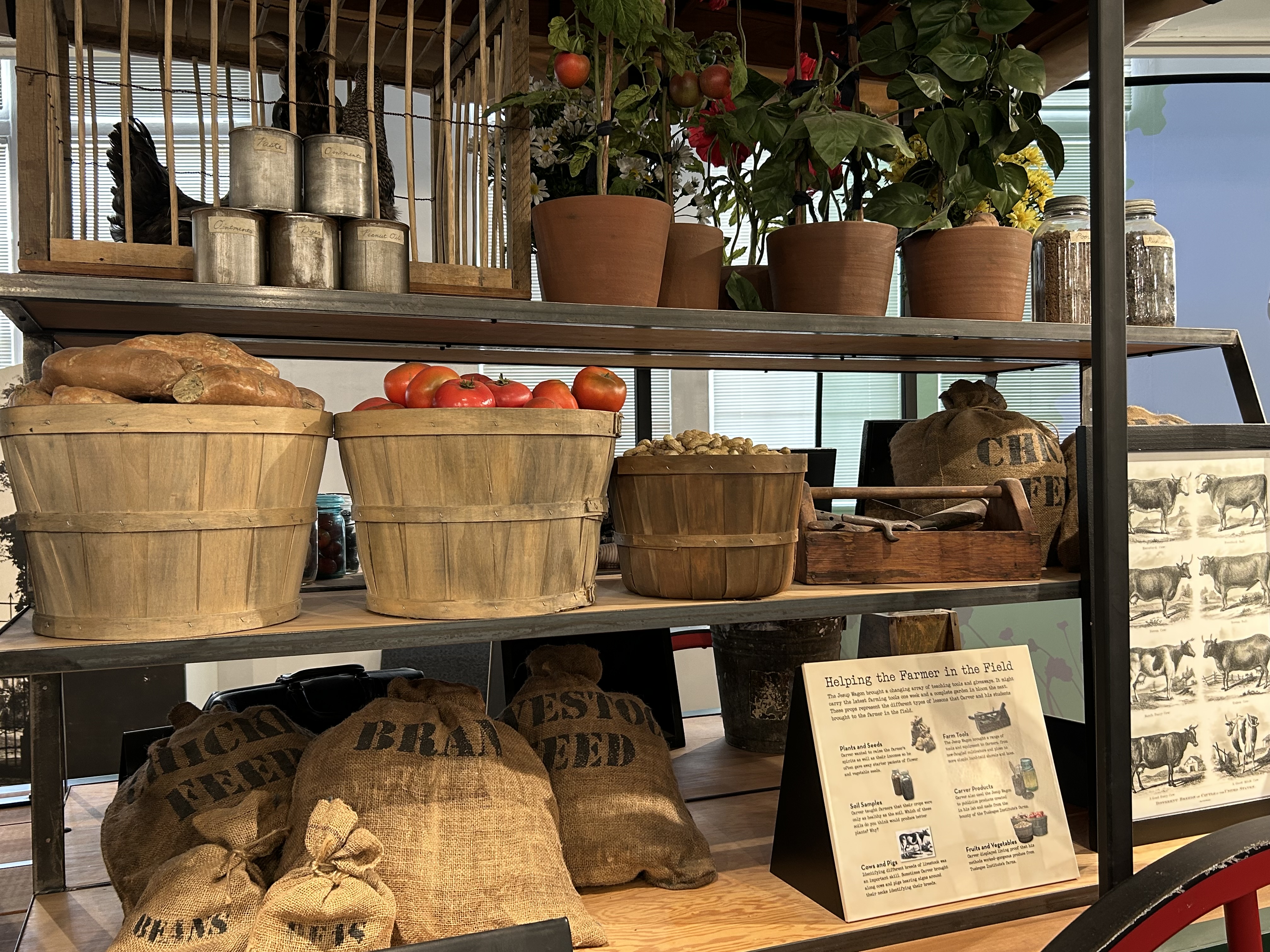
Booker T. Washington also hired George Washington Carver to teach and help improve the lives of African Americans, and the Carver’s museum on campus (see photo below) reveals his broad scientific interests beyond the peanut. Carver was an ecologist, who focused on profitable uses for peanuts in order to improve soil health, a forward-looking view that has only become more important over time. But following Washington’s practical focus, Carver spent much of his time in direct outreach to rural communities, bringing solutions and advice out in wagons.

I’m sure Washington could not have imagined that his institute would have been used by the US government to run a 40 year ”experiment” on black men, neither treating nor disclosing their diagnosis of syphilis. (See ”Miss Evers’ Boys” also set in Tuskegee & starring Laurence Fishburne). He might be pleased to know that there’s a private museum on campus dedicated to teaching the history of that infamous experiment as well as the genetic legacy of Henrietta Lacks. But doubtless Washington would have been out fundraising to develop the broader community of Tuskegee, which shows signs of economic neglect.