I like Mount Rushmore, but it’s in the wrong place. The Presidents selected all had issues with Native Americans (although the Presidents were all long dead when the monument was sculpted). The sculptor was a KKK member who wanted to sculpt confederate leaders, but that’s just a side note. No, the problem is that the monument is carved into the sacred Black Hills which may be the most shamefully taken, fought over and litigated place in America. It doesn’t help that the surrounding area is filled with common tourist traps, and that the tourist dollars do not go to the tribes who legitimately (according to Court decision) should own the land. Even though they have Tesla chargers in the parking lot, I just can’t appreciate the site as I did years ago.
I’ve now only a couple caves left to explore in the system. I’m all out of troll, dragon and lizard-people jokes. So, instead I will just encourage you to reserve your tour in advance, since they can sell out. I was lucky to get the last single ticket to the shortest tour, where I was able to see the jewel-like dog’s tooth structure above. There are many more interesting crystal and other features to see. And the cave maps continue to expand as new sections are explored.
The park is most famous for containing much of the world’s boxworks, pictured, which is the ‘mortar’ left over after most of the rock dissolved. The tour included a recitation of the origin myth of the Lakota people and the bison, since the cave is a central and sacred part of the story. The neighboring Custer State Park is a great place to see bison today, and they often wander across the road.
Since I was inspired here by an obscure fact about forest fire frequency, here’s another rant. There’s a popular misconception that park service mismanagement or ”fire suppression” caused many forests to overfill with fuel, creating conditions for today’s wildfires. Smokey the Bear encouraged people not to smoke or leave campfires unattended, but neither he nor the forest service has ever had the ability to put out a naturally occurring wildfire. Even the best efforts today can merely partially contain wildfires to try to protect structures.
So why did the fuel build up? Well, that’s because farmers, ranchers and timbermen cut down all the surrounding forests. Many of the remaining forests are isolated, so that wildfires that would have entered from neighboring areas stopped. The remedy to restore the natural balance would be to enlarge the forests and regrow the surrounding ecotones or transition zones with native scrub and grassland. Funnily enough, you don’t hear that solution often proposed. Instead, folks use farmer, rancher and timberman logic and suggest scheduled burns, like they use on their land. But there’s nothing natural or statistically normal about following a schedule, so the park service, which is the victim here, is left with no choice but to try to maintain forests artificially, which typically results in lower species diversity than the original.
In any case, with climate change, even using prescribed burns won’t save forests from increased bug damage, warmer winters, hotter summers, drier air, longer wildfire seasons, hotter fires and increased wind. I mention this because there are nearby areas where forests aren’t regrowing, since the extremely high temperature of the fire overcooked the soil, killing the microbial life needed to sustain the original trees. We need more accurate and truthful thinking about fires if we are going to save species in the future.
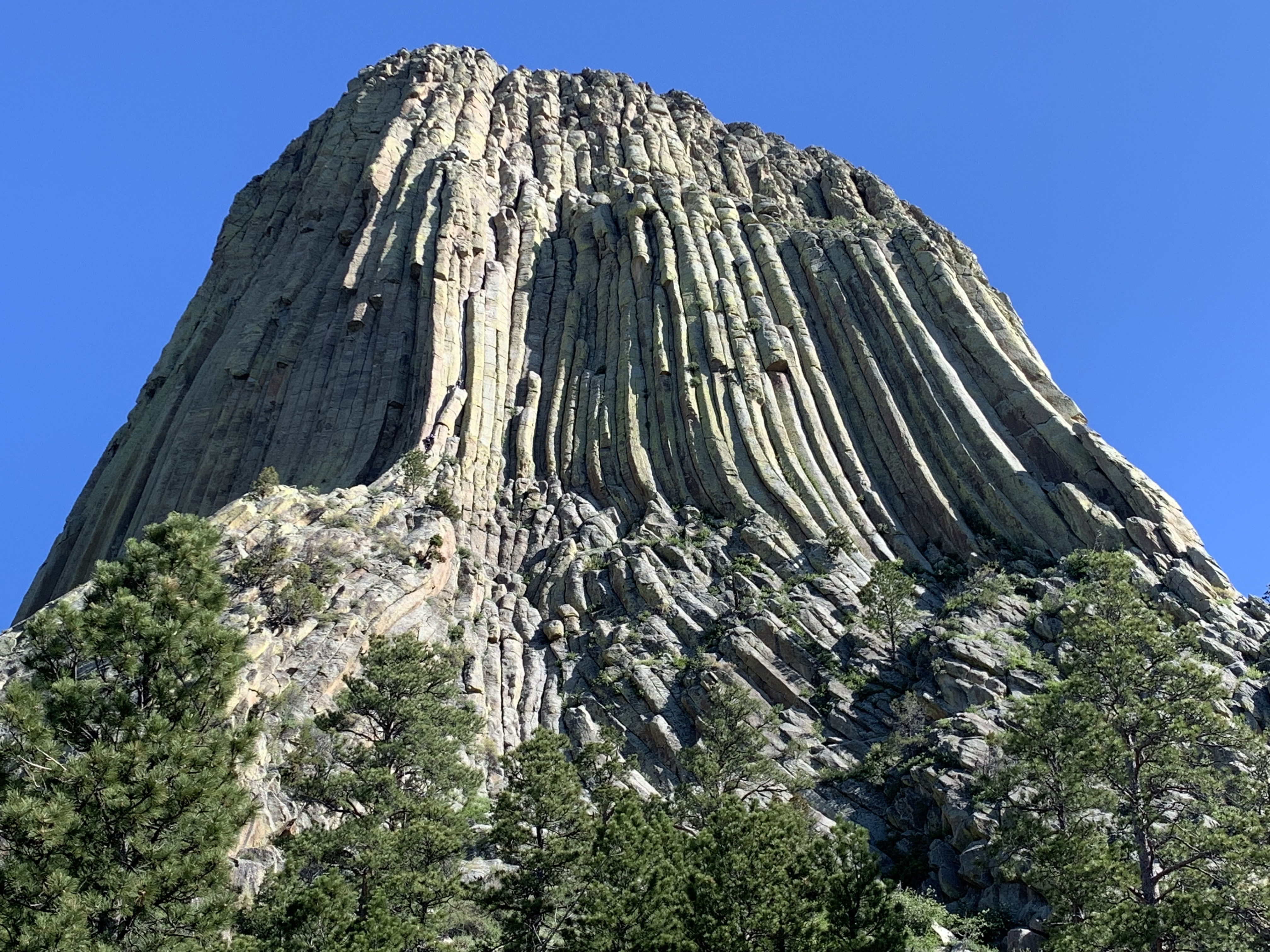
There are climbers in the photo on top of the leaning column on the left. I walked around whistling the theme from Close Encounters, but nobody seemed to get the reference. The area nearby is also beautiful, with a prairie dog town and lovely green and red valley with bison.
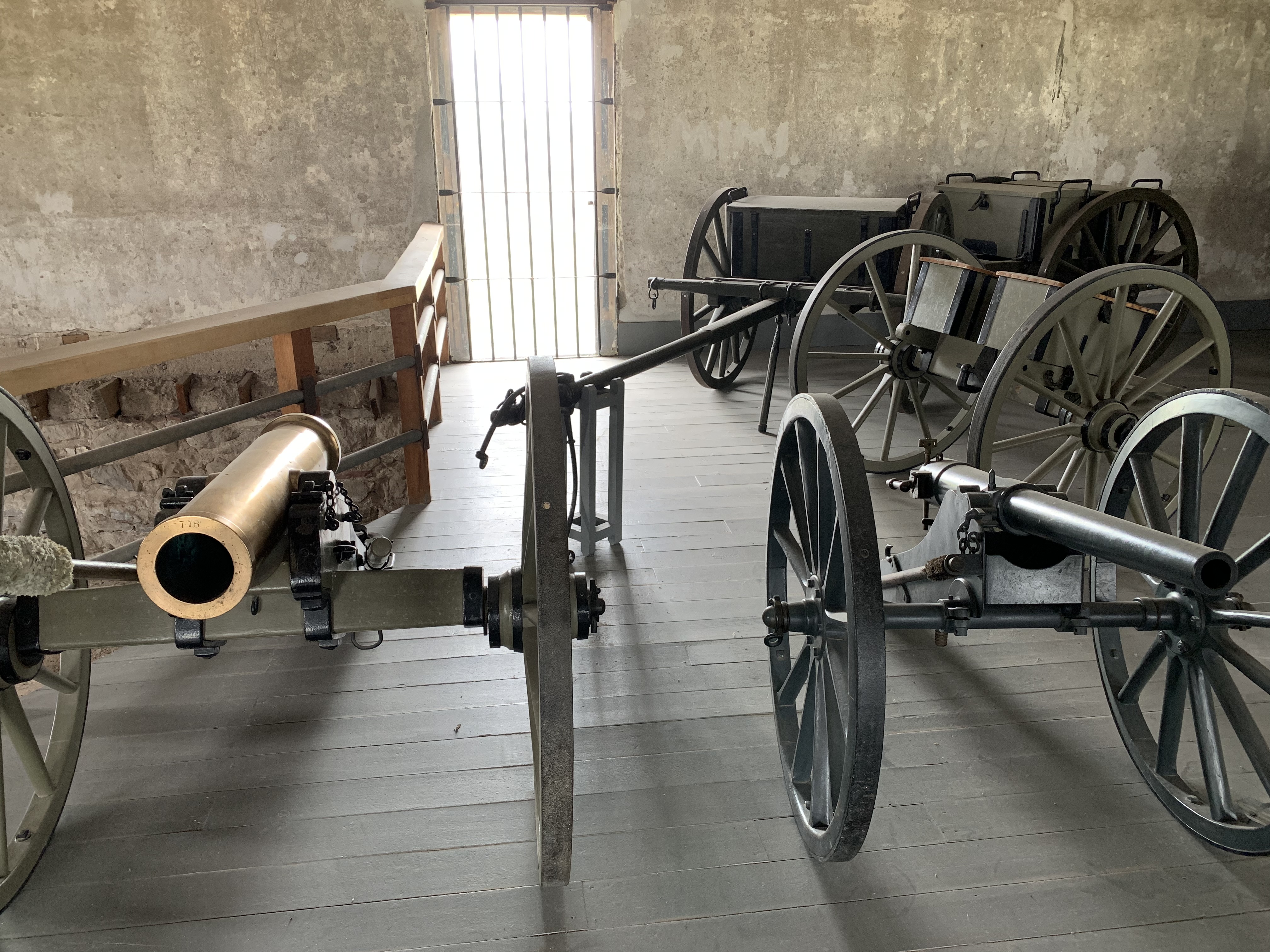
The site of two eponymous treaties, I ordered a sarsaparilla and talked history with a well-informed seasonal ranger. We decided that although the soldiers were sent out to protect pioneers, they were mostly bored silly, since the “attacks” were mostly myths or exaggerated stories. But the military leaders practiced diplomacy to try to avoid potentially deadly conflicts, and that didn’t always go well. Case in point, in 1854 a Mormon pioneer lady complained to authorities that a cow she lost on the trail had been caught and eaten by some natives who lived on the land while she was trespassing. Lt. Grattan was sent to arrest the offender (not the lady) with 29 soldiers. Apparently the negotiations were cut short when (most likely) one of the soldiers shot the chief, whose men subsequently killed all the soldiers. Several treaties were signed here, although they were not honored by the US. Ultimately, the US military ”solved the Indian problem”, by killing resistors with superior fire power, including the mountain howitzers above and Gatling guns, and driving the rest on to reservations. Four of these artillery pieces were used at Sand Creek.
This is a great place to learn about earthlodges due to the continuous maintenance of traditional culture here. Videos tours are available online too. Clearly the lodges were multi-use, serving both daily needs and special ceremonies. Having seen various ruins of similar structures around the country, it is informative to view such a complete exhibit.
The other reason these particular villages are important is that Lewis & Clark landed here and added a few folks to their expedition, including a French trapper named Toussaint Charbonneau and his wife and their infant son. Since she acted as interpreter and guide, Sakakawea became the expedition’s most valuable player and is memorialized on a US $1 coin first minted in 2000. A hike down to the river is worth the short walk.
Thanksgiving celebrates when Native American generosity saved the first settlers in New England. Natives taught settlers about native crops and game, they traded peacefully with the British, Spanish, French, Russians, mountain men, and pioneers, and they guided Lewis & Clark across the country. Many early Americans married natives and lived happily.
Somewhere along the line, these same natives were portrayed as bloodthirsty savages, and that racist portrait continues today. I have not yet had time to fix it, but Wikipedia’s entry on this site has extensive quotes from a 19th century book in an apparent effort to justify the massacre here, pointing to another ”massacre” by natives that provoked this military action. But that was a family of four killed ”supposedly” by natives, and other events described as native ”attacks” were actually thefts, robberies and destruction of property.
The natives were the victims, both here and elsewhere. They lost their bison, their land, their freedom and their way of life. Many of their sacred lands were stolen by illegal acts of the US government, and many lost their lives to settlers and soldiers. Yes, some Native Americans fought back, following repeated provocations. I read of one chief who, after working his whole life for peace, returned home to find his family slaughtered, and he turned to war. But it is dishonest to confuse the aggressor with the victim. Most Americans live in states or places originally named by natives, but there continues to be a desire to honor those ancestors who participated in the land theft, forced removals and slaughters of Native Americans. Only some Utes remain on tribal lands in Colorado. The town immediately south of the park is named Chivington, but when you learn what he did, you will find that honor to be a disgrace.
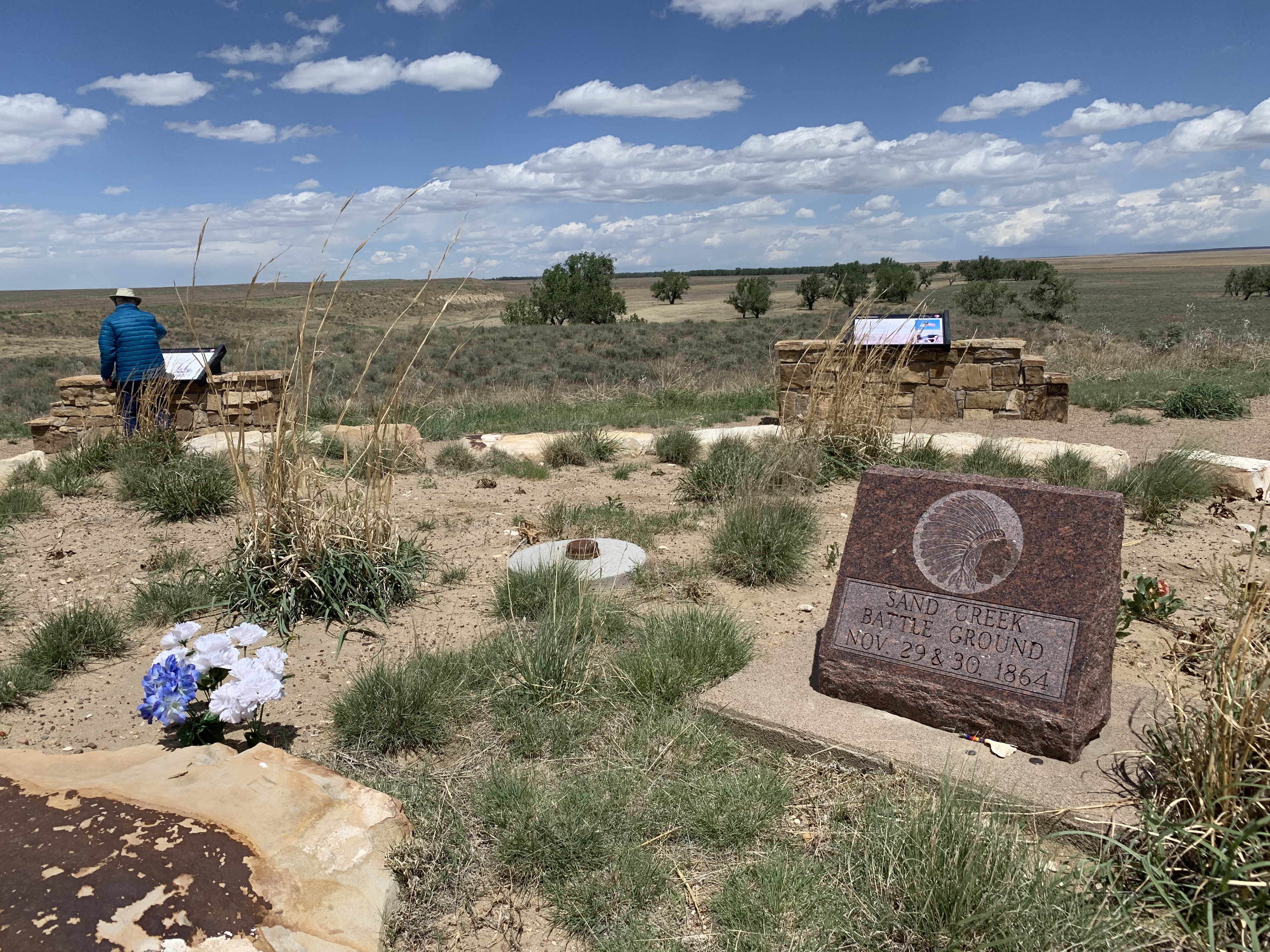
According to witness accounts of soldiers under his command, Colonel Chivington, who helped win the Battle of Glorietta Pass, was a politically ambitious man who wanted to add more victories to his resume. Peaceful native chiefs gathered here to continue peace negotiations under the protection of the local US military fort. Chivington knew that, and two days after the local commander transferred east, he attacked the village with 675 cavalry and 4 mountain howitzers. Two of his officers refused to follow orders, reported the massacre, and testified to investigators. They saw women and children bludgeoned to death while begging for their lives. Over 230 natives were massacred, including around 150 women, children and elderly. The details are horrific. Many bodies were mutilated post-mortem, and soldiers took ”trophies” including scalps, fingers, etc. to display in public. Fueled by greed and paranoid racist hatred, the townspeople treated the soldiers as heroes. But the government investigated and determined that it was an unjust, brutal “massacre”, ordering reparations (unpaid) and the removal of the governor for his involvement. Chivington, once a minister, escaped justice by resigning (loophole later closed) and the two men from a related military unit who murdered one of the witnesses also escaped justice. The other witness became a local sheriff.
As tragic as this story is, there was another similar massacre by US soldiers with a higher death toll at Bear River in Idaho. It also is tragic that many people even today, such as the Wiki liar, refuse to acknowledge the massacre as criminal and morally indefensible. At least the National Park Service is doing its job and preserving the site and the truth.
Yes, there’s also a new fort, and no, I didn’t go there. The fort is a beautiful reconstruction made for the US Bicentennial. You might notice the fire damage around the edges. Just a few days earlier, a fire (under investigation) burned the fields and trees surrounding the fort. Fortunately, the fire department and rangers saved the fort and the animals. Even though I could still smell smoke, the ranger/ volunteer firewoman gave a full tour in period costume.
The Bents were merchants who traded buffalo bison hides and other goods on the Santa Fe trail. The fort was more of a commercial trading post than an active military base, but the lines were blurred. Kit Carson spent some of his early years around here hunting shooting bison. The US government used forts along the trail to protect the mail and to replace the Natives with white settlers.
Racism drove cultural hegemony. Before the arrival of Europeans, the Native Americans built homes, ate bison, hunted, fished, and grew mixed crops of corn, beans & squash. The superior settlers introduced a completely new way of using the land by building homes, eating beef, hunting, fishing and growing wheat. Oh wait, that’s exactly the same.
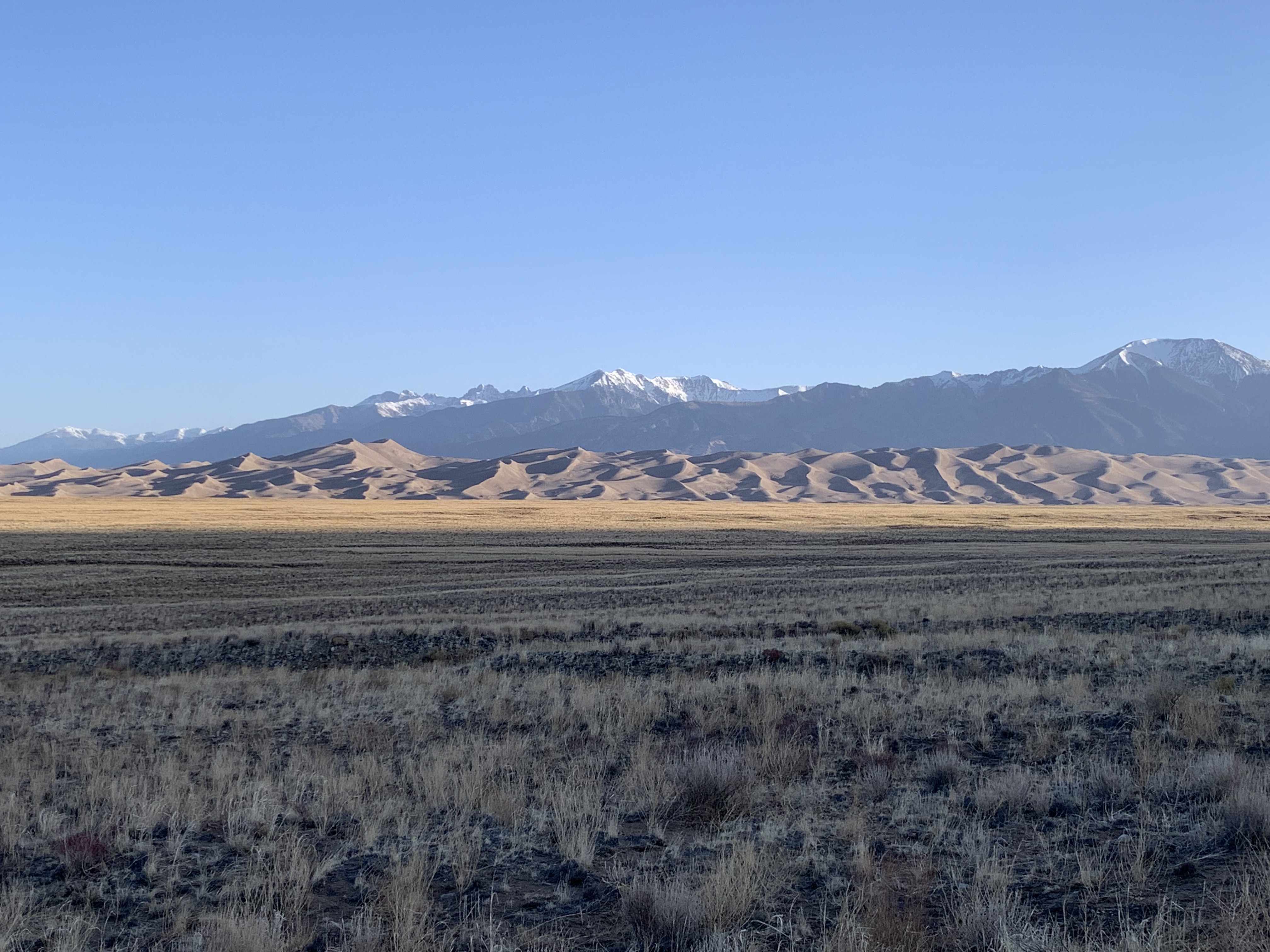
I’m obviously not much of a photographer, but I like this one. The tallest dunes here are over 700 feet, but they’re dwarfed by the surrounding mountains. Since I camped at Piñon Flats in the park, I was able to take this just as the sun came over the mountains, which added shadows for contrast. I hiked into the dunes before dawn and along the creek, but it’s not easy to take an interesting picture of so much brown sand, even in such a beautiful, surreal landscape in the moonlight. The dunes and the neighboring preserve are basically all wilderness, easily hiked into, and our footprints quickly disappear.
Whenever I wander into any wilderness, I always wonder about what we value. I have both a BS & MBA in business, and I worked in HQ at a Fortune 100 financial firm for a couple decades. And it seems to me that capitalism is terrible at valuation. One problem is that the first business to claim a resource is often just the first idea that comes along. There may be a better and more profitable use for a resource, but the quickest way to make money is typically the one that’s chosen. Another problem is that business people aren’t very innovative. If they see one business is successful in an area, then they will often just copy that idea. Economically, we’re far better off with a diverse set of competitive products and services than with a small number, because then we’re more resilient to market changes. But short term thinking dominates, which leads to over-investment in a few businesses, rather than a broad, diverse range of businesses.
It doesn’t take any special training to see this. Drive through most towns and see the same chain restaurants everywhere. Look at how similar most vehicles are or how all the fields in an area grow the exact same crop or raise the same cattle. Business is mainly herd behavior, and few want to risk money to develop a completely new business. Capitalists need tax incentives to change. Traditional car companies killed the electric car, then ignored Tesla, and now are demanding that the government build a charging network for them to compete. Who knew America’s largest and oldest corporations were such whiny cowards who need taxpayer handouts before they will adapt?
Why do I think about valuation in the wilderness? Because if the first guy to find this place had owned a cement company, he would have started carting off these dunes to make concrete. And then other concrete material suppliers would have copied him, lowering profits to nearly zero. And the wilderness would have been gone before anyone bothered to think whether there were any other better uses. The same is true of forests, wetlands, prairies, rivers, valleys, mountains and oceans. Capitalism rewards the first, fastest, cheapest exploiter for destroying wilderness, and penalizes long term thinking. Because time is money.




 Zero Carbon Travel