Pipe Spring National Monument

For millennia people had been using this spring to live, grow crops and travel through, but then the Mormons built a fort and walled it off. 80% of the Kaibab Paiute population died off between 1490 and 1860, many from starvation. The Mormons also enslaved the natives, technically 20 years of indentured servitude, after purchasing them from native slavers, a practice the natives learned from the Spanish.

On this trip I saw both the Green River at Dinosaur and the Colorado River in the Grand Canyon explored by John Wesley Powell, who employed Kaibab Paiute guides. Years later when Powell became director of the US Geologic Survey in DC, a Mormon missionary, translator and expedition member named Jacob Hamblin wrote to his old friend about how the Kaibab Paiutes were dying of starvation.

“The foothills that yielded hundreds of acres of sunflowers which produced quantities of rich seed, the grass also that grew so luxuriantly… the seed of which was gathered with little labor, and many other plants that produced food for the natives is all eat out by stock.”

Hamblin to Powell, 1880

Eventually, the US government intervened and gave the Kaibab Paiutes rights to 1/3 of the water, along with 1/3 to the perpetrators who were using the fort as a hideout for ‘plural families’, and 1/3 to the federal government. Like many wrongdoers, the Mormons at the time tried to justify their killing of the natives by saying that some natives had killed two Mormons, that they were bringing civilization to the natives and that they were more productive. I wasn’t interested in the Mormon pioneer fort or the old self-serving justifications, but the historic conflict over marriage rights seemed ironic, given the 2008 Mormon campaign against gay marriage in California. In any case, the native history is fascinating and helps explain why Utah is 1% Native American and over 2/3 Mormon. There’s a garden run by the local tribe that grows the three sisters (corn, beans & squash) along with Amaranth, which was a beautiful deep purple.

Overall, Utah does an exceptionally good job in managing its remarkable natural resources, but the climate crisis allows no time for delays. Today the spring above is full of toxic algal mats that can release deadly Cyanobacteria neurotoxins, which appears to be spreading as the climate warms. Civilization is destroying life on earth, via carbon pollution, so it hardly deserves the name.

Natural Bridges National Monument

The Bridges, so designated because water flowed through them and formed them, are much older (Permian) than Utah’s famous Arches (Jurassic). There are three main bridges to see here, each only a short hike from the scenic drive to view, and they span two canyons, Armstrong and White. The Owachomo Bridge above is over a dry creek bed and can easily be hiked under. The Kachina Bridge is at a more challenging viewing angle near the intersection of the canyons, but if you’re up for the Loop Trail hike, I bet it’s spectacular. Sipapu Bridge, second in size only to Rainbow Bridge, is named for the emergence gateway mythology common to Native American tribes. There’s an impressive view from the overlook, and if you hike and climb about halfway down and go out along a wide ledge, you can get a view from the other side, which is equally magnificent.

This is one of my favorite parks for geologic features. Unfortunately, none of the bridges were working as portals to distant past or other dimensions. The surrounding forest and beautiful canyon lands are part of the Bears Ears National Monument (managed by the US Forest Service and the Bureau of Land Management), and the mesa top buttes that look vaguely like ears from a distance can be seen from the parking lot as well as from miles away in several directions. I drove in from the east, stunned by the scenery, and then left south, where the road drops into Monument Valley. Wow.

“I’m pretty tired…. I think I’ll go home now.”

Forrest Gump

Hovenweep National Monument

Hovenweep Castle to the right and the Square Tower in the middle were likely part of a connected, multi-story pueblo, part of a complex of buildings surrounding this small canyon. 750 years ago, the farmers who built and lived in this castle grew corn, beans, squash, amaranth and probably cotton. They kept domesticated turkeys in the canyon and built small dams to control flash floods and enrich soil. The 2 mile round trip Little Ruin Trail is easy to follow to photograph the varied ruins from different angles.

Maybe if I had come out west here before visiting Europe, I would not have told my host family that we don’t have any old stone castles in America. This is an extremely photogenic place, and I was happy to walk the loop in the morning, before others arrived. The drive through the Canyons of the Ancients National Monument (managed by the Bureau of Land Management) and on ‘reservation roads’ is worth doing slowly.

Yucca House National Monument

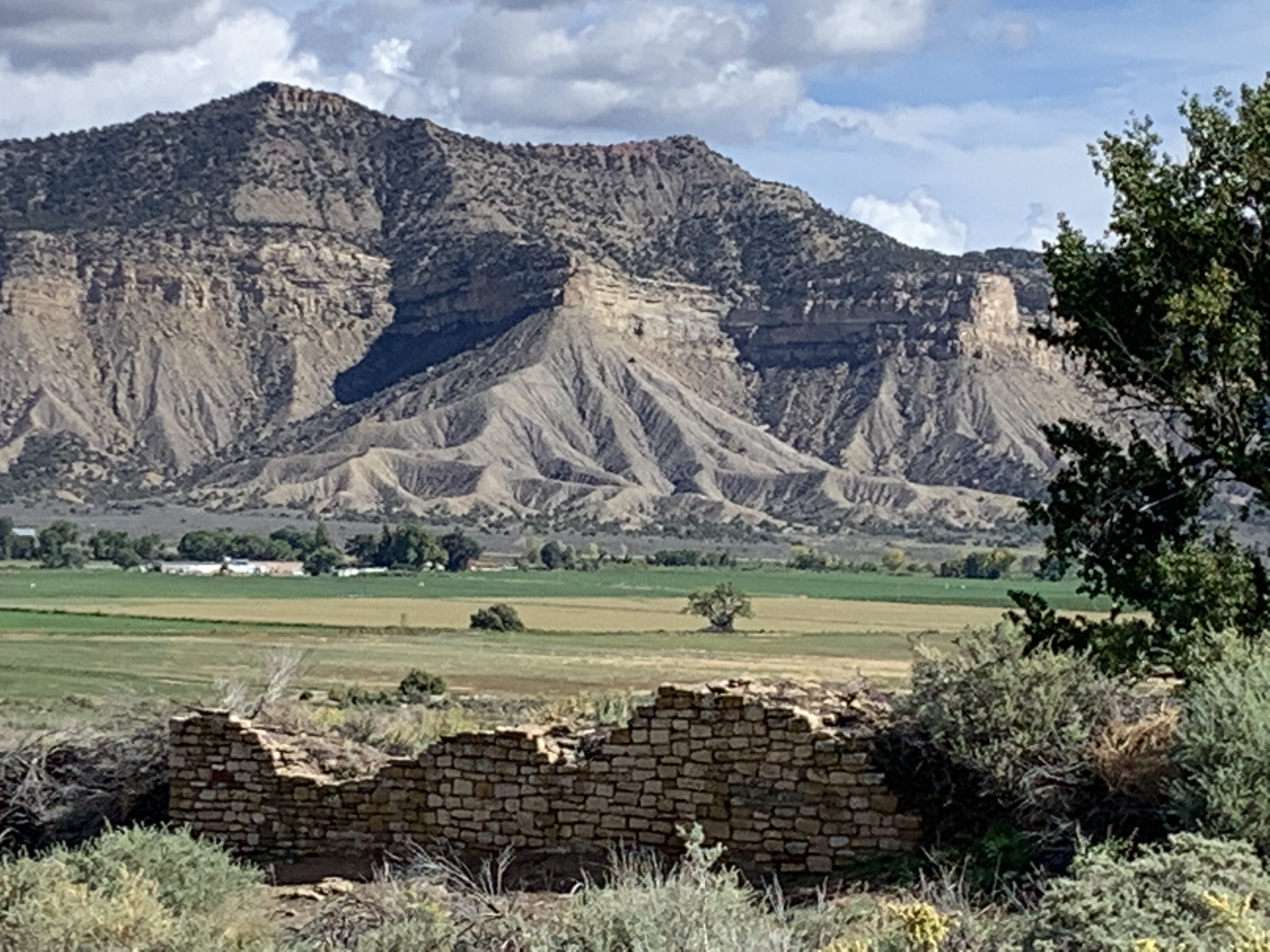
The rangers I asked discouraged me from visiting, because the reconstructed wall above and small mounds are all there is to see. But what makes this place special is that it is in the middle of the rich agricultural valley below Mesa Verde, and it wasn’t completely destroyed, vandalized or eroded away. Large pueblos, like this one with hundreds of rooms, used to be scattered across the region, but, as at Hopewell, the ones located in rich farming areas were often plowed under. This is actually one of the largest archaeological sites in southwest Colorado, recognized by researchers in the 1870’s, protected as a monument in 1919 (and by a bequest from the landowner at the request of an archaeologist) and protected unofficially by another landowner who donated an access route in 2002. Also unlike other sites, the archaeologists have mainly used less-invasive techniques in their research, saving the site for future generations.

Mesa Verde National Park

This is Balcony House, which requires a reserved ticket, climbing cliff-side ladders and crawling though a short tunnel. It’s worth it. The dwelling is named for the intact, original balcony on the right side of the photo under two upper story windows. At other cliff dwellings across the southwest, typically only the beams remain, like those on the wall to the far left. This dwelling is also unusual for facing northeast, lacking fires in this section, and for the large flat floor with a low wall at the edge of the cliff. This place was used for important gatherings, but not in winter.

Mesa Verde is a huge, green high plateau, so start at Park Point Overlook, where you can see from Colorado’s snow-capped peaks to Shiprock, which I first saw after visiting Canyon de Chelly. From up here, you get a sense of the region as one greater community of interrelated tribes, trading and interacting with one another frequently, and not four separate arbitrarily bounded states.

This is my favorite park for cliff dwellings, so see as many as you can. The Cliff Palace is the largest in North America (reserve a ticket), and while you only walk along the bottom edge, you do get close enough to appreciate its extent and architecture. Spruce Tree House is only visible from an overlook, Long House was booked, and Step House was perfect to visit on my own first thing in the morning. The ranger talks are extremely informative, even after visiting many other Native American sites.

Finally, slow down here. The mesa has basically no Wi-Fi or cell signal (save a photo of your tickets). There are bus loads of tourists, so the few places to eat are crowded (Metate needs reservations). The Far View Lodge rooms don’t have TV, and it can be a peaceful place, if you try. My laptop finally stopped working, so I ended up sitting outside, saw a rabbit and thought long enough to reconsider my past and future. This World Heritage Site has already seen more recent devastating wildfires than they have cliff dwelling sites open to visit, so these moments in places like this are rare and diminishing rapidly.

Black Canyon of the Gunnison National Park

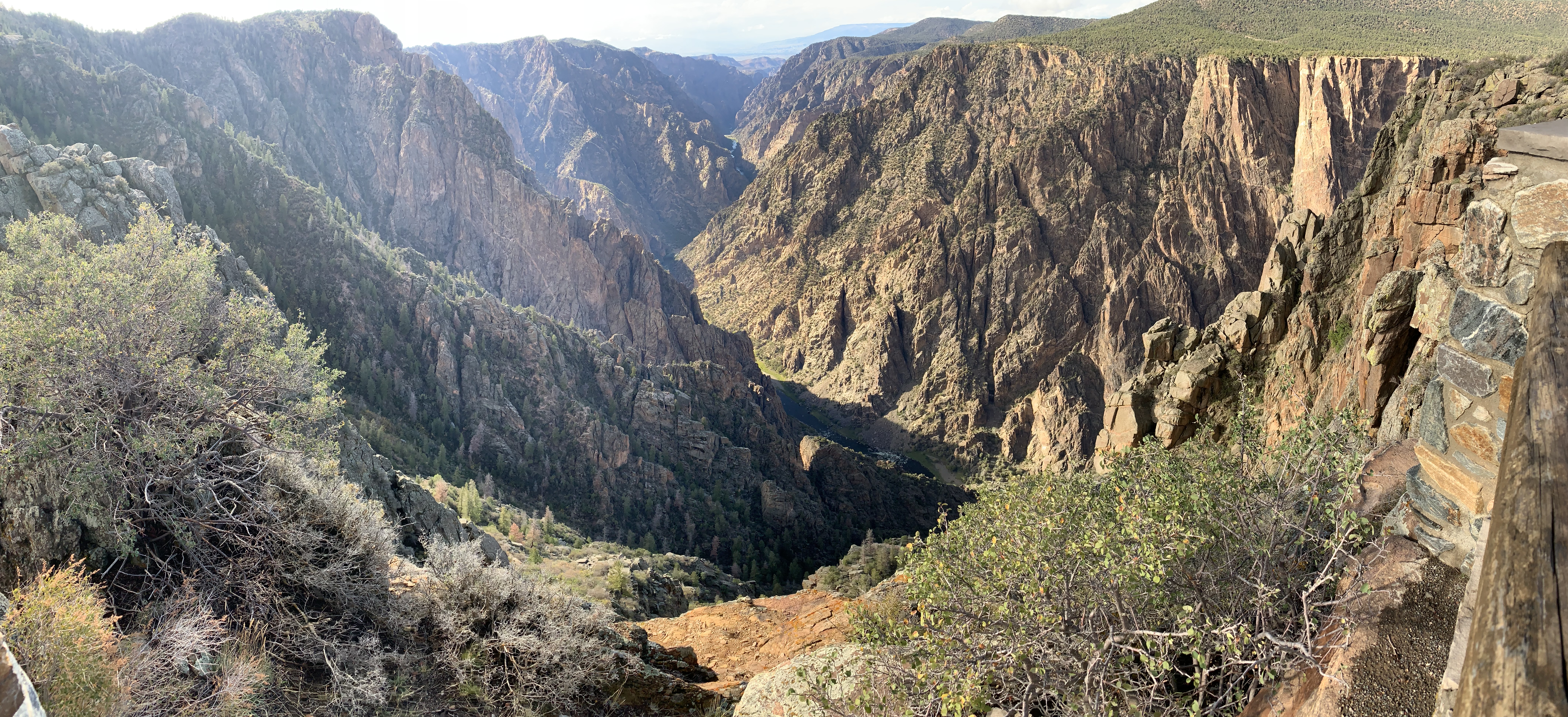
This view is looking downstream from Sunset View overlook, but the upstream view is blacker, steeper and narrower. The canyon there is over twice as deep (2250’) as it is wide at the top. The Sawatch Range, Elk Mountains and San Juan Mountains all feed into the canyon in spring. There are half a dozen good overlooks on the South Rim to peer down into the canyon, and some cause vertigo, as the cliffs are near vertical drops from the rim. The North Rim is a 2 hour remote drive, has fewer overlooks, a campground and horseback riding.

The South Rim has a campground and a visitor center, and is only steps from Gunnison Point, which may have the best view down into the canyon, although my photography skills were insufficient. The short hiking trails along the rim, down into the canyon (a little) and to the high point to the left above each provide a different view into the geologic depths.

The East Portal campground is technically in Curecanti NRA and is accessed by a steep road down to the Gunnison River (barely visible above) near the upstream dam. I’ll have to come back. Since I arrived here in October, there was already snow falling in the mountain pass on 50 to the east. The road was also being repaired after some fearsome rockslides. On the plus side, the drive through the mountains included bright fall foliage that contrasted with the black rocks. Montrose makes a convenient spot to charge, and it has two well-reviewed Himalayan restaurants.

Amache National Historic Site

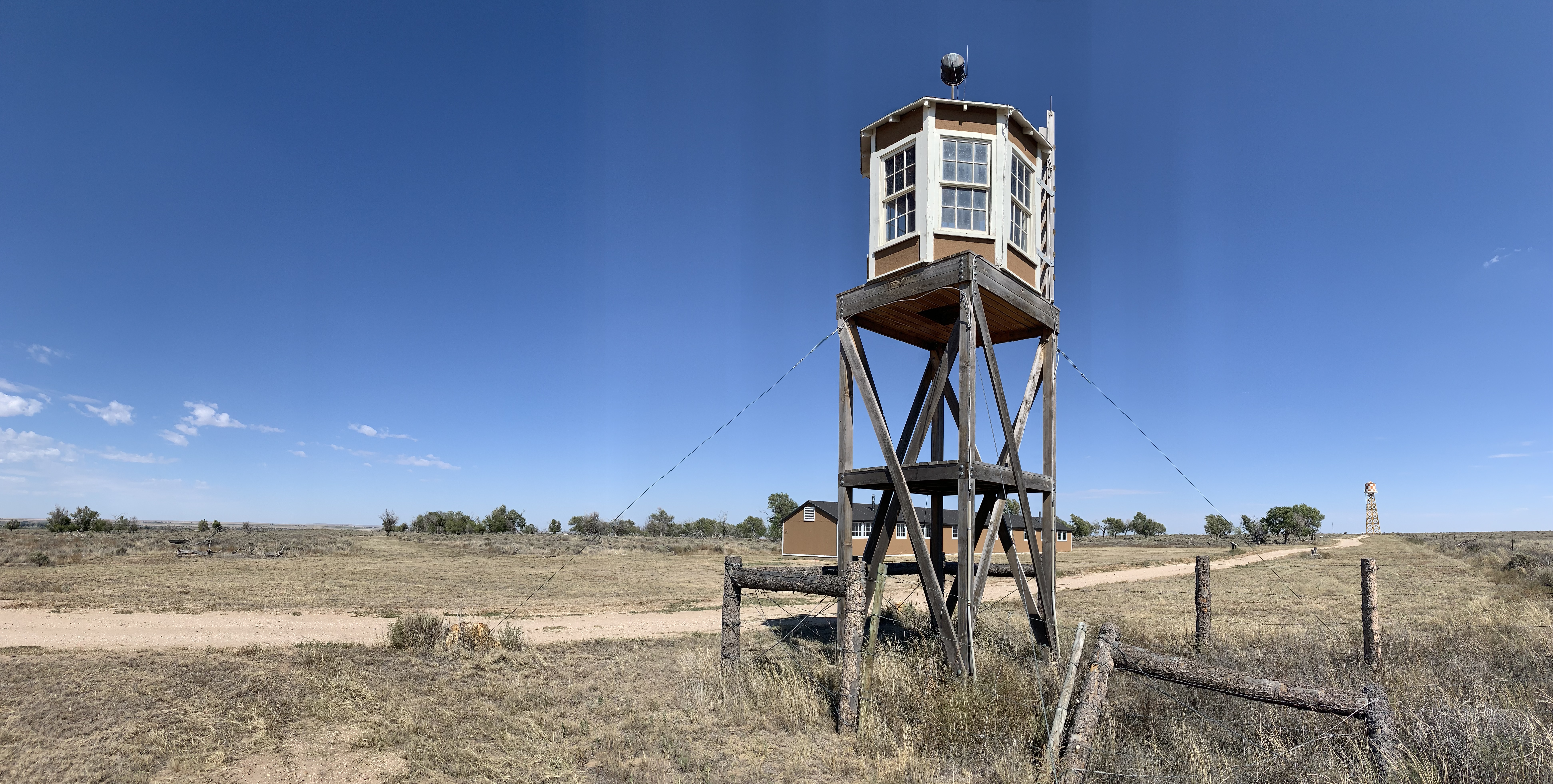
President Biden authorized this new park in March, but it will take time to become fully established. The local community is important in determining whether a park is created, how it will happen and when. In this case, the local Granada High School has been working on preserving the history here for many years and is largely responsible for the reconstruction of the guard tower above.

As with Manzanar and Minidoka, the image of a guard tower evokes the reality of the imprisonment of Japanese-American citizens during WWII. Each of the towers surrounding Amache was manned with a machine gun and a spotlight. But inside the camps, it is often the Japanese cultural touches that strike me, the rock gardens in Manzanar and the silk screen shop here. The silk screen shop was so good, that the incarcerated citizens made posters for the US Navy. Despite their incarceration and wrongful denial of their Constitutional rights, these citizens were proud of their country and many of the children joined the Boy Scouts and Girl Scouts here.

There are various monuments and markers remembering the 31 killed in action fighting for our country in Europe while their relatives were imprisoned, for the over 1,000 US military veterans from this camp including many interpreters, and for the over 100 inmates who died here, some before their time. While many were later reinterred elsewhere, a few graves remain in a Japanese styled cemetery, along with a memorial stone and a photo of the original epitaph, written in Japanese.

Interestingly, Colorado citizens of Japanese ancestry were not incarcerated, because the governor, Ralph Carr, correctly believed the program to be unconstitutional, arguing that once a majority violates the rights of a minority, “then you as a minority may be subjected to the same ill-will of the majority tomorrow.” His principles likely cost him his next election. (If the nearby town of Chivington wants to replace its shameful name, they could rename their town Carr).

But the Japanese [Americans] are protected by the same Constitution that protects us.
An American citizen of Japanese descent has the same rights as any other citizen. …
If you harm them, you must first harm me.
I was brought up in small towns where I knew the shame and dishonor of race hatred.
I grew to despise it, because it threatened the happiness of you and you and you.

Colorado Governor Ralph Carr to a hostile audience in 1942

Florissant Fossil Beds National Monument

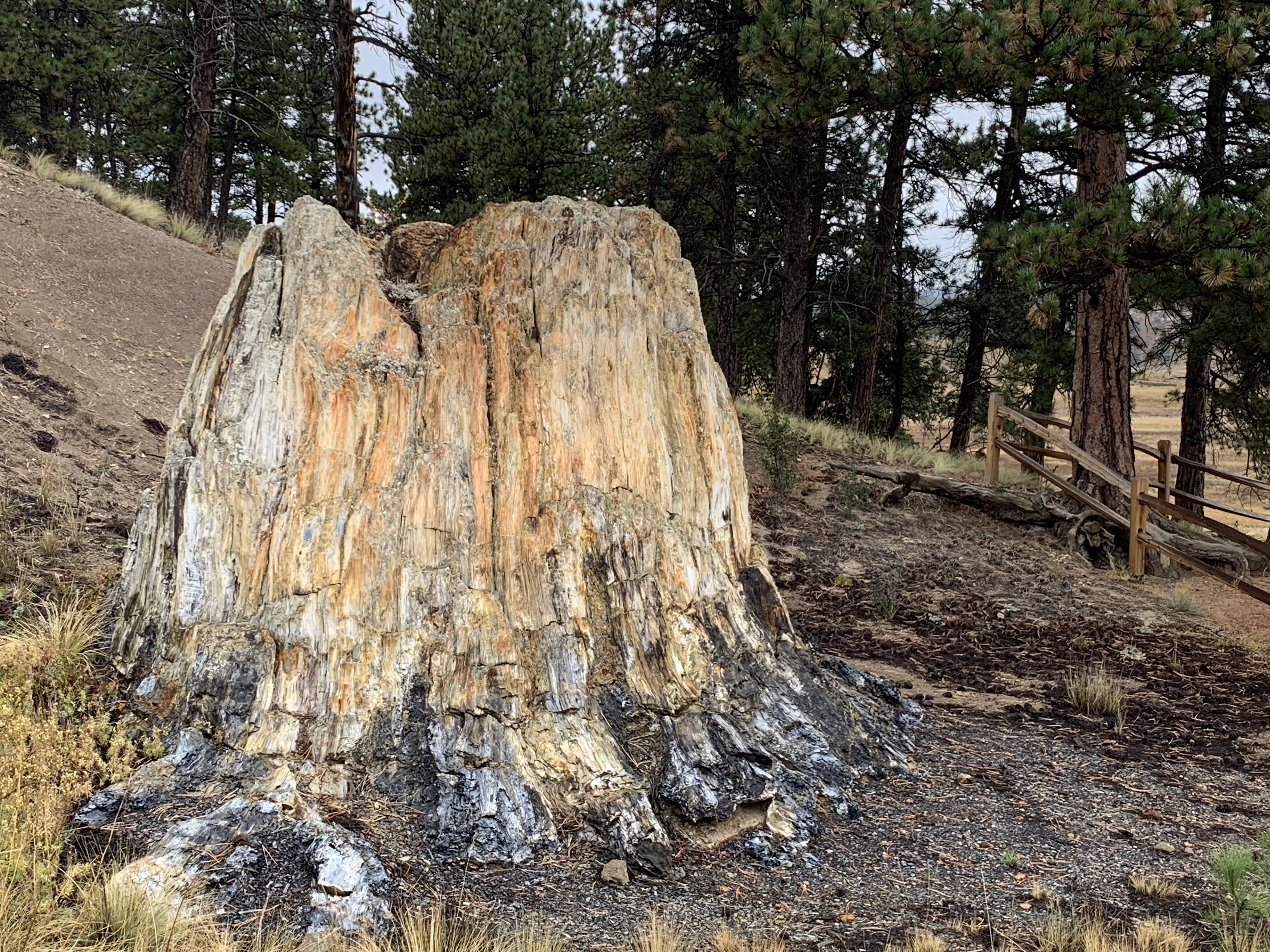
Giant Redwood trees once lived here, in Colorado, and many of their colorful stumps were preserved by volcanic ash along the easy 1 mile Petrified Forest Loop (at 8,400’). Early visitors took pieces of the petrified stumps and even left saw blades in the Big Stump above. See an array of Eocene fossils in the visitor center, including plants, bugs, fish and animals, and a rhinoceros bone. The volcanic ash layer captured a snapshot of the lake, meadow and forest here, which helps us understand how various plants and creatures evolved and adapted to a changing climate. But make no mistake, the current man-made climate crisis does not provide time for evolution or normal adaptation. Suddenly, our planet has a new, unprecedented and deadly climate, and most life won’t survive, unless we fix it now.

I wondered how large the peak range of the redwood trees must have been to have survived until today. They must have been successful in many different areas, like here, where the climate eventually become inhospitable to them. Now they only remain naturally in California and Oregon. People don’t seem to appreciate that for plants to survive over the long term, they need more than a few small, isolated reserves. They need to thrive in many different locations to have a chance of finding a stable and suitable one where they will have a future. Human limits, including pollution caused climate change, will extinguish species and ecosystems until we prioritize the protection of living things. Otherwise, all that will remain will be fossils and images of once thriving species.

Rocky Mountain National Park

Rocky was not what I expected. The strict timed entry system limits access to two hour windows and sells out within minutes after 5 pm the day prior, unless you reserve up to two months in advance in releases on the first of each month or unless you book a campground. The headwaters of the Colorado River are lovely, but not a huge source of water for over 40 million people downstream. The wildfires have been obviously devastating, especially in the western side of the park. The unique alpine landscape along the trail ridge road was smooth and barren, with low mats of tiny waxy hairy plants and, although I didn’t see any, only one species of bird, the Ptarmigan, tough enough to live there year round. Amid hail and high winds I failed at photography along the Trail Ridge Road over 12,000’, but the views were desolate, stormy and magnificent. Only after descending down to Upper Beaver Meadows did I manage to photograph a herd of elk and listen to the bull elk bugle.

In the line of cars, I keenly felt how masses of humans put pressure on fragile, limited nature. There were far more elk photographers and cars than elk. Even in unpleasant weather near the end of the season with controlled entry, every parking lot was full, and on the short trails I saw far more hikers than total wildlife. The best experience might be to book a summer campground at Bear Lake and try to hike into the backcountry. Park visitors love wildlife, but we’re overwhelming all the other species and increasingly encroaching on their last refuges. The towns surrounding the park are packed with galleries, gift shops and mini golf. Skiers fly into Colorado resorts and rent gas guzzling SUV’s, while the Congresswoman from western Colorado denies that the climate crisis exists. We are on the wrong path.

Dinosaur National Monument

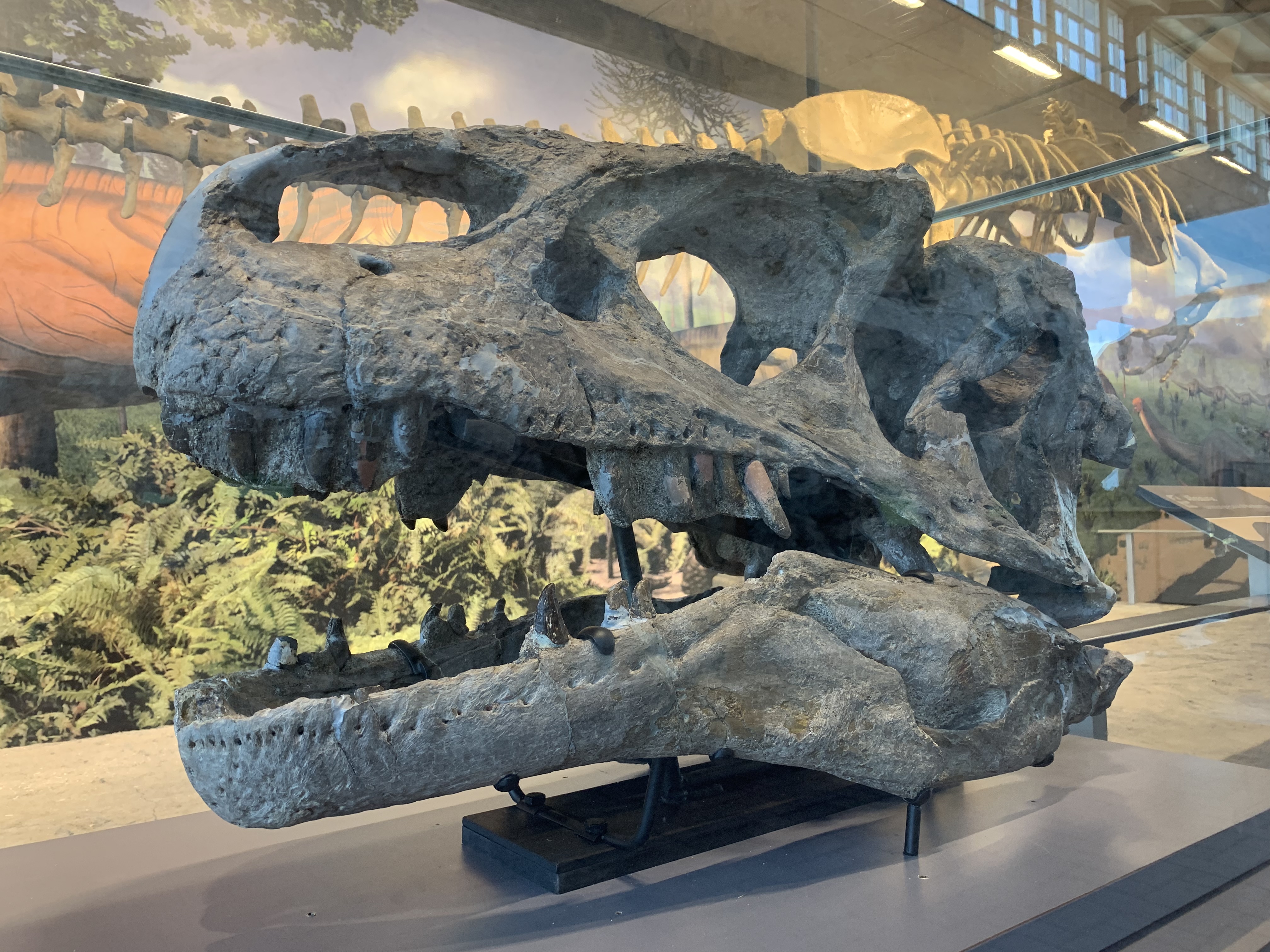
The Quarry Exhibit Hall, near Jensen Utah, has a crazy collection of large, late Jurassic dinosaur bones set in a two story high, very wide quarry wall, and you can touch them. It’s awesome. The Allosaurus skull above, a raptor talon-claw, Apatosaurus leg bones, and many Camarasaurus bones including a skull still set high in the quarry wall are all fascinating. This dinosaur exhibit is at the east end of the park after the Green River comes out of Split Mountain Canyon, and there’s a nice view, petroglyphs & pictograms.

Up the Green River is the extremely deep Canyon of Lodore, explored by John Wesley Powell, accessed from the north via permitted river trips or visible after a hike from the Gates of Lodore campground. Colorado’s Yampa River joins the Green from the east near Harper’s Corner, which has “the best view in the park” at the end of a hike and a 48 mile round trip drive. Unfortunately, I did not plan my charging to include either of those sections, so maybe next time.

There aren’t many good Tesla chargers around Dinosaur. Not sure why, but I noticed that some of the surrounding towns still support coal, have Halliburton operations, and have unfortunately unstable, irrational, fossil-fuel supporting representation in Congress. There’s a welcome center in Dinosaur Colorado with EV charging, but I don’t (yet) have the right kind of “combined charging system” CCS adapter. Since I’m in a hurry trying to visit high altitude parks during a short timeframe, I made due with a couple of 3rd party chargers I found using the PlugShare app, rather than stay in state park campgrounds. Especially when you get unexpected roadwork detours, being able to tap into other chargers is helpful.