Rocky Mountain National Park

Rocky was not what I expected. The strict timed entry system limits access to two hour windows and sells out within minutes after 5 pm the day prior, unless you reserve up to two months in advance in releases on the first of each month or unless you book a campground. The headwaters of the Colorado River are lovely, but not a huge source of water for over 40 million people downstream. The wildfires have been obviously devastating, especially in the western side of the park. The unique alpine landscape along the trail ridge road was smooth and barren, with low mats of tiny waxy hairy plants and, although I didn’t see any, only one species of bird, the Ptarmigan, tough enough to live there year round. Amid hail and high winds I failed at photography along the Trail Ridge Road over 12,000’, but the views were desolate, stormy and magnificent. Only after descending down to Upper Beaver Meadows did I manage to photograph a herd of elk and listen to the bull elk bugle.

In the line of cars, I keenly felt how masses of humans put pressure on fragile, limited nature. There were far more elk photographers and cars than elk. Even in unpleasant weather near the end of the season with controlled entry, every parking lot was full, and on the short trails I saw far more hikers than total wildlife. The best experience might be to book a summer campground at Bear Lake and try to hike into the backcountry. Park visitors love wildlife, but we’re overwhelming all the other species and increasingly encroaching on their last refuges. The towns surrounding the park are packed with galleries, gift shops and mini golf. Skiers fly into Colorado resorts and rent gas guzzling SUV’s, while the Congresswoman from western Colorado denies that the climate crisis exists. We are on the wrong path.
Dinosaur National Monument

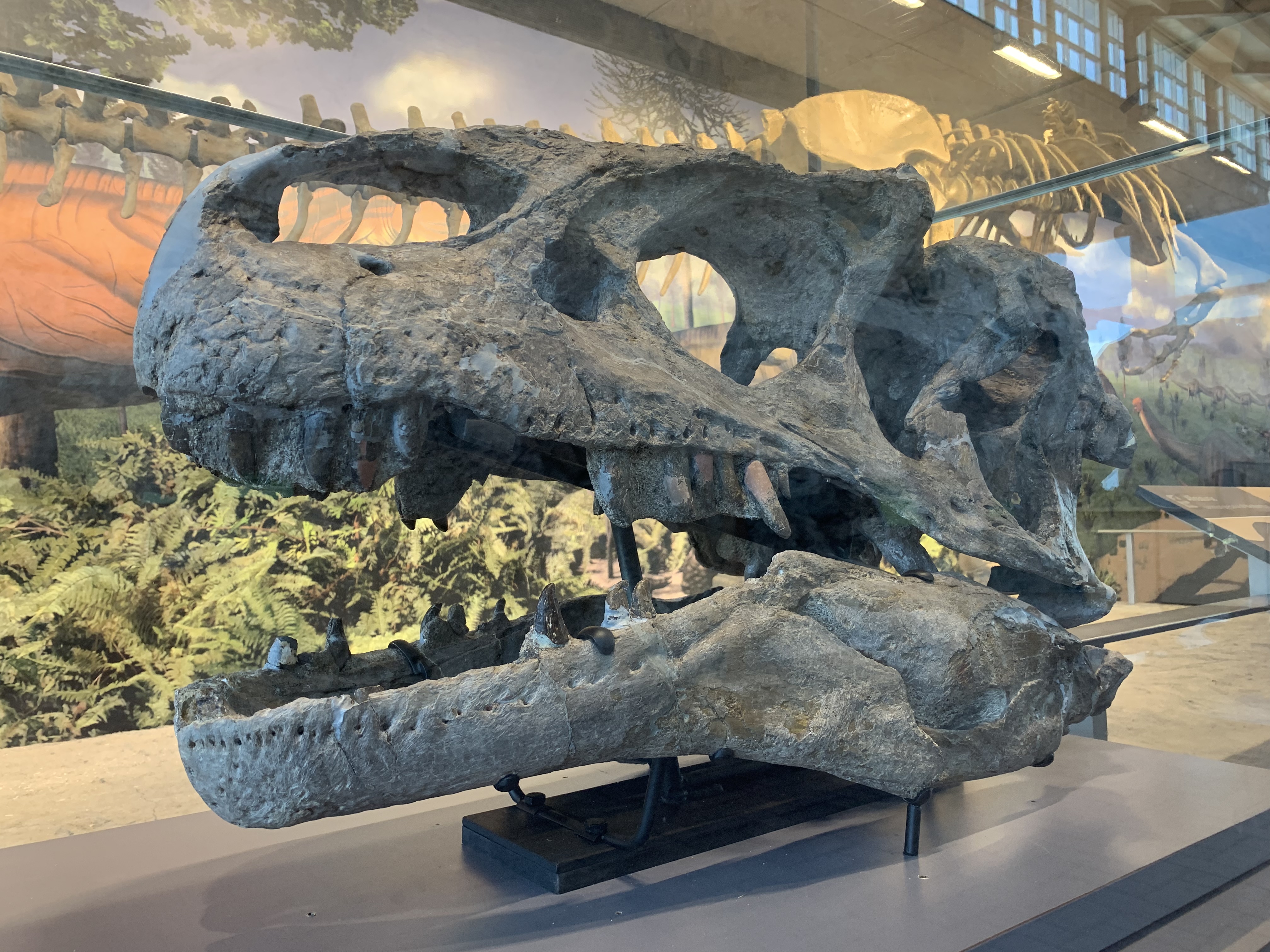
The Quarry Exhibit Hall, near Jensen Utah, has a crazy collection of large, late Jurassic dinosaur bones set in a two story high, very wide quarry wall, and you can touch them. It’s awesome. The Allosaurus skull above, a raptor talon-claw, Apatosaurus leg bones, and many Camarasaurus bones including a skull still set high in the quarry wall are all fascinating. This dinosaur exhibit is at the east end of the park after the Green River comes out of Split Mountain Canyon, and there’s a nice view, petroglyphs & pictograms.

Up the Green River is the extremely deep Canyon of Lodore, explored by John Wesley Powell, accessed from the north via permitted river trips or visible after a hike from the Gates of Lodore campground. Colorado’s Yampa River joins the Green from the east near Harper’s Corner, which has “the best view in the park” at the end of a hike and a 48 mile round trip drive. Unfortunately, I did not plan my charging to include either of those sections, so maybe next time.

There aren’t many good Tesla chargers around Dinosaur. Not sure why, but I noticed that some of the surrounding towns still support coal, have Halliburton operations, and have unfortunately unstable, irrational, fossil-fuel supporting representation in Congress. There’s a welcome center in Dinosaur Colorado with EV charging, but I don’t (yet) have the right kind of “combined charging system” CCS adapter. Since I’m in a hurry trying to visit high altitude parks during a short timeframe, I made due with a couple of 3rd party chargers I found using the PlugShare app, rather than stay in state park campgrounds. Especially when you get unexpected roadwork detours, being able to tap into other chargers is helpful.

Sand Creek Massacre National Historic Site

Thanksgiving celebrates when Native American generosity saved the first settlers in New England. Natives taught settlers about native crops and game, they traded peacefully with the British, Spanish, French, Russians, mountain men, and pioneers, and they guided Lewis & Clark across the country. Many early Americans married natives and lived happily.

Somewhere along the line, these same natives were portrayed as bloodthirsty savages, and that racist portrait continues today. I have not yet had time to fix it, but Wikipedia’s entry on this site has extensive quotes from a 19th century book in an apparent effort to justify the massacre here, pointing to another ”massacre” by natives that provoked this military action. But that was a family of four killed ”supposedly” by natives, and other events described as native ”attacks” were actually thefts, robberies and destruction of property.

The natives were the victims, both here and elsewhere. They lost their bison, their land, their freedom and their way of life. Many of their sacred lands were stolen by illegal acts of the US government, and many lost their lives to settlers and soldiers. Yes, some Native Americans fought back, following repeated provocations. I read of one chief who, after working his whole life for peace, returned home to find his family slaughtered, and he turned to war. But it is dishonest to confuse the aggressor with the victim. Most Americans live in states or places originally named by natives, but there continues to be a desire to honor those ancestors who participated in the land theft, forced removals and slaughters of Native Americans. Only some Utes remain on tribal lands in Colorado. The town immediately south of the park is named Chivington, but when you learn what he did, you will find that honor to be a disgrace.

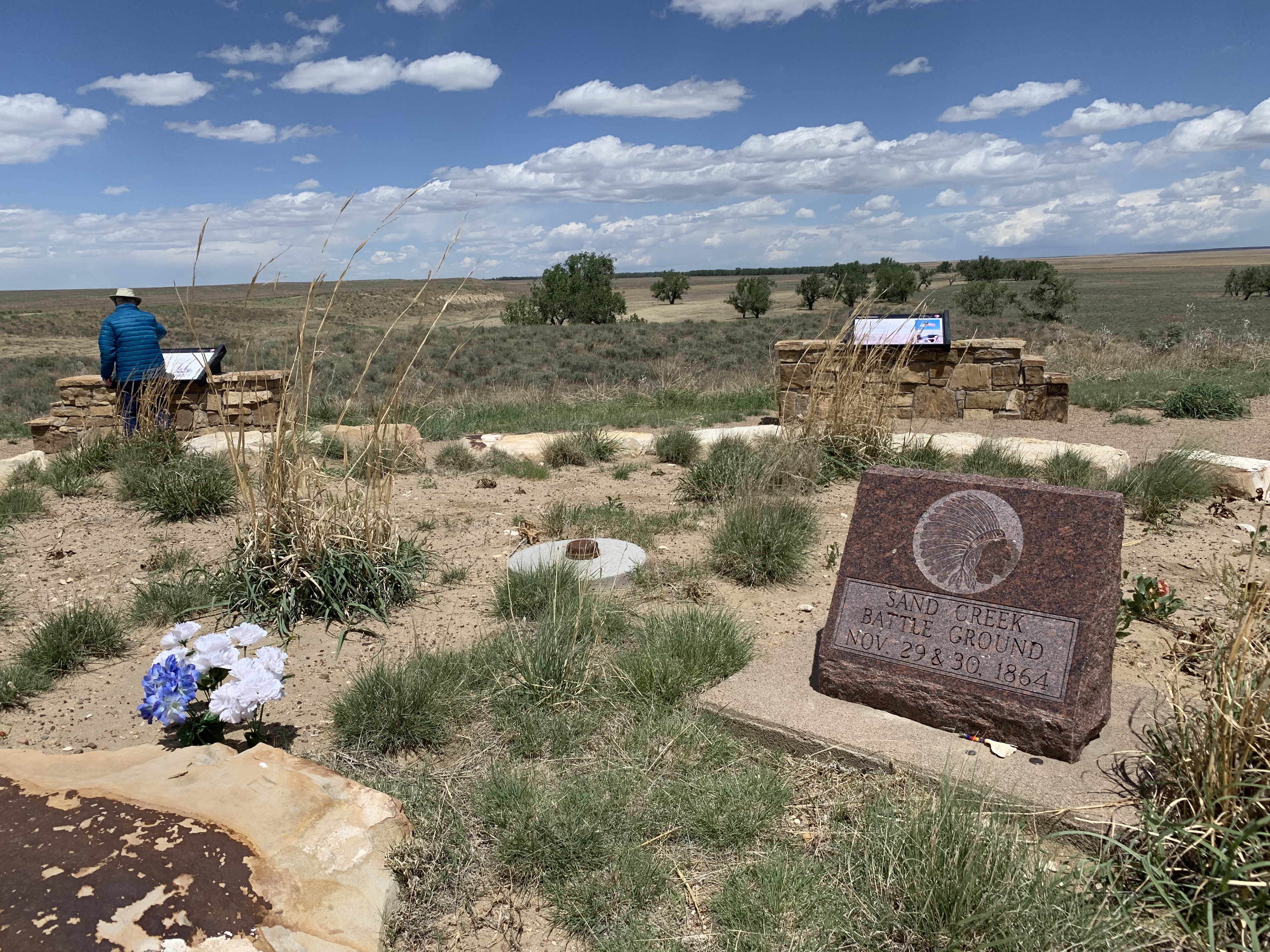
According to witness accounts of soldiers under his command, Colonel Chivington, who helped win the Battle of Glorietta Pass, was a politically ambitious man who wanted to add more victories to his resume. Peaceful native chiefs gathered here to continue peace negotiations under the protection of the local US military fort. Chivington knew that, and two days after the local commander transferred east, he attacked the village with 675 cavalry and 4 mountain howitzers. Two of his officers refused to follow orders, reported the massacre, and testified to investigators. They saw women and children bludgeoned to death while begging for their lives. Over 230 natives were massacred, including around 150 women, children and elderly. The details are horrific. Many bodies were mutilated post-mortem, and soldiers took ”trophies” including scalps, fingers, etc. to display in public. Fueled by greed and paranoid racist hatred, the townspeople treated the soldiers as heroes. But the government investigated and determined that it was an unjust, brutal “massacre”, ordering reparations (unpaid) and the removal of the governor for his involvement. Chivington, once a minister, escaped justice by resigning (loophole later closed) and the two men from a related military unit who murdered one of the witnesses also escaped justice. The other witness became a local sheriff.

As tragic as this story is, there was another similar massacre by US soldiers with a higher death toll at Bear River in Idaho. It also is tragic that many people even today, such as the Wiki liar, refuse to acknowledge the massacre as criminal and morally indefensible. At least the National Park Service is doing its job and preserving the site and the truth.

Bent’s Old Fort National Historic Site

Yes, there’s also a new fort, and no, I didn’t go there. The fort is a beautiful reconstruction made for the US Bicentennial. You might notice the fire damage around the edges. Just a few days earlier, a fire (under investigation) burned the fields and trees surrounding the fort. Fortunately, the fire department and rangers saved the fort and the animals. Even though I could still smell smoke, the ranger/ volunteer firewoman gave a full tour in period costume.

The Bents were merchants who traded buffalo bison hides and other goods on the Santa Fe trail. The fort was more of a commercial trading post than an active military base, but the lines were blurred. Kit Carson spent some of his early years around here hunting shooting bison. The US government used forts along the trail to protect the mail and to replace the Natives with white settlers.

Racism drove cultural hegemony. Before the arrival of Europeans, the Native Americans built homes, ate bison, hunted, fished, and grew mixed crops of corn, beans & squash. The superior settlers introduced a completely new way of using the land by building homes, eating beef, hunting, fishing and growing wheat. Oh wait, that’s exactly the same.

Great Sand Dunes National Park

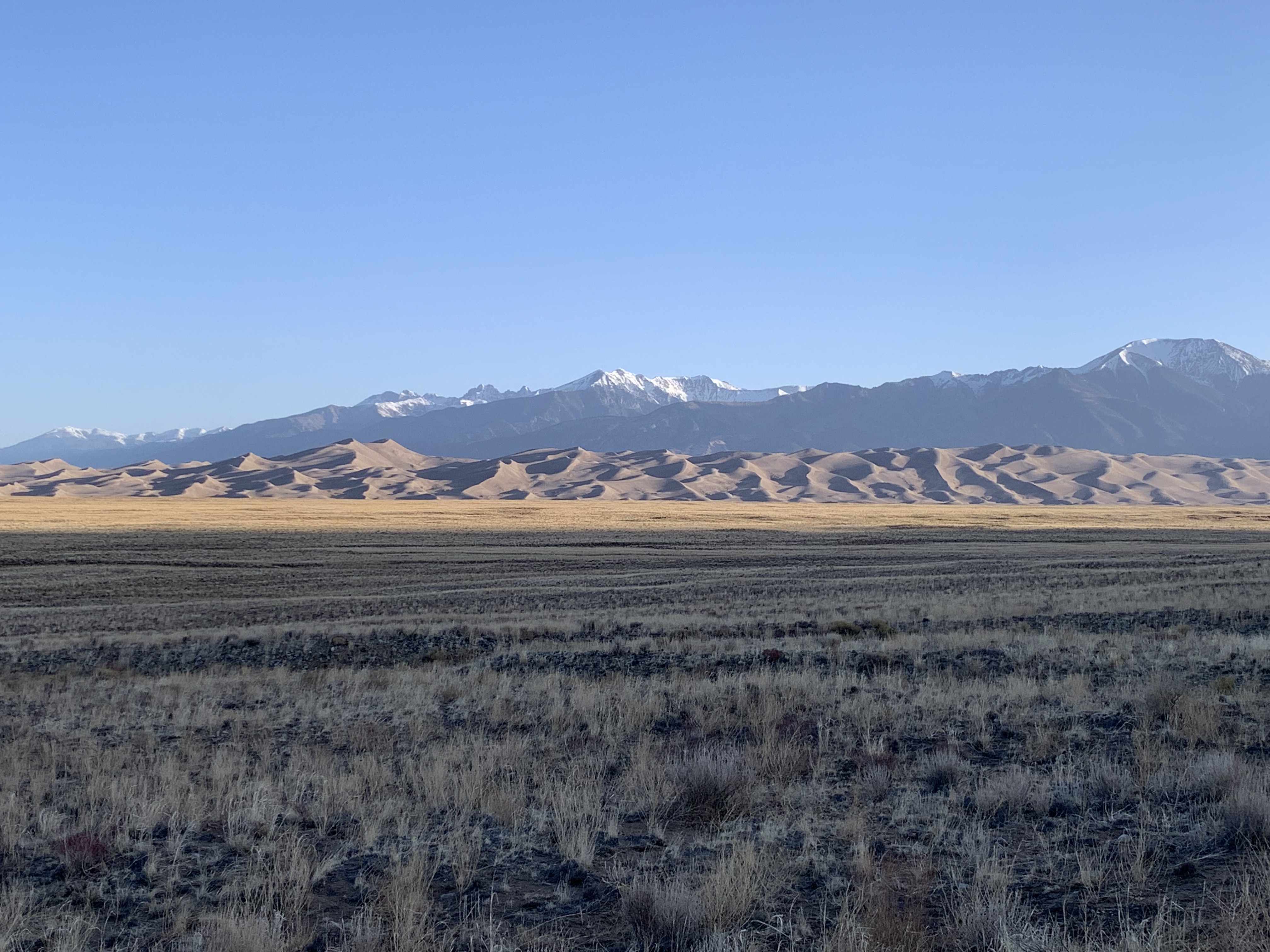
I’m obviously not much of a photographer, but I like this one. The tallest dunes here are over 700 feet, but they’re dwarfed by the surrounding mountains. Since I camped at Piñon Flats in the park, I was able to take this just as the sun came over the mountains, which added shadows for contrast. I hiked into the dunes before dawn and along the creek, but it’s not easy to take an interesting picture of so much brown sand, even in such a beautiful, surreal landscape in the moonlight. The dunes and the neighboring preserve are basically all wilderness, easily hiked into, and our footprints quickly disappear.

Whenever I wander into any wilderness, I always wonder about what we value. I have both a BS & MBA in business, and I worked in HQ at a Fortune 100 financial firm for a couple decades. And it seems to me that capitalism is terrible at valuation. One problem is that the first business to claim a resource is often just the first idea that comes along. There may be a better and more profitable use for a resource, but the quickest way to make money is typically the one that’s chosen. Another problem is that business people aren’t very innovative. If they see one business is successful in an area, then they will often just copy that idea. Economically, we’re far better off with a diverse set of competitive products and services than with a small number, because then we’re more resilient to market changes. But short term thinking dominates, which leads to over-investment in a few businesses, rather than a broad, diverse range of businesses.

It doesn’t take any special training to see this. Drive through most towns and see the same chain restaurants everywhere. Look at how similar most vehicles are or how all the fields in an area grow the exact same crop or raise the same cattle. Business is mainly herd behavior, and few want to risk money to develop a completely new business. Capitalists need tax incentives to change. Traditional car companies killed the electric car, then ignored Tesla, and now are demanding that the government build a charging network for them to compete. Who knew America’s largest and oldest corporations were such whiny cowards who need taxpayer handouts before they will adapt?

Why do I think about valuation in the wilderness? Because if the first guy to find this place had owned a cement company, he would have started carting off these dunes to make concrete. And then other concrete material suppliers would have copied him, lowering profits to nearly zero. And the wilderness would have been gone before anyone bothered to think whether there were any other better uses. The same is true of forests, wetlands, prairies, rivers, valleys, mountains and oceans. Capitalism rewards the first, fastest, cheapest exploiter for destroying wilderness, and penalizes long term thinking. Because time is money.