Theodore Roosevelt Birthplace National Historic Site

The Roosevelts moved into New Amsterdam (NYC) around the 1640’s, buying 50 acres in the middle of Manhattan, entered politics in the next generation and soon split into what would become the Hyde Park Democratic Roosevelts and the Oyster Bay Republican Roosevelts. Teddy’s financially adept grandfather expanded the family’s fortunes, including gifting this home in Gramercy Park, and his grandmother instilled Quaker virtues of public service in the family. The home, which Teddy did not want preserved “as a shrine”, was rebuilt after his death by Teddy’s sisters who figured he couldn’t complain anymore, and mainly includes original family items, including his crib (on temporary display), mementos of his trip to Egypt, his Rough Riders uniform and the folded speech that helped block an assassin’s bullet.

Teddy lived here until age 14, and learned much from his family about politics, travel, natural history, charity and life. His parents were involved in many charitable works, including establishing the Natural History Museum, and Teddy set up his own “Roosevelt Natural History Museum” as a child with his cousins. A frail asthmatic child, Teddy was encouraged to exercise in a home gym, as his father said, “to do all you can with your mind, you must make your body match it”. Teddy was a dynamo at Harvard, was elected to the NY Assembly, and published Naval War of 1812. Unfortunately, on Valentine’s Day in 1884, both his wife and mother died of illnesses. Feeling cursed, Teddy abandoned politics and withdrew from city life, traveling to the Dakotas to mourn and recover.

I was introduced to Teddy Roosevelt through the beautifully illustrated, humorous tales of The Roosevelt Bears read by my grandfather. The Teddy Bear was invented in response to a true story where Teddy refused to shoot a cornered bear, believing it to be unsportsmanlike. President Roosevelt was a Progressive who fought for “a square deal” “for the plain people” “not politicians” and “not men of great wealth”. He challenged and broke the great monopolies of his day, and he was proudest of his work for conservation, reserving 150 million acres of forest. He credited his family upbringing for his achievements.

“Of all the questions which can come before this nation,
short of the actual preservation of its existence in a great war,
there is none which compares in importance with the great central task
of leaving this land even a better land for our descendants than it is for us.”
Theodore Roosevelt

St. Paul’s Church National Historic Site

The New York Royal Governor Crosby’s allies tried to disenfranchise the Quakers by requiring them to swear an oath on the Bible, which violates their beliefs. In response, the colonial assembly voted in favor of religious freedom and protecting voting rights. The press coverage so annoyed the Governor, that he had the publisher arrested and tried at Federal Hall. But the publisher (Zenger) was acquitted in the case, resulting in expansion of freedom of the press.

The original church here was established by the British to impose the Church of England on the heretical Puritans and Quakers and others who lived here, including people like Anne Hutchinson, who fled both Boston and Rhode Island to avoid harassment over her belief that women could interpret scripture too. (The Hutchinson River Parkway is named after her). As the revolution approached, the people here split into factions of loyalists and patriots, and the graveyard contains families who fought on both sides, as well as Hessian mercenaries, slaves and free African Americans. There was some fighting nearby at Pell’s Point which helped Washington retreat to White Plains, and the church was used as a military hospital.

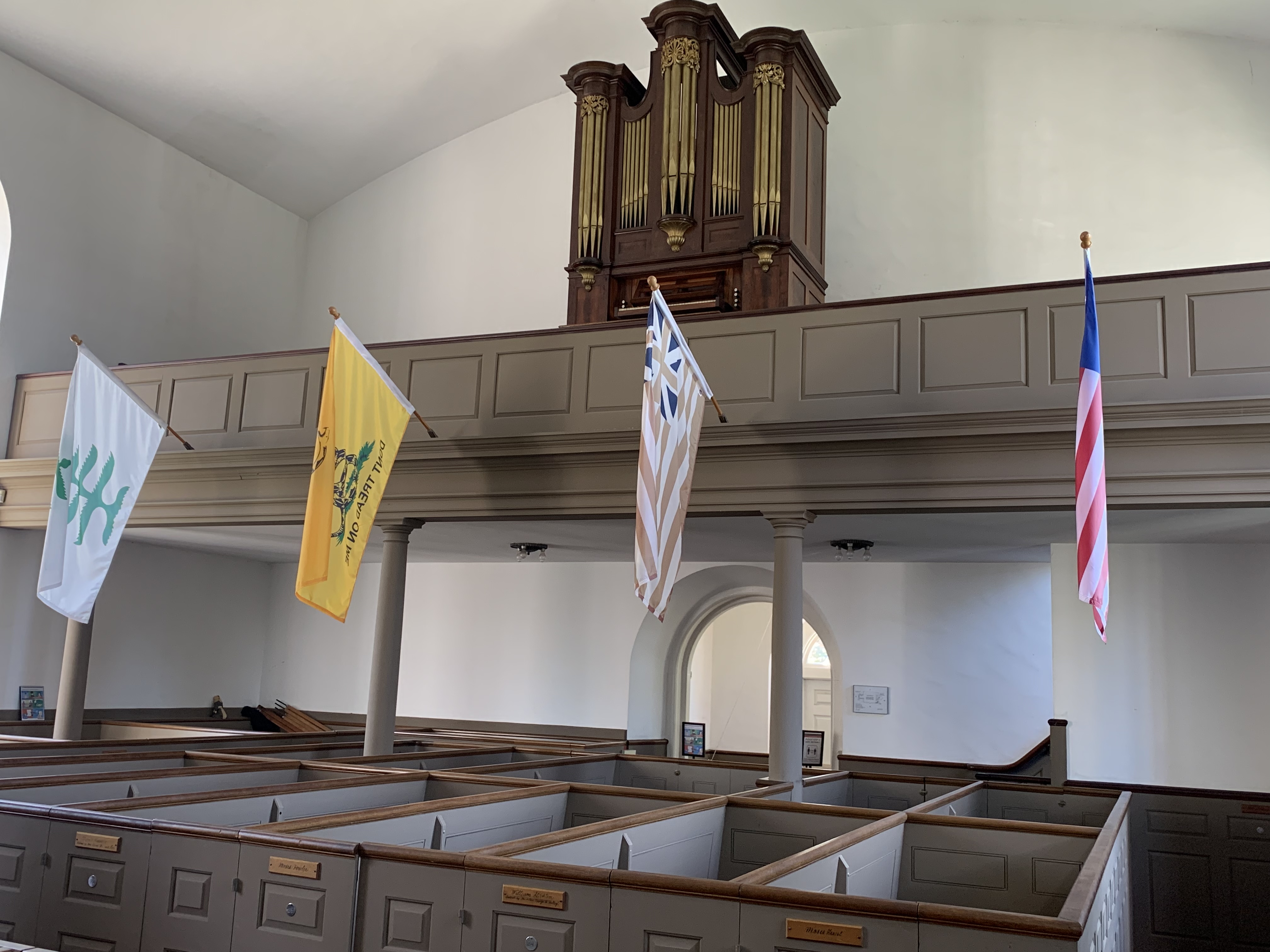
In addition to the fine old organ, family box-pews and flags pictured above, there’s also a bell cast in London in 1758 and a stained glass window. Much of the restoration work was done around WWII with fundraising led by FDR’s mother. But the surrounding neighborhood at the northeast border of the Bronx is now heavily industrial, not residential. (I walked from the Eastchester-Dyer Av station). The Episcopal church, which is related with yet independent from the Anglican Church, was deconsecrated around 1978 and is cooperatively managed with the parks service as a (secular) national historic site. Take some time to walk around the evocative colonial and early American graveyard.

African Burial Ground National Monument

Yesterday I mused about the need ‘to learn from our past to prepare for the future’, without realizing that today I would be looking at a symbol that means exactly that, the West African Sankofa, which is carved above the doorway of return on the opposite end of the memorial structure above. The architect, Rodney Leon, has filled this space with symbols and symbolism, and it evokes the slave-ship hold, the middle passage, the diaspora centered on West Africa and the depth of the remains. When we choose to recognize our roots and learn from them, we can draw strength to be better.

When the burial ground was rediscovered in 1991 and when protests forced the government to change their plans, I was abroad and missed the news reports of the historic find and cultural repercussions. Fortunately, the story is well told in the museum in both the park film and in the exhibits. Government leaders were initially unable to see the pricelessness of the rediscovery due to the value of the land, and the African American community needed to speak out both for their ancestors and for all of us to force the government to respect the remains, preserve the site and honor the contributions of Africans to this city and to our society. The archaeological research, the history of those buried here and some African artifacts are all on display. Facing the emotionally moving subjects daily, the rangers help visitors understand the site’s importance, history and significance.

“You may bury me in the bottom of Manhattan.
I will rise. My people will get me.”

Maya Angelou

Stonewall National Monument

If General Sheridan returned to admire his statue, he would likely wonder why there were so many rainbow flags in his park. If he walked into the Stonewall Inn bar (to the left above), he would probably have more questions. But here on the 28th of June 1969, a police raid against the bar for illegally serving homosexuals sparked a riot against police oppression. Unlike earlier riots, a large crowd gathered and forced the police to retreat into the bar. The police called for backup, but the community brought even more protesters who linked arms and fought back. The bar was boarded up, but the protests became larger, as the LGBTQ+ community came out into the open in force to organize marches to Central Park that grew each year. Before Stonewall, some activists had begun staging “sip ins” at gay bars like Julius’ to protest the denial of civil rights and attempts to humiliate and prosecute people based on their sexual orientation. After Stonewall, laws began to change.

The bar itself is still serving drinks with pride, but the site is scheduled to become the headquarters & visitor center in 2024. There are other bars, nice shops and restaurants in the area, and it’s worth taking a stroll and maybe ordering a drink to raise a glass to the brave souls who fought police here. Despite being discriminated against by society and targeted by law enforcement, they demanded and won respect for their rights, bringing more freedom for everyone.

Castle Clinton National Monument

To prevent the British from taking New York (again) in 1812, a fort was built here on a man-made island (since filled in with the park above). As usual, the city reinvented the space several times, as an exhibition hall, an immigration center, an aquarium and as a national monument (where people also buy tickets to the Statue of Liberty & Ellis Island). The exhibit space is basically one room with displays showing the castle’s history, plus a few placards. The rangers are very helpful and knowledgeable, but unfortunately, nobody knew of a way to get to Liberty or Ellis Islands without burning carbon.

Federal Hall National Memorial

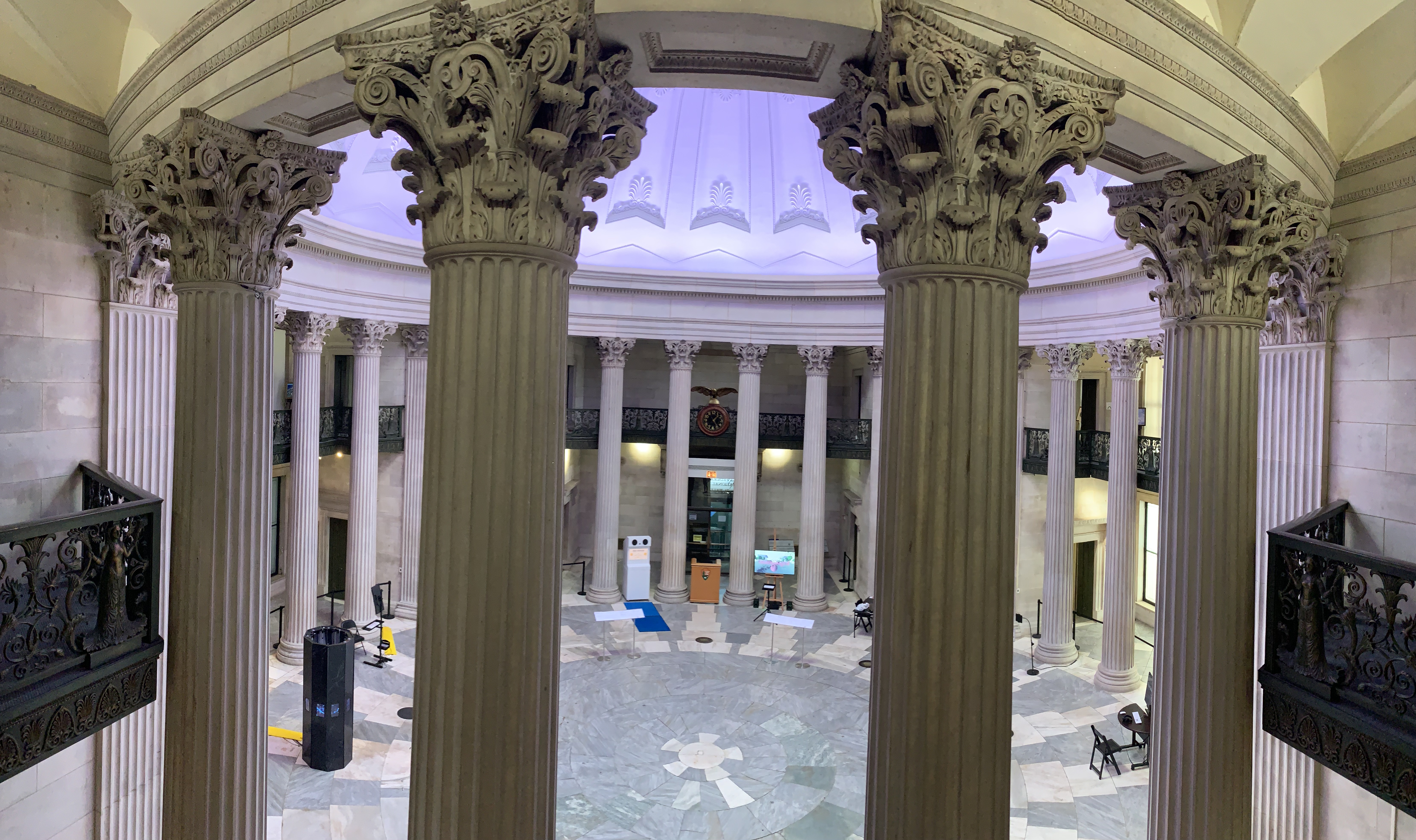
From the balcony outside, George Washington was sworn in as our first President in 1789. In 1790, Congress passed the Bill of Rights here, which was appropriate since the Zenger case that defined freedom of the press was tried here in 1735 and since the 1765 Stamp Act protests outside here defined freedom of assembly. The current version of Federal Hall was a Customs House in 1842 and later became a bullion depository for the US Treasury, which is appropriate given that it is around the corner from the NY Stock Exchange. New York City’s national park sites all seem to serve multiple purposes, as layers of history stack up in crowded urban spaces, but this quiet site offers a moment of respite to reflect on our past as we must prepare to face our future. I recommend eating at Fraunces Tavern nearby, since it predates our founding and is the oldest restaurant in New York City.

Lower East Side Tenement Museum National Historic Site

While I took the 1902 tour focusing on Jewish immigrants and the beef riots, the film in the museum was about two Joseph Moores, one black and one Irish, and explored the unequal outcomes dictated by law and society. I highly recommend both, as seldom does history provide so valuable a perspective on current issues such as the importance of activism in resisting inequality and injustice and as the long term impact of systemic racism.

The Levine family lived and worked in a three-room sweatshop tenement producing garments like those above (the one on the right is original), and their butcher’s family lived and worked in the basement. In the spring of 1902, the new scion of the Armour meatpacking firm of Chicago decided to hike the price of Kosher beef by 50%. He was trying to build an estate for his wife which would include a bowling alley, 20 marble fireplaces, fish ponds, a large herd of deer, and a greenhouse for growing oranges. (He inspired Upton Sinclair’s novel The Jungle). The Beef Trust had a monopoly on Kosher beef in New York City (at the time the largest Jewish city in the world), so they simply dictated the new price to all the butchers. The firm was renowned for low pay, strike-breaking, and hardball tactics to get whatever they wanted.

But they underestimated the Jewish housewives of the Lower East Side tenements. The women organized, boycotted, threw bricks through butcher shop windows, burned meat on their floors and even climbed down from the synagogue balconies to throw raw ground beef in the butchers’ faces. In a month, the price rise was reduced by 2/3rds, and a whole generation of suffragettes, union leaders and political activists was born. (In my first job, I worked with old women who had numbers tattooed on their arms, and they were not to be underestimated).

One of the historic Orchard St buildings is undergoing renovations, but all the tours, including the walking tours of the neighborhood are insightful. I recommend Katz’s deli or Russ & Daughters for a bite before or after your tour.

Hamilton Grange National Memorial

Since the musical, Hamilton’s home has been busier than ever. Built as a countryside retreat for his wife, Hamilton was killed in a duel only a couple of years later. But his wife and children lived here for many years, protecting his legacy and eventually donating his 18th century piano pictured above. The house itself has been moved a few blocks, twice, and the park service has only opened it for tours here in the past few years. The gardens are being regrown according to Hamilton’s old instructions, and the site is now located on the edge of a public park.

The town has grown up a bit since then. Historic Harlem is only a few blocks away, and I recommend dining at one of the old soul food restaurants with live music, if you have the time. I’m obviously in New York City, still traveling by EV, namely the Metropolitan Transit Authority’s NYC Subway.

“Who talks most about freedom and equality?

Is it not those who hold the bill of rights in one hand

and a whip for affrighted slaves in the other?” 

Alexander Hamilton

Weir Farm National Historical Park

When I say that I don’t like J. Alden Weir’s paintings, don’t misunderstand me. I was kicked out of my only art class at age 9 for drawing sketches of a battle including graphic illustrations of stick figures getting blown apart by WWII tanks & planes. I couldn’t tell you the difference between a tint or a tinge from a tincture. One of my favorite pieces of modern art remains the remains of an artist named Art, who, according to his will, was cremated and put on display. So, don’t judge Weir by my predilections.

Actually, I do like “On the Porch”, a Japanese inspired watercolor of two of his daughters painted here on his farm. But I don’t like “The Red Bridge”, where he contrasts a natural setting with a railroad bridge, and I find his landscapes to be too muted and subtle in color to hold my attention. Unlike some European impressionists, Weir didn’t typically paint laborers, preferring farm animals or his family (although he sold paintings to help the unemployed). In any case, tastes change, so creativity must overcome tastes.

Weir, the son of a West Point drawing instructor, helped found American Impressionism. Where his brother went to Hudson Valley, Julian went to Paris, where he overcame his initial horror of Impressionism to adopt some of the techniques. Soon he was back in the US, exhibiting impressionist paintings with his friends, Twachtman, Ryder, and others who organized a group of ten artists to promote the new style. His daughters grew up to be artists as well, and one married one of Brigham Young’s grandsons, Mahonri Young, whose studio is also on the Weir Farm.

While the tour of Weir’s house and studio is interesting, the magic of the place is in the artists who continue coming here to paint. Art colonies and communities constantly influence and depict each other, as when a student of Saint-Gaudens created a bronze relief of Weir. There’s an artist-in-residence, and a small army of artists of all levels who continue to see the new in the old barn, gardens, fields, forest, pond and porch. Some of their paintings are in bold, bright dramatic colors, which I like.

But honestly, real nature is subdued and muted in color. Light on leaves reflected in water is blurred. Roots and rocks on dirt trails near muddy banks are all shades of brown and gray. The real bear in the woods here isn’t kaleidoscopic. Nature is messy, mostly dully boring and awkwardly chaotic, with one tiny amphibian emerging from the algae to catch one’s eye on a stone before almost being trampled. Hmm, maybe I should go back and take another look at Weir’s landscapes.

Fort Stanwix National Monument

Yes, I’m back with a bang! Tesla is still working on my car (Chaco was tough on the springs), but rather than hold me hostage, they’re letting me travel around in a Model S until my car is ready. And the fort celebrates the 1777 victory for two weeks in mid-August with hourly cannon fire!

This fort has it all: drawbridge, sally-port, parapets, ramparts, and meticulously detailed barracks. And it’s open, labeled, extremely photogenic and great fun to climb around and explore. A small crowd gathers just a few yards from the cannon just below the colonial officer walking in the photo, and each step is demonstrated from candle to boom!

Long before we became an independent country, French fur traders gathered at this natural portage between the St Lawrence Seaway and the Hudson River and bought beaver pelts from Native Americans to make hats. I drove up the Hudson River Valley, along the Mohawk River and saw signs for Oneida Lake which drains into Lake Ontario. A short portage here connects the two watersheds, making this a strategic point in the middle of New York State, later connected by the Erie Canal. Control of this portage had international repercussions, as colonial powers divided up the globe.

The British built the original fort after capturing the area during the French & Indian War, and George Washington rebuilt it to defend the territory from the British. The key battle happened when a British Colonel led troops from the Great Lakes to meet with General Burgoyne’s force from Montreal in order to separate New England from the rest of the colonies. Both sides were joined by Native American warriors, and there was a particularly bloody ambush in the woods near the fort. The Patriots defended the fort for about 3 weeks before Benedict Arnold’s reinforcements (when he was still on our side) disrupted the plan, leading to Burgoyne’s surrender at Saratoga. Regardless of which side they fought on, the Native Americans were eventually forced to cede lands in New York, Ohio and Pennsylvania, in return for some annual compensation and limited sovereignty over their remaining land near here.