Women’s Rights National Historical Park

Seneca Falls is a lovely town in the Finger Lakes region of New York, linked by canal to Lake Erie, Albany, New York and the St Lawrence Seaway. Frank Capra modeled his fictional town of Bedford Falls after here, and every Christmas they have events reminiscing about the make-believe story.

When the privileged Elizabeth Cady Stanton settled here with her Abolitionist lawyer husband, she found the real-life industrial mill town full of poor immigrant female laborers and found her own life filled with drudgery, taking care of her many children, while her husband’s career advanced. “How much I long to be free of housekeeping and children, so as to have time to think and read and write.” Starved of the intellectual community she had known in New York, Europe and Boston, she organized a ‘conversation club’ to discuss progressive social ideas, inviting Quakers like Lucretia Mott and Abolitionists like Frederick Douglass to her home above. One day, her friend Amelia Bloomer (who popularized the women’s pants) introduced Stanton to Susan B. Anthony, and together they changed history.

“It has been said that I forged the thunderbolts
and she fired them.”

Elizabeth C. Stanton of her co-author and friend Susan B. Anthony

At the Revolution, many women and people of color had the vote, which was determined by each state. Abigail Adams asked her husband to “remember the ladies” in 1776, but women’s rights were not included. The biggest barrier to voting was neither race nor gender, it was lack of property. White males disenfranchised others by taking control of land, businesses, marital assets, divorce settlements, bank accounts etc., and then requiring minimum amounts of property to vote. Then they started making gender discrimination official. In 1777, women in New York explicitly lost the right to vote. In 1780, Massachusetts women did too. In 1784, New Hampshire women were disenfranchised. When the Constitution was enacted in 1787, only New Jersey women kept the right to vote.

Native American women in upstate New York owned property and had other rights in their Haudenosaunee Confederacy. And African Americans also wanted voting rights. Elizabeth Stanton realized deeply what was happening in America: women were being systematically oppressed. She sought out allies among the Abolitionists, African Americans, Native Americans and immigrant activists, and they began organizing a movement. In London, her husband had been allowed to speak at the Anti-Slavery Convention, but the women were all excluded. In America, this new movement would be led by women. In 1848, at the Wesleyan Chapel, the First Women’s Rights Convention demanded equal rights, including the right to vote. And they began a campaign that continues to this day, from the American Woman Suffrage Association to the League of Women Voters. Many suffragettes went to prison to try to win rights for all women. The 19th Amendment finally passed in 1920, when the last holdout’s mother sent the Senator a telegram, causing him to flip.

The park unit does not do a good enough job of telling the story—with the notable exception of ranger Nicole above. On the plus side, the names and images of numerous women’s rights activists are presented, and many of the related issues are described in the text-heavy exhibits. Sojourner Truth demands inclusion for African American women, “I have borne 13 children, and seen them most all sold off to slavery, and when I cried out with my mother’s grief, none but Jesus hear me. And ain’t I a woman?” FEW Harper puts it well too, saying that white women “need to be lifted out of their airy nothings and selfishness.” There’s a single image of a women’s rights meeting that occurred in Persia (now Iran) one month before the convention here, with a quote from Táhirih, “You can kill me as soon as you like, but you cannot stop the emancipation of women.”

But the park film is no longer available, and replacing it “is difficult”. One of the largest photos shows a female African American military (ROTC?) recruit in front of a line of white uniformed men, without any information or ranger knowledge, thus forgetting the name and act of a woman who apparently broke both a gender and color barrier. More of the exhibits are about the Underground Railroad and fashion than to the right to vote. Frankly, I learned more about the direction and timeline of women’s voting rights from a small display in the parking lot of the XIX Cafe than from the official park exhibits. One of the local women described the whole park as “lame”. It took me two days walking all over town to piece together the story. It is frustrating to see such a missed opportunity to tell the story effectively about the extraordinary centuries long struggle for the basic rights of the majority of US citizens.

But go anyway. Ask to see the park film—they’re counting the number of people who complain. Ask how the history here relates to the loss of voting rights today. Ask about the Equal Rights Amendment. Ask about Lily Ledbetter. Ask about Trans rights and reproductive rights. Ask them to describe the Suffragettes who burned Wilson’s effigy in front of the White House. Make some noise, and don’t let manners hold you back. Don’t let this history die, or future generations will have to fight it all over again. The fight goes on!

Theodore Roosevelt Inaugural National Historic Site

This is a quirky little site. Even Teddy didn’t spend much time here. He arrived in response to McKinley’s assassination, left when told he would recover, returned upon hearing he would die, and was inaugurated in 30 minutes by a local judge.

One of Teddy’s first official acts here was to invite Booker T. Washington to the White House. Teddy was also famously friends with John Muir, and he also befriended activist Jane Addams—who eventually won a Nobel Peace Prize and deserves a park site of her own. You can tell a lot about a person by his friends.

There are only a handful of rooms to see, but there are interactive exhibits about the Pan American Expo—where McKinley was shot by an anarchist—issues of Teddy’s Presidency, his friends & advisors, his draft first speech, and the room above where he was sworn into office. The tour evokes the hasty events here well. And if you get hungry, there’s a bar down the street that claims to have invented Buffalo Wings.

General Grant National Memorial

As General, U.S. Grant won the Civil War, and as President, he saved the Union. He created the Justice Department, supported the 15th Amendment and fought the Ku Klux Klan. Over a million people gathered to watch his funeral procession in 1885, and his mausoleum became one of the top tourist destinations in the nation.

Racists like President Johnson were determined to resist letting African Americans vote, and Grant agreed to run for President in large part to protect those rights. This divide of bigotry, which festered after the Civil War, continues to divide our country. After Grant’s death, the descendants of traitors promulgated the big lie (known as the Lost Cause) that the confederates were honorable, benevolent to slaves, and were the moral victors of the Civil War. To do so, they maligned Grant as a drunk, ignoring his reform efforts and associating him with corrupt officials. The campaign was effective, and Grant was often ranked among the worst Presidents.

Grant’s Indian policy illustrates the problem. Grant appointed the first Native American to be Commissioner of Indian Affairs, and Grant pledged “proper treatment of the original occupants of this land—the Indians.” Supporting peaceful reconciliation, his administration allowed many Quakers and Episcopalians to “help” the natives, instead of continuing genocide. Grant was a firm believer in the separation of church and state, but the religious people believed that converting the Natives was the best way to help them and thus erased so much of their culture. And many people still wanted to take Native American land, so well-intended land policies were similarly corrupted.

Like most of the park rangers I’ve spoken with, I’m a fan of Grant. We believe he was, generally for his time, on the right side of history and does not deserve the vitriol he received in life and death from those on the wrong side of history. I wish he had better understood the depths of and had proposed better solutions against systemic racism, but he was an ally of the Americans who were denied their rights by many white Americans. The struggle to secure the voting rights of African Americans and to restore justice to Native American communities continues over 150 years later. Grant recognized both his own failures of judgement and the moral sins of our nation. But Grant also said victory goes to those who keep fighting.

“Nations, like individuals, are punished for their transgressions.”

Ulysses S. Grant

Theodore Roosevelt Birthplace National Historic Site

The Roosevelts moved into New Amsterdam (NYC) around the 1640’s, buying 50 acres in the middle of Manhattan, entered politics in the next generation and soon split into what would become the Hyde Park Democratic Roosevelts and the Oyster Bay Republican Roosevelts. Teddy’s financially adept grandfather expanded the family’s fortunes, including gifting this home in Gramercy Park, and his grandmother instilled Quaker virtues of public service in the family. The home, which Teddy did not want preserved “as a shrine”, was rebuilt after his death by Teddy’s sisters who figured he couldn’t complain anymore, and mainly includes original family items, including his crib (on temporary display), mementos of his trip to Egypt, his Rough Riders uniform and the folded speech that helped block an assassin’s bullet.

Teddy lived here until age 14, and learned much from his family about politics, travel, natural history, charity and life. His parents were involved in many charitable works, including establishing the Natural History Museum, and Teddy set up his own “Roosevelt Natural History Museum” as a child with his cousins. A frail asthmatic child, Teddy was encouraged to exercise in a home gym, as his father said, “to do all you can with your mind, you must make your body match it”. Teddy was a dynamo at Harvard, was elected to the NY Assembly, and published Naval War of 1812. Unfortunately, on Valentine’s Day in 1884, both his wife and mother died of illnesses. Feeling cursed, Teddy abandoned politics and withdrew from city life, traveling to the Dakotas to mourn and recover.

I was introduced to Teddy Roosevelt through the beautifully illustrated, humorous tales of The Roosevelt Bears read by my grandfather. The Teddy Bear was invented in response to a true story where Teddy refused to shoot a cornered bear, believing it to be unsportsmanlike. President Roosevelt was a Progressive who fought for “a square deal” “for the plain people” “not politicians” and “not men of great wealth”. He challenged and broke the great monopolies of his day, and he was proudest of his work for conservation, reserving 150 million acres of forest. He credited his family upbringing for his achievements.

“Of all the questions which can come before this nation,
short of the actual preservation of its existence in a great war,
there is none which compares in importance with the great central task
of leaving this land even a better land for our descendants than it is for us.”

Theodore Roosevelt

St. Paul’s Church National Historic Site

The New York Royal Governor Crosby’s allies tried to disenfranchise the Quakers by requiring them to swear an oath on the Bible, which violates their beliefs. In response, the colonial assembly voted in favor of religious freedom and protecting voting rights. The press coverage so annoyed the Governor, that he had the publisher arrested and tried at Federal Hall. But the publisher (Zenger) was acquitted in the case, resulting in expansion of freedom of the press.

The original church here was established by the British to impose the Church of England on the heretical Puritans and Quakers and others who lived here, including people like Anne Hutchinson, who fled both Boston and Rhode Island to avoid harassment over her belief that women could interpret scripture too. (The Hutchinson River Parkway is named after her). As the revolution approached, the people here split into factions of loyalists and patriots, and the graveyard contains families who fought on both sides, as well as Hessian mercenaries, slaves and free African Americans. There was some fighting nearby at Pell’s Point which helped Washington retreat to White Plains, and the church was used as a military hospital.

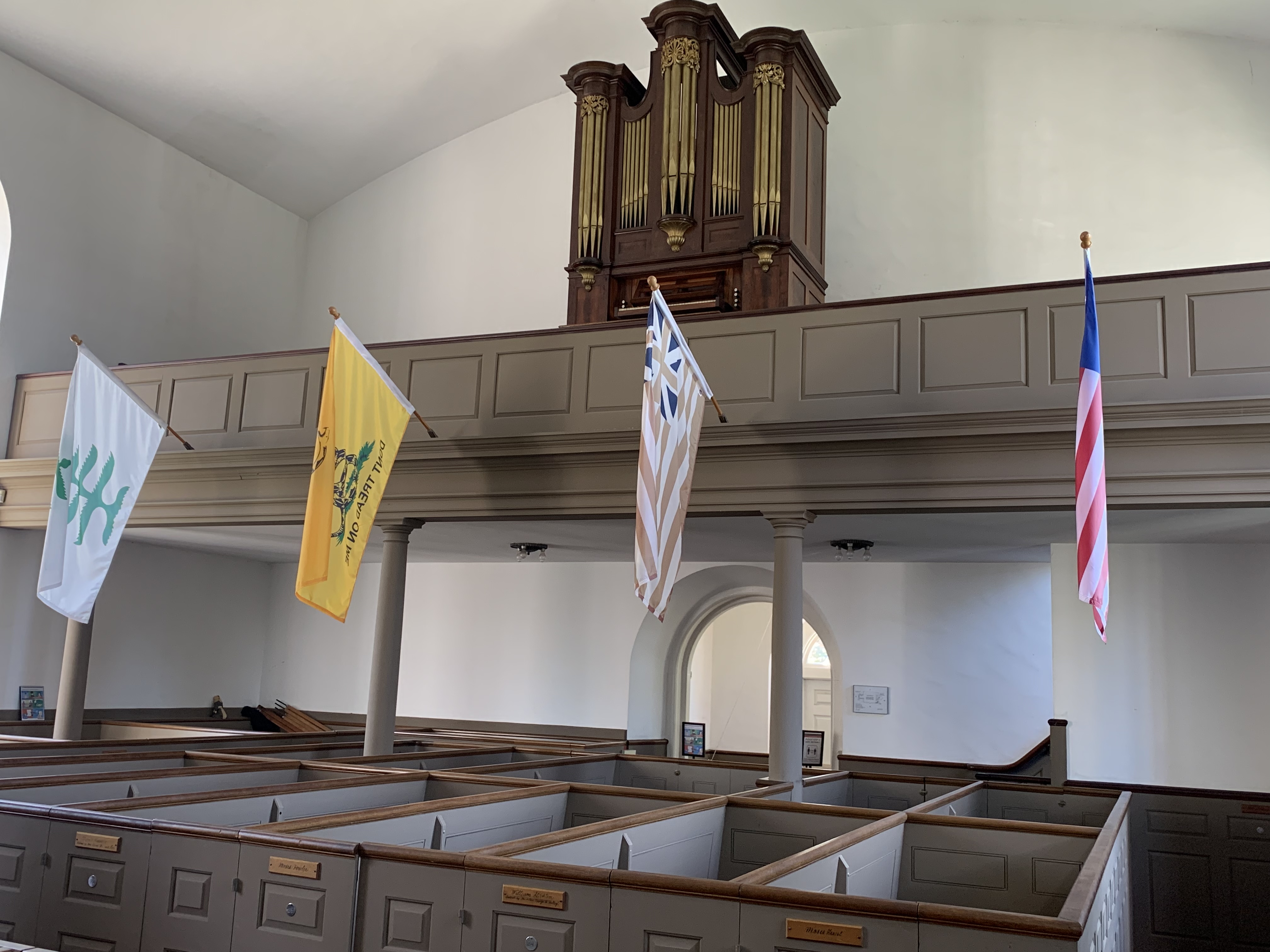
In addition to the fine old organ, family box-pews and flags pictured above, there’s also a bell cast in London in 1758 and a stained glass window. Much of the restoration work was done around WWII with fundraising led by FDR’s mother. But the surrounding neighborhood at the northeast border of the Bronx is now heavily industrial, not residential. (I walked from the Eastchester-Dyer Av station). The Episcopal church, which is related with yet independent from the Anglican Church, was deconsecrated around 1978 and is cooperatively managed with the parks service as a (secular) national historic site. Take some time to walk around the evocative colonial and early American graveyard.

African Burial Ground National Monument

Yesterday I mused about the need ‘to learn from our past to prepare for the future’, without realizing that today I would be looking at a symbol that means exactly that, the West African Sankofa, which is carved above the doorway of return on the opposite end of the memorial structure above. The architect, Rodney Leon, has filled this space with symbols and symbolism, and it evokes the slave-ship hold, the middle passage, the diaspora centered on West Africa and the depth of the remains. When we choose to recognize our roots and learn from them, we can draw strength to be better.

When the burial ground was rediscovered in 1991 and when protests forced the government to change their plans, I was abroad and missed the news reports of the historic find and cultural repercussions. Fortunately, the story is well told in the museum in both the park film and in the exhibits. Government leaders were initially unable to see the pricelessness of the rediscovery due to the value of the land, and the African American community needed to speak out both for their ancestors and for all of us to force the government to respect the remains, preserve the site and honor the contributions of Africans to this city and to our society. The archaeological research, the history of those buried here and some African artifacts are all on display. Facing the emotionally moving subjects daily, the rangers help visitors understand the site’s importance, history and significance.

“You may bury me in the bottom of Manhattan.
I will rise. My people will get me.”

Maya Angelou

Stonewall National Monument

If General Sheridan returned to admire his statue, he would likely wonder why there were so many rainbow flags in his park. If he walked into the Stonewall Inn bar (to the left above), he would probably have more questions. But here on the 28th of June 1969, a police raid against the bar for illegally serving homosexuals sparked a riot against police oppression. Unlike earlier riots, a large crowd gathered and forced the police to retreat into the bar. The police called for backup, but the community brought even more protesters who linked arms and fought back. The bar was boarded up, but the protests became larger, as the LGBTQ+ community came out into the open in force to organize marches to Central Park that grew each year. Before Stonewall, some activists had begun staging “sip ins” at gay bars like Julius’ to protest the denial of civil rights and attempts to humiliate and prosecute people based on their sexual orientation. After Stonewall, laws began to change.

The bar itself is still serving drinks with pride, but the site is scheduled to become the headquarters & visitor center in 2024. There are other bars, nice shops and restaurants in the area, and it’s worth taking a stroll and maybe ordering a drink to raise a glass to the brave souls who fought police here. Despite being discriminated against by society and targeted by law enforcement, they demanded and won respect for their rights, bringing more freedom for everyone.

Castle Clinton National Monument

To prevent the British from taking New York (again) in 1812, a fort was built here on a man-made island (since filled in with the park above). As usual, the city reinvented the space several times, as an exhibition hall, an immigration center, an aquarium and as a national monument (where people also buy tickets to the Statue of Liberty & Ellis Island). The exhibit space is basically one room with displays showing the castle’s history, plus a few placards. The rangers are very helpful and knowledgeable, but unfortunately, nobody knew of a way to get to Liberty or Ellis Islands without burning carbon.

Federal Hall National Memorial

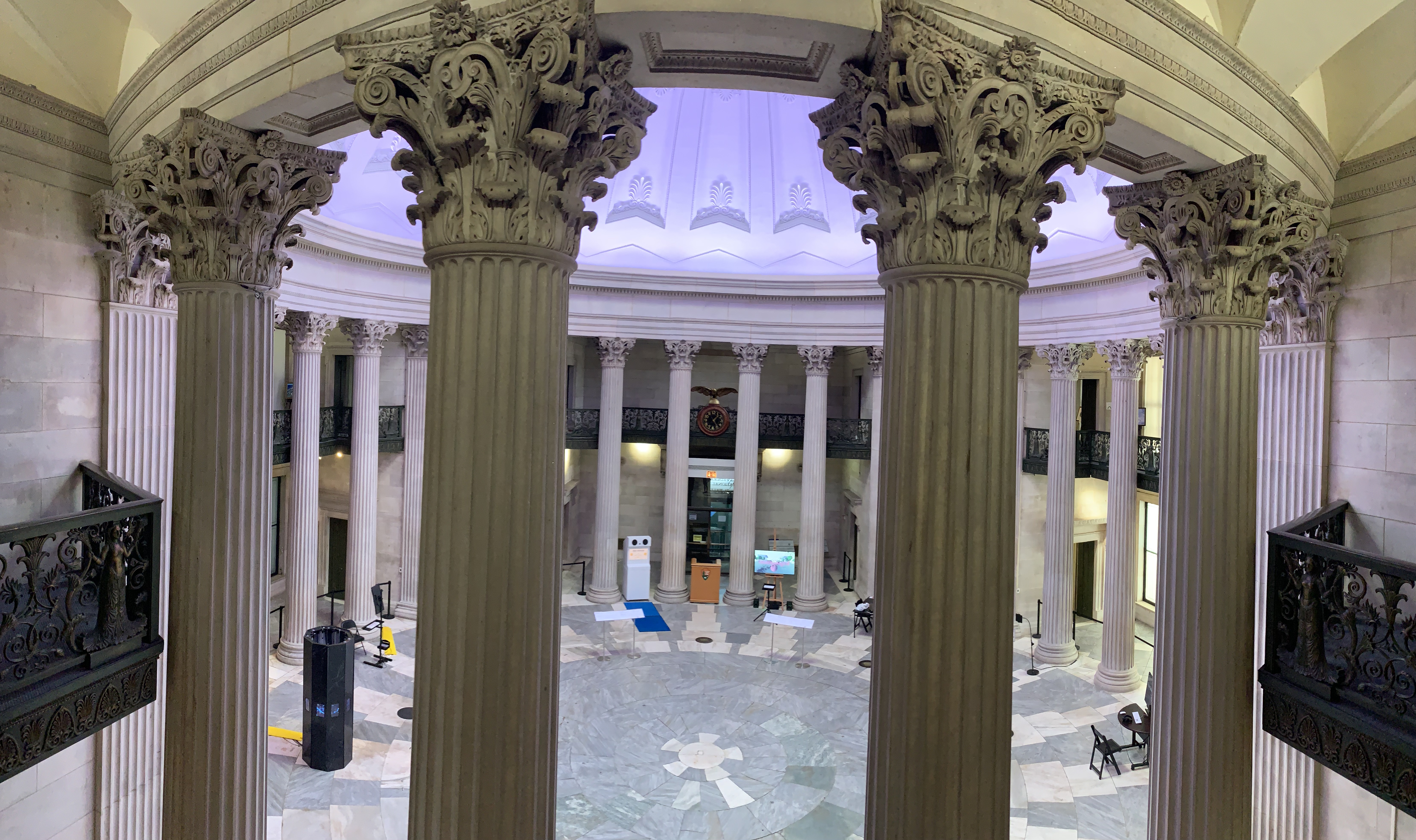
From the balcony outside, George Washington was sworn in as our first President in 1789. In 1790, Congress passed the Bill of Rights here, which was appropriate since the Zenger case that defined freedom of the press was tried here in 1735 and since the 1765 Stamp Act protests outside here defined freedom of assembly. The current version of Federal Hall was a Customs House in 1842 and later became a bullion depository for the US Treasury, which is appropriate given that it is around the corner from the NY Stock Exchange. New York City’s national park sites all seem to serve multiple purposes, as layers of history stack up in crowded urban spaces, but this quiet site offers a moment of respite to reflect on our past as we must prepare to face our future. I recommend eating at Fraunces Tavern nearby, since it predates our founding and is the oldest restaurant in New York City.

Lower East Side Tenement Museum National Historic Site

While I took the 1902 tour focusing on Jewish immigrants and the beef riots, the film in the museum was about two Joseph Moores, one black and one Irish, and explored the unequal outcomes dictated by law and society. I highly recommend both, as seldom does history provide so valuable a perspective on current issues such as the importance of activism in resisting inequality and injustice and as the long term impact of systemic racism.

The Levine family lived and worked in a three-room sweatshop tenement producing garments like those above (the one on the right is original), and their butcher’s family lived and worked in the basement. In the spring of 1902, the new scion of the Armour meatpacking firm of Chicago decided to hike the price of Kosher beef by 50%. He was trying to build an estate for his wife which would include a bowling alley, 20 marble fireplaces, fish ponds, a large herd of deer, and a greenhouse for growing oranges. (He inspired Upton Sinclair’s novel The Jungle). The Beef Trust had a monopoly on Kosher beef in New York City (at the time the largest Jewish city in the world), so they simply dictated the new price to all the butchers. The firm was renowned for low pay, strike-breaking, and hardball tactics to get whatever they wanted.

But they underestimated the Jewish housewives of the Lower East Side tenements. The women organized, boycotted, threw bricks through butcher shop windows, burned meat on their floors and even climbed down from the synagogue balconies to throw raw ground beef in the butchers’ faces. In a month, the price rise was reduced by 2/3rds, and a whole generation of suffragettes, union leaders and political activists was born. (In my first job, I worked with old women who had numbers tattooed on their arms, and they were not to be underestimated).

One of the historic Orchard St buildings is undergoing renovations, but all the tours, including the walking tours of the neighborhood are insightful. I recommend Katz’s deli or Russ & Daughters for a bite before or after your tour.