Vietnam Veterans Memorial

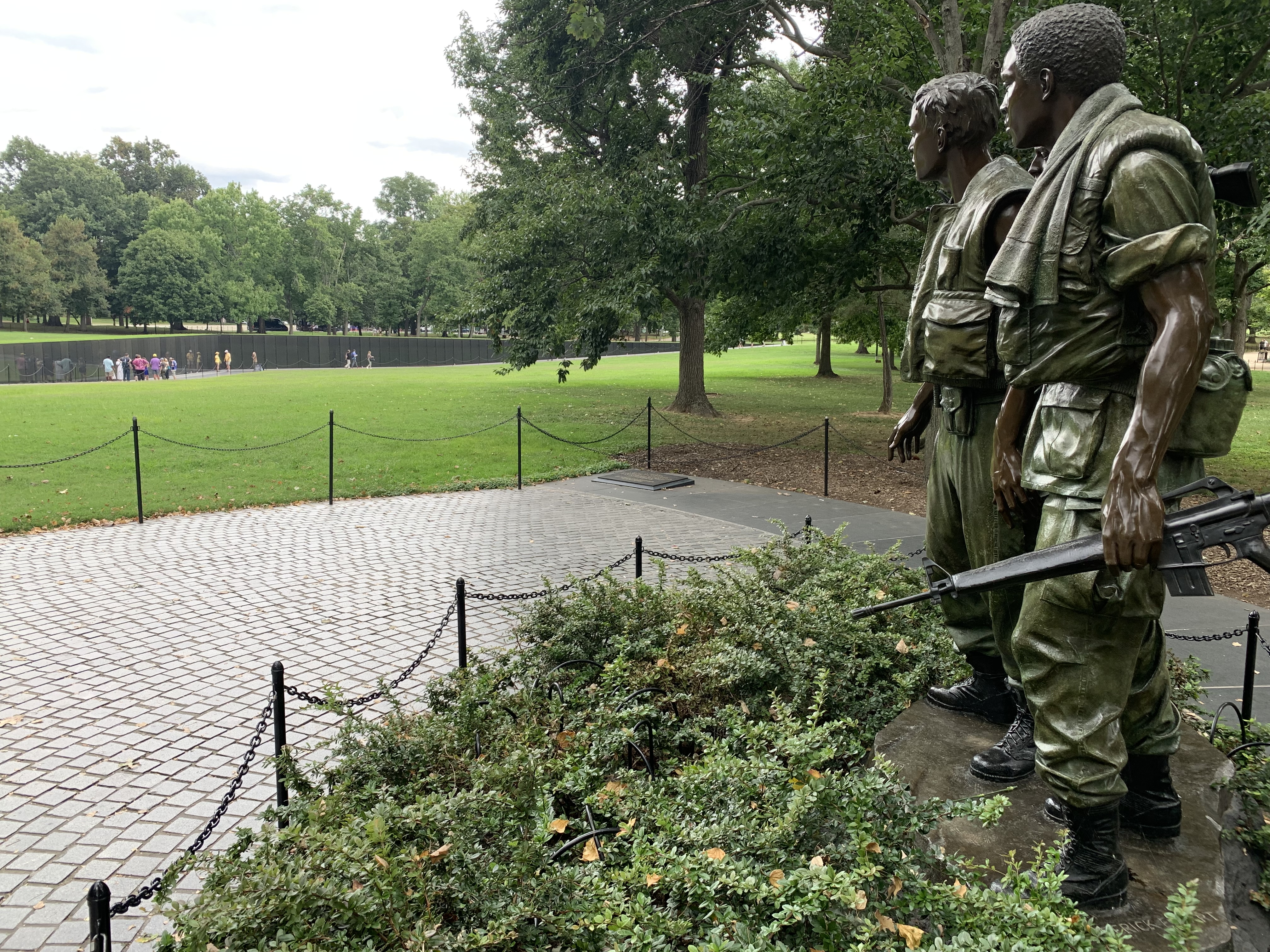
The memorial is effective. As you walk along the wall, gazing at the names engraved chronologically in the reflecting stone wall, you slowly enter the earth like the dead. Visitors can look up names in books, find their panels and etch a copy of a name to bring home with them. Some bring mementos or attend ceremonies if a status changes from MIA to recovered. There’s another statue to women who served and died. The statues of the three servicemen above look over the visitors at the enormous cost of the war. Over 58,000 Americans soldiers died, and over 300,000 were wounded.

Strangely, the memorial’s website doesn’t describe the war itself in any way, so I guess I have to try. Vietnam was both a civil war between the Vietnamese and a proxy war among the great powers at the time. The North, under Ho Chi Minh, had overthrown the French colonial government and wanted to unify the country under Communism. They were supported by China and Russia. The South was set up by France and allies to resist Communism, and we supported them with money, material, and military. Eventually, the weaker, more corrupt and incompetent South Vietnamese government failed, despite our extraordinary efforts to prop them up.

Robert McNamara, the architect of the US war in Vietnam, called the war a mistake in 1995 and said “we were wrong. I believe we were terribly wrong”. In retrospect, Kennedy’s effort to keep Vietnam from being the next ‘domino’ to fall to Communism, Johnson’s stubborn expansion of the war, and Nixon’s machinations were all failures. I have never read a credible analysis of how we could have won the war. Besides US casualties, millions of Vietnamese died and were crippled by Napalm and Agent Orange. About a decade after we left, the Communists had ruined the economy, and the Vietnamese abandoned that system on their own.

The park service has a responsibility to educate the public about history, in addition to memorializing the dead and remembering the sacrifice of veterans, regardless of controversy. Publishing the history of the Vietnam War on their site would be a good start.

Korean War Veterans Memorial

Korea wasn’t just one war. After the North Koreans launched their surprise attack, the allies only controlled one major city, Pusan, and its surroundings in southeastern Korea, near Japan. MacArthur brilliantly counterattacked with an amphibious assault at Inchon to liberate Seoul, and then he swept north as the allies had reinforced South Korea. But then China sent hundreds of thousands of troops across the border, which MacArthur described as an entirely new war.

That second war, with China, almost became a nuclear war, as MacArthur supported using nukes tactically, including using nuclear waste to create an uncrossable border and against (presumably) military targets across the North Korean border in China. President Truman, who had authorized the bombings of Hiroshima & Nagasaki, at first seemed inclined to allow MacArthur to make those calls. Instead, he relieved MacArthur of command and fought the war to achieve a stalemate, which still holds in the armistice (under Eisenhower) and at the (heavily armed) ‘demilitarized zone’ between the two Koreas today.

Freedom Is Not Free

Major Kelly Strong

World War II Memorial

Each of the 4,048 stars on the wall represent 100 American military deaths. 16 million served in the US Armed Forces, and many millions more supported the war effort directly. Appropriately, this classical memorial occupies center ground in the National Mall next to the Washington Monument. There were many veterans (of more recent wars) visiting, as well as international visitors and families all admiring the fountains, statues, monuments and inscriptions.

There are many detailed tributes, especially the bas-relief sculptures of both Atlantic and Pacific theaters. In the Atlantic, the memorial illustrates the Lend-Lease program that supported our allies before we entered the war, the military contributions of women, the industrial contributions of women, the code-breakers, the flying fortresses (later protected by the Tuskegee Airmen), the paratroopers, Normandy, Sherman tanks, medics, the Battle of the Bulge where the allies stopped Hitler’s last gasp advance, and meeting the Russians at the Elbe River as the allies stormed into Germany. In the Pacific, the memorial sculptures show Pearl Harbor, the massive enlistment and mobilization for war, battleships, submarines, aircraft carriers, amphibious assaults, jungle warfare, prison camps, and V-J Day.

“Today the guns are silent. A great tragedy has ended. A great victory has been won.
The skies no longer rain death – the seas bear only commerce –
men everywhere walk upright in the sunlight.
The entire world is quietly at peace.”

General Douglas MacArthur

World War I Memorial

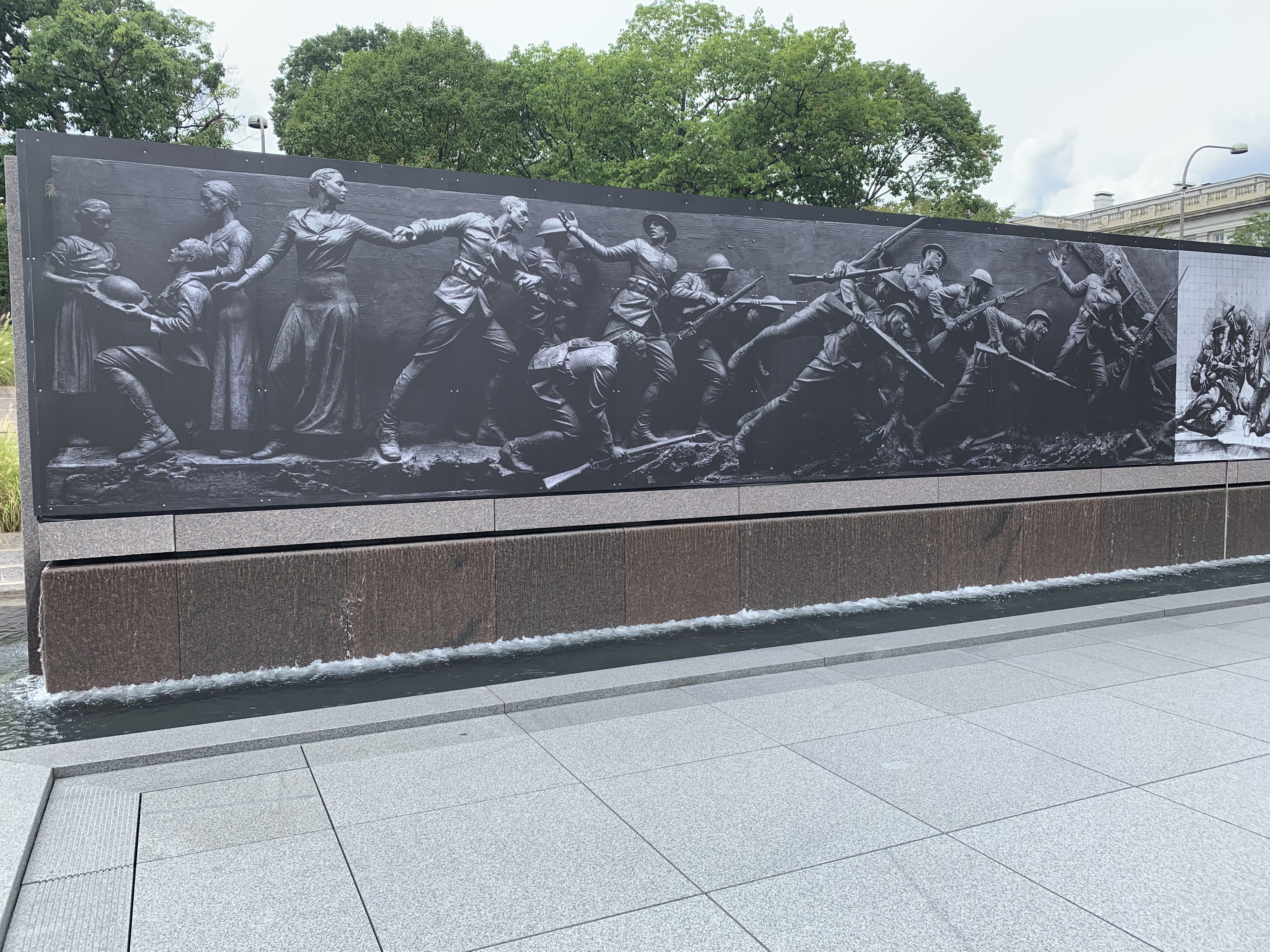
The artwork, “A Soldier’s Journey”, is not yet complete and “will not be installed before 2024”, so what you see above is a photo of the first half of the journey which continues as a drawing to the right. There is a statue of General Pershing in his park too with quotes and maps of the Western Front and the Meuse-Argonne Campaign. Nearby is an outline of L’Enfant’s plan for DC.

Pershing is the one general, besides Washington, to be named as “General of the Armies of the United States” after his success in WWI. He kept our forces together, instead of blending with allied forces, to increase their impact, and they broke the stalemate to win the war. Over the course of his career, the West Point grad commanded the next generation of leaders, including MacArthur, Marshall, Patton and Truman. Many of his earlier commands were much more problematic, including setting the perimeter at Wounded Knee, being called “Black Jack” because he led the 10th cavalry of “Buffalo Soldiers” (African Americans), fighting the Moros in the Philippines and his failed search for Pancho Villa. In all cases, he distinguished himself for his exceptional effort to understand his opponents.

Washington Monument

Welcome to Washington DC! I’m staying with my brother here for a few days, visiting monuments and park sites, on foot and by Metro (electric vehicles only). I won’t have time to see everything, so I’m planning a return trip next year. I’m trying to publish a post per day, so you’ll have something to read while I’m on my way home.

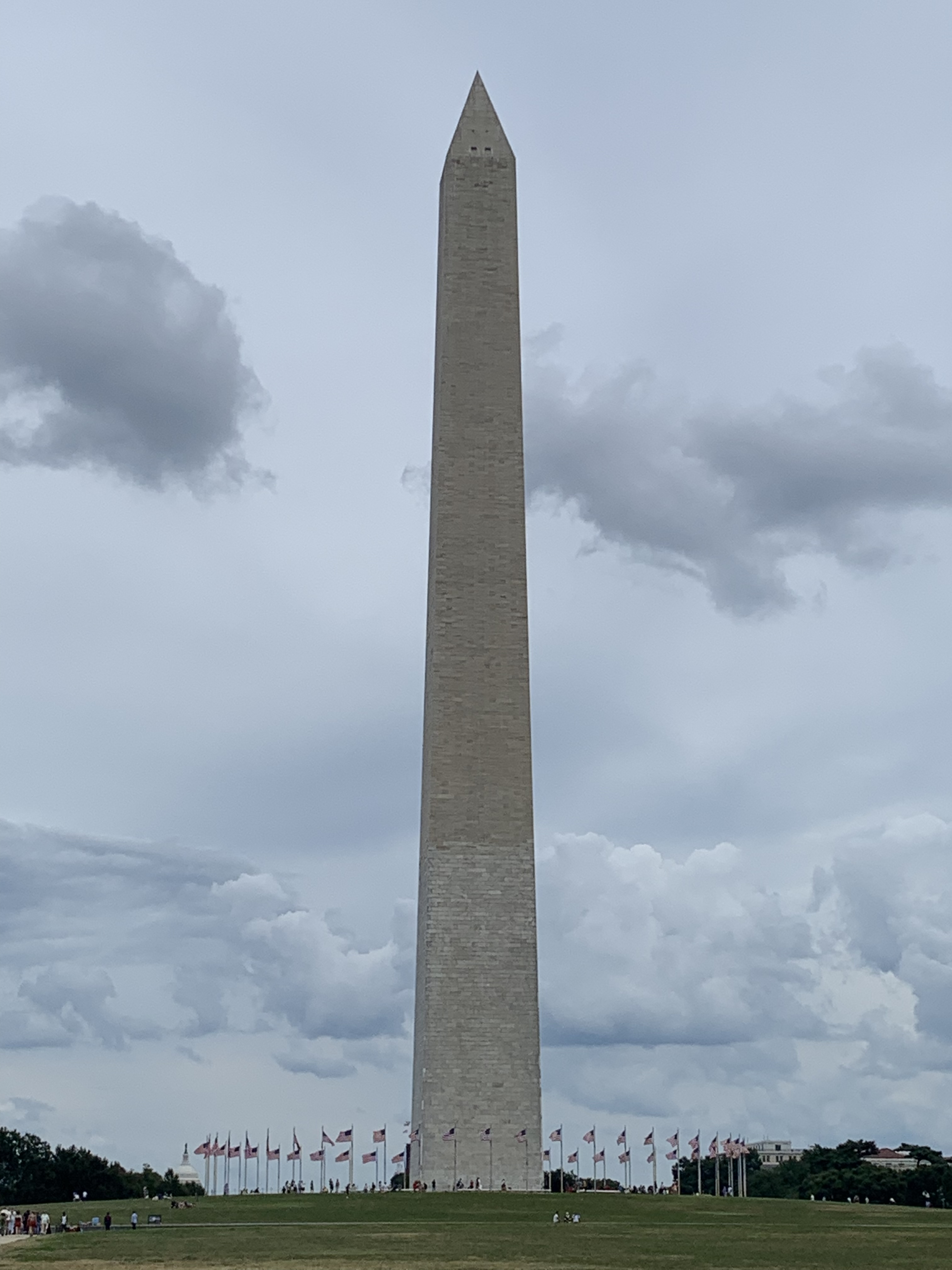
George’s imposing monument above is the tallest structure in the city, and it’s got a great view of the National Mall, from the Lincoln Monument to the Capitol. There are tickets to the top sold at 8:45 each morning, but for $1 per ticket you can reserve up to a month in advance. The windows are small, but it’s still the best way to get a sense of L’Enfant’s Plan. L’Enfant served with Washington as a military engineer, and Washington commissioned him to design the city. His bold vision for the city exceeded the initial instructions from Jefferson, and L’Enfant deserves credit for creating the bold public spaces that define the District of Columbia for both government and the people.