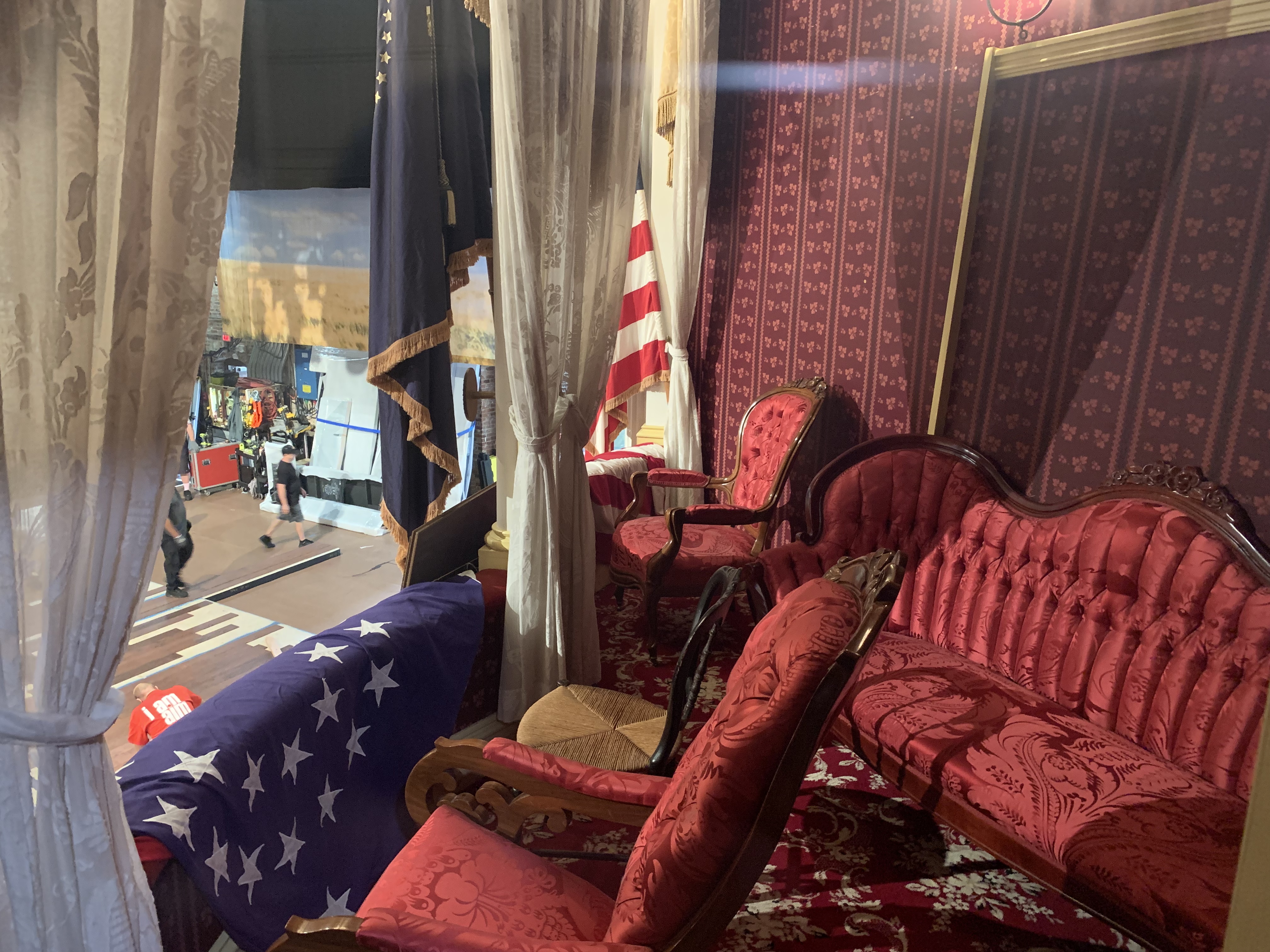
“By God, that will be the last speech that he will ever make!”
John Wilkes Booth
A Shakespearean actor, infuriated by a Lincoln speech about voting rights for African Americans, after learning where the President would be, shot him.
Completed.
“By God, that will be the last speech that he will ever make!”
John Wilkes Booth
A Shakespearean actor, infuriated by a Lincoln speech about voting rights for African Americans, after learning where the President would be, shot him.

This DC area 1700 acre nature reserve and historic park (our nation’s 3rd national park) is chockablock full of wildlife, old buildings and monuments, and its popular attractions for hiking, biking, horseback riding, boating, field trips, sports, picnics, learning and fun are well worth your time. The Sarah Whitby Site and Pierce Mill are recommended historic attractions. The Planetarium was closed, but the park extends to Georgetown, passes the Washington National Cathedral, the National Zoo and includes nearby parks, one with a memorial to Khalil Gibran.
But my brother suggested we go to Fort Stevens, at the edge of the park near the Maryland-DC border, one of many Civil War era forts. We think most people don’t realize that confederate troops attacked DC, but there’s a small cemetery where over 40 fort defenders were buried. As depicted in bronze relief, the only time a US President has been under direct enemy fire was here, when confederate sharpshooters shot at Lincoln as 20,000 troops attempted to take our nation’s Capital. A young officer (long before he joined the Court) issued a sharp order to the easily identifiable President.
“Get down, you damn fool!”
Oliver Wendell Holmes Jr.
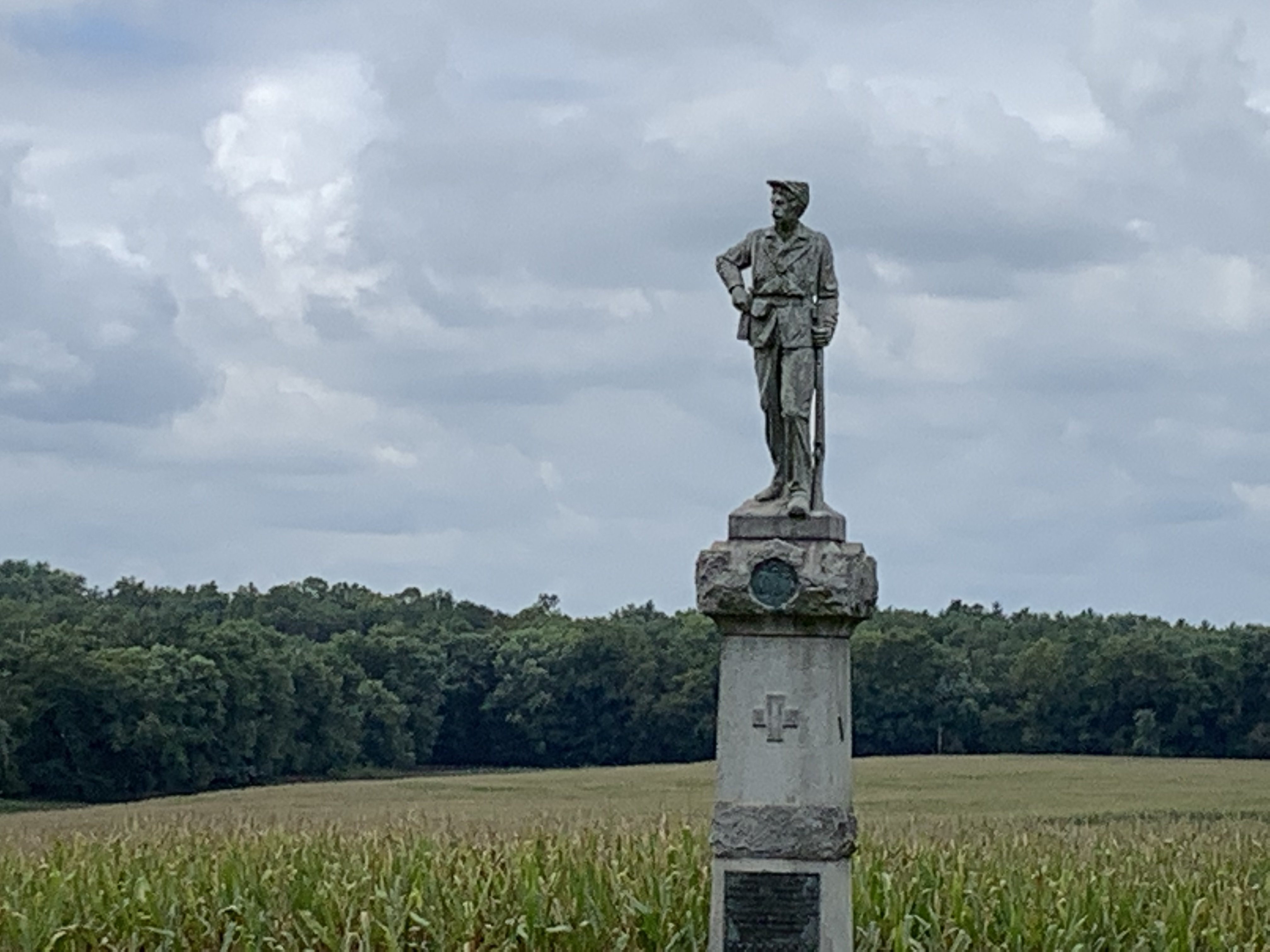
Monocacy (a Native word for river bend) is a junction northeast of DC, and during the Civil War the 14th NJ, later known as the Monocacy Regiment (above), built two blockhouses to defend the road and rail bridges. Early in the war, secret order #191 from Robert E. Lee was discovered here, providing advance warning of his movements and gaining the Union critical time to respond at Antietam. When over 15,000 troops suddenly began marching towards DC in 1864, control of the junction became critically important.
About 6,000 mostly inexperienced soldiers were rushed here to stop the advance, under the command of Lew Wallace. General Wallace had earned both distinction at Fort Donelson and shame at Shiloh, which is why he had been relegated to defensive duties. Now, he had to hold the river crossing outnumbered 3 to 1. In fierce fighting on July 9th, Union troops fought back waves of attacks and held the bridges until the confederates crossed a shallow point a mile downriver. Then Wallace ordered the road bridge burned, recalled his men from the blockhouse across the railroad bridge and launched a counterattack on the new front. After fighting all day with 1,300 casualties, his forces were finally flanked and forced to retreat.
But, as in the case of the secret order, the Union gained time to redeploy troops to defend the Capital. After only a brief skirmish at Fort Stevens, the attack was withdrawn. General Wallace and his men lost the battle, but they saved Washington DC. Wallace went on to preside over the military tribunal for the commandant of Andersonville, but he’s best known for writing Ben Hur in 1880.

Arlington House is “a riddle, wrapped in a mystery, inside an enigma, but perhaps there is a key.” The key is slavery. The house belonged to the descendants of George Washington’s stepson, John P. Custis, and Robert E. Lee married John’s granddaughter. Lee was a veteran (Mexico) and West Point grad who put down John Brown’s abolitionist rebellion at Harper’s Ferry. Abraham Lincoln offered him command of the Union Army, but here Lee declined and chose treason.
While it would have been better if Lee had chosen morally, it was no surprise to his slaves here. When John Custis’ son G. W. P. Custis died, his will ordered his slaves freed, except that Lee didn’t free them and cracked down instead. Some slaves resisted, escaped, were caught, jailed and lashed.
Lee fought to dissolve the Union to preserve slavery and against those who fought to preserve the Union without slavery. The country split in half right near here, with Maryland staying with DC and the traitors set up their HQ nearby in Virginia. When Lee evacuated, his slaves were finally freed, and one, Selina Gray, personally handed the keys to the cellar over to the Union General in order to preserve George Washington’s personal relics (including his war tent now on display in the Museum of the American Revolution in Philadelphia).
Periodically, slavery-supporting “lost cause mythology” believers try to rehabilitate Lee’s reputation. After the war, Lee supported disarmament and peaceful reconciliation, but that doesn’t excuse either his own slave owning or his treason on behalf of slave owners. Still, there have been periodic political attempts to elevate Lee, especially in times when white nationalism is in vogue or politicians feel that “reconciling his legacy” would be worth a few votes. This house, previously known as the Custis-Lee House, became known as “Arlington House, The Robert E. Lee Memorial”, but there’s legislation pending to remove his name again.
The site is educational, especially the slave quarters exhibits with audio. There’s a metro stop in front of Arlington National Cemetery, and it’s a healthy walk from there, through security, past the idling gas-polluting buses, past the Military Women’s Memorial and up the hill on a path between the graves to the park site. Be sure to visit the Tomb of the Unknown Soldier and watch the Sentinels of the Old Guard change the Tomb Guard every hour every day. The Old Guard is the name General Winfield Scott gave to the 3rd U.S. Infantry Regiment, and only their most elite volunteers may serve as Sentinels.
“You have made the greatest mistake of your life,
General Scott’s response to Lee on his refusal to fight for the US
but I feared it would be so.”
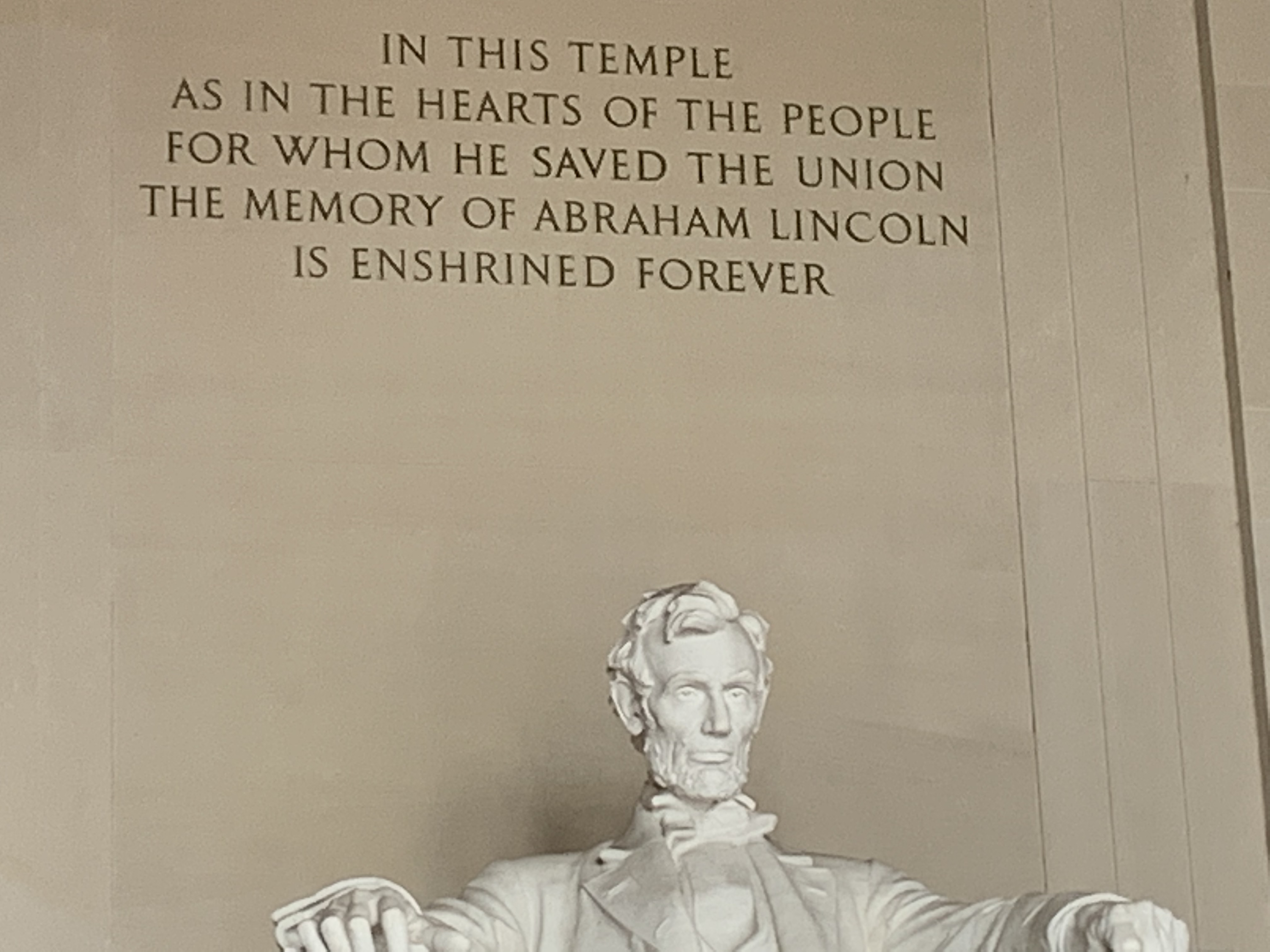
Carl Sandburg reported that Lincoln felt that the important monument was not the marble one but the “more enduring one in the hearts of those who love liberty, unselfishly, for all men.” Lincoln gave his life to extend our ideal of liberty, “that all men are created equal”, to all men. To understand Lincoln is to recognize his cause: to reform the Union to include African Americans equally. To misunderstand Lincoln is to ignore that this condition is required to participate in our Union.
In addition to the Gettysburg Address, the other inscription here is from his Second Inaugural Address. “With malice toward none with charity for all” are only two thirds of what Lincoln said were necessary to achieve peace. His next five words must not be ignored: “with firmness in the right”. He spoke before the war ended, saying that slavery was an offense against God and that paying the cost for that debt in blood was true and just. Lincoln did not act out of hatred, but, because those who fought for slavery were so absolutely, profoundly and unacceptably wrong morally, he was right to go to war against them.
Those who deny freedom to others,
Abraham Lincoln
deserve it not for themselves
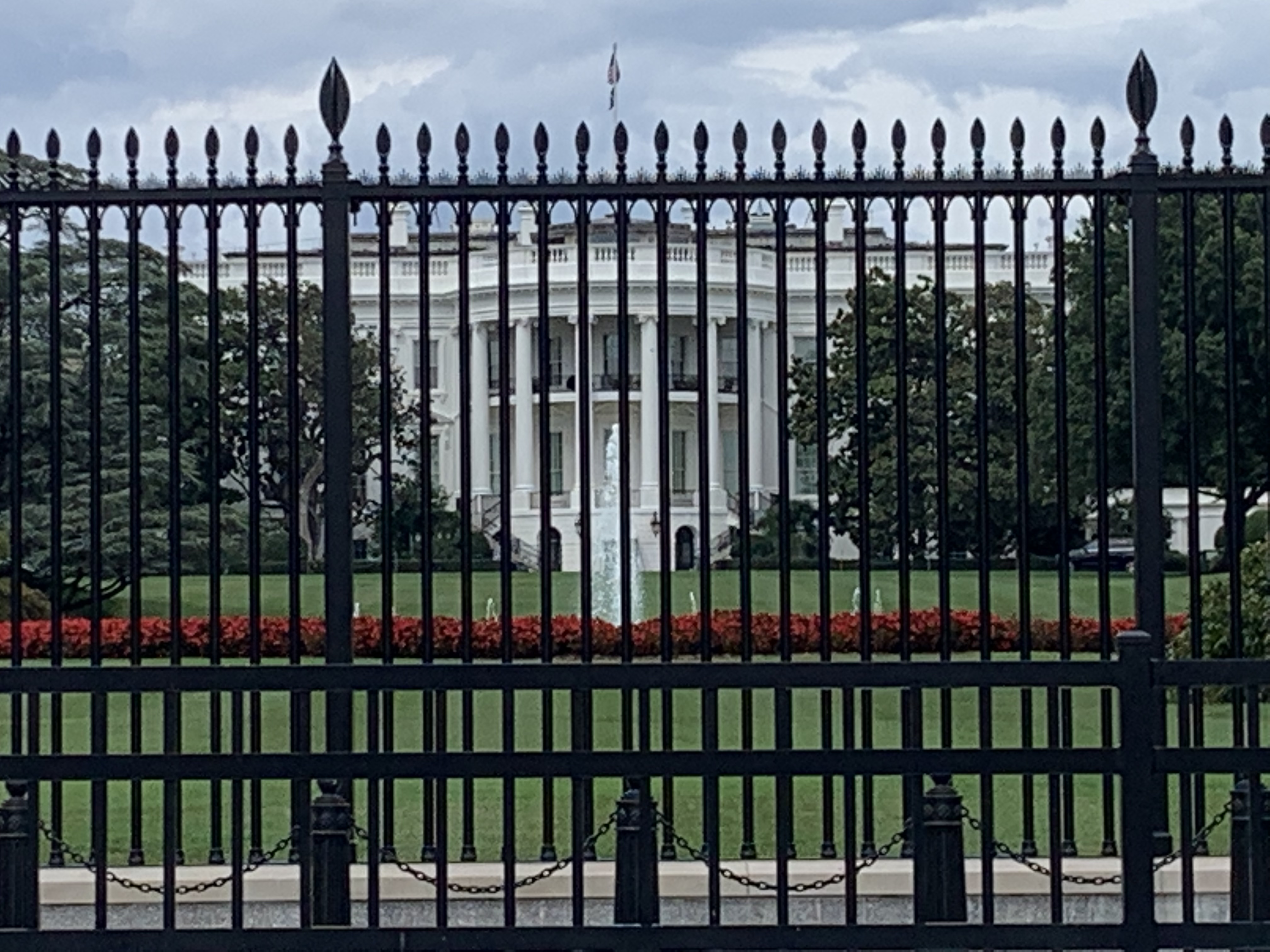
I’m not trying to be funny with this photo. As I was walking by, I heard people taking photos and complaining “it’s all fence”, so I took one too. The White House, or “President’s Park” as the park service has started calling it, is beautiful, with the fountains, roses, columns and beautiful lawns. On the other side (North) you can get a little closer, but security is tighter than it used to be. The trick is to contact your House member between 3 weeks and 3 months in advance of your visit, and hope for the best. If you’re lucky, you can get a tour. I’ve never been. But someday, I’d like to go inside.

Yeah, the street is another park. The avenues named after states are typically important routes in DC, but this one, because it goes from the White House to the Capitol (above), is particularly significant. I took the photo from the top of the Old Post Office Tower, which is one of the tallest buildings in DC. The former owner recently sold it to the Waldorf Astoria, but the park service continues running tours.
I took the Metro to Federal Triangle, walked across the street, went around the corner of the hotel to the right, turned left down the steps, and found the entrance that takes you to the elevator to the top. There are helpful rangers there who know an awful lot about the city’s history. One let me know that Pennsylvania Avenue is on the Washington-Rochambeau Trail, since that’s part of the route that the British took when they burned the White House and other public buildings during the War of 1812. Fortunately, it’s very rare for violent people to march down Pennsylvania Avenue causing mayhem, death and disrupting our Democracy. Hopefully it won’t happen again.

Yeah, I don’t make the rules. This is an official park unit like Constitution Gardens within the National Mall and Memorials, and don’t ask me where the boundaries of each are, it’s very confusing. But I’ve walked all the way up and down the mall a few times, which counts as zero carbon travel. I’ve also seen the fireworks here on the 4th of July, visited the Smithsonian museums and been here during political demonstrations. The photo is from the edge of some side edifice of the Lincoln Memorial, which I took from this angle, so that you can see the Capitol behind the Washington Monument. There’s actually another smaller reflecting pool at that far end, but it’s not easy to approach.
Anyways, the Mall is moving, no matter how many times I visit. Here, people from all over the country (and world) come to see DC, the most important city on earth. Some may be here for work, to study, to visit a memorial, to see art, learn about science, for history, to protest or to celebrate. The Mall reminds us of our ideals, teaches us something new and gives us space to be free. It’s ours, but it’s also bigger than us. It symbolizes the past, the present and future. It’s what we argue about, what we make of it, and what we love or hope it will be. As frustrating as it can be sometimes, it’s a great country, and I encourage you to get out, explore and enjoy. And dream of a better world.

The memorial is open & under maintenance with climate driven flooding at the Tidal Basin. Tom’s face has some cobwebs, and his reputation is also ebbing, as the stain of his slave exploitation will never wash. So, let’s clear up why he has a monument. Among other things, Jefferson was Governor of Virginia, Ambassador to France, codifier of religious freedom, the primary author of the Declaration of Independence, proposer of the Bill of Rights, Washington’s Secretary of State, John Adams’ Vice President, 3rd President, purchaser of the Louisiana Territory, appointer of Lewis & Clark, President of the American Philosophical Society, founder of the University of Virginia, and classical architect whose memorial resembles his own work, Monticello.
Jefferson was also a racist who owned hundreds of slaves in his lifetime, fathered children with one beginning when Sally Hemmings was a teenager, and sold over 100 slaves at auction through his will. He opposed slavery in theory and condemned it in his original draft of the Declaration (edited out to placate Georgia and South Carolina). But despite his ideals, Jefferson feared a Haitian-style rebellion and believed there was too much animosity between people of different races to reconcile and live together in peace. As President, Jefferson began removing Native Americans from the southeast in return for “new” land around Oklahoma (which was already populated with Native Americans).
Recognizing what he did that was wrong, we need to imagine what he could have done better, beyond freeing all his slaves, and not just Sally and her children. Nationally he should done more to end slavery, As a slave-owning President who added the Louisiana Territory to our country, Jefferson was uniquely suited to end slavery and offer reparations to slaves by setting aside a significant portion of that territory for ex-slaves to homestead. Similarly, instead of removing Native Americans from their sacred homelands, Jefferson should have honored and signed more treaties protecting their land and culture, especially in the “new” territory.
I view Jefferson as having missed his opportunity to solve those great moral challenges. But I have little patience for people who criticize Jefferson for his moral failings, without considering whether they themselves are doing enough about the greatest moral challenge of our time. Jefferson hated the idea that people would live “under the barbarism of their ancestors”. Jefferson was a student of science who loved nature, so he would be appalled by our lack of action in stopping the climate crisis.
“I like the dreams of the future better than the history of the past.”
Thomas Jefferson

DC is confusing, park-wise. First of all, parks usually have a type (monument, memorial, etc.) but not this one. Second, there are overlapping layers. Constitution Gardens originally referred to a large area, including the National Mall, but now both parks are part of the National Mall and Memorial Parks, which is a grouping but not a park unit. In 1982 the area with a pond next to the Vietnam Veterans Memorial, was established as this park unit in tribute to the Constitution, and it’s signature feature (above) is the semicircle of stones on Signers Island. Which is nice, but, third, these are not signers of the Constitution but rather of the Declaration of Independence.
I know that, because I’m from Concord, Massachusetts and my father was a history major. So I went to the Massachusetts contingent where I saw five names I recognized. John Hancock, John and Sam Adams (yes, the beer guy was a real patriot) didn’t attend the convention. Robert Paine (unrelated to the guy who wrote Common Sense) wasn’t a delegate, and Elbridge Gerry (for whom Gerrymandering is named) was there as a delegate but didn’t sign the Constitution. Only 39 of the 55 delegates actually signed. The important thing was that they had enough votes to pass it and send to the states to ratify.
But, the garden-variety misnomer not withstanding, the signers of the Declaration of Independence did risk their lives, fortunes and sacred honor by signing that document. Their signatures on paper, here captured in stone, meant Treason against the King, punishable by death. 56 brave patriots, including Thomas Jefferson, Benjamin Franklin, Robert Morris, Thomas Stone and the others remembered in this garden signed, and we owe them all our thanks.
 Zero Carbon Travel