Fort Scott National Historic Site

Built in 1842 to defend the “permanent” frontier with Native American territory, the fort quickly fell behind events. Settlers were already moving west on the Santa Fe Trail. Within four years the actual frontier was being taken from Mexico, with cavalry “dragoons” riding a thousand miles west from here to fight in that war. The fort was abandoned in 1853 and the buildings auctioned. But the military withdrawal set the stage here for Bleeding Kansas, the conflict that presaged the Civil War. Turns out the military wasn’t needed here to keep peace between the settlers and the “warlike” Natives, but rather between the slavers and the abolitionists.

When the Supreme Court overturned the Missouri Compromise and the government passed the Kansas-Nebraska Act, the US government officially decided that it was best to just let the states decide on slavery by themselves. Here, the pro-slavery townspeople– and “border ruffians”–took over the fort to defend against militant abolitionists in the surrounding countryside who were determined to prevent the expansion of the moral abomination of slavery. Around 60 people were killed, including a pro-slavery former deputy marshal, whose widow is remembered for swearing revenge.

The US military returned to use the fort during the Civil War and defended it from guerrilla attacks. Both African American and Native American regiments were formed here. And after the war, soldiers were again sent west to defend the railroads against squatters who protested being cheated out of the land stolen from the natives.

While educational, I believe the park service has a responsibility to do more than simply illustrate the views of both sides. The Civil War was not “a controversy over states’ rights” nor was Bleeding Kansas merely “growing pains” as park exhibits say. The only states’ “right” being contested was the “right” to chain and breed people, on the basis of race, in perpetual ignorance and slavery, including women and children, forever. By any standard of human rights, that is not a right, but a profound moral crime. There is no legitimate justification of slavery. Perpetuating traitorous and racist views that there was any honor in fighting for slavery is dangerous to society and deeply offensive, to those held in bondage, to their descendants and to those who fought and died to end slavery in America.

Tallgrass Prairie National Preserve

The bison surprised me as I walked along the creek. Fortunately, there’s a barbed wire fence between us, as they can be dangerous. Unfortunately, the ranger later told me that the bison can easily go over or through the fence. The building on the hill is a one-room schoolhouse.

That there is a preserved tallgrass prairie preserve here at all is a combination of luck and innovation. The Flint Hills here make it substandard farmland in Kansas, so it was purchased by a cattleman who wanted a last stop to fatten up cattle on the local grasses before going to market. He made good money and built a big house. When big agribusiness was buying up all the land, this property had too much house and too little grazing to be profitable enough to attract decent bids. So, the Nature Conservancy takes a look, sees that the land still has the original tallgrass growing here and decides to buy the land for that, despite not buying land with houses by their previous practice. Then, the park service does a deal with them to manage the buildings for visitors, jointly protect the land and also bring back bison. The result is a lovely, quiet, natural place to visit with stone walls, a wooded hill, flowering trees, authentic prairie, historic buildings, a creek, and the occasional one ton American bison.

I’ve been wondering about how the US might atone for the Native American removal policies, and when I see all the giant corporate agribusiness land owned by the 1% around here, I wonder if maybe a tiny portion of it might be given over to a large tallgrass prairie bison ranch managed by the descendants of the Native Americans who owned the land and had it stolen. I’ve eaten commercially raised bison, and it’s at least as good as regular steak. What’s more, recreating the original ecosystem also would support additional species, like the Prairie Chicken that used to live here abundantly. While it might appear to be a net economic loss in terms of land use, adding more product diversity is good for the economy overall. Maybe throwing in some housing would be fair too.

Harry S. Truman National Historic Site

The home was actually Bess’s family’s, before becoming the vacation White House. Due to my inattention and Tesla’s quirky routing, I briefly visited Truman’s family farm, which is much less fancy, before getting to the center of Independence where Harry worked as a judge and could walk a couple blocks to Bess’s house. President Truman evidently enjoyed coming back to Missouri as often as possible, and I’m sure he would be pleased having so many folks visit.

Very little official business was conducted here. But if you’re looking for information on Truman’s Presidency, his library and related artifacts are managed separately by the National Archives a few blocks away.

Brown v. Board of Education National Historical Park

The volunteer here deftly explained to me why the NAACP chose an elementary school in Topeka Kansas as part of their legal battle against segregation. The NAACP had tried various cases in other states, where white schools like John Philip Sousa in DC were superior and where black schools like Hockessin #107c in Delaware were inferior, but here in Kansas, the two schools were almost identical in terms of facilities. In fact, the teachers in the black school were more qualified, due to lack of opportunities elsewhere. Because of the superficial “equality”, the NAACP was able to argue that segregation itself, no matter how “equal”, is unfair and damaging.

It’s not that Kansas was all or always fair-minded. Violent racist agitators in Kansas both predate the Civil War and still exist today. At the time, racist policies were implemented either broadly by law in states like South Carolina or locally and selectively in states like Kansas. Perhaps because Topeka is the state capital, the schools here were segregated with substantially equal funding.

The key to the case was the Clark Doll test, where black children often identified with and preferred to be like a white doll rather than a black doll. The evidence made it to the Supreme Court, where it was cited by Chief Justice Warren as revealing the permanent damage done by legal segregation. One of the original dolls used in the test is here.

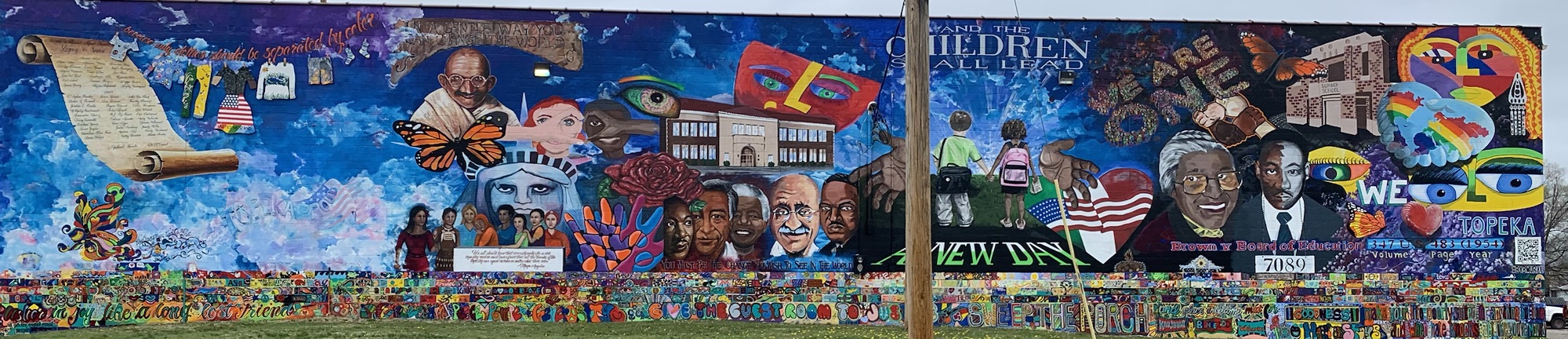
It is a privilege to be able to visit and feel connected to such an important site in the Civil Rights movement. The nation has many sites devoted to war, especially Civil War memorials, and I wish it had more sites devoted to the other kinds of fights we had for moral progress. The mural outside pictured above was done in 2018, and at the bottom local kids added their own colorful illustrations showing what Brown v. Board of Education means to them.

Homestead National Historical Park

I grew up reading about the frontier spirit of rugged individual homesteaders who followed their manifest destiny, tamed the wilderness and settled the country by grit, determination and hard work. Most Americans can trace their roots back to folks like these, and this view traditionally defines what it means to be an American.

But I’ve learned a few things on my way here, so it’s time for some myth busting. First, the “untamed wilderness” was already occupied by Native Americans who built homes, farmed and lived off the land. Second, the settlers received serious government assistance in the form of the US military clearing the Native Americans off the land and giving it to them. Third, the homesteaders almost immediately ruined the environment by removing the topsoil, causing the dust bowl and mass migration to California. And finally, I only see little huge corporate agribusiness here now, not individual farms.

The park is impressive, with both a state of the art Heritage Center and an Education Center. The film and museum are “award-winning”, and much of the focus appears to be on teaching kids to be proud of their homesteading ancestry. Much of the money was donated by the local fossil fuel utility, so I’m not surprised that environmental issues such as the tallgrass prairie devastation, the dust bowl and the changing climate are not the focus. But what angered me was a slight-of-hand trick employed to tell the homesteading story.

The film & exhibits make it abundantly clear that the Native Americans once lived on the land before the homesteaders settled, and the unfair history is presented in a way that kids can’t leave without learning some basic facts. However, at the beginning of the film Native Americans are described as not believing in land ownership, in the middle they say all they want is for everyone to respect the land, and at the end one Native American speaks of how he loves his reservation. And the egalitarian aspects of the Homestead Act are used to justify it: blacks could homestead (although slavery held them back at the beginning), women also benefited, and European immigrants homesteaded.

I believe it’s wrong to lie to our kids, especially to make them feel better about something that was wrong to do. The Native Americans did own the land. And the homesteaders knew it, because the newspaper ads that urged them to go west clearly said “Indian Territory Open to Homesteaders” and “Grand Rush for the Indian Territory”. They knew it, because some moved into sod pit-dwellings built by Native Americans. They knew it when they copied Native American burn techniques to encourage new growth to feed cattle. And they knew it when they grew corn in the same fields as the Native Americans. What the Natives didn’t have were written real estate deeds or the ability to defeat the US military.

It’s simply dishonest to suggest that it was OK to take the land due to lack of ownership rights. It’s also wrong to imply that it was OK to take the land since it was under-utilized. Imagine someone comes into your home and tells you that they bought your land on the dark web using Bitcoin. Then they explain that it’s all legal in the new digital world and that you have to move out now since you don’t have a hexadecimal key to participate in the secret auction online. When you protest, they force you to leave with high tech weapons. Finally, to justify their actions, they say that they can house more people and grow more food on your lot. You would correctly say that you had been robbed, and you would correctly say that the explanation doesn’t justify the crime.

Frankly, in the 21st century, to be repeating old lies that the Native Americans wanted homesteaders to take their land because they would better use it is offensive. The US military forced the Native Americans off the land at gunpoint, by slaughtering bison, and by encouraging white settlers to move in. The homesteaders used the land in the same way as the Natives, farming, ranching, hunting and fishing. In some ways they were more advanced, and in other ways, such as topsoil removal, they were more destructive. It is also devious to try to defend the racist policy of Native American removal by saying that it benefited blacks, women and immigrants. Would you teach your son that it’s OK to beat up and steal another child’s lunch as long as he shared a little of it with other kids who were hungry?

Fort Larned National Historic Site

This large US military base was built to end “the Indian problem” permanently. How? I direct your attention to the ammunition and gunpowder in the room above. The problem that the Native Americans had was that their land was being systematically stolen, often in violation of US treaties. The “problem” the US government had was how to stop the Native Americans from defending their illegally-seized territory.

After the Civil War, the US military moved against the Native Americans. Near this fort in 1867, General Hancock’s troops massed near a large Cheyenne village, which evacuated quickly, and then, on the General’s suspicions and order, burned it to the ground, prompting a widespread escalation of conflict across Kansas that summer. Perhaps realizing his mistake, the General hired an interpreter, signed a treaty and paid several tribes to move away. The terms were unfair, but the fighting moved away from Kansas as the military fortified this base and increased troops here over the next year.

Make no mistake. The Native Americans were forced from their lands at gunpoint, while the US government repeatedly broke its own treaties.

On a completely coincidental point, today’s conservative political folks are extremely afraid of undocumented foreigners coming in with guns and taking over America. Think about that.