New Philadelphia National Historic Site

‘Free’ Frank McWorter mined saltpeter as a slave, purchased first his wife’s, then his and ultimately 14 more family members’ freedom and founded this town with 12 dozen plots in 1836, the first African American registered & surveyed town in America. It was a mixed race community as Frank sold lots to all, and it became an important stop on the Underground Railroad. Fugitive slaves were assisted across the rivers, hidden in wagons and at least one basement and were even accompanied to Canada. Unfortunately, at the end of the 19th century the actual railroad bypassed the town in favor of a white town, so eventually folks moved away.

None of the early buildings survive, but there are a few old buildings built on their foundations, providing years of fun for archaeologists. There are a dozen or so signs explaining whether the plot belonged to the shoemaker, wheelwright, carpenter, seamstress, physician, teacher, merchant, cabinet maker, the blacksmith or the Post Office (above). Many of those tradespeople provided invaluable services to fugitive slaves. I wasn’t able to load the VR app which superimposes cartoon pioneers on your screen to help you visualize, but I was fine without. This brand new park is not in the completely uninteresting town of New Philadelphia, Illinois, an hour north, but it is about 30 miles east of the interesting town of Hannibal, MO.

On April 22nd, the park film was screened in Springfield, and, being a park nerd, I attended the gala park service premiere (cookies were served). Several members of the community responsible for gaining recognition for the site were there. The film was produced mainly by staff from the Lincoln Home. Just as Lincoln’s presence here attracted freedom-seekers, the folks here are broadening out understanding of history.

Ronald Reagan’s Boyhood Home

Reagan lived here in Dixon, Illinois, 100 years ago, from 1920 to 1924, as a young boy. Ronnie’s Mother encouraged him to act in church plays, which led to his career in Hollywood, his nick-name ‘the Gipper’ for his role in a movie about Notre Dame football star Knute Rockne, to becoming the President of the Screen Actors Guild and honing a skill set that served him well in politics.

Reagan’s economic policies of cutting top tax rates and deregulation contributed to an immediate economic boom and later increased inequality. Domestically, he favored harsh treatment of drug dealers, although his CIA was secretly involved in the Colombian drug trade which sold crack in US cities. His foreign policies followed his anti-communist views forged in Hollywood during the Blacklist days and contributed to the collapse of the Soviet Union as well as to the rise of some anti-Democratic regimes, especially in Latin America. Many of his team’s efforts were covert, including asking Iran not to release the hostages until Reagan took office, supporting the Mujahideen, etc. Reagan was extremely popular, both when winning a landslide reelection and in polls after leaving office. But there was definitely a dark side to his administration, as seen in the callous disregard for the victims of the AIDS epidemic, which contributed to thousands of deaths.

For many years a private foundation has given free tours here, declining to become an official park site, due to Reagan’s philosophy that “government is the problem”. After the death of their main benefactor, the foundation was reportedly ready to sell the property to the National Park Service, which is the last step needed for it to become an official park site. In 2021, the Young America Foundation, which also runs Reagan’s ranch in California, purchased the property. There are persistent unfounded rumors that Republican Presidents are denied as many park sites as Democratic Presidents, but the truth is that often private foundations choose to manage Republican Presidential sites, either out of disapproval of government management or out of a desire to keep control over the President’s legacy and present their version of the administration’s history. While I made it to his home in time for the last tour of the week, unfortunately, it was closed for a middle school event. Oh well, at least I made it to his door, while touring many historic homes on this trip.

Pipestone National Monument

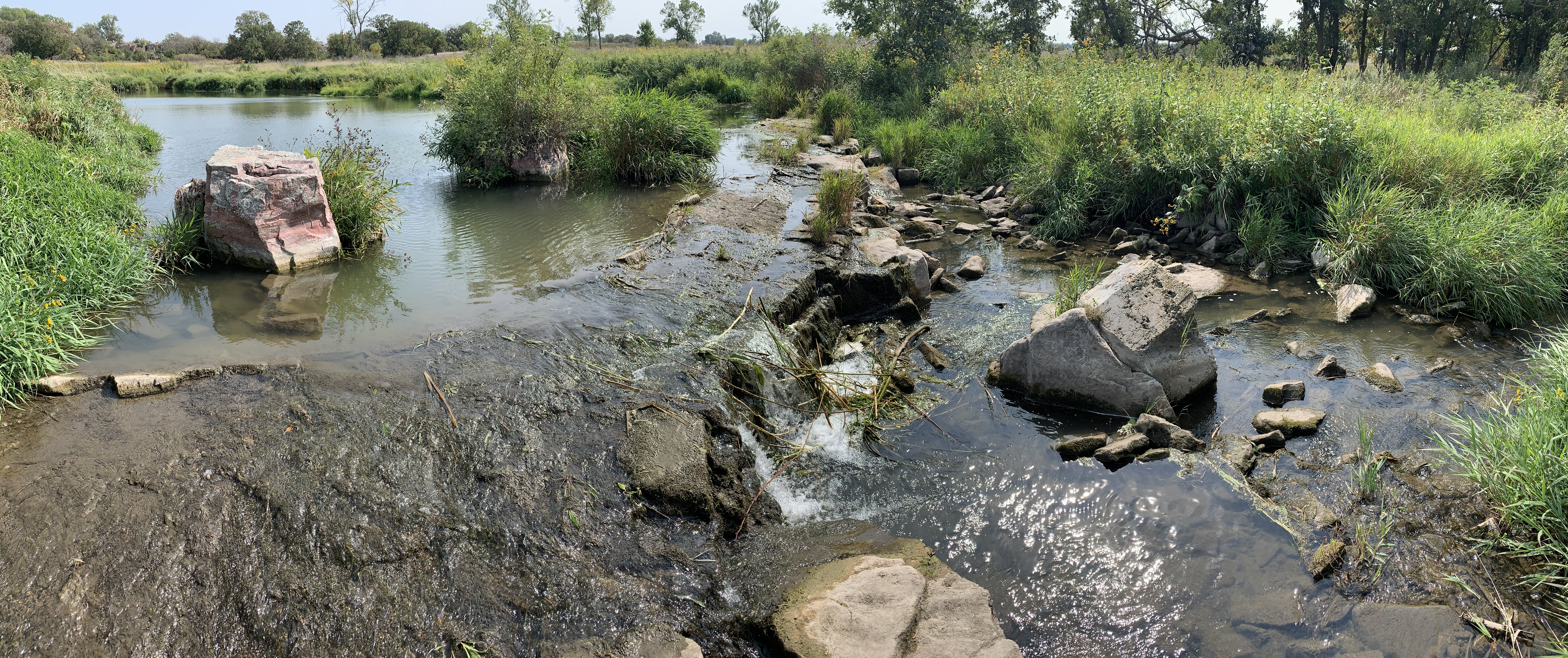
In some Native American mythology stories, the red pipestone comes from the blood of ancestors killed in floods. Similar to the story of Noah, prayers are heard and a few survive. The pipes send prayers to heaven. So this quarry has special religious and cultural significance, and the pipes are still formed using traditional techniques. There’s a great exhibition inside the visitor center, where native artisans answer questions while working and beautiful pipes are displayed. The film explains the importance of the local plants, including a field of red Smooth Sumac, used in making medicine and blends to smoke or hang in offering ties on sacred cottonwood trees where ceremonies like the Sun Dance are performed. The short circle trail up the creek past the small Lake Hiawatha leads through a beautiful hewn ravine of red pipestone across a footbridge and back around to an exhibit quarry.

Effigy Mounds National Monument

On the Iowa side of the Mississippi River looking across from the high bluffs toward Wisconsin, there are over 200 hundred mounds, round, linear, bird and bear shaped. They are in clear lines straight out from the river, and they date back roughly 1,000 years, evidence of cultural traditions that continued for hundreds of years. Although these sites typically do not make the connection, there are similar sites along the Mississippi and other rivers at overlapping time periods with evidence of trade between them. Bird symbols in particular are found in both modern and ancient Native American culture. Many similar mounds were flattened and plowed under after the land was stolen.

The hiking here is excellent, with many overlooks, including Fire Point above and Third View which looks upriver. The hillock to the right of the path is one of the mounds, first in a long line into the woods. A pair of hawks soared high above. If you can make it a few miles, your chances of seeing deer and other wildlife improve. Since it is a sacred site, please stay on the trails and do not walk over the mounds.

Cahokia Mounds

Tens of thousands of Native Americans lived in this city 1,000 years ago, and it was the center of the Mississippian culture that thrived in the valley and as far as Ocmulgee in Georgia. In the distance from atop 100′ high Monks Mound (named for French Trappist Monk settlers), you can see Gateway Arch. This is the largest Native American mound north of Mexico, and it is still an impressive, tiered, geometric structure surrounded by 50 other smaller mounds of different shapes and sizes, for burials and as foundations for public buildings. There’s also an astrological calendar circle with wooden post markers, called “Woodhenge”.

Cahokia is actually both a state park and a UNESCO World Heritage Site but not a national park site. However, it is on the Lewis & Clark National Historic Trail, and Illinois’ Senators have asked President Biden to make it an official national park site. It’s simply too big to ignore, so, I stopped and climbed, even though the visitor center is closed.

Herbert Hoover National Historic Site

Hoover may have been a Stanford graduate who made his fortune working on foreign mine extraction projects, but he grew up poor in this tiny house in a rural Iowa Quaker village. Note the outhouse in back and his father’s blacksmith shop on the right. His hardworking father died of heart failure and his even harder working mother later died of typhoid and pneumonia. Herbert’s relatives took him and his two siblings in, and he grew up in a school principal uncle’s house in Oregon.

I also visited his Presidential Library & Museum next door, run by the National Archives. They go to great lengths to rehabilitate Hoover’s reputation, since he was widely blamed for the Great Depression. They point to his conservation efforts for example, but neglect to mention that his 5 million acres are not as much as Teddy Roosevelt’s 150 million acres. The museum helped convince me that Hoover was a generous humanitarian who saved many lives in Belgium, Russia and elsewhere by running food aid programs, who was elected with extremely high expectations, and who implemented a variety of positive programs (not just the dam). I genuinely think he was a smart and nice guy.

But, Hoover was an ardent believer in solving social problems with volunteerism and without government intervention. Even though he had warned Coolidge about the dangers of stock speculation, Hoover was all about efficiency, not reform. Hoover had seen massive, desperate social failure all around the world, including being trapped in the foreign enclave during the Boxer Rebellion with his wife (see movie, ’55 Days at Peking’). But he still believed that if government supported business leaders and capitalists, then everything could be solved with goodwill and determination.

He was wrong. FDR crushed him and immediately implemented massive social programs including unemployment payments, government work programs, and Social Security. In retrospect, Hoover should have been able to look at his own family’s struggle with poverty and the tragedies of his parents’ deaths and consider that maybe government intervention would have helped them in their hour of need. Instead, he shared the common views among the ruling elites, that government programs like military protection for foreign business interests in China are good but that government programs like unemployment relief are bad.

Lincoln Home National Historic Site

It’s not his hat, but the small desk is where Lincoln wrote his early speeches. In the parlor downstairs, he held the funeral service for his son, Edward, and years later was invited to be the Republican nominee for President. In this house, he refined his political views and his arguments against slavery. Lincoln drew from his early childhood and boyhood experiences to become the most powerful advocate for freedom.

“As I would not be a slave, so I would not be a master. This expresses my idea of democracy. Whatever differs from this, to the extent of the difference, is no democracy.”

Abraham Lincoln in 1858

Lincoln understood the fundamental flaw in our country, that the ideal of equality did not apply to all and that Democracy and slavery are absolutely incompatible. He knew that most voters held racist views and did not want war to bring about immediate equality. So he was careful, not always the loudest abolitionist, and he opposed John Brown’s raid. But Lincoln was determined to end slavery, crafted a greater variety of effective, convincing arguments against slavery, introduced legislation and used his arguments in debates against Douglas.

“That is the real issue. That is the issue that will continue in this country when these poor tongues of Judge Douglas and myself shall be silent. It is the eternal struggle between these two principles — right and wrong — throughout the world. They are the two principles that have stood face to face from the beginning of time; and will ever continue to struggle. The one is the common right of humanity and the other the divine right of kings. It is the same principle in whatever shape it develops itself. It is the same spirit that says, “You work and toil and earn bread, and I’ll eat it.” No matter in what shape it comes, whether from the mouth of a king who seeks to bestride the people of his own nation and live by the fruit of their labor, or from one race of men as an apology for enslaving another race, it is the same tyrannical principle.”

Final Lincoln-Douglas debate

Beyond the home tour, I found the neighborhood fascinating. One of the neighbors was a conductor on the Underground Railroad who gave the President-elect his inaugural ride to the depot. One was a Jewish family whose son helped build 5,000 Rosenwald schools to educate African Americans across the south. And one is currently being used as a local office for Senator Dick Durban. Springfield is all about Lincoln, and they have set aside 4 surrounding blocks of period houses, a short walk from the his Presidential Library and Museum. The museum there is modern, multi-media and includes an excellent map visualization of Civil War casualties over time. Explore the neighborhood, stay in an atmospheric B&B and eat at a fine restaurant. I did, at reasonable cost, and learned Springfield is on Route 66.

Lincoln Boyhood National Memorial

When Lincoln’s father left Abe’s birthplace in search of a new home that wouldn’t be stolen, he took the family here, deep into the forest to make their new home from scratch. The park has a living historical farm (above) with crops, chickens and sheep that does a good job of showing life in the early 1800’s, when Abe lived here from age 7 to 21. Much emphasis is placed on the log cabins, to show Lincoln’s humble roots. The visitor center film explains the loss of his closest family members, mostly buried here. There is a trail with stones commemorating Lincoln’s lifetime milestones.

But for me, it is the initial experience that Lincoln had that defines him. His family had literally arrived at the end of the road, being “the poorest people”, and his father must have said, ‘let’s keep going, we’ll make our own road from here’. And they did. Lincoln became a log splitter in boyhood, because the first step at the end of that road was to chop down trees to make a path.

Yes, he was poor and hard-working. But more importantly, Lincoln was a path-making thinker. Unlike formally educated people who are provided answers and common ways of thinking, Lincoln had precious few educational resources available to him, requiring him to be a self-starting, inventive thinker, to use common sense and observation to extrapolate answers to a broad range of questions he had. His mother, who had taught his father how to read, died, and his step mother brought three children with her and about as many books. Faced with a life of endless labor without security that his father had endured and given him, Lincoln viewed knowledge as his pathway into a bigger and broader world.

One of his formative experiences on an early journey was when he got sued for ferrying folks out to catch passing steamboats. The ferry operator said that he was encroaching on their business without a license. Lincoln, arguing his own case in court, said that he wasn’t carrying people all the way across the river, just halfway. And he won.

Another was when he traveled down the Ohio and Mississippi rivers to Natchez, where he saw slaves auctioned. His family was against slavery, but seeing the cruelty up close made a powerful impression on him. He would spend the rest of his life convincing people to abolish slavery.

Where other people in his time may have been educated to believe that slavery was normal and even justifiable, Lincoln was used to forming his own thoughts. Arguing against those who thought slavery normal, he noted that none of them are willing to volunteer for it themselves. He argued to those who believe that slavery is justified by skin shade, intellect or self-interest, that they should logically become the slaves of anyone lighter in color, smarter or greedier than they are. His arguments persuaded people.

The times were leading to an inevitable bloody conflict to choose slavery or Democracy, and Lincoln would be the one to find the path forward.

Dayton Aviation Heritage National Historical Park

Sorry for the lengthy post, but here’s a summary for those short on time. Watch the ‘On Great White Wings’ park film online, skip both interpretive centers and spend time at the Carillon Historical Park, where you can see the first practical airplane and other fascinating original Wright Brothers’ artifacts.

The Wright-Dunbar interpretive center is in the Wright Brothers print shop building, shows the park film and has exhibits about the print and bicycle businesses that funded the brothers’ aviation experiments. The poet Dunbar is not related to aviation, but he was an internationally acclaimed African American writer.

The Huffman Prairie interpretive center also shows the film, has exhibits about the Wright Brothers grand tour in Europe and has a nicely landscaped monument, but it’s also not essential.

If you want to walk on the field where the first practical airplane first flew, you need to find gate 16A at H Road on route 444, drive out past the shooting range and park in the woods behind Huffman Prairie Field. (Don’t let the sounds of shotguns spook you, as they’re probably out of range). Do not take Kauffman Avenue or 844 to the Wright-Patterson Air Force Base main gate and parking lot, since they won’t let you in. The brochure map will help, but the other maps were wrong.

As a private partner site included in the enacting legislation, the Carillon Historical Park is extraordinary. The park was funded by a local inventor whose wife liked the bells she heard in Europe, and in addition to holding Wright Brothers artifacts, the park has collections showing the varied inventive history of Dayton, including historic trains, bicycles and cars, historic buildings, exhibits and many helpful people. The museum of local inventions takes you from the cash register and electric starter to the space age. Best of all, the park runs a brewery, Carillon Brewing circa 1850, which uses traditional wooden equipment, old recipes and fire to make beer. If every historical park did that, there would be a million more visitors interested in history. This site is one of my favorites.

Hopewell Culture National Historical Park

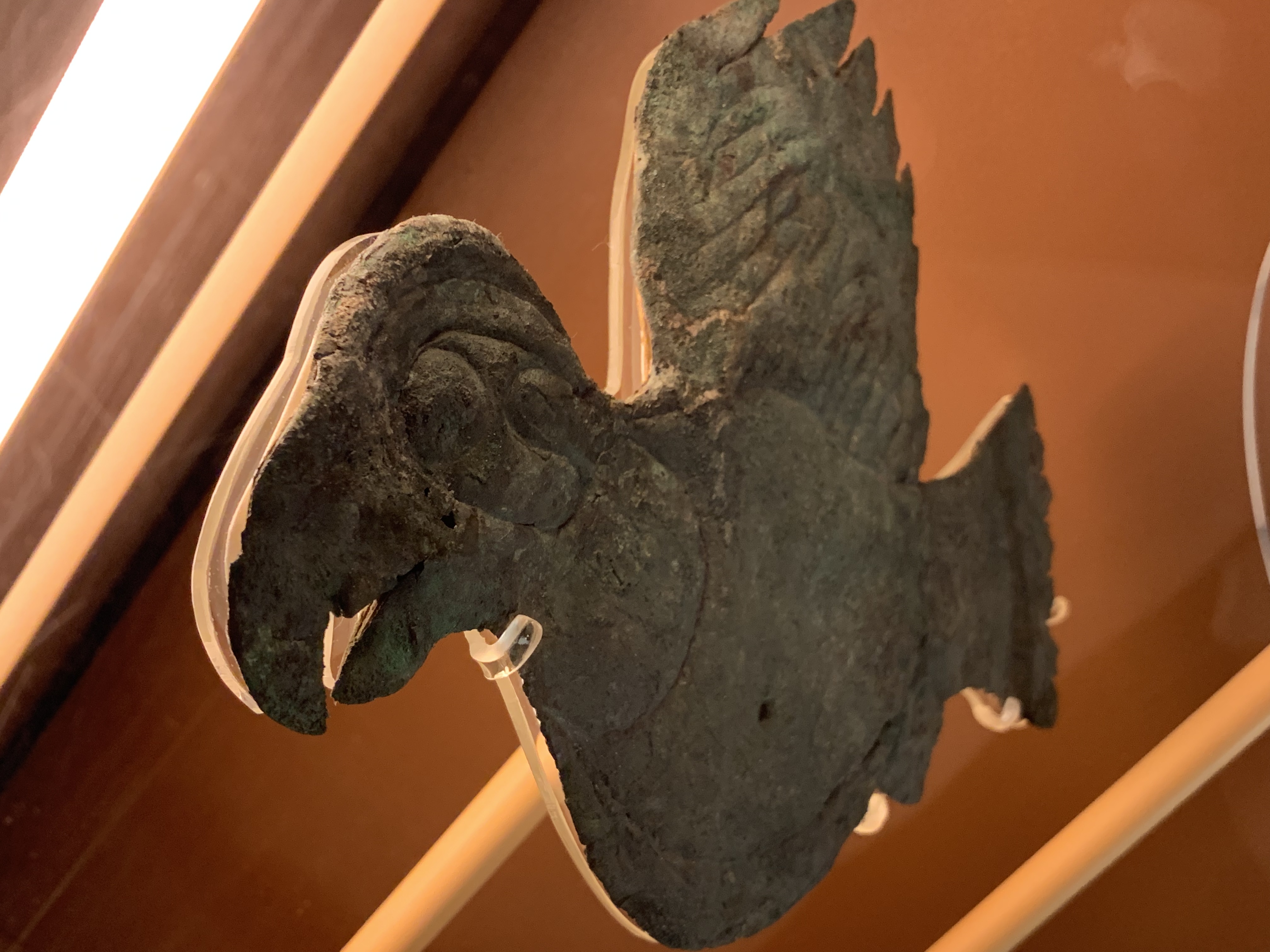
Does this bird look like a Peregrine Falcon or a parrot? I ask, because some of the folks at this Native American archaeological site suggested the former and seemed pretty insistent that the Eastern Woodlands people must have been “completely separate” from the Southwestern people who traded parrots widely at the time. Having just driven along the Canadian, Arkansas, Mississippi and Ohio Rivers, I can confirm that people who traveled by canoe could easily cover that distance. Of course, if it’s a Carolina Parakeet (now extinct), then it would have been native to both Ohio and Colorado.

Some archaeologists and anthropologists resist making obvious conclusions. Each native site focuses on its speciality, often avoiding drawing any connection between contemporaneous, sequential or geographically neighboring cultures. For me, it’s clear that the Paleo, Archaic, Woodland, Mississippian and Puebloan people are all related ancestors of today’s Native Americans. It’s silly to ask “what happened to the people who built these?” Because, as Native Americans universally answer, “we’re still here; they were our ancestors”. Pretending that an early Native American culture just magically popped up out of nowhere and then mysteriously disappeared (as the park film sort of suggests) is stupid and ignores the role of European-Americans who plowed over evidence of the early people after driving their descendants off their land.

Native Americans living in North & South America still travel and interact with each other, as they did for thousands of years spreading different ideas, crops, weapons, tools, and materials across our continents. The Alibates Flint Quarries, Russell Cave, and Ocmulgee Mounds parks units all show evidence of fairly continuous use over the entire 17,000 year period until Europeans began to encroach. Poverty Point, Hopewell and Chaco Culture sites all show extensive trade routes over thousands of miles. These people all built similar sites aligned with the sun and moon, in round and square shapes, at different times and in different places from 1500 BC to 1500 AD. Every site I have been to and every description I’ve read describes Native Americans as using feathers and bird figurines for ceremonies and adornment. The park service should make these connections, so visitors can appreciate the full scale of Native American culture. At least UNESCO is now recognizing Hopewell as a World Heritage Site in reflection of its importance as a religious pilgrimage and burial site for Native Americans across the continent.