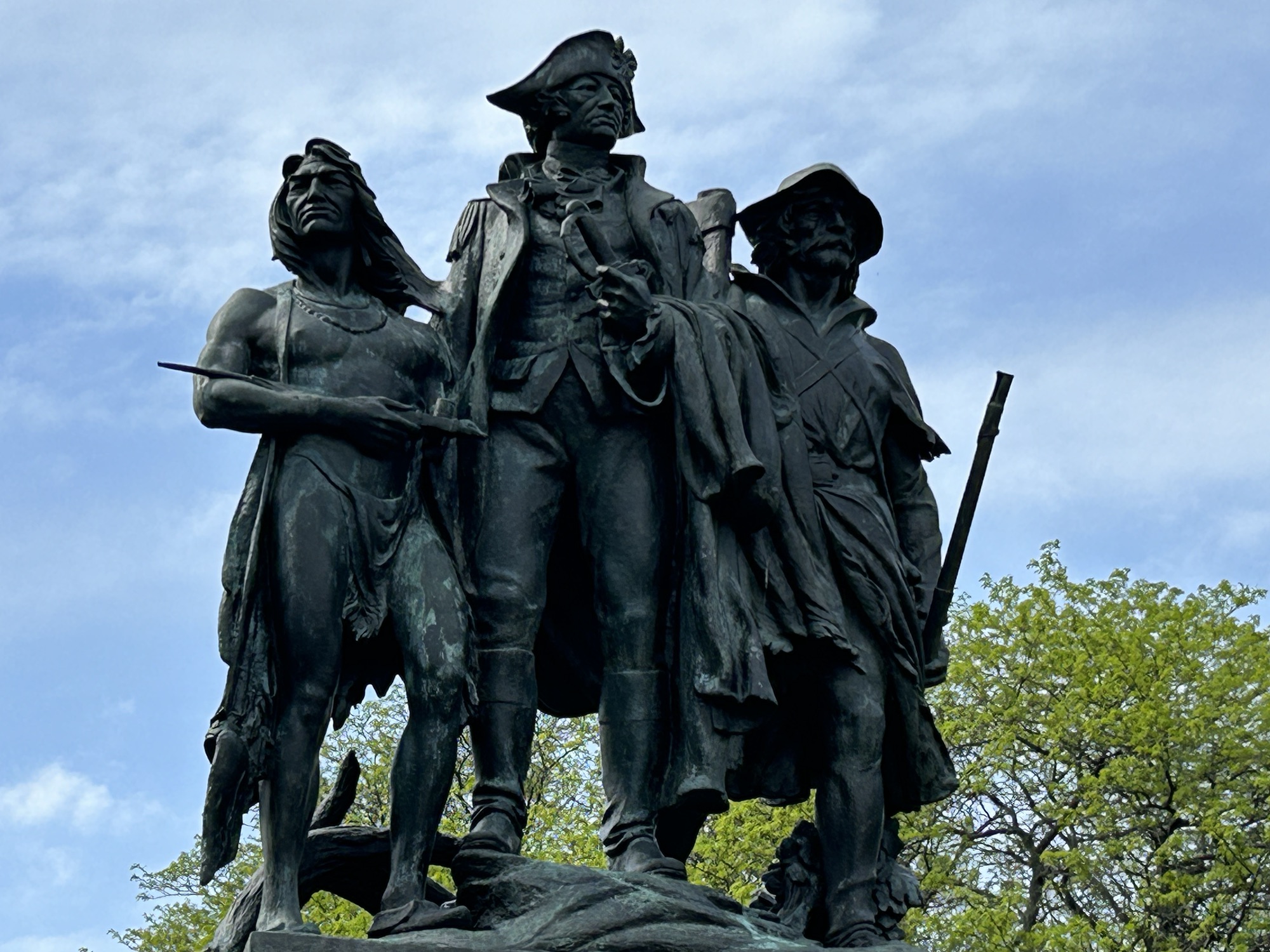
The much disputed western frontier was once here in Ohio, where the British Fort Miamis guarded the crossing point and last navigable stretch of the Maumee River to Lake Erie, backed by their confederation of Native American allies. George Washington sent General Wayne (above center) here after his previous general had been defeated. In 1794, Wayne’s troops met over 1,000 native warriors in battle, and prevailed, resulting in much native land being ceded to the US.
In 1811, Indiana Governor William Henry Harrison provoked the natives into fighting again. When the War of 1812 broke out, the British reforged their native alliances and used their naval power to reoccupy Fort Miamis. Now General Harrison—later the 9th President—built a new fort on the other side of the Maumee River and held it against attack. The fighting then moved north, where Harrison’s troops killed the Shawnee leader Tecumseh and defeated the British on the Canadian side of Lake Erie, ending both the British occupation and native land ownership in most of the northwest.
The site is affiliated with the NPS and managed by Toledo. Due to an early mistaken account of where the battle occurred, the statue above is neither on nor facing the battlefield, which is behind them over a bike bridge in the woods. There are plenty of bike trails connecting different riverside parks, and there’s an Audubon island with heron in the middle of the river. The earthworks of Fort Miamis are still clearly visible overlooking the Maumee. History and nature await us.
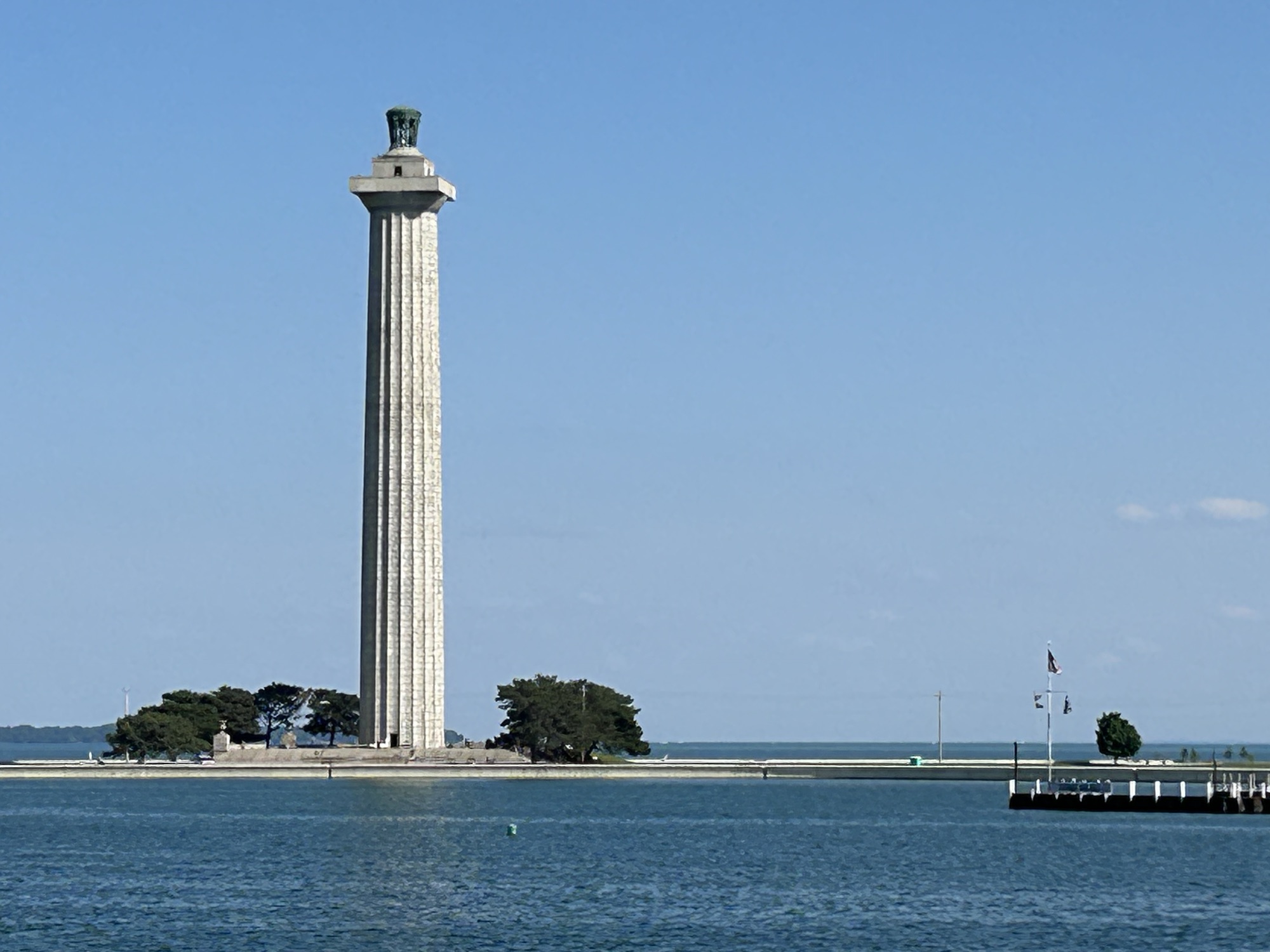
Captain James Lawrence was shot by the crew of a British ship blockading Boston in June of 1813. Dying, his last command was “don’t give up the ship”, but his ship was captured. Three months later, his friend Commodore Oliver Hazard Perry commanded the USS Lawrence under the flag “DONT GIVE UP THE SHIP” against the British for control of Lake Erie and access to the western Great Lakes. Despite balky support from the USS Niagara, Perry sailed up close under long range fire to bring his short range big guns to bear. The Lawrence suffered 80% casualties, was disabled, and Perry withdrew, taking command of the Niagara. He returned to the middle of the battle, pummeled the British ships and won the day. His fleet then ferried US troops across Lake Erie, where they forced a British retreat. US negotiators leaned heavily on these victories when negotiating peace, making Perry’s victory here perhaps the most consequential of the War of 1812 and for determining the US border with Canada today.
One of Perry’s younger brothers, Matthew, commanded the ‘Black Ships’ that sailed into Tokyo Bay and forced the internationally isolated Japanese Shogunate to open its country to the West in 1854. There are several ferry options for visiting the touristy island town of Put-In-Bay, and Perry’s monumental tower—the world’s largest Doric column—has great views of the surrounding islands, part of the longest undefended international border in the world, and the naval battlefield. Three British and three US officers are interred in the memorial, and the regular sailors killed were sewn up in their hammocks and committed to Lake Erie. Please take some time this Memorial Day weekend to remember those who gave their lives for our country.
For some reason, the volunteers giving the tour did not appreciate my ‘Dad joke’ references to the cat from the comics (no relation). James Garfield was a veteran of Shiloh and Chickamauga and an effective General. He was also a large man, a skilled orator and quite intelligent, devising mathematical proofs, etc. At the 1880 Republican Convention, Garfield went to support John Sherman, of the Sherman Antitrust Act, but Sherman couldn’t win the nomination. After over 30 failed ballots, someone proposed Garfield, and he became the nominee. Garfield built a path from the railroad line at the back of his Ohio property to his front porch and invited all comers to hear him speak. This new ‘front porch’ campaign was a hit, and he won.
After only a few months in office, Garfield was fatally shot in the back by a failed applicant for a Civil Service job. It took months for him to die, and a rich friend raised a considerable amount of money to take care of his widow. So, the most significant policy which arose from his brief administration was to reform the Civil Service process, so that the President wouldn’t have to meet anyone who wanted a job and hand them out (often corruptly). They also granted pensions to the widows Garfield and Lincoln.
Garfield’s widow, now rich, added 20 rooms or so to her house and built a private Presidential Library upstairs, a first. The house is mostly filled with authentic items and is remarkably well restored. The room above is the best lit and shows the finery. The library no longer contains Garfield’s papers, but it contains many books, prints and busts of authors, and Garfield’s congressional desk. Based on his Congressional career, one could argue that Garfield would have been a good President, supporting African American suffrage, voting for Johnson’s impeachment, etc., but it’s neither clear nor a flawless record. We’ll never really know.
Ida Saxton McKinley’s house above is managed by the site, and was preserved by a private foundation before the park service got involved. The tour is interesting, with some original artifacts, and the ranger did a good job of comparing this famous widowed first lady with Jackie Kennedy. While times change, the political importance of presenting a positive public image remains.
The museum and visitor center a block away has rotating exhibits of the various First Ladies, and Nancy Reagan was on display. Jackie Kennedy’s display begins on May 2nd. Not sure why Michelle Obama’s poster has to be in the most difficult to find corner of the basement, but whatever. One of the park films was on fashion and power, and it did an excellent job of explaining the political power of First Ladies like Dolly Madison and Jackie Kennedy, who used White House events, interior design, fashion and adroit diplomacy to support their husbands’ administrations, often more effectively.
Cleveland’s mayor, the first African American elected mayor of a major city, Carl Stokes, faced an environmental crisis. The Cuyahoga River, above, caught fire in 1969. And it wasn’t the first time. Mayor Stokes led journalists on a pollution tour and tied the issue to poor and underserved communities, many of color, which often suffered most. He led the fight for change.
In many ways, this park is a great example of what can be done, when we make the effort to restore nature. While interstate highways still cross over the park, they do so from extremely high bridges, separate from the deep valley below. Many tributary watersheds are protected by municipal and state parks and other reserves. Instead of removing the old railroad line along the river, there’s a classic old train line with restored historic whistle stops for hikers, bikers, and even kayakers to return after traveling through the park one way. An old inn on the canal has been repurposed as a museum. An old mill village is now a visitor center with a store selling drinks, sandwiches and ice cream (black raspberry chocolate chip is the best). The tow path, which both separated the canal from the river and provided a walkway for teams of oxen to pull barges, makes a perfect, nearly level, dry, packed gravel path for bikers, hikers and equestrians to travel for miles through the woods, admiring both wildlife and the beautiful scenery.
This is my favorite park for bicycling. I biked from Frazee House to Peninsula, above, about 20 miles round trip, in order to see some of the northern and middle sections where the path runs close to the river and far from the road. I saw both a Bald and a Golden Eagle, the first with the help of a park volunteer who let me look through his telescope. Brandywine Falls also surprised me by being larger than expected in Ohio, and the Ledges is another popular hike. I also hiked through Beaver Marsh at the southern end to look for more birds and watched a Great Blue Heron fishing for about an hour, among the geese, various ducks, redwing blackbirds, giant snapping turtles and other wildlife. Wonderful!
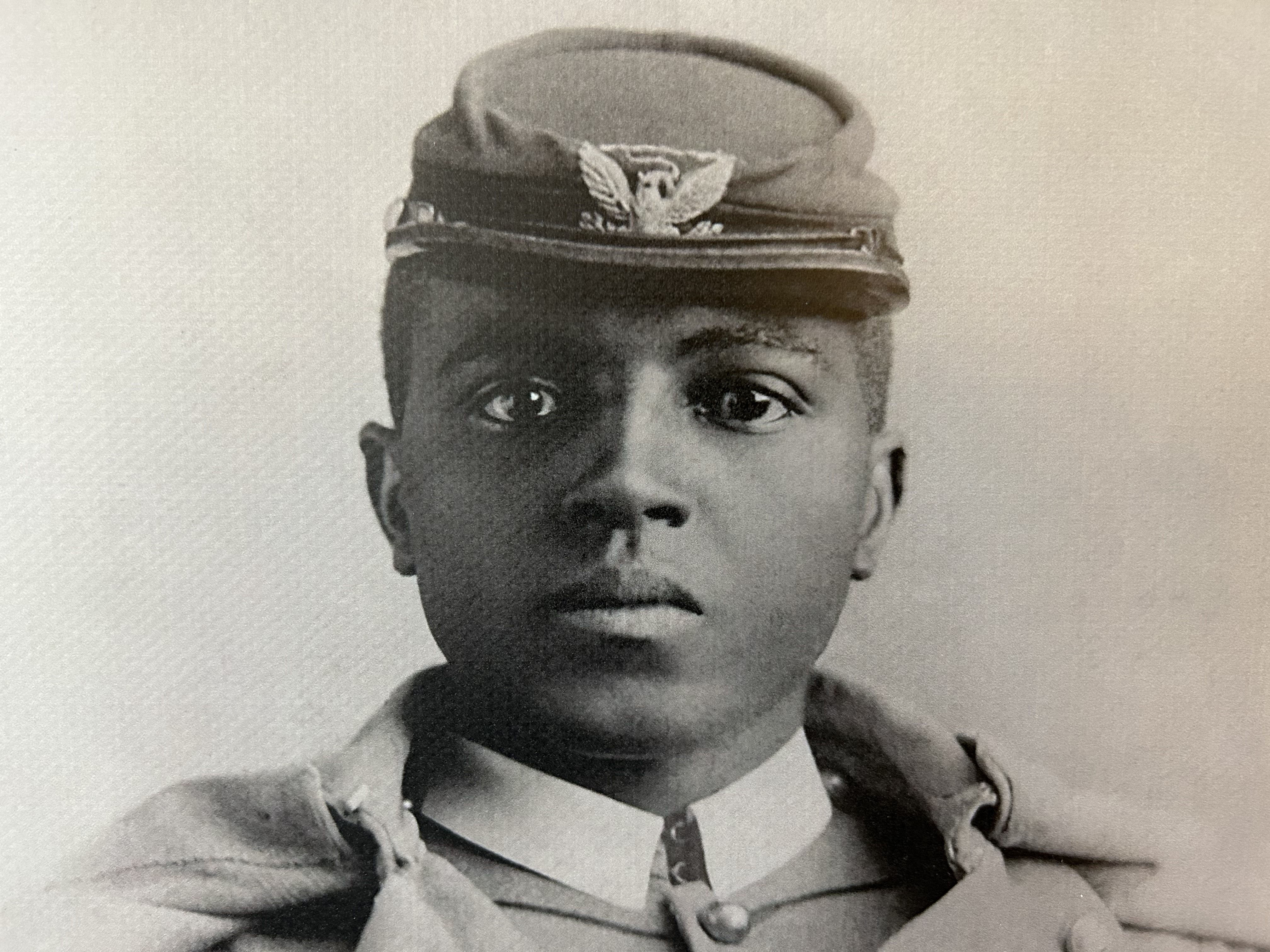
Charles Young’s father was born into slavery, escaped and joined an African American heavy artillery regiment in the Civil War. His mother and grandmother were also born into slavery but were educated and taught Charles as a boy.
Charles Young was the third African American West Point graduate to become an officer, and in 1901 he became the first African American Captain in the Army. Young was also the first African American superintendent of a National Park, Sequoia, and he eventually became the first African American Colonel in our Army.
The park here reflects the community in Wilberforce, which is the site of the first University owned and operated by African Americans. Young taught military tactics and how to be a soldier. The University also employed luminaries including WEB DuBois, voting rights activist Hallie Q. Brown, and the poet Paul L. Dunbar, all of whom enjoyed the hospitality and vibrant discussions held regularly at the Young family home, once a stop on the Underground Railroad. The Young house is still in the midst of extensive renovations, and there’s a small exhibit inside a nearby seminary library.
Young was an excellent officer, who overcame great prejudices during his interesting career, but the site is also dedicated to the many African Americans who served with him and after him. In the west, these soldiers were known as Buffalo Soldiers, due to their curly black hair, and their service is recognized at 20 different national parks, including Forts Bowie, Davis, Larned, Point, Union and Vancouver. Tragically, much of their service was against Native Americans.
Sorry for the lengthy post, but here’s a summary for those short on time. Watch the ‘On Great White Wings’ park film online, skip both interpretive centers and spend time at the Carillon Historical Park, where you can see the first practical airplane and other fascinating original Wright Brothers’ artifacts.
The Wright-Dunbar interpretive center is in the Wright Brothers print shop building, shows the park film and has exhibits about the print and bicycle businesses that funded the brothers’ aviation experiments. The poet Dunbar is not related to aviation, but he was an internationally acclaimed African American writer.
The Huffman Prairie interpretive center also shows the film, has exhibits about the Wright Brothers grand tour in Europe and has a nicely landscaped monument, but it’s also not essential.
If you want to walk on the field where the first practical airplane first flew, you need to find gate 16A at H Road on route 444, drive out past the shooting range and park in the woods behind Huffman Prairie Field. (Don’t let the sounds of shotguns spook you, as they’re probably out of range). Do not take Kauffman Avenue or 844 to the Wright-Patterson Air Force Base main gate and parking lot, since they won’t let you in. The brochure map will help, but the other maps were wrong.
As a private partner site included in the enacting legislation, the Carillon Historical Park is extraordinary. The park was funded by a local inventor whose wife liked the bells she heard in Europe, and in addition to holding Wright Brothers artifacts, the park has collections showing the varied inventive history of Dayton, including historic trains, bicycles and cars, historic buildings, exhibits and many helpful people. The museum of local inventions takes you from the cash register and electric starter to the space age. Best of all, the park runs a brewery, Carillon Brewing circa 1850, which uses traditional wooden equipment, old recipes and fire to make beer. If every historical park did that, there would be a million more visitors interested in history. This site is one of my favorites.
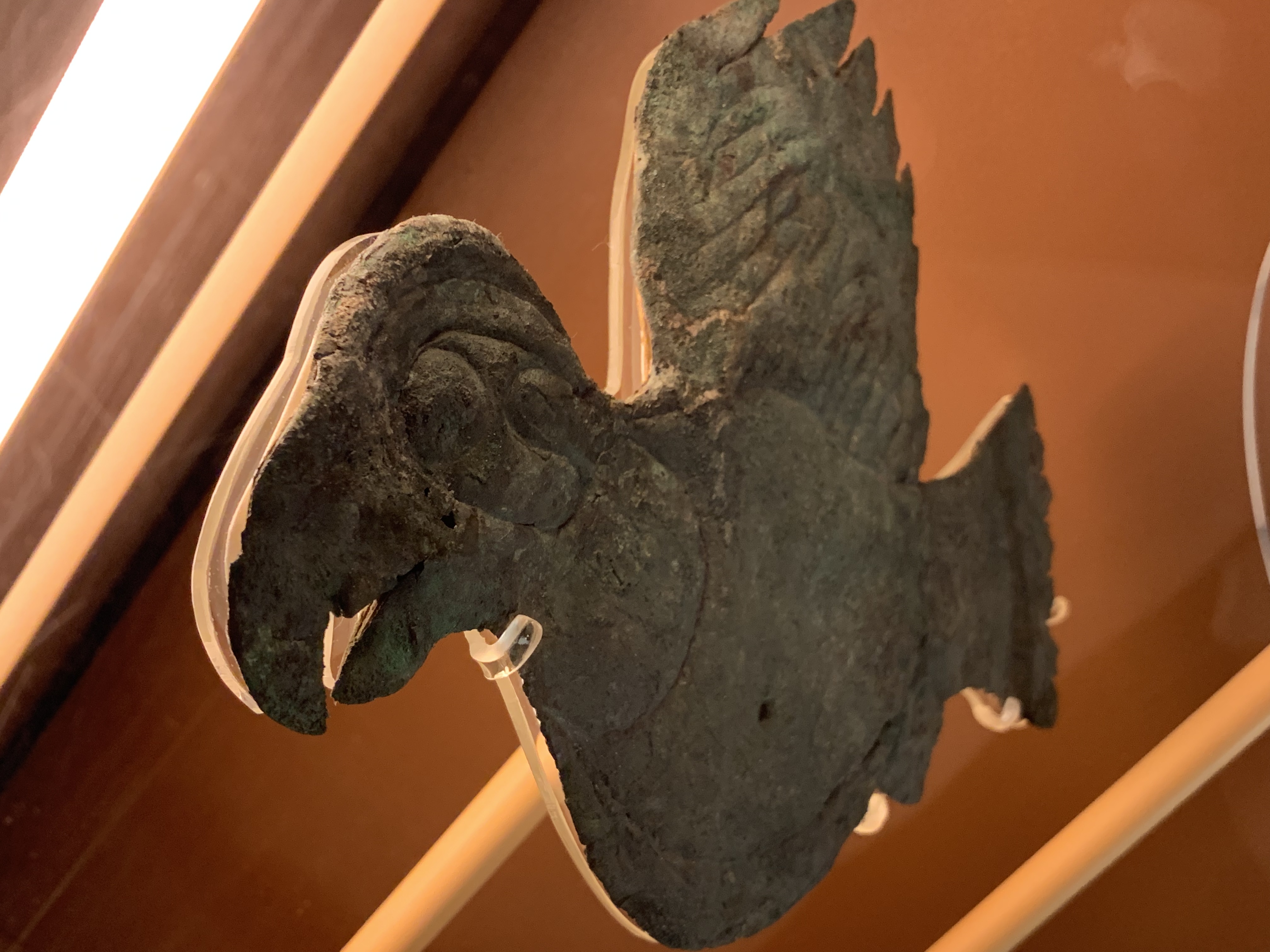
Does this bird look like a Peregrine Falcon or a parrot? I ask, because some of the folks at this Native American archaeological site suggested the former and seemed pretty insistent that the Eastern Woodlands people must have been “completely separate” from the Southwestern people who traded parrots widely at the time. Having just driven along the Canadian, Arkansas, Mississippi and Ohio Rivers, I can confirm that people who traveled by canoe could easily cover that distance. Of course, if it’s a Carolina Parakeet (now extinct), then it would have been native to both Ohio and Colorado.
Some archaeologists and anthropologists resist making obvious conclusions. Each native site focuses on its speciality, often avoiding drawing any connection between contemporaneous, sequential or geographically neighboring cultures. For me, it’s clear that the Paleo, Archaic, Woodland, Mississippian and Puebloan people are all related ancestors of today’s Native Americans. It’s silly to ask “what happened to the people who built these?” Because, as Native Americans universally answer, “we’re still here; they were our ancestors”. Pretending that an early Native American culture just magically popped up out of nowhere and then mysteriously disappeared (as the park film sort of suggests) is stupid and ignores the role of European-Americans who plowed over evidence of the early people after driving their descendants off their land.
Native Americans living in North & South America still travel and interact with each other, as they did for thousands of years spreading different ideas, crops, weapons, tools, and materials across our continents. The Alibates Flint Quarries, Russell Cave, and Ocmulgee Mounds parks units all show evidence of fairly continuous use over the entire 17,000 year period until Europeans began to encroach. Poverty Point, Hopewell and Chaco Culture sites all show extensive trade routes over thousands of miles. These people all built similar sites aligned with the sun and moon, in round and square shapes, at different times and in different places from 1500 BC to 1500 AD. Every site I have been to and every description I’ve read describes Native Americans as using feathers and bird figurines for ceremonies and adornment. The park service should make these connections, so visitors can appreciate the full scale of Native American culture. At least UNESCO is now recognizing Hopewell as a World Heritage Site in reflection of its importance as a religious pilgrimage and burial site for Native Americans across the continent.
Taft was a well-educated, hard-working, intelligent, admired, talented, ethical, moderate public service from a family of successful politicians, and he had an accomplished career as a judge, foreign administrator, and President. But what makes him unique among Presidents was that 100 years ago he also became Chief Justice of the Supreme Court. As he had in other jobs, he instituted important and intelligent reforms and improvements, such as focusing on only cases of national and constitutional importance and getting Congress to build the Supreme Court building. In particular, Taft tried to convince the other justices to join in unanimous or near unanimous decisions, to avoid having the Court lose popular respect by issuing sharply divided opinions. Imagine that!




 Zero Carbon Travel