While not the largest rock formation in the west, Chimney Rock above, was the first exceptional one seen by the pioneers on their journey across the wide open prairie, so many pioneers elaborately described it in their journals. Judging by the old photos, it has lost some of its point, but it still towers over the landscape. Chimney Rock also made a clear landmark for the prairie schooners navigating on the Pioneer Trails from the Platte River to the nearby pass at Scotts Bluff. The site is affiliated with the NPS, but it is managed by the Nebraska State Historical Society.
“O, Shenandoah, I love your daughter, Away you rolling river. I’ll take her ‘cross yon rolling water. Ah-ha, I’m bound away, ‘cross the wide Missouri.”
American folk song
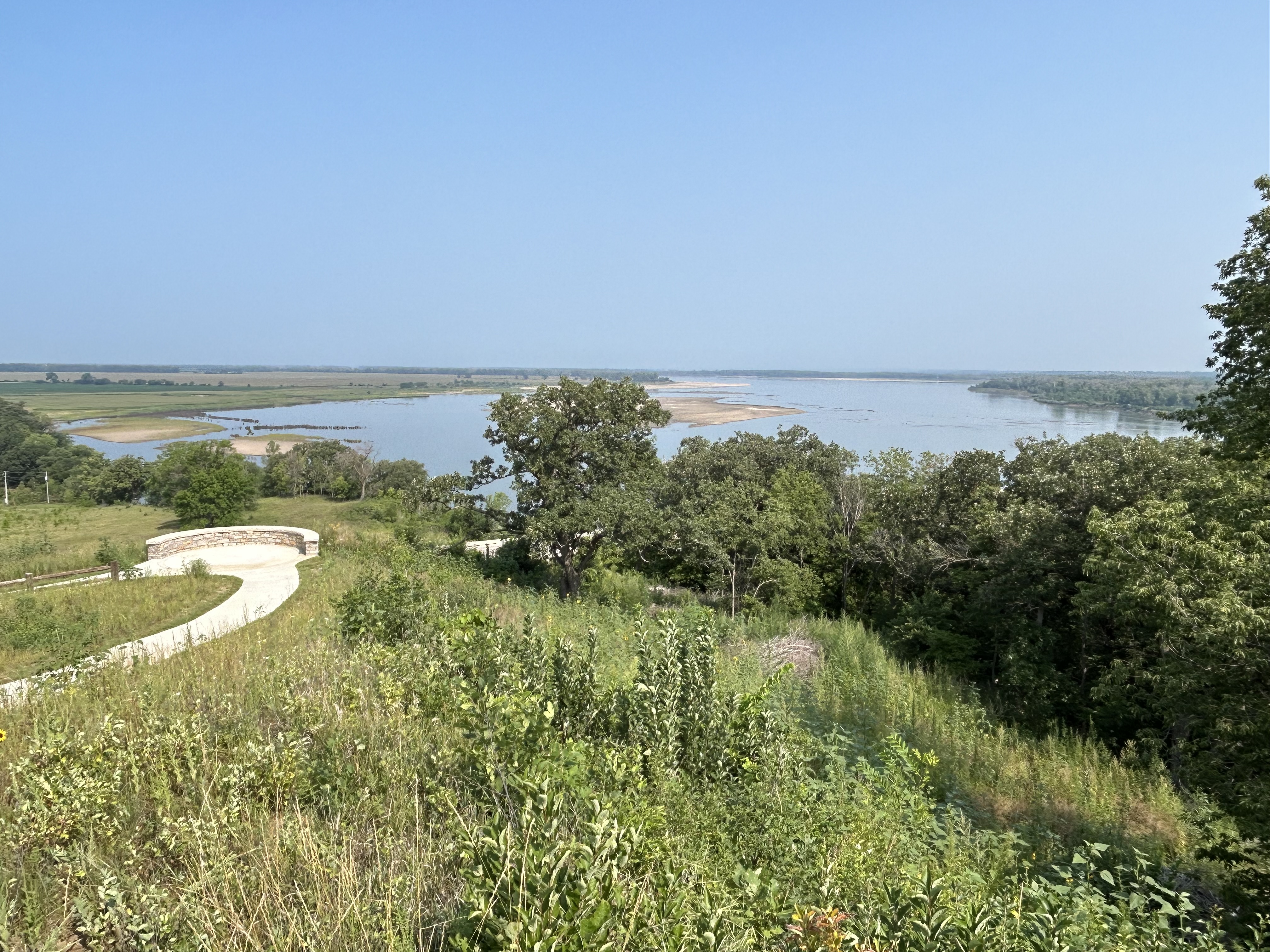
Above looks upstream from the hill above Mulberry Bend in the 59 mile eastern park district, where Lewis & Clark scouted some 219 years ago, along with other places introduced by the Yankton Sioux, one of many tribes that helped the expedition. The Yankton Sioux relinquished most of their land 165 years ago before either South Dakota (right) or Nebraska (left) were states, but they are still considered defenders of Pipestone in Minnesota. Their reservation runs along the north bank of most of the 39 mile western park district, above the confluence of the Niobrara, and they are park partners. Both districts of the park preserve the natural river flow, without commercial traffic, and most power boaters stick to Lewis & Clark Lake in the middle.
Further up the ‘big muddy’ Missouri River, at the confluence of the Knife River in North Dakota, teen mom Sacagawea joined their expedition with her French fur trapper husband and their infant. Like Pocahontas, her story is part of America, and similar stories are part of our heritage. As a child, I loved the song “Shenandoah” but was confused whether it was about the Shenandoah River in Virginia or the Missouri River. Turns out, Skenandoa was an Iroquois Chief, whose daughter was stolen by a French fur trapper and taken away across the wide Missouri River. Romantic stories about natives are part of our cultural heritage, albeit often one-sided. Especially given current tragedies of missing and murdered indigenous women, more effort—and funding—is needed to protect these women and tell more stories from a Native American perspective.
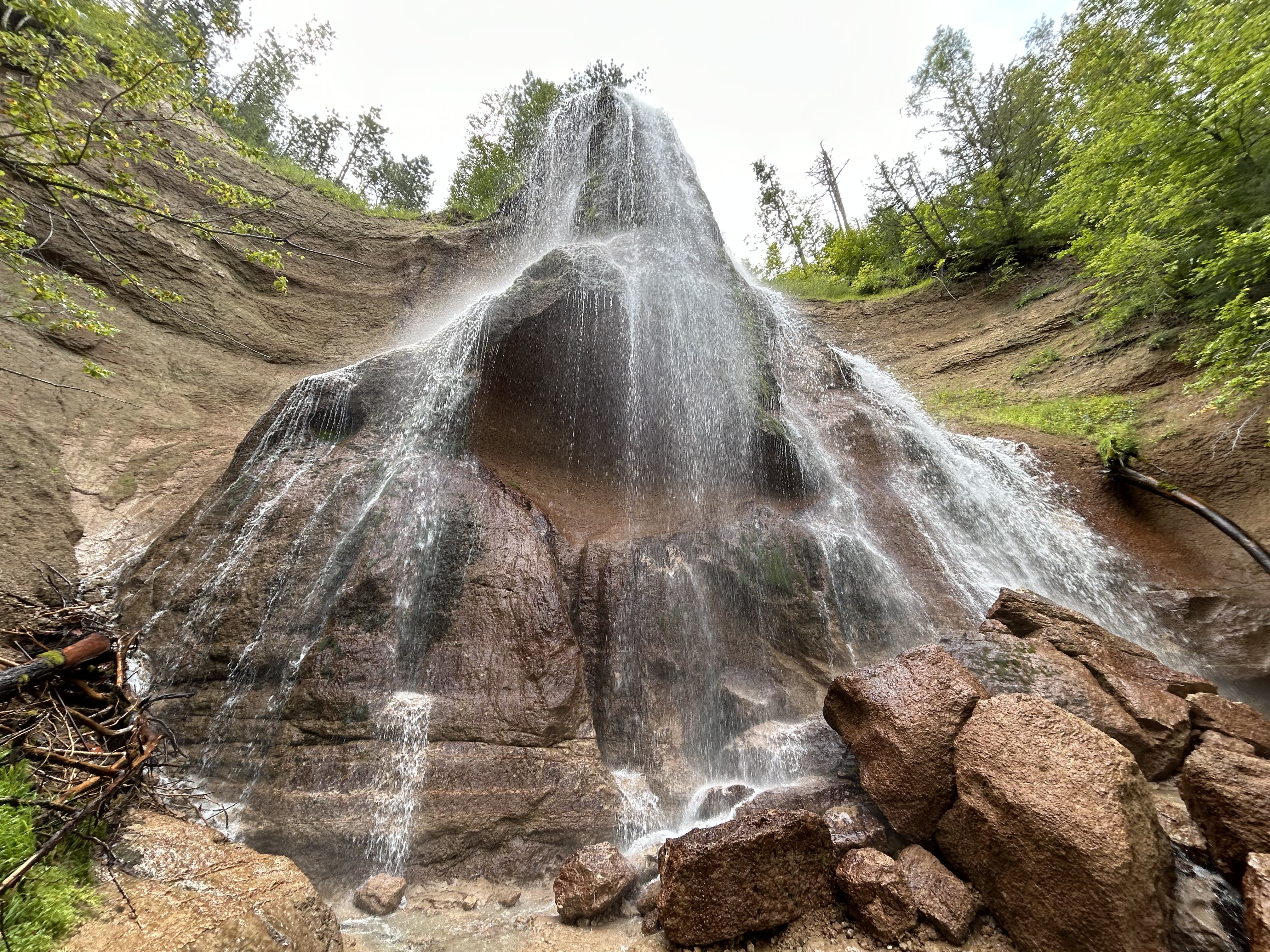
Smith Falls above is the largest waterfall in Nebraska, and it makes a good picnic stop when floating down river. I got a ride with Little Outlaw from Brewer Bridge up to Fort Niobrara and kayaked back. Most people start at Berry Bridge and just float down on giant tubes ‘lazy river’ style, but they miss the pretty part at the beginning. I suppose the nature reserve doesn’t allow alcohol, so that may explain it. Either way, it’s very pleasant, with thick grassy banks, high bluffs, a couple of Great Blue Heron, several smaller waterfalls and no boat engines.
The interesting little town of Valentine is a decent base, with the small visitor center and places to stay. It’s in a well known Dark Sky county, which makes sense since the area is remote & peaceful. There’s a large nature reserve to the south, where I spotted a bald eagle but no bison. With all the space, they should have even more wildlife areas. Somewhere downriver were likely hideouts of bank robbers Frank & Jesse James. There are a number of reservations in the area, especially in South Dakota. There are not many places to charge, so I had to plan and drive a little slower than usual. Be sure to try a Runza—meat pie/ sandwich—if you see the local chain restaurant in one of the larger towns. I recommend mushroom Swiss.
This diorama is one of the best I’ve seen, and it showcases all the major finds discovered here to date. The first fossil was found by James Cook on his ranch here at the headwaters of the Niobrara, but his collection of Native American art & artifacts rivals the attraction of the fossils. He was a great friend of Chief Red Cloud, and, unlike many of the original fossils which have gone on for display and study elsewhere, Cook insisted his gifts remain here. If that weren’t enough, there’s a lovely creek with wildlife on the trail up to where most of the fossils were found. This is one of my favorite fossil sites, although Dinosaur is better.
Like many folks, I grew up watching Westerns, so when I think of wagon trains of pioneers, I think of circling the wagons to defend against native attacks. But that’s another myth. More pioneers were killed by gun accidents than native raids. Pioneers traded peacefully with Native Americans as a rule. There was another school shooting recently, and the myth that guns make us safer is still being repeated today.
Of course, the main cause of death for the pioneers was cholera, so what actually protected them was coffee. Folks who drank “cowboy coffee” (strong enough to float a horseshoe) were saved by boiling water. I knew there was a reason I love espresso.
The park is beautiful, and many of our ancestors in the west walked (“prairie schooners” or wagons were for supplies) through the pass above. The rangers are both informative and engaging, and as always I learned more in a brief conversation than from any other source. Since I arrived early, I hiked up the Saddle Rock trail, but you can also drive up. The bluffs aren’t the highest or most brightly colored in the whole country, but they offer pleasant views of the historic trail.
I grew up reading about the frontier spirit of rugged individual homesteaders who followed their manifest destiny, tamed the wilderness and settled the country by grit, determination and hard work. Most Americans can trace their roots back to folks like these, and this view traditionally defines what it means to be an American.
But I’ve learned a few things on my way here, so it’s time for some myth busting. First, the “untamed wilderness” was already occupied by Native Americans who built homes, farmed and lived off the land. Second, the settlers received serious government assistance in the form of the US military clearing the Native Americans off the land and giving it to them. Third, the homesteaders almost immediately ruined the environment by removing the topsoil, causing the dust bowl and mass migration to California. And finally, I only see little huge corporate agribusiness here now, not individual farms.
The park is impressive, with both a state of the art Heritage Center and an Education Center. The film and museum are “award-winning”, and much of the focus appears to be on teaching kids to be proud of their homesteading ancestry. Much of the money was donated by the local fossil fuel utility, so I’m not surprised that environmental issues such as the tallgrass prairie devastation, the dust bowl and the changing climate are not the focus. But what angered me was a slight-of-hand trick employed to tell the homesteading story.
The film & exhibits make it abundantly clear that the Native Americans once lived on the land before the homesteaders settled, and the unfair history is presented in a way that kids can’t leave without learning some basic facts. However, at the beginning of the film Native Americans are described as not believing in land ownership, in the middle they say all they want is for everyone to respect the land, and at the end one Native American speaks of how he loves his reservation. And the egalitarian aspects of the Homestead Act are used to justify it: blacks could homestead (although slavery held them back at the beginning), women also benefited, and European immigrants homesteaded.
I believe it’s wrong to lie to our kids, especially to make them feel better about something that was wrong to do. The Native Americans did own the land. And the homesteaders knew it, because the newspaper ads that urged them to go west clearly said “Indian Territory Open to Homesteaders” and “Grand Rush for the Indian Territory”. They knew it, because some moved into sod pit-dwellings built by Native Americans. They knew it when they copied Native American burn techniques to encourage new growth to feed cattle. And they knew it when they grew corn in the same fields as the Native Americans. What the Natives didn’t have were written real estate deeds or the ability to defeat the US military.
It’s simply dishonest to suggest that it was OK to take the land due to lack of ownership rights. It’s also wrong to imply that it was OK to take the land since it was under-utilized. Imagine someone comes into your home and tells you that they bought your land on the dark web using Bitcoin. Then they explain that it’s all legal in the new digital world and that you have to move out now since you don’t have a hexadecimal key to participate in the secret auction online. When you protest, they force you to leave with high tech weapons. Finally, to justify their actions, they say that they can house more people and grow more food on your lot. You would correctly say that you had been robbed, and you would correctly say that the explanation doesn’t justify the crime.
Frankly, in the 21st century, to be repeating old lies that the Native Americans wanted homesteaders to take their land because they would better use it is offensive. The US military forced the Native Americans off the land at gunpoint, by slaughtering bison, and by encouraging white settlers to move in. The homesteaders used the land in the same way as the Natives, farming, ranching, hunting and fishing. In some ways they were more advanced, and in other ways, such as topsoil removal, they were more destructive. It is also devious to try to defend the racist policy of Native American removal by saying that it benefited blacks, women and immigrants. Would you teach your son that it’s OK to beat up and steal another child’s lunch as long as he shared a little of it with other kids who were hungry?



 Zero Carbon Travel