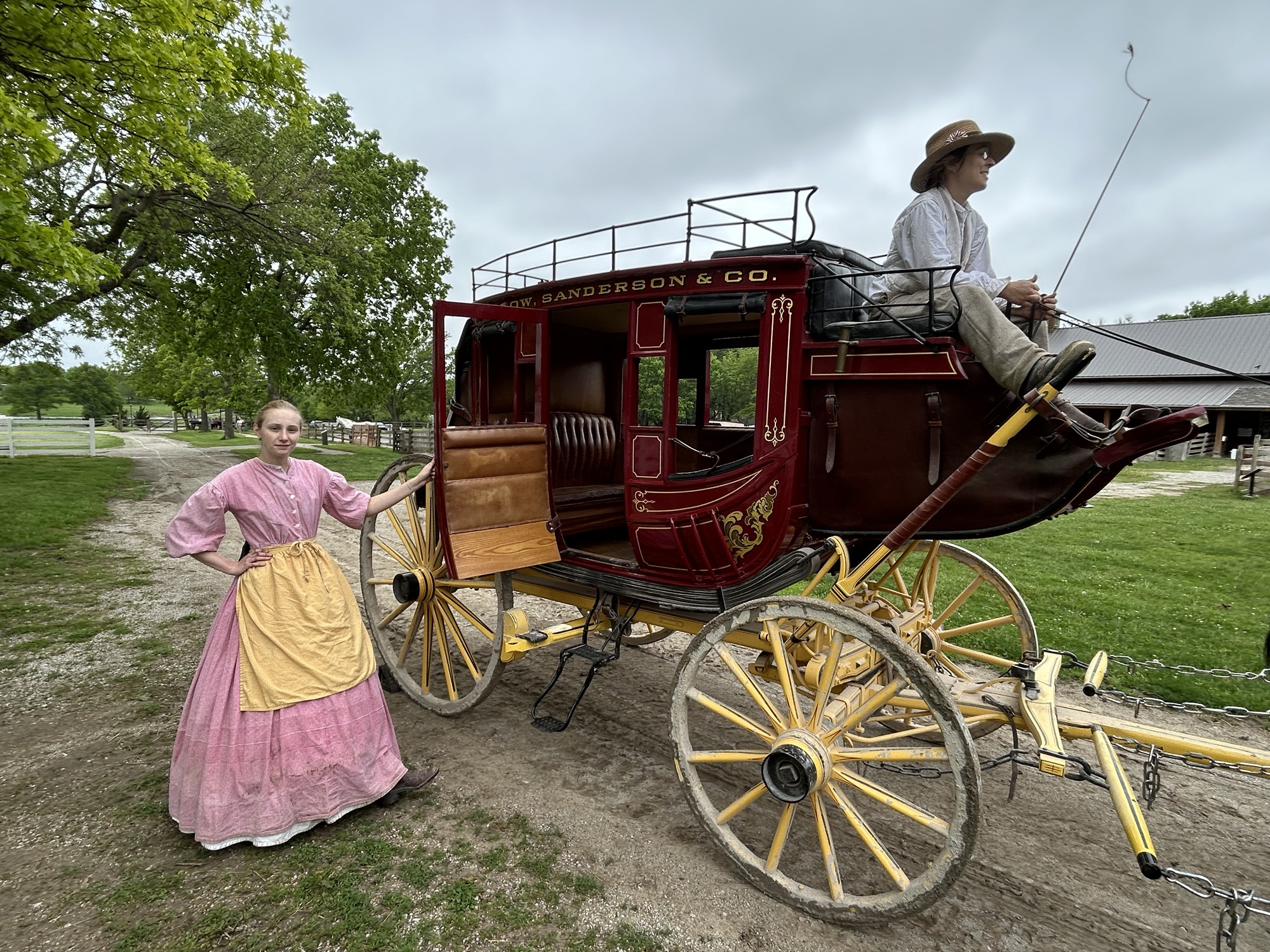
Kansas does not deserve the short shrift it often gets. At the state-managed Mahaffie Stagecoach Stop and Farm, for $7 I rode in the Santa Fe Trail stagecoach above, ate a quick bite as the passengers did in the original house, dodged heritage chickens in the yard, saw a ‘prairie schooner’ in the barn, carefully watched a blacksmith demonstration, and learned how differently vintage baseball was played in 1860. Living history is so much better than a regular museum, although they have one of those here too. The staff is bright and answered all my dumb questions quickly and cheerfully. This is my favorite trail stop.
Turns out that John Brown’s half sister lived here and insisted on strident ‘free state’ politics, doubtless supporting the Underground Railroad. John Brown freed slaves from Missouri, and one of his sons was killed fighting ‘border ruffians’ in front of his half-sister’s cabin nearby. Bushwhackers from Missouri frequently crossed the river to try to rig the election in favor of slavery, but they were fought by local Jayhawkers. Around 100 people were killed in the violent fighting known as Bleeding Kansas that is considered a prelude to the Civil War. Kansans’ staunch and courageous support for freedom was the hope of the nation, at a dark time in our history.
The greater area is also the starting point for basically all the trails going west, including Lewis & Clark, the Pioneer Trails and the Pony Express, all of which have museums nearby. And the first documented Civil War combat by African American Union soldiers—the 1st Kansas Colored Volunteers—occurred at Island Mound (YouTube) in Missouri, although not the first regiment. Oh, and Amelia Earhart’s birthplace, the Negro Baseball League and other interesting sites are also part of the NHA, along with official NPS sites like Fort Scott, Fort Larned and Brown v Board. So, let’s give Kansas some overdue credit.
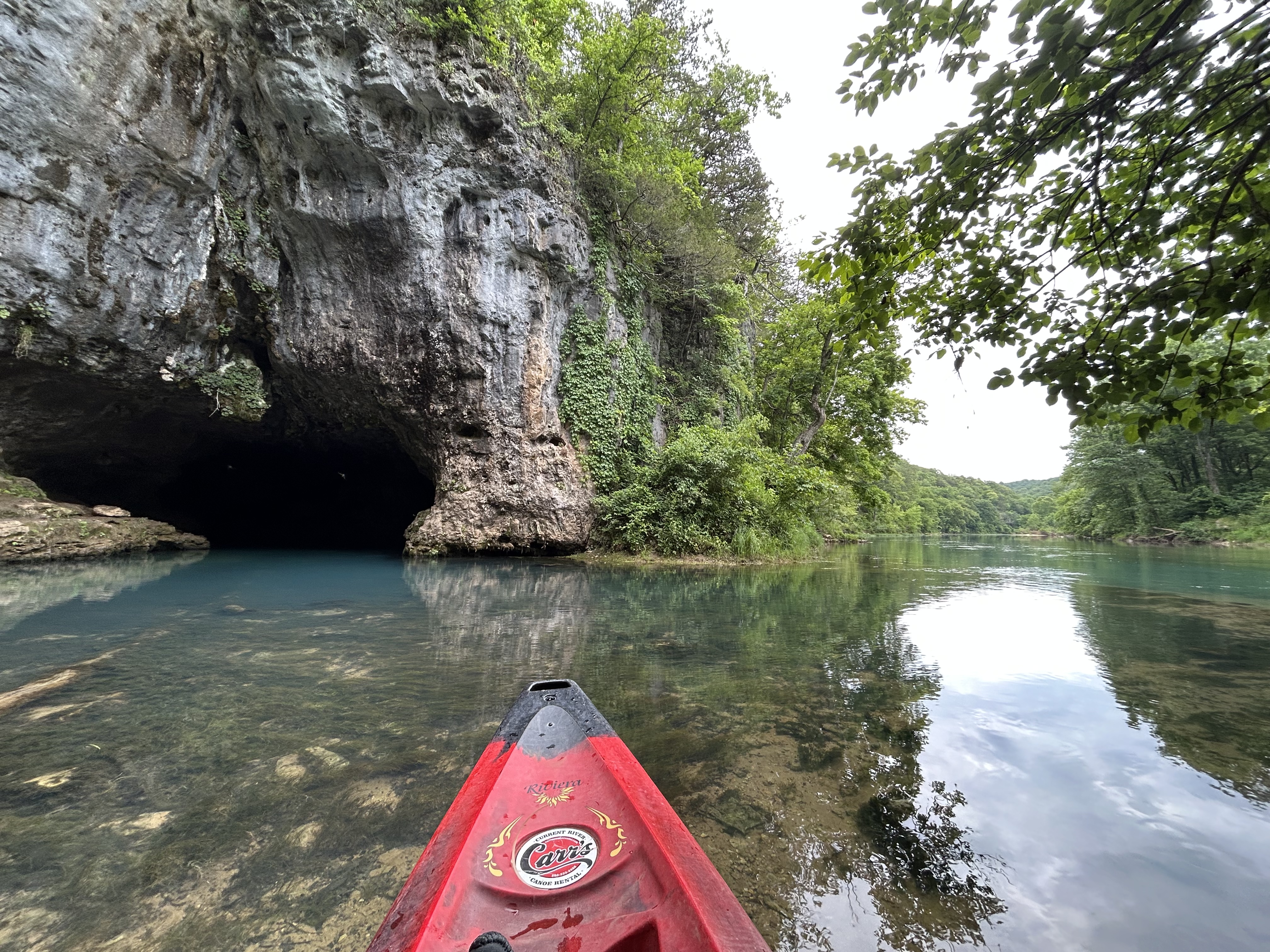
Nature requires pristine conditions to sustain diverse species, and here they exist undiminished. Cave Spring above is fed from Devils Well, a huge underground lake in a Karst cavern 100’ below the surface. The water is so clean and cold that bright green watercress grows in thick clumps underwater. I saw baby swallows above the cave mouth, baby ducks following their mother down the rapids, a river otter, great blue heron and bald eagles. The air was thick with mayflies over the water and butterflies on the wildflowers. Lovely.
Carr’s, aka Current River, offered to provide their equipment for the same price as a shuttle, so I paddled from Akers Ferry to my campground at Pulltite. There’s tubing downstream, but when the water is high enough, upstream is more scenic. There’s an excellent cave tour at Round Spring where I saw cave salamanders, but tickets are limited. The other river in the park is the Jack’s Fork, and there’s a scenic mill at Alley Spring where I saw baby skunks. The largest spring is unimaginatively called Big Spring, and it’s strikingly beautiful with hundreds of millions of gallons of aquamarine water pouring out of the rock daily. Blue Spring is one of the deepest in the world, but I didn’t have time to explore everywhere. This Missouri park is my favorite for kayaking, so I’m planning on returning to paddle another stretch soon.
This park is the lynchpin of the nation. If it were removed, the whole country would fall apart.
OK, maybe not, but it is an important spot. The domed courthouse above heard the infamous Dred Scott case, which was used by the Supreme Court to take the country backwards, deny people their basic rights and help spark the Civil War. (How times change). The arch represents a gateway to western expansion, facilitated by Jefferson’s Louisiana Purchase in 1803 and subsequently explored by Lewis & Clark from here.
Many factors came together for the territory to wind up as ~12 US states. France traded with the Native Americans who lived there, and all along the rivers there were French communities, from Pittsburgh to St Louis and from Quebec to New Orleans. Shortly before we became independent, Britain declared war on France, used their ships to take Quebec and blockaded Spain from their colonies, and in exchange for peace, they took Canada and Florida, while France kept Haiti and Spain wound up with the Louisiana territory.
That peace treaty didn’t last long. The British heavily taxed the colonists to pay for that war (bad idea), the US declared independence (and won), the slaves in Haiti revolted (and won), Spain secretly gave Louisiana back to France, and France & Spain were preparing to invade England (and lose). Amidst this chaos, Napoleon wanted cash more than colonies that he couldn’t control, and Jefferson wanted to secure the Mississippi and expand our new country. Both sides approached each other to make a deal.
Beautiful new park with many buildings dating back to 1785, and an active community of French cultural preservationists. There even seems to be a bit of friendly rivalry between the park service and the French living history museum folks. As the economy moved elsewhere, the town avoided development and kept their unique culture intact. There are three tours: a tavern, a French Don American (long story) governor’s house and a former slave’s house. Together they weave a fascinating story of a French settlement halfway between Quebec City and New Orleans.
Grant was a quiet, thoughtful man who was sometimes taken advantage of by others, developed strong moral convictions and enjoyed travel. He was also the leader who saved the Union in battle and in his Presidency. This is one of my favorite presidential homes, next to Sagamore Hill.
While he served in the war with Mexico, he correctly deduced that it was “a wicked war” waged to expand slavery by taking territory from a neighbor in the midst of internal conflicts. After leaving the military to be with wife and kids, he somehow wound up owning a slave, most likely received from his father-in-law, and Grant freed him. His father-in-law kept his other slaves, until they escaped during the Civil War. Unlike some Union generals, Grant advanced African American units as key to victory.
I have now visited a number of his battlefields, but here at his (and his in-laws’) home his views are made clear. Grant clearly attributed the cause of the Civil War to slavery, and as President he fought hard for African American rights, establishing the precedent of sending in troops to protect African Americans being terrorized by racists including the KKK. Grant was often underestimated, even by historians, but in life he counter-attacked aggressively, and in history his core views have proven to be right.
I love this statue. Carver was born at the end of the Civil War and was kidnapped and orphaned by the Klan. His mother’s owners retrieved him and raised him here, where he studied the plants near the creek as a child. He was educated mainly in Kansas, despite racial barriers, and eventually became the first African American to graduate from his school. His manner was mild, but he demonstrated great determination in the face of poverty, adversity and prejudice.
Recognized for his extensive scientific knowledge of botany and for being a groundbreaking African American scientist, he was hired to teach at Booker T. Washington’s Tuskegee University. His goal was to help the least in society, so he worked on modernizing agricultural techniques used by African American farmers, even bringing a cart from the university out to the fields to teach, a technique copied by the US Department of Agriculture. He published many books and pamphlets, developed patented techniques and is best remembered for developing the lowly peanut into a highly profitable series of products. He testified to Congress about the peanut and scientific agricultural techniques and was widely recognized for his many accomplishments.
I know Carver is an inspirational figure admired for overcoming obstacles, but I can’t help but wonder how many others were denied even the limited opportunities he had. Slavery existed here for 244 years, with 10 million sent across the Atlantic and maybe another 10 million born into slavery here. None of them were properly educated. None had the freedom to pursue their dreams. And all died without being able to fully contribute their talents and ideas to improve the world. How many young, inquisitive minds were destroyed by slavery? How much human enlightenment was snuffed out to pick cotton? Carver was one of the first born after the Emancipation Proclamation was signed, and he spent his life making the world a better place for all of us. But I can’t help but mourn the incalculable loss of all the other people during those 244 years and after who could have contributed as well or even more.
Here’s the creek. It’s quite pretty, and there used to be a mill here. I saw a bald eagle nearby.
Alright. An important Civil War battle was fought here. To appreciate the story, you need to understand that Missouri was an important strategic state, with a neutral populace and a pro-slavery governor, which President Lincoln very much wanted on the Union side. Lincoln asked Missouri for troops, and the governor refused and plotted to seize the arsenal in St. Louis to help the confederates.
The arsenal’s Captain, Nathaniel Lyon, however, had already secretly moved the weapons to Illinois. After being promoted, Lyon took the state capital and forced the governor to retreat to southwest Missouri, where Wilson’s Creek is. In the summer of 1861, General Lyon marched his forces here, attempting a surprise attack. But the confederates had assembled a larger force. On August 10th, here on Bloody Hill, the forces engaged brutally for five hours. Lyon fought aggressively, was wounded twice in action and was killed leading a countercharge that morning, becoming the first Union general killed. The Union army retreated, but Missouri remained in Union control, despite many guerrilla battles to retake it.
The home was actually Bess’s family’s, before becoming the vacation White House. Due to my inattention and Tesla’s quirky routing, I briefly visited Truman’s family farm, which is much less fancy, before getting to the center of Independence where Harry worked as a judge and could walk a couple blocks to Bess’s house. President Truman evidently enjoyed coming back to Missouri as often as possible, and I’m sure he would be pleased having so many folks visit.
Very little official business was conducted here. But if you’re looking for information on Truman’s Presidency, his library and related artifacts are managed separately by the National Archives a few blocks away.





 Zero Carbon Travel