Superior is the biggest, deepest and cleanest of the Great Lakes, and our most scenic lakeshore park is on the north coast of the upper peninsula of Michigan. Within the park are ~10 miles of dramatic 200’ cliffs, painted by various minerals washed through the sandstone, and the best way to see is by boat. The pastels, turquoise shallow waters, green trees, blue skies and waterfalls (below) are spectacular.
Besides taking a popular commercial tour of the most scenic section of the cliffs in a couple hours, as I did, it’s possible to kayak or to hike along the edge. Lover’s Leap (above) has only 3’ of water below, so don’t take it literally. The lakeshore trail—part of North Country NST—is 40+ miles over dunes, creeks, and long beaches, with many side trails exploring forests, marshes, and lookouts. Short hikes can be done near the ends of the park, but the middle is roadless.
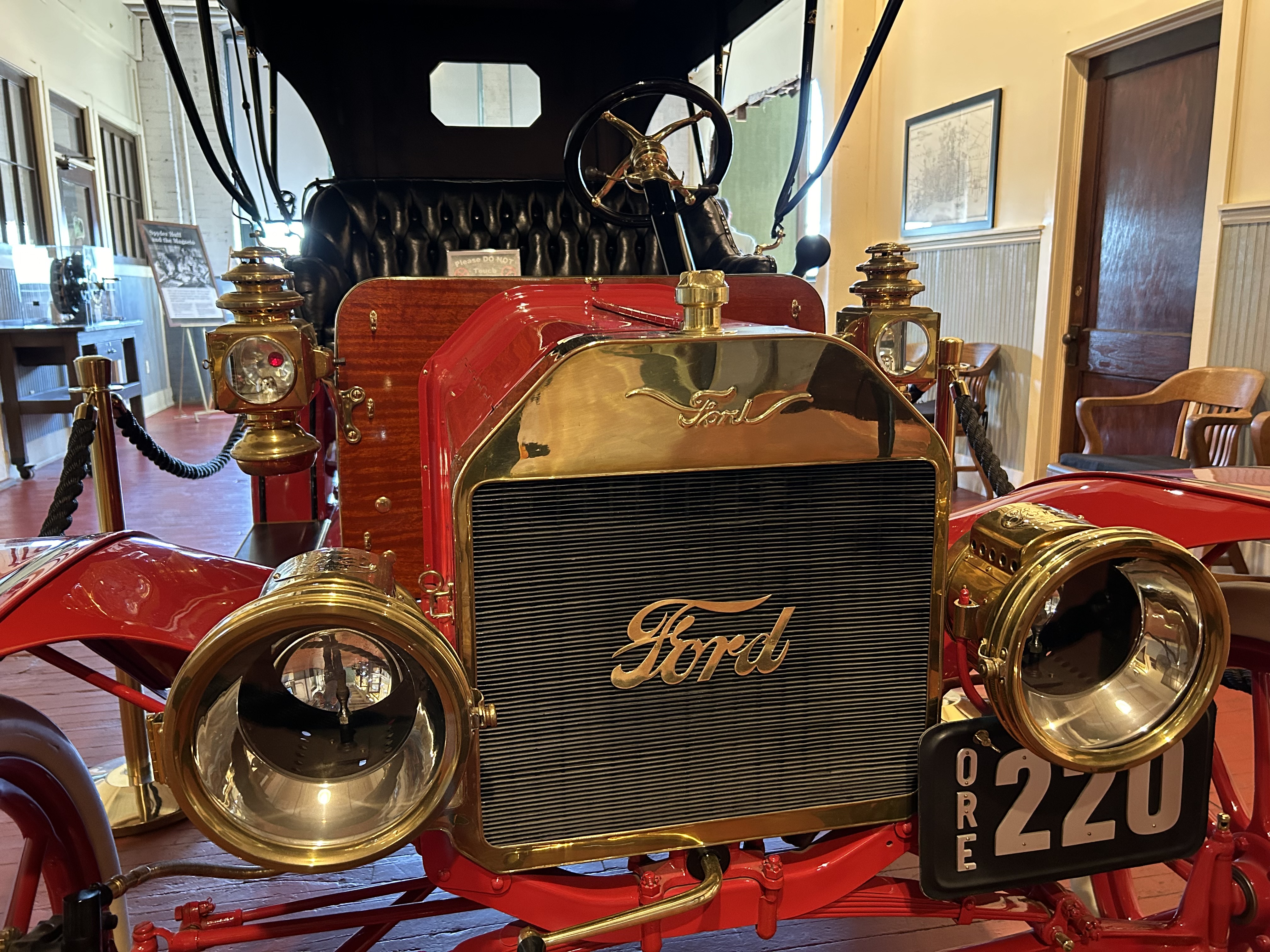
Behind “Elizabeth” above is the secret room where Henry Ford designed and built the first Model T in his factory on Piquette Avenue on the then outskirts of Detroit. His buddy Harvey Firestone got the first ride, and then Ford road-tested the vehicle by driving through Wisconsin to the Upper Peninsula on a hunting trip. (Along with the influential naturalist John Burroughs and the inventor Thomas Edison, the four were close friends and camping buddies). Then, introduced in 1908, the Ford Model T took over the US car market.
Roughly half the price of a horse-drawn carriage (including horses, shoes and fodder), priced lower than competing cars, and offering useful attachments like truck beds, skis or tractor wheels, folks loved the rugged, practical vehicles. Ford had already built models B, C, F, K, R, N and S in this factory, but a lighter weight steel allowed him to build the vehicle he knew would be popular in rural America (Ford grew up on a 200 acre farm), the Model T, with 6 models ranging from $825 to $1100: the Roadster, Tourabout, 5-Passenger Touring Car(above), Town Car, Coupe (popular with doctors) and Landaulet (taxi). The original Model A that had been built down the road in 1903 was redesigned and reintroduced in 1927 to replace the Model T as another commercial success. Of over 100 car makers in Michigan when Ford started, his is the only original firm remaining.
By making the popular standard car, Ford determined the direction of the industry. His wife insisted the steering wheel be placed on the roadside, so that when he drove she didn’t dirty her dress while stepping to the curb. Instead of alternatives like steam-punk coal-burning vehicles or electric vehicles—several of Ford’s earliest vehicles were electric—, gasoline was readily available across the country for small machines and farm equipment. Before realizing that black paint was cheaper and dried quicker, red and green models were also sold, often with raw white rubber tires, as above. After making various improvements to the assembly process here, Ford designed his next factory with steel-reinforced concrete floors to bring parts down to the world’s first synchronized assembly line. While this fascinating heritage area includes many different car museums, the Piquette Factory tour must be considered the highlight, with two dozen early model cars built here on display over 100 years later.
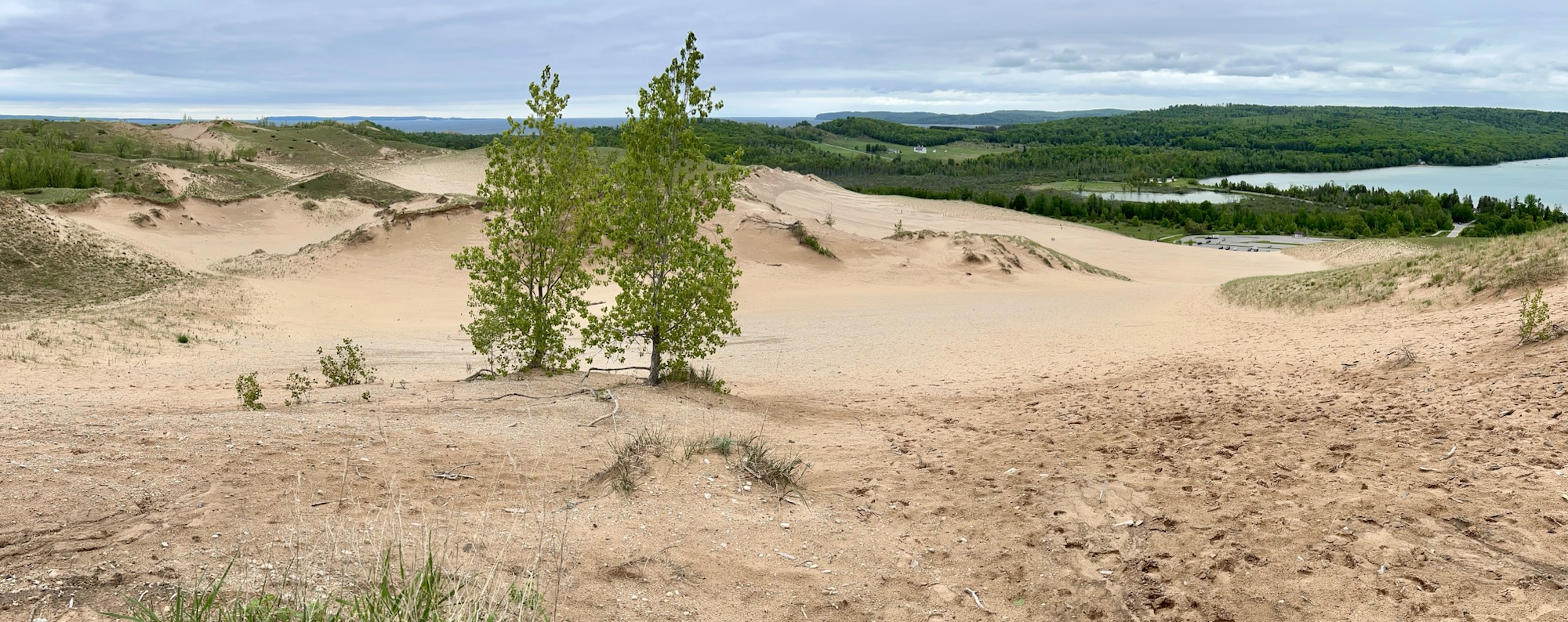
The small lake on the right is Glen Lake, and Lake Michigan is at the top left. If you zoom in to the right, you might see tiny people climbing the middle dune from the parking lot. I got up to this vast view on the pleasant Cottonwood Trail (less than 2 miles round trip) from the Pierce Stocking Scenic Drive, which also takes you to the breathtaking Lake Michigan Overlook and the splendid Sleeping Bear Overlook. Many folks seem to want to do things the hard way, but I definitely recommend hiking from the scenic drive. The impressive Sleeping Bear Dune itself is over 1000 feet high, and folks frequently need rescuing ($3,000) after climbing down to the lake and not being able to climb back up. A few extreme winter folk ski down the steep dune to the lake. Not sure how they get back up. Please stay on the trails, as past humans caused much erosion damage to the fragile ecosystem here. This is a beautiful park with wildlife, deep Native American roots, and it is part of a new UNESCO Biosphere across northern lower Michigan.
The University of Michigan Biological Station—better known as ‘bug camp’—on Douglas Lake (above) began over 100 years ago, and now, under its new Anishinaabemowin name, it is recognized as the heart of a huge UNESCO biosphere protecting species in northern Michigan. While UMBS is not a tourist destination at all, I saw groups of enthusiastic students and researchers preparing scientific experiments and data collection, various boats and a large protected forest. They are doing important research on the Climate Crisis and preparing a new generation of experts with hands on experience. We need to stop climate change denial, pay attention to the science and stop carbon pollution, before it’s too late.
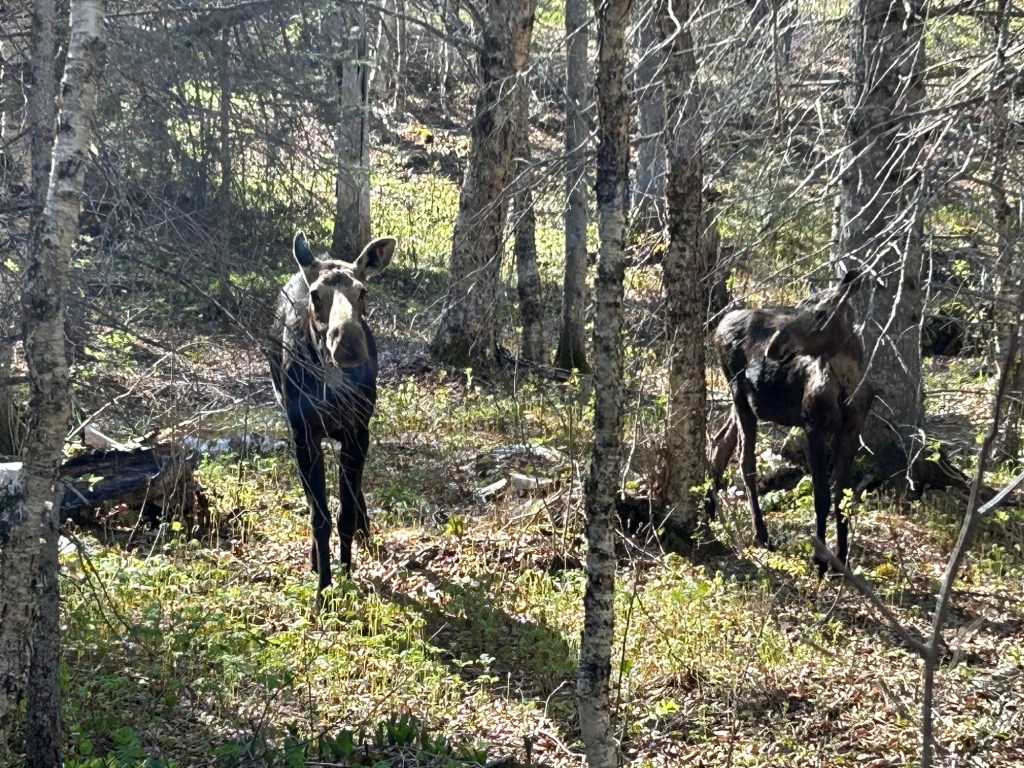
This is now my favorite park for wildlife. I was lucky to get a photo of this moose and her calf on the 1 mile Nature Trail in Windigo just before my boat left. Despite seeing loons, mergansers, swans, geese, and even a bushy tailed fox parading near my shelter on Washington Creek, I had neglected to take any decent wildlife photos, so until these two approached me, all I had was one photo of two ducks: a paradox.
I hiked a dozen miles and enjoyed the pitcher plants and boardwalks through the swampy areas and the mossy boulders on the north shore. The island is larger than I imagined, so be sure to download the park map in advance and charge your phone. This Biosphere is one of the least visited National Parks but most re-visited. Many folks hike the length over several days, and early in the season there were many volunteers hiking off-trail doing scientific research on wolf-moose predator-prey. A few were carrying a canoe for inland lakes. It’s an idyllic place, with hours of silence and solitude, a wonderful trip into the wilderness.
Isle Royale is in Lake Superior, and the shortest ferry ride is a couple hours from Minnesota to Windigo. The island is part of Michigan, and there are also ferries from the Keweenaw Peninsula in Upper Michigan to Rock Harbor. Most visitors are experienced hikers who backpack to their campgrounds, and it’s 40 miles between Windigo and Rock Harbor. Some arrive by private boat, and several campgrounds have docks. Lodgings are limited to Rock Harbor and a couple cabins in Windigo, and rooms are both very expensive and typically sold out many months in advance. The season roughly runs from early June to early September, so it’s a good idea to plan your trip a year in advance.
At 36, Jacques Marquette was already a famous explorer and missionary. He spoke at least half a dozen Native American dialects and languages, had helped found Sault (‘Soo’) Ste. Marie, and he helped others settle and avoid conflicts. But then he embarked on a trip through Green Bay, down the Mississippi, to the Arkansas and back up the Illinois, greatly enhancing settlers’ understanding of central North America. The return route, suggested by native guides, proved the pivotal Chicago Portage. Beyond his importance to French Catholics and their descendants, he introduced Christianity to many Native American tribes, and his explorations and settlements helped determine the future of trade and growth in the Great Lakes, on both sides of the border.
Missionaries also brought deadly diseases into the lives of many people with no natural immunity, and their practices of baptizing babies, distributing bread at Communion, and gathering closely together weekly for songs and prayers were lethal for many native communities. But Marquette traveled among the tribes a few years before Leeuwenhoek discovered bacteria. Marquette himself died after contracting dysentery at 37, and his memorial is on the north side of the above Mackinac Bridge—which connects upper and lower Michigan—in the touristy town of St. Ignace which Marquette founded. There’s honestly not much to see in this affiliated park site (since the small museum burned down years ago) except for a few plaques and a short trail, but nearby there’s a nice view of the Mackinac Bridge (above) over the straights that Marquette explored and traveled through often.
Reports of a two ton boulder of pure copper lying in a river bank on the Keweenaw peninsula of the upper peninsula of Michigan were dismissed as tall tales, until proven by a geologist in 1840. The boulder wound up at the Smithsonian Natural History Museum, a huge mining boom rush erupted, and the closest port town was named after the geologist, Houghton. Most of the small mines failed, but eventually a large consolidated firm found and mined the largest pure copper lode in the world.
Technically the copper was “rediscovered” (or stolen) as the Native Americans here had been mining it for at least 7,000 years and traded it as far as Effigy Mounds, Hopewell, and other prehistoric sites around the country—so don’t accept the common misconception that Europeans introduced metal work to this continent. However, European immigrants did expand the mines here to an astounding scale. The deepest part of the Quincy Mine above is over 9,000 feet below ground, which is over 6 times deeper than the Empire State Building is high, with huge rooms left behind after the copper seam was excavated (see photo), and 92 levels mostly flooded after the mine closed in 1945 due to competition from western mines.
The huge equipment includes many rare and once record-breaking pieces of industrial machinery, and the Quincy Mine tour is fascinating and essential to understand miners’ lives. Be sure to get a big Cornish Pasty at Roys in Houghton. There are some museums and a visitor center in Calumet, including a magnificent old theater with lovely murals, but since most of those tours are only in the afternoon, it may be smarter to tour the mine in the morning. There are a couple dozen interesting sites on the Keweenaw peninsula, but for me the most haunting exhibit was the description of the Italian Hall disaster at Christmas in 1913.
While capitalists are allowed to organize freely under the law, labor was not. Thousands of copper miners went on strike, and the mine owners hired ruthless, violent strikebreakers. Someone—an anti-unionist according to eight witness who later testified to Congress—yelled ‘fire’ into a crowded Christmas party on the second floor of the Italian Hall in Calumet. There was no fire, but 59 children and 14 adults died. Woody Guthrie explained what happened below.
“The copper boss’ thugs stuck their heads in the door, One of them yelled and he screamed, “there’s a fire” A lady she hollered, “there’s no such a thing. Keep on with your party, there’s no such thing.”
A few people rushed and it was only a few, “It’s just the thugs and the scabs fooling you, “ A man grabbed his daughter and carried her down, But the thugs held the door and he could not get out.
And then others followed, a hundred or more, But most everybody remained on the floor, The gun thugs they laughed at their murderous joke, While the children were smothered on the stairs by the door.”
The battlefields outside were long forgotten, covered by a paper mill and other modern uses, but this is a story that Americans must never forget. So the community came together to make sure we “Remember the Raisin”, correctly, completely and for our kids. The park opened in 2011, repurposing an underused ice rink, and built this longhouse and other exhibits and made the park film with the support and participation of local Native American tribes. My guide passionately explained how learning the history of his own backyard literally changed his life.
The War of 1812 was a mistake, which led to the burning of the White House and the Capitol. The US could have remained neutral as the French & British continued fighting, but instead we declared war on England without adequate preparations. The cause in the history I read was about trade relations and kidnapped sailors, but the real cause was Native American relations. The war was opposed by the ocean trading states in the northeast. Americans wanted to move west, despite the land being occupied by Natives, with treaty protections in many cases. Declaring war was popular among the western border states.
Indiana Governor Harrison destroyed a sacred Native American settlement called Prophetstown at Tippecanoe in 1811. The Americans committed atrocities there, including digging up corpses and scattering the remains. That caused the almost 20 tribes to ally with the British. When the war broke out just as the British were ready to be more conciliatory, the Americans took a French settlement on the River Raisin south of Detroit. Native Americans, with some support from British-Canadian troops, retook the village and killed a number of wounded Americans, in retaliation for Prophetstown.
Americans turned their large military losses into a recruiting tool with a big campaign to ‘Remember the Raisin’—which was followed by similar campaigns for the Alamo, the Maine, the Lusitania, Pearl Harbor and 9/11. When the new recruits arrived, the troops advanced and killed the Native leader Tecumseh. The British fled back to Canada. But for Native Americans, this was the beginning of a national military campaign to force them to Oklahoma and other reservations. Harrison was elected President after Jackson on an equally racist platform.
So it’s appropriate to start with the longhouse, the dugout canoes, maple syrup, corn meal and other Native exhibits, because this site is ground zero for US choosing policies of reneging on treaties, ignoring rights, forcing removal and waging asymmetrical war against the original inhabitants of our country.







 Zero Carbon Travel