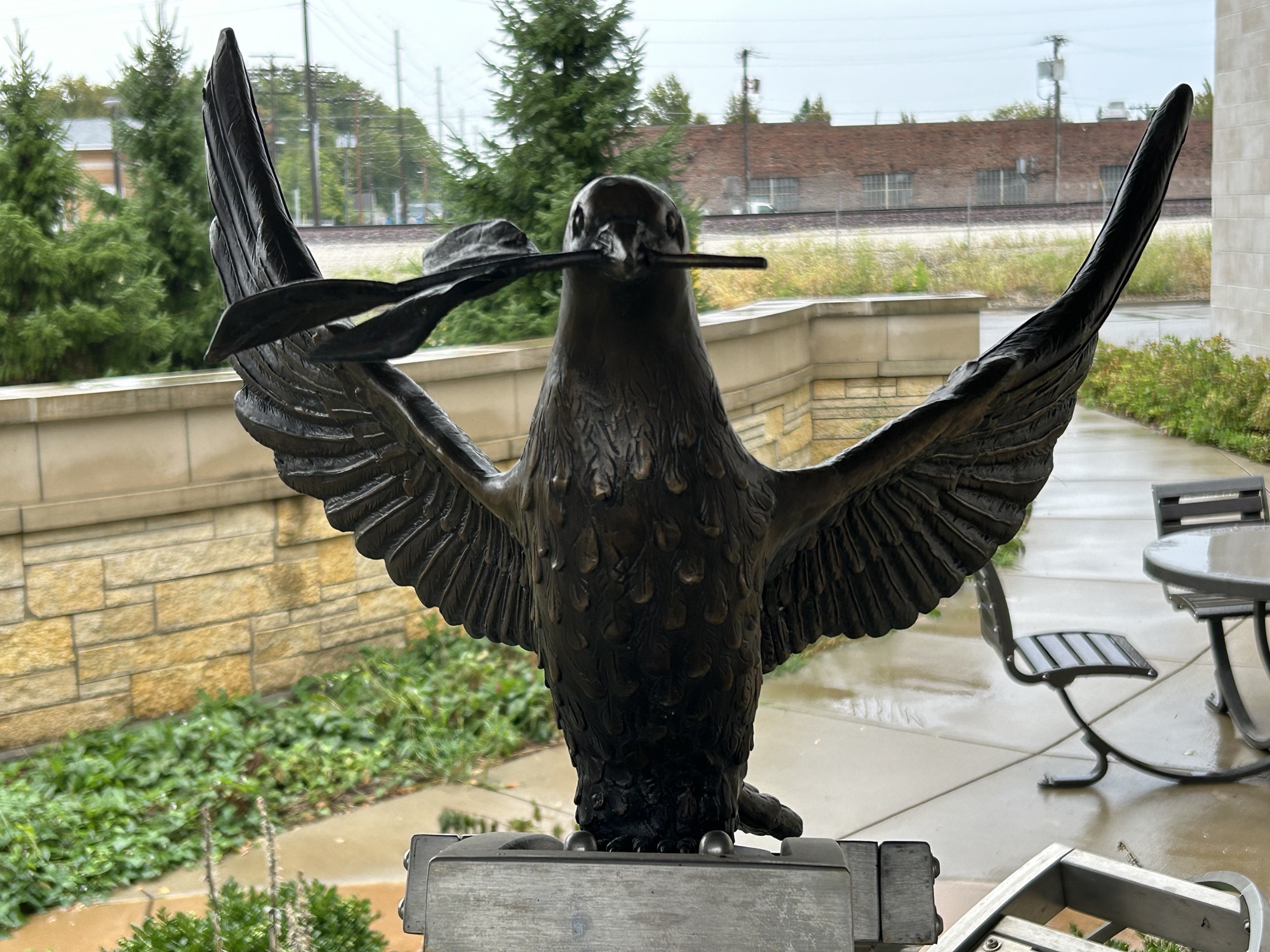
This new park established by President Biden this August is still a fenced off construction area next to the railroad tracks, but there are several art installations dedicated to the riot, including the dove above and a mural at the Children’s Hospital next door. 11th Avenue along the site is known as Reconciliation Way, to commemorate the terrible events here in 1908.
In mid August 1908, in Springfield Illinois, a white mob of five thousand lynched 2 black men, killed 7 others, burned out millions of dollars worth of black homes and businesses and also targeted Jews and whites deemed sympathetic to the black community. The police did nothing to stop the riot. The burning, looting, ransacking and violence lasted 3 days until put down by the state militia, which resulted in 6 dead rioters.
Church leaders blamed the victims for being “sinful”. Although everyone knew the perpetrators and many were arrested, only one 15 year old was convicted after he confessed to stealing revolvers, shooting at black people and starting 15 fires. The others denied any responsibility, the witnesses denied seeing them, and the charges were dismissed. The judge denied that there was racism in Springfield.
Many Americans were shocked by the scale of the violence in Abraham Lincoln’s home town, and civil rights advocates like W.E.B. Du Bois and Ida B. Wells helped form the NAACP in 1909 in response. In 1910 speaking before the NYC Republican Club (the party of Lincoln), Du Bois argued that if racial hierarchy were the natural order of the world, then there would be no need to use social and physical weapons to oppress a race.
“So soon as the prejudiced are forced into this inevitable dilemma, then the real bitterness and indefensibility of their attitude is revealed; they say bluntly that they don’t care what [slurs] may be capable of—they do not like them and they propose to keep such folk in a place of permanent inferiority to the white race—by peaceful policy if possible, but brute force if necessary. And when a group, a nation or a world assumes this attitude, it is handling dynamite. There is in this world no force as the force of a man determined to rise. The human soul cannot be permanently chained.”
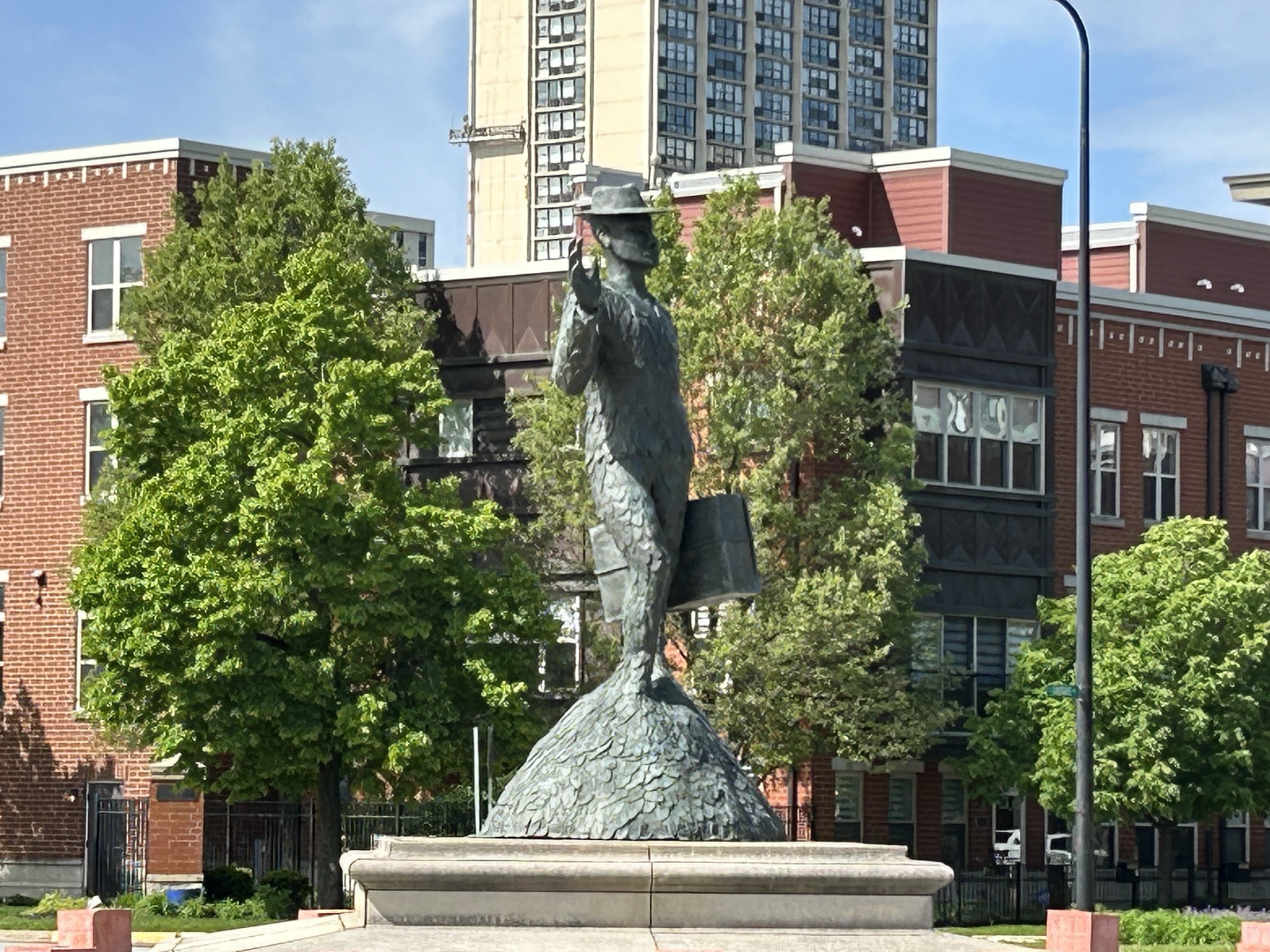
The South Side of Chicago has long been a historic district, and now it will be recognized as its own National Heritage Area. This is the neighborhood of activist Ida B. Wells, the church for Emmett Till’s funeral, of poet Gwendolyn Brooks, boxer Jack Johnson, musicians Louis Armstrong and Nat King Cole, and where a young community organizer named Barack Obama worked before law school. 1/2 a million African Americans moved to Chicago during the early 20th century. Above is the Monument to the Great Migration at MLK & 25th, welcoming people to join the community, and every so often you will find a bronze plaque recognizing accomplished residents on the walk to 35th, where there’s another statue, honoring the African American soldiers who chased the Germans at the end of WWI.
The neighborhood continues south, with many beautiful brownstone buildings and a few blues venues. Unfortunately, many historic buildings—like the Checkerboard Lounge where Muddy Waters used to play—were lost to poor government planning, an expressway that cut the neighborhood off, and expansion of the University of Chicago. Establishing a specific heritage area helps recognize the unique cultural value of a neighborhood, encouraging more visitors by promoting it. Now, I expect Black Metropolis will continue experiencing its renaissance, and I look forward to trying the food at Bronzeville Soul (closed Mondays) the next time I pass through town.
Way back in 1673, French explorers Louis Jolliet and Father Jacques Marquette were preparing to travel east to return to Canada after exploring the Mississippi River. Though the statue wrongly implies that Marquette pointed out the route, their Native American guides showed them a shortcut, by traveling up the Illinois River and portaging (carrying) their canoes between some muddy lakes to Lake Michigan. Marquette realized that if there were a canal, weeks-long journeys would reduce to days. 175 years later, the government finally built the canal, and suddenly, Chicago became one of the largest and most important transportation hubs and cities in the US.
The site itself is in a small woods between the Des Plaines and Chicago Rivers, and as part of Chicago’s river greenways, it’s managed by Cook County in affiliation with the NPS. The canal itself is 100 miles long with a bike trail, and there is a 1 mile canal boat tour in LaSalle at the Illinois River end. A non-profit association runs summer boat tour as well as the larger Illinois and Michigan Canal National Heritage Area, which includes Chicago Portage, the Pullman National Historical Park and promotes tourism to neighboring communities and parks. The canal is a key part of the Great Loop, a boat trip around the eastern part of the country, from the Great Lakes down the Mississippi, around Florida, up the eastern seaboard to New York, and back to the Great Lakes.
The animosity against African Americans, especially in the Deep South, is hard to comprehend, but it is deep, real, persistent and extremely dangerous. Emmett Till’s mother warned him, but even she underestimated the risk. In late August of 1955, Emmett Till was kidnapped from his great uncle’s home by a shopkeeper’s husband and his half-brother, who accused Emmett of whistling at the shopkeeper, a white woman. From past midnight to pre-dawn, the two men, along with several others, held Emmett, aged 14, in the back of a pickup truck, drove around the county, terrorized him, tortured him, shot him and dumped his body in the river. Witnesses reported hearing Emmett’s screams all over town for hours. His great uncle reported the kidnapping, the men were arrested, and the body was found a few days later. His mother, saying “let the world see what I see”, insisted on an open casket at the funeral in Chicago. Jet magazine published photos of his brutalized body. His mother became a lifetime activist, author and motivational speaker on education, poverty and Civil Rights with the NAACP. Many consider Emmett Till’s killing to be the beginning of the Civil Rights Movement, not least because Rosa Parks cited Emmett as the reason she kept her seat on the bus in Montgomery on 1 December 1955.
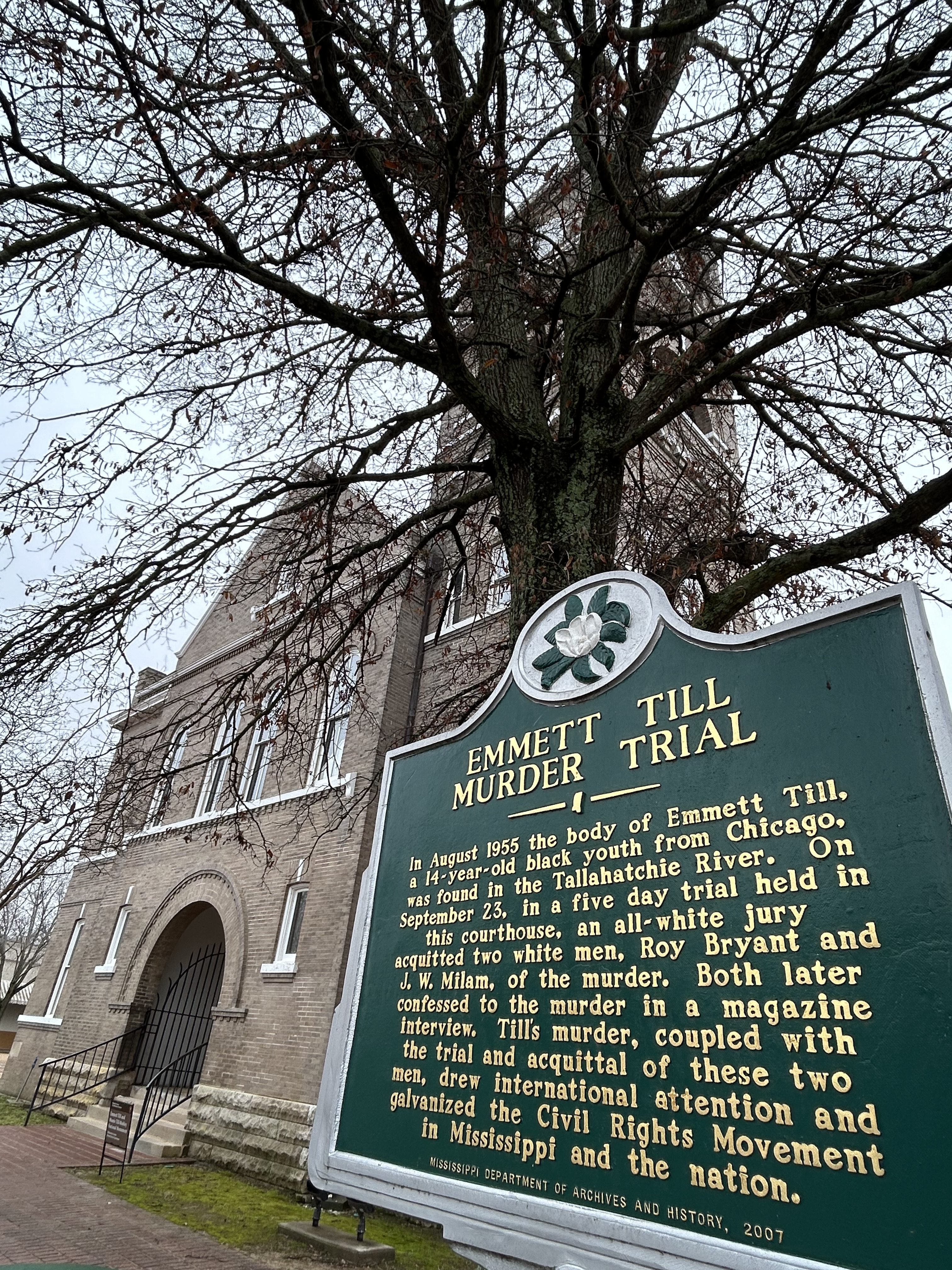
The trial was a foregone conclusion. Outside the courthouse (below) stood a statue dedicated to the “Heroes” of the Confederacy. Inside there was no justice. Instead of jurors, police, court officers and elected officials defending the Law, the courthouse became the focal point of a deep criminal conspiracy, based on racism. Witnesses were intimidated, hidden, immunized and silenced. Emmett’s great uncle testified at the trial, pointing out the kidnappers and murderers, and then he left town immediately and went into hiding under a false name. And for many years afterwards, there has been a concerted effort to conceal the truth. Evidence lost. Signs have been repeatedly shot and torn down. Historic artifacts and structures intentionally left to ruin or demolished. One witness, in hiding for decades under another name, still received death threats demanding silence. The confederate statue still stands in front of the courthouse, just left of the photo.
But despite the legacy of lies, terror and violence, people still work to tell the truth about Emmett Till. Especially if you’re exploring the new monument’s sites in Illinois and Mississippi, I recommend reading the darkly fascinating stories in the Emmett Till Memory Project app, after being introduced to it by one of the contributors at the Emmett Till Interpretive Center across from the courthouse in Sumner, MS. Emmett Till’s coffin is on display at the National Museum of African American History and Culture in Washington DC. His name was given to the Anti-Lynching Act of 2022. And this new national monument was established by President Biden on 25 July 2023, on what would have been Emmett Till’s 82nd birthday.
Railroads being perhaps the largest and most important industry in the land over 100 years ago, it was cheaper to buy the US Attorney General and easier to influence President Cleveland to send in troops than to reinstate wages for the 250,000 striking Pullman railroad workers. The leader of the strike, Eugene Debs, was thrown in jail and emerged as a Socialist. On the plus side, we got Labor Day.
The feudal administration building above was center to a huge company town, with dozens of blocks of row houses, hotels, cafes, wheelhouse, stable, church, hospital and fire station. The neighborhood has suffered more than its share of fires, including the right wing of the building above, but this new park is rebuilding and revitalizing this fascinating area. The Florence Hotel is still closed for restoration, and some of the partner museums are only on weekends in spring. There were some tours going on, but I found no information about them in the visitor center above. Walking the row houses is worth the effort, as many are still lived in and well-loved today.
‘Free’ Frank McWorter mined saltpeter as a slave, purchased first his wife’s, then his and ultimately 14 more family members’ freedom and founded this town with 12 dozen plots in 1836, the first African American registered & surveyed town in America. It was a mixed race community as Frank sold lots to all, and it became an important stop on the Underground Railroad. Fugitive slaves were assisted across the rivers, hidden in wagons and at least one basement and were even accompanied to Canada. Unfortunately, at the end of the 19th century the actual railroad bypassed the town in favor of a white town, so eventually folks moved away.
None of the early buildings survive, but there are a few old buildings built on their foundations, providing years of fun for archaeologists. There are a dozen or so signs explaining whether the plot belonged to the shoemaker, wheelwright, carpenter, seamstress, physician, teacher, merchant, cabinet maker, the blacksmith or the Post Office (above). Many of those tradespeople provided invaluable services to fugitive slaves. I wasn’t able to load the VR app which superimposes cartoon pioneers on your screen to help you visualize, but I was fine without. This brand new park is not in the completely uninteresting town of New Philadelphia, Illinois, an hour north, but it is about 30 miles east of the interesting town of Hannibal, MO.
On April 22nd, the park film was screened in Springfield, and, being a park nerd, I attended the gala park service premiere (cookies were served). Several members of the community responsible for gaining recognition for the site were there. The film was produced mainly by staff from the Lincoln Home. Just as Lincoln’s presence here attracted freedom-seekers, the folks here are broadening out understanding of history.
Reagan lived here in Dixon, Illinois, 100 years ago, from 1920 to 1924, as a young boy. Ronnie’s Mother encouraged him to act in church plays, which led to his career in Hollywood, his nick-name ‘the Gipper’ for his role in a movie about Notre Dame football star Knute Rockne, to becoming the President of the Screen Actors Guild and honing a skill set that served him well in politics.
Reagan’s economic policies of cutting top tax rates and deregulation contributed to an immediate economic boom and later increased inequality. Domestically, he favored harsh treatment of drug dealers, although his CIA was secretly involved in the Colombian drug trade which sold crack in US cities. His foreign policies followed his anti-communist views forged in Hollywood during the Blacklist days and contributed to the collapse of the Soviet Union as well as to the rise of some anti-Democratic regimes, especially in Latin America. Many of his team’s efforts were covert, including asking Iran not to release the hostages until Reagan took office, supporting the Mujahideen, etc. Reagan was extremely popular, both when winning a landslide reelection and in polls after leaving office. But there was definitely a dark side to his administration, as seen in the callous disregard for the victims of the AIDS epidemic, which contributed to thousands of deaths.
For many years a private foundation has given free tours here, declining to become an official park site, due to Reagan’s philosophy that “government is the problem”. After the death of their main benefactor, the foundation was reportedly ready to sell the property to the National Park Service, which is the last step needed for it to become an official park site. In 2021, the Young America Foundation, which also runs Reagan’s ranch in California, purchased the property. There are persistent unfounded rumors that Republican Presidents are denied as many park sites as Democratic Presidents, but the truth is that often private foundations choose to manage Republican Presidential sites, either out of disapproval of government management or out of a desire to keep control over the President’s legacy and present their version of the administration’s history. While I made it to his home in time for the last tour of the week, unfortunately, it was closed for a middle school event. Oh well, at least I made it to his door, while touring many historic homes on this trip.
Tens of thousands of Native Americans lived in this city 1,000 years ago, and it was the center of the Mississippian culture that thrived in the valley and as far as Ocmulgee in Georgia. In the distance from atop 100′ high Monks Mound (named for French Trappist Monk settlers), you can see Gateway Arch. This is the largest Native American mound north of Mexico, and it is still an impressive, tiered, geometric structure surrounded by 50 other smaller mounds of different shapes and sizes, for burials and as foundations for public buildings. There’s also an astrological calendar circle with wooden post markers, called “Woodhenge”.
Cahokia is actually both a state park and a UNESCO World Heritage Site but not a national park site. However, it is on the Lewis & Clark National Historic Trail, and Illinois’ Senators have asked President Biden to make it an official national park site. It’s simply too big to ignore, so, I stopped and climbed, even though the visitor center is closed.
It’s not his hat, but the small desk is where Lincoln wrote his early speeches. In the parlor downstairs, he held the funeral service for his son, Edward, and years later was invited to be the Republican nominee for President. In this house, he refined his political views and his arguments against slavery. Lincoln drew from his early childhood and boyhood experiences to become the most powerful advocate for freedom.
“As I would not be a slave, so I would not be a master. This expresses my idea of democracy. Whatever differs from this, to the extent of the difference, is no democracy.”
Abraham Lincoln in 1858
Lincoln understood the fundamental flaw in our country, that the ideal of equality did not apply to all and that Democracy and slavery are absolutely incompatible. He knew that most voters held racist views and did not want war to bring about immediate equality. So he was careful, not always the loudest abolitionist, and he opposed John Brown’s raid. But Lincoln was determined to end slavery, crafted a greater variety of effective, convincing arguments against slavery, introduced legislation and used his arguments in debates against Douglas.
“That is the real issue. That is the issue that will continue in this country when these poor tongues of Judge Douglas and myself shall be silent. It is the eternal struggle between these two principles — right and wrong — throughout the world. They are the two principles that have stood face to face from the beginning of time; and will ever continue to struggle. The one is the common right of humanity and the other the divine right of kings. It is the same principle in whatever shape it develops itself. It is the same spirit that says, “You work and toil and earn bread, and I’ll eat it.” No matter in what shape it comes, whether from the mouth of a king who seeks to bestride the people of his own nation and live by the fruit of their labor, or from one race of men as an apology for enslaving another race, it is the same tyrannical principle.”
Final Lincoln-Douglas debate
Beyond the home tour, I found the neighborhood fascinating. One of the neighbors was a conductor on the Underground Railroad who gave the President-elect his inaugural ride to the depot. One was a Jewish family whose son helped build 5,000 Rosenwald schools to educate African Americans across the south. And one is currently being used as a local office for Senator Dick Durban. Springfield is all about Lincoln, and they have set aside 4 surrounding blocks of period houses, a short walk from the his Presidential Library and Museum. The museum there is modern, multi-media and includes an excellent map visualization of Civil War casualties over time. Explore the neighborhood, stay in an atmospheric B&B and eat at a fine restaurant. I did, at reasonable cost, and learned Springfield is on Route 66.





 Zero Carbon Travel