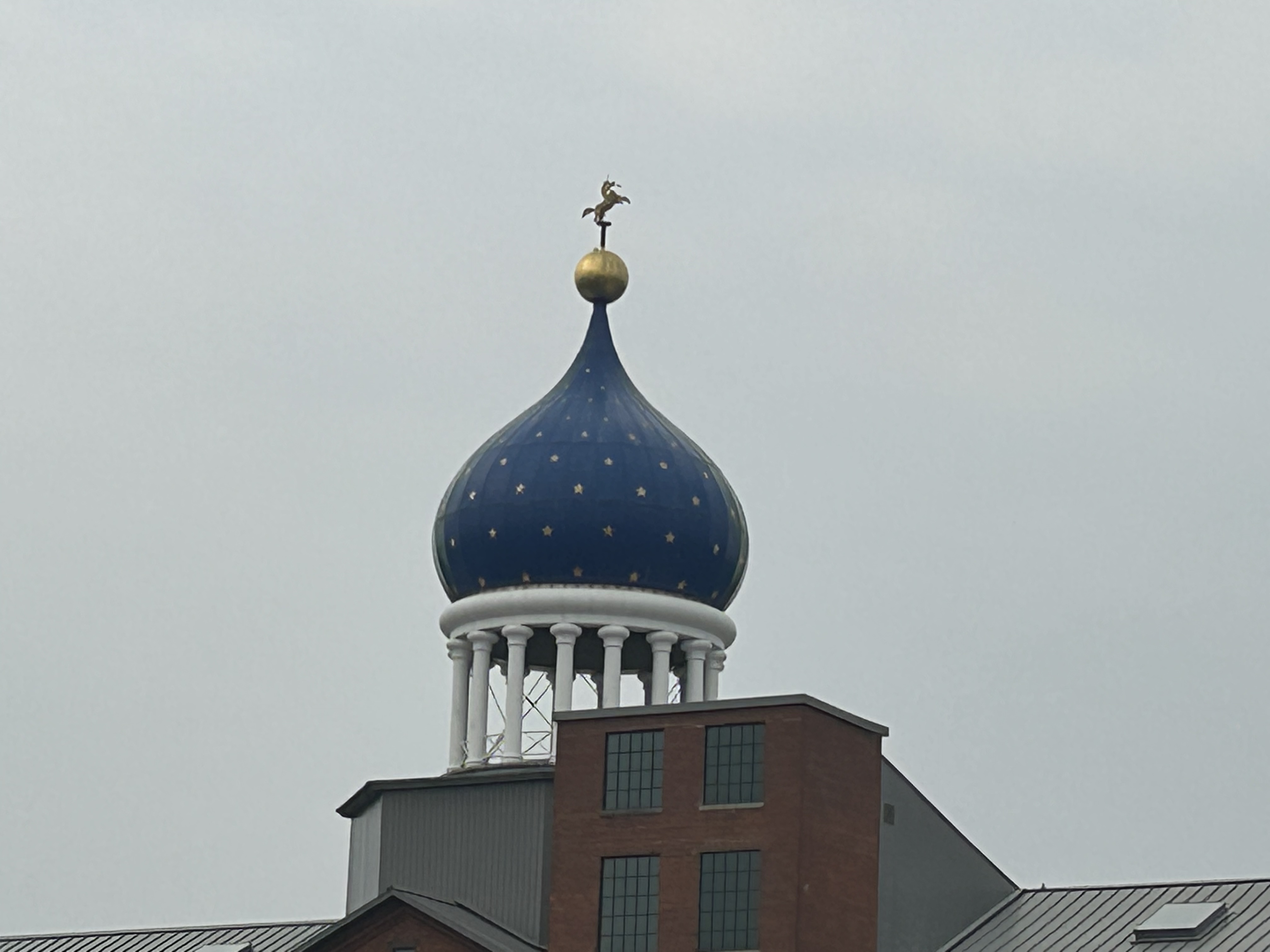
Samuel Colt sold a lot of guns to Russia, one of their first major clients, so he built the original iconic onion dome that defines the Hartford CT skyline (the one above is a replacement after a fire). You may notice the “rampant colt” on the top, which symbolizes loyalty, as the animal is breaking a lance to defend its fallen knight. The dome is actually one reason for the delay in converting the park to full status, as leaseholders control access to the dome which the park service needs. The two original brick buildings that the park service owns are in dire need of restoration too. There’s a nice walk through the large recreational Colt park to find his estranged brother’s house and through the company town to a church commissioned by the widow Elizabeth Colt, who ran the company for decades. Until this park opens officially, you may want to visit the Springfield Armory to learn more about the development of guns in the Connecticut River Valley.
These are the Quantico Falls, within this massive 16,000 acre Virginia park with CCC campgrounds. There are remnants of natives, freed slaves and farmers ‘displaced’—evicted by the government—during the Depression. In WWII Wild Bill Donovan took over the park to train his OSS spies in the forest. You’ve probably heard of the nearby Marine & FBI bases. Now, the park is popular for camping, hiking, biking and orienteering.
Christmas night 1776 was a bad one. The Revolution was going poorly for the Americans. The British Navy had taken New York City and controlled the whole area. Some American militiamen were heading home, and the British had reason to believe they would win the war soon. Their regular army left Hessian mercenaries in charge of camps along the Delaware, but as the river was filled with dangerous ice flows, patrols were limited. Not that the German soldiers were drunk, mind you. They were professionals, and they were keeping careful watch, despite the storm.
George Washington wasn’t going to let the weather or river stop him. He wrote ‘Victory or Death’, and loaded his 2,400 troops and 18 cannon into sturdy river cargo boats which made repeated trips across the Delaware River (see photo) from Pennsylvania on the right to New Jersey on the left. Two other crossings had been aborted, and the storm was getting worse. It took longer than expected, but by around 4 am, his troops (and horses) climbed the hill and began marching south towards Trenton. The Hessians fought back, and the British reinforced. But Washington won three battles, two in Trenton and one in Princeton, before making camp in the mountains. The war would not be over as soon as everyone thought.
The New Jersey side of the crossing has a large wooded park on a hill, with trails and a small museum with some interesting artifacts. The Pennsylvania side has a museum, replica boats and some historic buildings along the river. I took the photo above from the narrow bridge as I walked between them. The lower section of the Delaware is either a full park unit or an affiliated multi-partner site, depending on who you ask or which website you check. There are roads and a fair amount of development on both sides, so it’s not particularly wild or even scenic in stretches. The designation seems aspirational to me. But our rivers do need more protection, and there are many interesting historic places on both sides of the river. Congress did authorize parts of the lower Delaware as ‘wild & scenic’ in 2000, but if you paddled it, you’d go in and out of those every few miles. There are no federal facilities, so although the park website calls it a ‘unit’, I don’t think it counts towards 424. Still, just in case I’m wrong, and out of respect for our first Commander in Chief, I humbly post.
In August of 1814, the British launched a two-pronged attack on our nation’s Capital: a naval raid up the Potomac and an overland raid from the Chesapeake. Due to shallow water the land troops reached Washington DC first. DC was poorly defended, as Secretary of War Armstrong had decided that the Capital was not of strategic value?!? The British burned the White House and many other government buildings. Before the fleet reached the original fort here (Warburton), Captain Dyson decided to spike the guns, blow up the magazine and retreat?!? The British fleet sailed right past the smoldering ruin and took Alexandria. In September, the British fleet sailed to Baltimore where they had a different experience with Fort McHenry.
The much larger Fort Washington was built after the war on the old fort’s foundations, and it has a commanding view of the Potomac where Piscataway Creek enters. This fort’s guns were updated several times, but they were not used in battle as the Union maintained naval superiority during the Civil War. Due to fears that Maryland might change sides and give this fort to the Confederacy, additional forts were built around DC. The walk down to the lighthouse (above center) is pretty.
This park was founded to protect the view across the Potomac from Mount Vernon, so visitors there can see the Maryland shore as it appeared to George & Martha Washington. Now it is the site of a middle-class Colonial farm, an ecosystem farm, a demonstration farm, a marsh boardwalk, a sacred Native American burial ground, docks and a kayak launch. The park service leases the land to partners and co-manages it. The tobacco barn above and nearby buildings pre-date the USA, and there is actual tobacco drying inside. The crops are heirloom, and the animals are 18th century breeds. While beautiful and interesting, it appears most of the visitors are local hikers, fishermen, school groups and dog walkers. Iridescent barn swallows dart all around the boardwalk. The views are lovelier close up.
[Update, due to the recent tragic demolition of the above Jackie Kennedy garden, the colonnade on the right and the East Wing, tours have been suspended until sometime in 2026 or later.]
I took the tour! After standing outside the fence last year, I finally got organized and made a reservation. You need to make reservations through your Congressperson—even if you didn’t vote for them—to request a date within 3 weeks to 3 months in advance. Tours are currently given Tuesday through Saturday mornings, and they’re very popular. I requested any date in April, and they said no, the first available was in May. They confirm 2-3 weeks before. So, I changed my schedule, and a few months later, I’m walking through the East Portico, through the historic red, green, blue and other historic rooms. The best experience is to download the WHExperience App from the Historical Society and get all the details on your phone. The staff inside will answer questions and reveal a few fascinating stories, but they’re also there to make sure people behave. It’s difficult to imagine a more historic site, since the residents literally make history. I enjoyed both the recent photographs and the historic portraits.
If you can’t get a reservation, you can peer through the fence on either the north or south sides—pedestrians are once again allowed to walk up to the fence to take a decent photo. There is also a visitor center (no reservations needed) near the East Gate with a movie, detailed model and exhibits. Oh, and my sister reminded me to always put the park site location in my posts—she’s in Real Estate and location is very important—, so, the White House is located at 1600 Pennsylvania Ave, NW, in Washington DC. Thanks!
This DC park is managed by Capital Parks East, which includes the long riverside park and 12 mile bike trail along the Anacostia. In summer, this is likely the prettiest DC park, when the water lilies are in bloom. Once a commercial enterprise, the community now volunteers to maintain this beautiful “oasis in the city”, and I saw a dozen folks knee deep in the mud digging around among the roots. Outside of the water lily ponds, there are wetlands accessible by boardwalk. I saw a Great Blue Heron, sandpipers and various warblers, and the water is also full of life.
That this park exists is a bit miraculous. The area was a failed tobacco plantation, a failed port, a failed reclamation project, a failed industrial zone, a failed housing development, a failed country club, a dump, and a Hooverville of WWI veterans who were removed by the Army after asking for their promised bonus, which failed.
The water lily business was the most successful, with species from all over the world. Civil War veteran WB Shaw and his daughter Helen Fowler ran it in the ‘20s and ‘30s. The wetlands are now seen as critical habitats that keep the river healthy. Freshwater mussels now clean what was once a terribly polluted river. African American community leaders like Rhuedine Davis and Walter McDowney recreated the gardens and taught kids to love nature’s beauty. We owe them all a great debt.
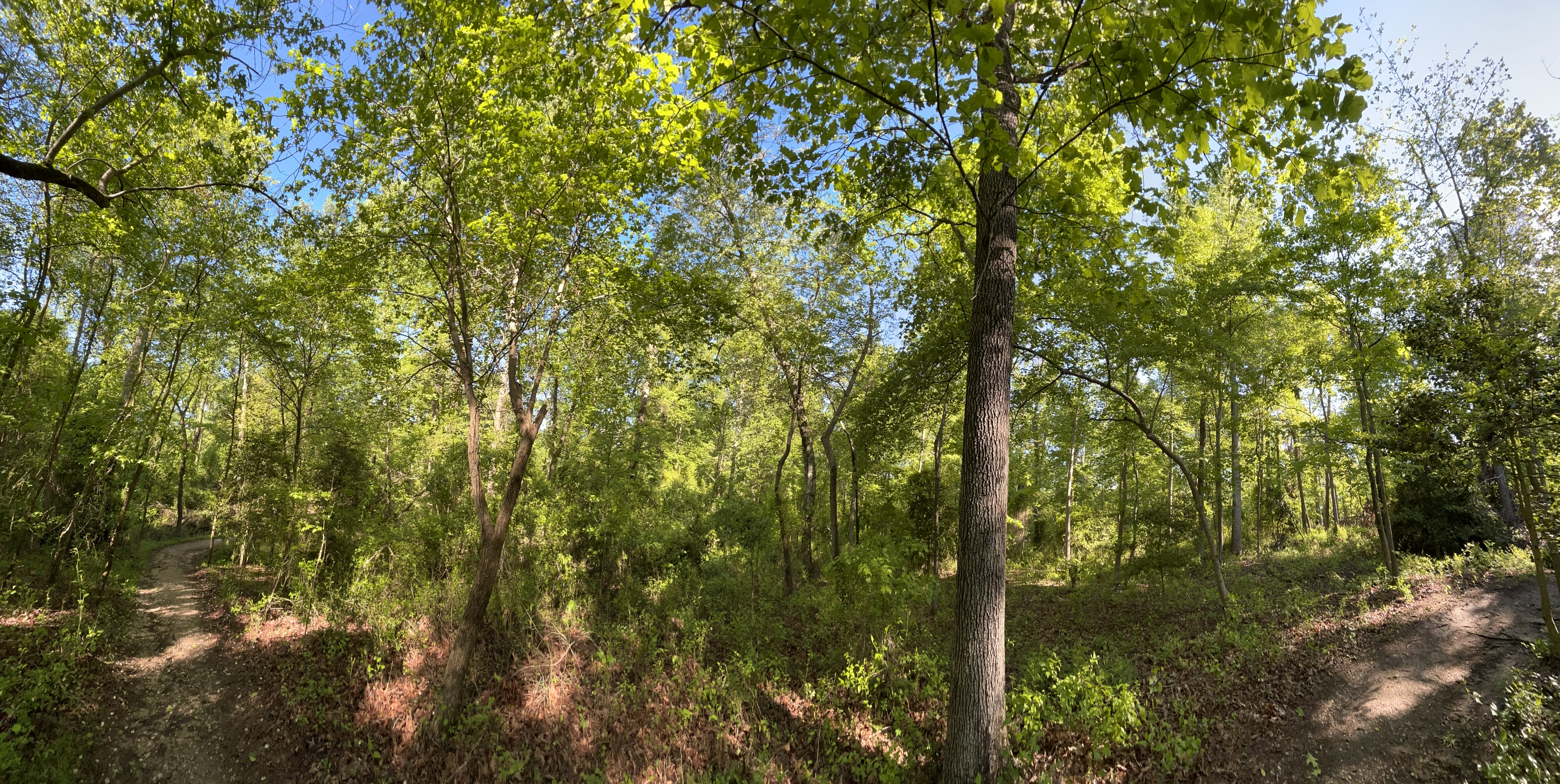
This pretty, wooded park lies within the beltway just across the DC border in Maryland. The photo above is on the Dogwood trail. There are 172 camp sites open year round, and it’s only 10 miles or so to the Washington Monument. The nearest Metro is UMD/ College Park, about a 2 mile walk. Due to the unusually high winds recently, there were a number of downed trees, but the trails were all clear.
Reagan lived here in Dixon, Illinois, 100 years ago, from 1920 to 1924, as a young boy. Ronnie’s Mother encouraged him to act in church plays, which led to his career in Hollywood, his nick-name ‘the Gipper’ for his role in a movie about Notre Dame football star Knute Rockne, to becoming the President of the Screen Actors Guild and honing a skill set that served him well in politics.
Reagan’s economic policies of cutting top tax rates and deregulation contributed to an immediate economic boom and later increased inequality. Domestically, he favored harsh treatment of drug dealers, although his CIA was secretly involved in the Colombian drug trade which sold crack in US cities. His foreign policies followed his anti-communist views forged in Hollywood during the Blacklist days and contributed to the collapse of the Soviet Union as well as to the rise of some anti-Democratic regimes, especially in Latin America. Many of his team’s efforts were covert, including asking Iran not to release the hostages until Reagan took office, supporting the Mujahideen, etc. Reagan was extremely popular, both when winning a landslide reelection and in polls after leaving office. But there was definitely a dark side to his administration, as seen in the callous disregard for the victims of the AIDS epidemic, which contributed to thousands of deaths.
For many years a private foundation has given free tours here, declining to become an official park site, due to Reagan’s philosophy that “government is the problem”. After the death of their main benefactor, the foundation was reportedly ready to sell the property to the National Park Service, which is the last step needed for it to become an official park site. In 2021, the Young America Foundation, which also runs Reagan’s ranch in California, purchased the property. There are persistent unfounded rumors that Republican Presidents are denied as many park sites as Democratic Presidents, but the truth is that often private foundations choose to manage Republican Presidential sites, either out of disapproval of government management or out of a desire to keep control over the President’s legacy and present their version of the administration’s history. While I made it to his home in time for the last tour of the week, unfortunately, it was closed for a middle school event. Oh well, at least I made it to his door, while touring many historic homes on this trip.
Best paddling day yet! I took the Cooks Lake to Scatterman Paddling Trail, and the middle section is like a slalom through the trees. A local canoe guide told me about the old trees above, several of which are over a hundred and fifty years old. The loop is about 5 miles and goes up through some low current dead ends and back downstream via the Naches River, so it’s not a difficult paddle. The only trick is to explore the flat water, try to get a close up of the snapping turtles before they jump back in the water and try to quietly sneak up on the wood ducks before they take flight. Blue skies, green leaves and muddy water. Glorious.
After so much frustration trying to kayak the Rio Grande, this has been a slice of paradise in the Big Thicket, supported by another excellent Texas State Park (Village Creek) and an exceptional local restaurant (Tia Juanita’s Fish Camp). Remind me to winter here for the rest of my life. My main suggestion is to budget more time for this area. There are roughly eight different sections of Big Thicket to explore, miles of paddling trails and nearby state parks including beaches. My final Texas park unit is one of my favorite parks for paddling.




 Zero Carbon Travel