Grand Canyon National Park

The white peak on top of the center red rock is Mount Hayden, 5000’ above the canyon floor, viewed from Point Imperial, North Rim, looking east. The Colorado River is down there somewhere, along with the Painted Desert and Marble Canyon to the left. Everyone should visit the Grand Canyon, and the grandest, widest and most awe inspiring views are from the popular South Rim. I took my family there years ago, and I’ll never forget ‘Ooh, Aah’ point, which was so windy that the name required exclamation marks of terror.

But the North Rim is more conducive to contemplation than the South Rim, because instead of development and crowds, there are bright yellow and gold Aspen forests, meadows and quieter vistas. The yellow Cliffrose was in bloom along the trail, and a large coyote crossed the road in front of me. Angels Window makes for a nice photo and has a great overlook on top. Bright Angel Point is just a few steps from the Grand Canyon Lodge, and it is one of several overlooks nearby that have spectacular panoramic views.

The season is shorter on the higher altitude North Rim, but fall is beautiful. There was wildfire damage and some smoldering burns in the Kaibab Forest, but overall the forests still look healthy. The ranger gave a talk trying to explain how difficult it is for them to respond to climate change locally, let alone nationally or globally. Logistically, my long range EV can visit the North Rim from Page AZ, where there’s a supercharger, round trip, but getting all the way out to Cape Royal would have been too far. The nearest destination chargers are at Cliff Dwellers Lodge at Lees Ferry (mean steak & eggs) and at Days Inn in Kanab Utah. I used both and continued northwest.

Mesa Verde National Park

This is Balcony House, which requires a reserved ticket, climbing cliff-side ladders and crawling though a short tunnel. It’s worth it. The dwelling is named for the intact, original balcony on the right side of the photo under two upper story windows. At other cliff dwellings across the southwest, typically only the beams remain, like those on the wall to the far left. This dwelling is also unusual for facing northeast, lacking fires in this section, and for the large flat floor with a low wall at the edge of the cliff. This place was used for important gatherings, but not in winter.

Mesa Verde is a huge, green high plateau, so start at Park Point Overlook, where you can see from Colorado’s snow-capped peaks to Shiprock, which I first saw after visiting Canyon de Chelly. From up here, you get a sense of the region as one greater community of interrelated tribes, trading and interacting with one another frequently, and not four separate arbitrarily bounded states.

This is my favorite park for cliff dwellings, so see as many as you can. The Cliff Palace is the largest in North America (reserve a ticket), and while you only walk along the bottom edge, you do get close enough to appreciate its extent and architecture. Spruce Tree House is only visible from an overlook, Long House was booked, and Step House was perfect to visit on my own first thing in the morning. The ranger talks are extremely informative, even after visiting many other Native American sites.

Finally, slow down here. The mesa has basically no Wi-Fi or cell signal (save a photo of your tickets). There are bus loads of tourists, so the few places to eat are crowded (Metate needs reservations). The Far View Lodge rooms don’t have TV, and it can be a peaceful place, if you try. My laptop finally stopped working, so I ended up sitting outside, saw a rabbit and thought long enough to reconsider my past and future. This World Heritage Site has already seen more recent devastating wildfires than they have cliff dwelling sites open to visit, so these moments in places like this are rare and diminishing rapidly.

Black Canyon of the Gunnison National Park

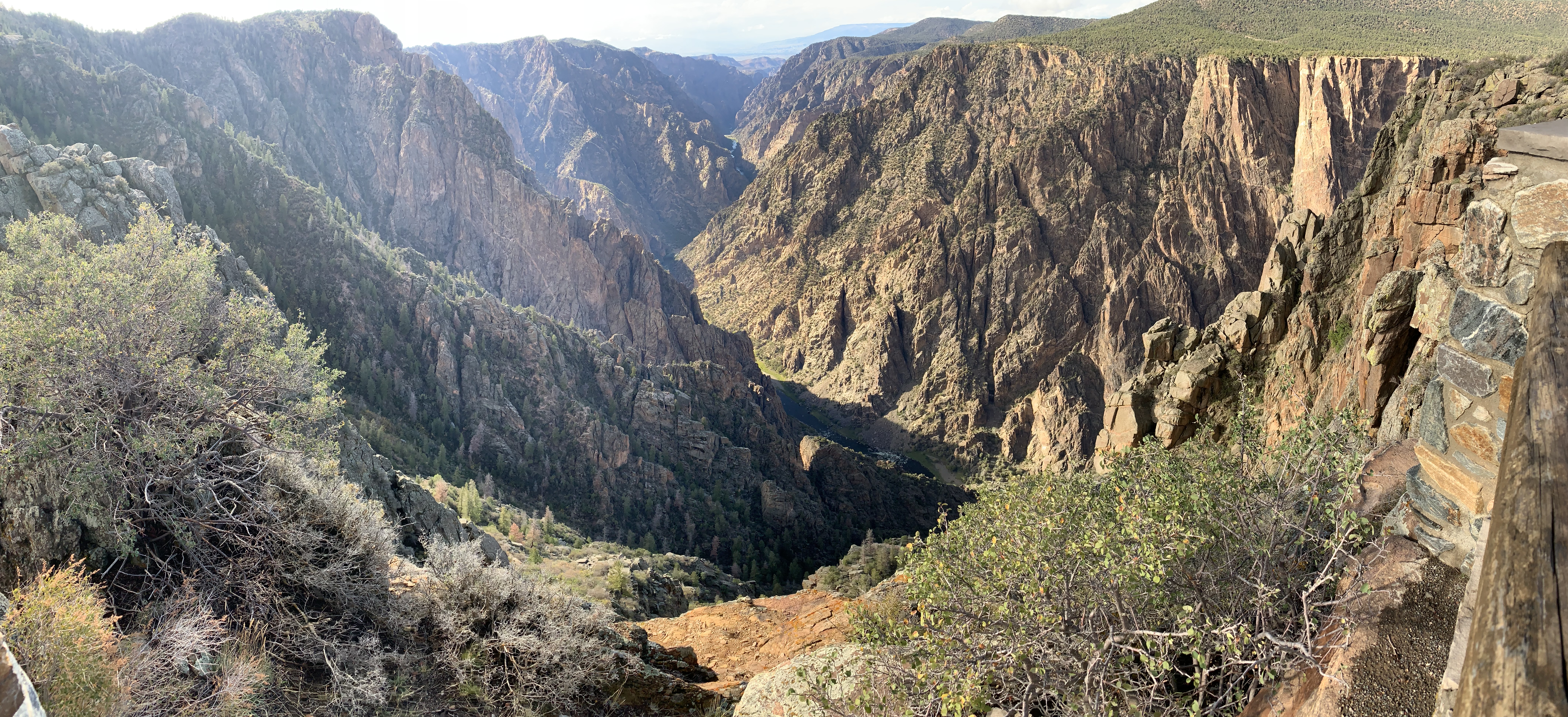
This view is looking downstream from Sunset View overlook, but the upstream view is blacker, steeper and narrower. The canyon there is over twice as deep (2250’) as it is wide at the top. The Sawatch Range, Elk Mountains and San Juan Mountains all feed into the canyon in spring. There are half a dozen good overlooks on the South Rim to peer down into the canyon, and some cause vertigo, as the cliffs are near vertical drops from the rim. The North Rim is a 2 hour remote drive, has fewer overlooks, a campground and horseback riding.

The South Rim has a campground and a visitor center, and is only steps from Gunnison Point, which may have the best view down into the canyon, although my photography skills were insufficient. The short hiking trails along the rim, down into the canyon (a little) and to the high point to the left above each provide a different view into the geologic depths.

The East Portal campground is technically in Curecanti NRA and is accessed by a steep road down to the Gunnison River (barely visible above) near the upstream dam. I’ll have to come back. Since I arrived here in October, there was already snow falling in the mountain pass on 50 to the east. The road was also being repaired after some fearsome rockslides. On the plus side, the drive through the mountains included bright fall foliage that contrasted with the black rocks. Montrose makes a convenient spot to charge, and it has two well-reviewed Himalayan restaurants.

Rocky Mountain National Park

Rocky was not what I expected. The strict timed entry system limits access to two hour windows and sells out within minutes after 5 pm the day prior, unless you reserve up to two months in advance in releases on the first of each month or unless you book a campground. The headwaters of the Colorado River are lovely, but not a huge source of water for over 40 million people downstream. The wildfires have been obviously devastating, especially in the western side of the park. The unique alpine landscape along the trail ridge road was smooth and barren, with low mats of tiny waxy hairy plants and, although I didn’t see any, only one species of bird, the Ptarmigan, tough enough to live there year round. Amid hail and high winds I failed at photography along the Trail Ridge Road over 12,000’, but the views were desolate, stormy and magnificent. Only after descending down to Upper Beaver Meadows did I manage to photograph a herd of elk and listen to the bull elk bugle.

In the line of cars, I keenly felt how masses of humans put pressure on fragile, limited nature. There were far more elk photographers and cars than elk. Even in unpleasant weather near the end of the season with controlled entry, every parking lot was full, and on the short trails I saw far more hikers than total wildlife. The best experience might be to book a summer campground at Bear Lake and try to hike into the backcountry. Park visitors love wildlife, but we’re overwhelming all the other species and increasingly encroaching on their last refuges. The towns surrounding the park are packed with galleries, gift shops and mini golf. Skiers fly into Colorado resorts and rent gas guzzling SUV’s, while the Congresswoman from western Colorado denies that the climate crisis exists. We are on the wrong path.

Great Basin National Park

First, if you can’t get a reservation in time to visit Lehman Caves, just visit the park anyway. I took the virtual cave tour, and, I suspect that Timpanogos in Utah is better and less damaged. Besides, the park isn’t a cave park, it’s the highlight of the Great Basin area, which includes most of Nevada, western Utah and parts of three other states, and has a glacial basin of its own at the top of a 13,500 foot mountain.

Second, stop at Mather Overlook to admire the views and fall foliage of yellow and orange Aspen amid the dark green conifers. There’s a bronze model there that shows the structure of the basin, which is helpful orientation, since it is a long winding road.

Third, understand that the glacier here, “the only glacier in Nevada”, is gone. In theory, there might be some subterranean ice under some of the rocks for another couple years, but climate change has wiped this glacier off the face of the earth. The park maps showing a “rock glacier” in white are out of date. Any snow you see up there is seasonal.

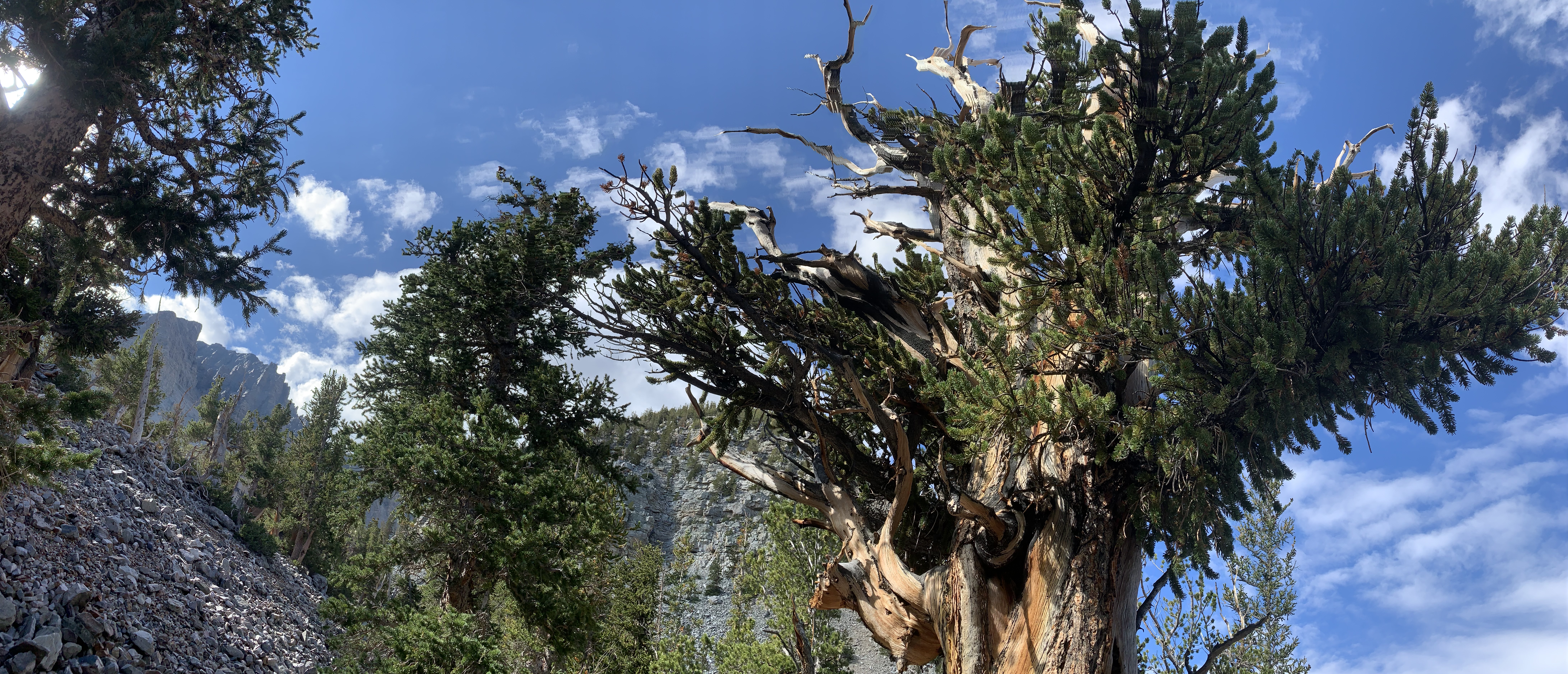
Fourth, take the Glacier Trail anyway, since it goes through the Bristlecone Pine grove and up into the basin. If you only get as far as the grove (2.8 miles roundtrip), that’s what I felt was the highlight of the park. The other two Bristlecone Pine groves are in very remote areas of the park. There are also some trails to pretty alpine lakes, but be careful, as many of the hikes are over 10,000 feet. Spending the night at altitude can help, as well as give you lovely views of the Milky Way.

Finally, this is my favorite park for old trees. The Bristlecone Pine, far from merely eking out a bleak minimal survival, is a gold resinous Adonis, shining in the bright Alpine sun, with luxurious thickly packed bright green bristles. We don’t know how long they can live. One that was removed from here in 1964 was over 4,900 years old. Unfortunately, climate change will likely make them extinct, as other trees will grow at higher elevations, crowding them and subjecting them to more wildfire damage.

Gateway Arch National Park

This park is the lynchpin of the nation. If it were removed, the whole country would fall apart.

OK, maybe not, but it is an important spot. The domed courthouse above heard the infamous Dred Scott case, which was used by the Supreme Court to take the country backwards, deny people their basic rights and help spark the Civil War. (How times change). The arch represents a gateway to western expansion, facilitated by Jefferson’s Louisiana Purchase in 1803 and subsequently explored by Lewis & Clark from here.

Many factors came together for the territory to wind up as ~12 US states. France traded with the Native Americans who lived there, and all along the rivers there were French communities, from Pittsburgh to St Louis and from Quebec to New Orleans. Shortly before we became independent, Britain declared war on France, used their ships to take Quebec and blockaded Spain from their colonies, and in exchange for peace, they took Canada and Florida, while France kept Haiti and Spain wound up with the Louisiana territory.

That peace treaty didn’t last long. The British heavily taxed the colonists to pay for that war (bad idea), the US declared independence (and won), the slaves in Haiti revolted (and won), Spain secretly gave Louisiana back to France, and France & Spain were preparing to invade England (and lose). Amidst this chaos, Napoleon wanted cash more than colonies that he couldn’t control, and Jefferson wanted to secure the Mississippi and expand our new country. Both sides approached each other to make a deal.

Theodore Roosevelt National Park

Certainly the highlight of my trip, the three units are connected by the Little Missouri River, which is the south unit oxbow on the left. The south unit also has bison, wild horses, a painted canyon, petrified logs, a prairie dog town, badlands, a replica of Teddy’s cabin, a ranch, camping, and lots more. The north unit has even better oxbow views on one of the best hikes I’ve ever done: Caprock Coulee 4 miles. Even the tiny Elkhorn Ranch unit, hemmed in by cattle fences and pumpjacks, had a pair of whooping cranes to amaze me. I’m honestly struggling for superlatives. Teddy used the phrase “grim beauty” which gets at the serious nature of the park. This is one of my favorite national parks. Click here for more Teddy Roosevelt sites.

I would like to spend a week up here and ride a horse, but I’m already in Montana. For EV travelers who want to see all 3 units, I recommend charging overnight in state campgrounds before & after. There’s one next to the south unit and another not too far from the north.

Badlands National Park

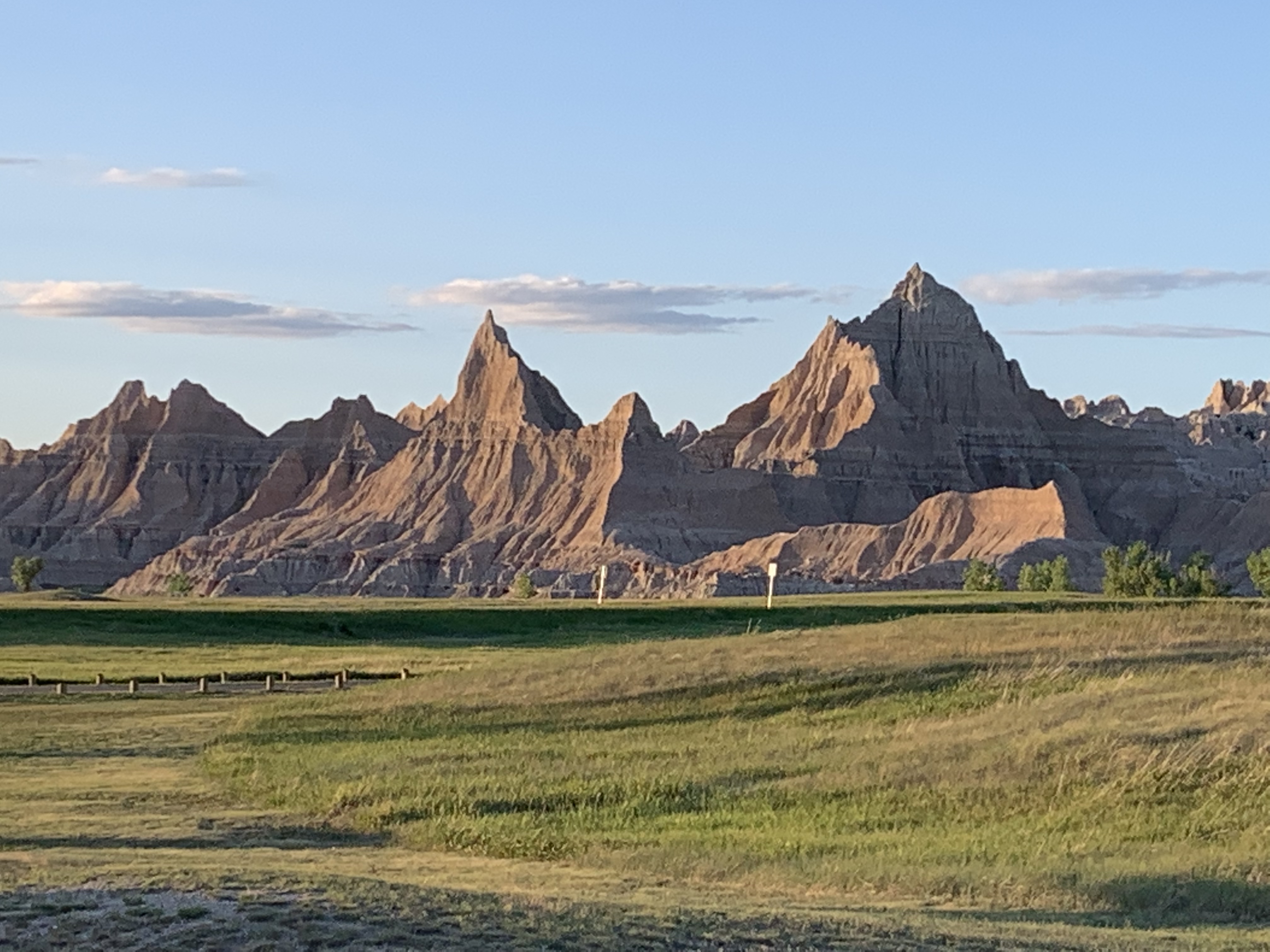
I took the photo just a minute after arriving at Cedar Pass campground. Much of the “original badlands” scenery is down in canyons, but these peaks are more photogenic. The long loop road is worth it, and the park allows even off-trail scrambling. The ranger talk was excellent, and I learned that the town of Wall (and famous Wall Drug Store) is named after the barrier that the park’s landscape presents to travel.

Wind Cave National Park

The park is most famous for containing much of the world’s boxworks, pictured, which is the ‘mortar’ left over after most of the rock dissolved. The tour included a recitation of the origin myth of the Lakota people and the bison, since the cave is a central and sacred part of the story. The neighboring Custer State Park is a great place to see bison today, and they often wander across the road.

Since I was inspired here by an obscure fact about forest fire frequency, here’s another rant. There’s a popular misconception that park service mismanagement or ”fire suppression” caused many forests to overfill with fuel, creating conditions for today’s wildfires. Smokey the Bear encouraged people not to smoke or leave campfires unattended, but neither he nor the forest service has ever had the ability to put out a naturally occurring wildfire. Even the best efforts today can merely partially contain wildfires to try to protect structures.

So why did the fuel build up? Well, that’s because farmers, ranchers and timbermen cut down all the surrounding forests. Many of the remaining forests are isolated, so that wildfires that would have entered from neighboring areas stopped. The remedy to restore the natural balance would be to enlarge the forests and regrow the surrounding ecotones or transition zones with native scrub and grassland. Funnily enough, you don’t hear that solution often proposed. Instead, folks use farmer, rancher and timberman logic and suggest scheduled burns, like they use on their land. But there’s nothing natural or statistically normal about following a schedule, so the park service, which is the victim here, is left with no choice but to try to maintain forests artificially, which typically results in lower species diversity than the original.

In any case, with climate change, even using prescribed burns won’t save forests from increased bug damage, warmer winters, hotter summers, drier air, longer wildfire seasons, hotter fires and increased wind. I mention this because there are nearby areas where forests aren’t regrowing, since the extremely high temperature of the fire overcooked the soil, killing the microbial life needed to sustain the original trees. We need more accurate and truthful thinking about fires if we are going to save species in the future.

Great Smoky Mountains National Park

This little guy walked out on the trail through the meadows in Cades Cove. There’s a beautiful loop drive around there with an old mill, horses playing and a spectacular natural environment. Nice campground too. The road closes to traffic some days, but there are miles of trails, creeks, a lake and mountains to explore by foot, horseback, boat or bicycle. This is one of the most visited parks, one of my favorites for wildlife, a World Heritage Site and a UN biosphere, but I think most people just pass through quickly. My last trip here, I drove through far too quickly, without any idea what I was missing. Just lovely.