The cloaked inhabitants can’t be seen on Wizard Island under Watchman’s Overlook above, nor can the massive moss beds in our nation’s deepest lake. But there’s plenty of evidence of volcanic activity, including lava flows, cinder cones and the caldera itself. The lake is restricted, but there are a few summer boat tours from Cleetwood Cove. The rim road on the far left side is often under construction, but there are many trails and overlooks elsewhere including from the Rim Village off to the right. Due to snow, the Scenic Rim Drive is usually closed from November through June, if not longer. The outside of the mountain is also worth exploring, such as a one mile hike through Godfrey’s Glen in the south. Signs of 2017 wildfires are seen near the north entrance, and the forests of Oregon are getting hotter and drier due to carbon pollution.
I’m finally catching up on my summer travel backlog, just California national parks for the remaining Mondays of the year. Thursday posts will also continue eclectically.
Even though the Hoh Rain Forest is on the far side of the park from Seattle, it’s popular in July, so I watched an otter playing in the water for half an hour while waiting my turn to drive through the gate to look for parking. (A parking map at the gate would save everyone time). The Hall of Mosses Trail above is easily hiked from the visitor center, and it’s impressive and definitely worth the trip. Several of the trees appear to be 1000 years old, and the streams are clear from spring water, where I saw tiny salmon among the bright green watercress.
There are some signs that the increased heat from carbon pollution is damaging some of the mosses, and while the overall annual precipitation has remained the same, it’s more concentrated in heavy downpours and less in the misty fog-drip that these sensitive plants require. The glaciers are also disappearing rapidly and will disappear completely in a few decades or less, severely impacting all the downstream ecosystems. Still, it’s my favorite park for moss.
Of course, Olympic also has mountains, including Hurricane Ridge and Mount Olympus, which feeds the Hoh and Queets Rivers. There’s a Hot Springs resort at Sol Duc and boating at Lake Crescent. The Olympic Peninsula also has Native American Reservations which help manage the coastal wilderness, wildlife refuge and marine sanctuary. For me, their crown jewel is their large temperate rainforest, but the other areas are also stunning. Some artists are painting the glaciers before they melt, but wouldn’t it be better if we all did our part to reduce our carbon footprints?
Panorama Point above is about 1,500’ above the Paradise parking lot, halfway along the 5 mile ‘strenuous’ Skyline loop trail, just under halfway up the mountain. In July, there were waterfalls, snow on sections of the trail, wildflowers and marmots. Mts St Helens, Adams & Hood all visible in the distance. The northwest and southeast corners of the park both have old growth forests, along the Carbon River Rainforest—which is open for bicycling on the first few miles—and the Ohanapecosh River Grove of the Patriarchs Trails respectively. I understand why Muir extolled Rainier as the best of the volcanic peaks in this area.
“Of all the fire mountains which like beacons, once blazed along the Pacific Coast, Mount Rainier is the noblest.
John Muir
For me, it’s another return trip after several decades since my brother and sister and I took a hike and a photo up here somewhere. I was pleased to see the forest looking healthy, the clear streams near the top, the glacial gray rivers on the way down and the blue glacial lakes below, as I remember. Of course, when the rapidly receding glaciers disappear, the whole ecology will be severely disrupted. But for now, I’m happy to visit a place like this when the rest of the country is under a carbon fueled heat dome.
This photo looks down from the High Bridge at the end of the road 11 miles from Stehekin (rent an e-bike) on Lake Chelan. Here the bridge connects to the Pacific Crest Trail which cuts northeast across the southern wilderness on the last leg to Canada. The northern wilderness section of the multi-park complex is across the Skagit River and west of Ross Lake up to the Canadian border.
Both the north and south roadless wilderness areas have many high peaks with receding glaciers, so the hiking isn’t easy. And the wildlife includes black bears, cougars, gray wolves and grizzly bears. Careless campers closed one campsite by leaving food for bears to find, and another was closed due to grizzlies fighting over a nearby carcass. Being long of tooth and short of courage, I just hiked the short Agnes Gorge Trail on the edge of the wilderness to catch some more glimpses of rushing Stehekin River.
Wilderness, of course, has now ended. Now that our carbon pollution is changing the climate globally, there is nowhere on earth unaffected by humans. With that change comes responsibility. Since we no longer allow nature to keep itself in equilibrium, we must act to restore balance. We broke it, so now we own it. The park has increasingly fierce wildfires, which we exacerbated. So the extra damage is our fault, and we must fix it.
I have dreamed of Voyageurs since childhood. Imagine, a park dedicated to canoeists, fur trappers, traders and explorers, with remote boat-in campsites along the Canadian border in Minnesota! The Kabetogama Peninsula is almost an island with only a short portage around some rapids connecting it to the mainland. To the north lies the large Rainy Lake. Kabetogama, Namakan, Sand Point & Crane Lakes lie to the south, with three visitor centers open in summer.
Time limited, I focused on Ash River and took a tour boat out to Kettle Falls, where the southern lakes flow north on their way to the Arctic Ocean. There’s an old hotel there with a wide porch & lawn for enjoying sandwiches & summer sun. There’s another busier portage here, along with a dam and one of the few places in the states where you look south to see Canada. The highlight of the tour for me was going through the islands and stopping briefly at an old resort (see photo).
The park is on the old trading route from Montreal to Great Slave Lake all along the southern edge of the Canadian Shield. Glaciers pushed most layers of soil and rocks south, revealing some of the oldest bedrock in the US at 2.8 billion years ago. The Ojibwe are the traditional gatekeepers of the lands northwest of the Great Lakes. After the Voyageurs, or French fur traders, came miners, lumberjacks, and eventually a few hearty resort owners tried living here. Huge blocks of ice were cut and dragged out of the lake and stored through summer. Logging was massive and filled the coves with timber to be loaded on rail.
Now the forests have begun regrowing, and some wildlife, like elk, have mostly moved north due to climate change. I saw maybe a dozen bald eagles total, including juveniles flying high. The few remaining moose are rarely seen, preferring the swampiest areas far from trails.
I hiked a scenic trail out to Kabetogama Lake Overlook from the Ash River Visitor Center, and there are a couple of other boat tours, one which goes to a rocky garden. I stayed in Chisholm to be near a CCS charger (Combo Adapter needed) and a delicious ‘supper club’ called Valentini’s (order the Walleye). The biggest improvement opportunity would be to have more electric vehicles. There are a lot of noisy gas-powered fishing boats, some being towed by large houseboats. Sound carries far across the lakes, so they definitely detract from the natural setting (and pollute with carbon). Houseboats, slow-moving, sitting in the sun for long periods with large flat roofs, would convert well to solar-electric.
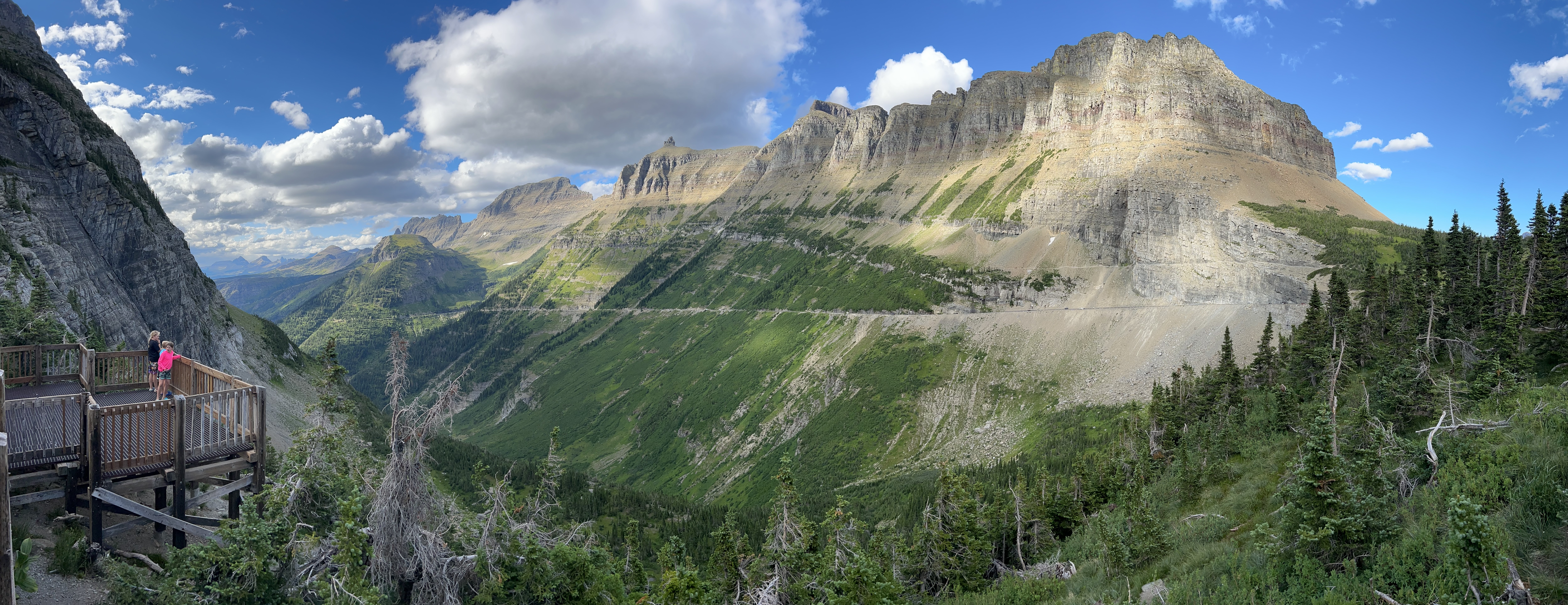
The horizontal line across the Garden Wall on the other side of the valley is the Going-to-the Sun Road, which I finally drove—3rd time’s the charm. This year the dramatically scenic road opened on 13 June with little ice & snow visible in July. Just over the wall in Many Glacier, old photos show the many large glaciers are now very small, rapidly melting glaciers. My son and I rode horseback up in 2018, and the area should be renamed Many Lakes. Combined with its neighbor across the border, Waterton Glacier International Peace Park is still a UNESCO World Heritage Site, despite the obvious melting problem.
Melting ice and glaciers are one of the tipping points that will flip our Climate Crisis into a catastrophe. Consider the Arctic ice cap. Every year recently, the multi-year ice has been shrinking at an accelerating rate. Eventually, the ice will disappear in summer. Then the same energy that currently raises ocean surface temperatures by 1° will raise it by a multiple of that amount. There are two reasons for that. First, the white ice will no longer reflect the sun. Second, the existing ice will no longer be there to act as a temperature break. When you boil water with ice, it takes something like three times the energy as water without ice, because most of the energy goes into melting the ice first. So, not only is it bad that glacial ice is melting due to flooding and dry rivers in the fall, but once the ice is gone, the surface temperature rise will accelerate much more rapidly. Please, reduce your carbon footprint.
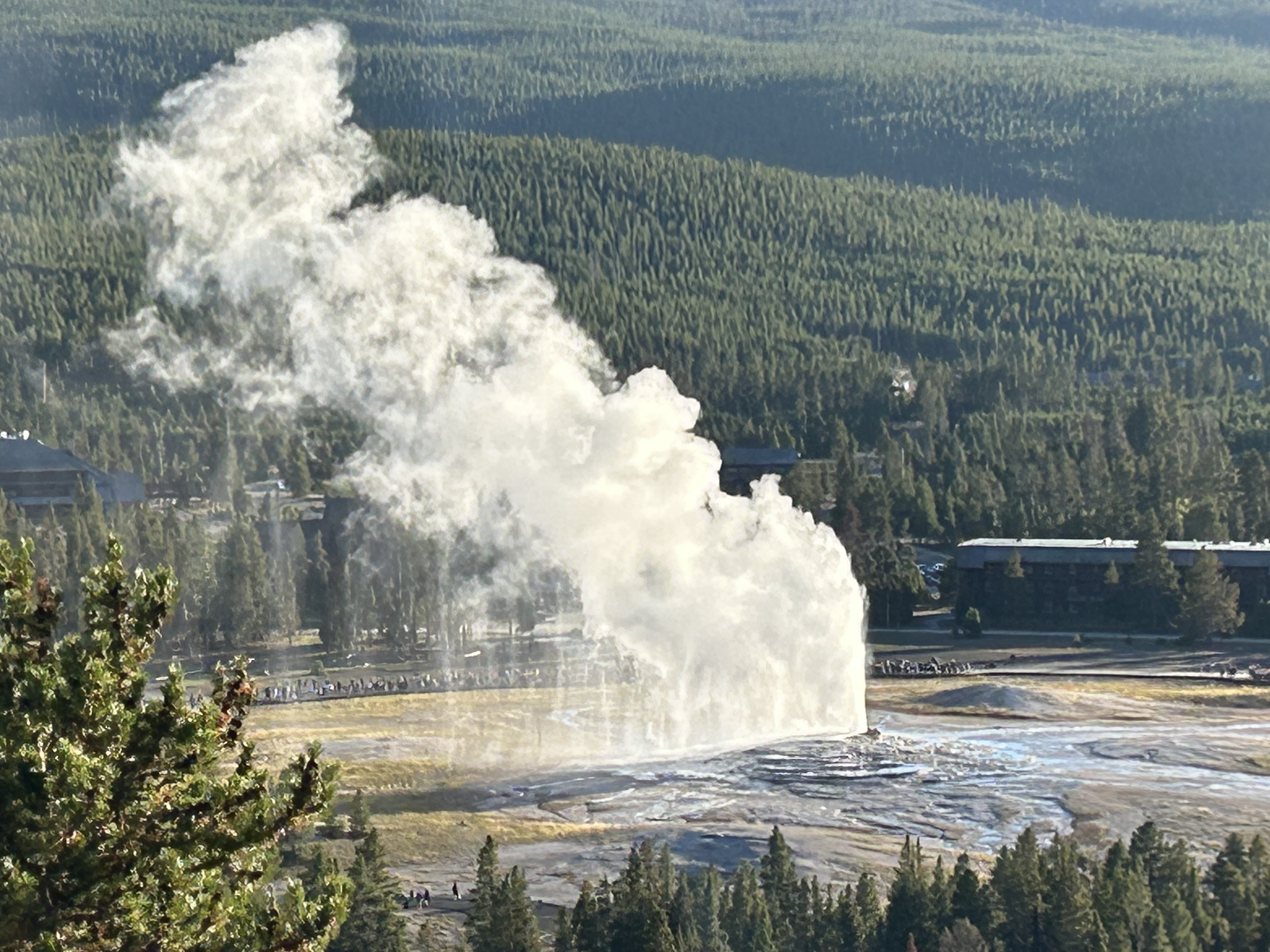
Clockwise from top: Morning Glory pool, Daisy, Grand and Old Faithful geysers.
Most of the world’s geysers are here, near the country’s largest high elevation lake and the headwaters of the longest free-flowing river in the lower 48, in a park bigger than some states. For wildlife alone, this is my favorite national park, plus the geysers are my favorite geologic feature in a park. There’s a lot to see and do, but I’m not going to write more about it. Come see for yourself.
Oxbow Bend (above) is popular at sunrise as wildlife gathers in the coils of the Snake River and the light hits the Teton Range high on the right. Owls, a bald eagle, beaver and bugling elk all appeared out of the mist. Elsewhere in the park, pelicans, geese, ducks, osprey and many different small birds, then foxes and a large herd of bison wandered into view. Black bears foraging for hawthorn berries forced a trail detour, but I only saw scat.
Pronghorn migrate from here in Wyoming as far as New Mexico, and the headwaters from the nearby Continental Divide eventually reach the Pacific. This is an important park, ecologically, more than just a great photo stop. Still, the many lakes provide lots of flat hikes with steep mountain backgrounds, and lots of mountain hikes with water vistas. Or you could take the Jenny Lake boat across for even more views. Kayaking is a hassle with the permit & inspection process, and the views are wonderful on scenic drives and trails. Jackson Hole is crowded and expensive now, so look elsewhere for a place to stay.
The bridge over the gorge is huge; it’s one of the highest in the world and the largest single arch bridge in the western hemisphere. I took some nice pictures of it, when I drove the old Fayetteville Station Road and crossed on the old one lane bridge. Some of the commercial raft trips end there, and it’s fun to watch them take their last rapid. The most crowded part of the park is the Canyon Rim Visitor Center near the bridge, where many folks stop to have ice cream or picnic.
But the bridge is not the point of the park. The New River watershed is huge and very old. It starts in North Carolina near the Blue Ridge Parkway, includes the Bluestone and Gauley scenic rivers, and flows up to the Kanawha which is a major tributary into the Ohio River. The photo above shows folks fishing at Sandstone Falls, far upstream of the famous bridge. It’s a lovely spot with plenty of birds, an easy hike and a boardwalk.
The point is that the whole area was ruined by coal mining. This was the land of John Henry, if you know the old song about a railroad tunnel dug here. Now coal is more expensive than renewable energy, and many of the mines here have closed, becoming ‘exhibition mines’—fascinating tour in Beckley—, historic sites or slowly forgotten. A few coal trains still run through the gorge, but the park is now protected and recovering. Tourism generates more income and jobs now, and West Virginia is one of the most beautiful states in the US. The park is proof that we can change and improve. The point is that we can choose to save nature, instead of destroying it, and that it’s never too late to start trying.
Well every Monday morning When the bluebirds begin to sing You can hear John Henry a mile or more You can hear John Henry’s hammer ring, Lord, Lord You can hear John Henry’s hammer ring
Well, Acadia, I’m back! My first National Park visit was here, on Cadillac Mountain at sunrise, some decades ago as a happy camper. We wanted to be the first in the US to see the sunrise, and—assuming nobody was awake on West Quoddy Head a bit further east—we were. This visit, I decided to get a photo before sunset, since I had already done the cold, dark and windy sunrise. Then I had an excellent meal at Geddy’s in Bar Harbor and slept until it was already light.
Acadia, in Maine, has excellent hiking on old carriage trails around ponds and lakes around Mt Desert Island—which refers to an area of bald rocky top mountains, not sandy deserts. Also, there’s kayaking, tide pooling, a pebbly “sandy” beach, bicycling, star gazing and more. The park dates back to 1929, and it’s popular enough that you need to buy a timed-entry ticket online to drive to the mountaintop above. I just pulled over at an overlook, ordered from recreation.gov and drove up. This park inspired me to visit as many national parks as I can, so I’m glad to be back, even if it took me a few decades.