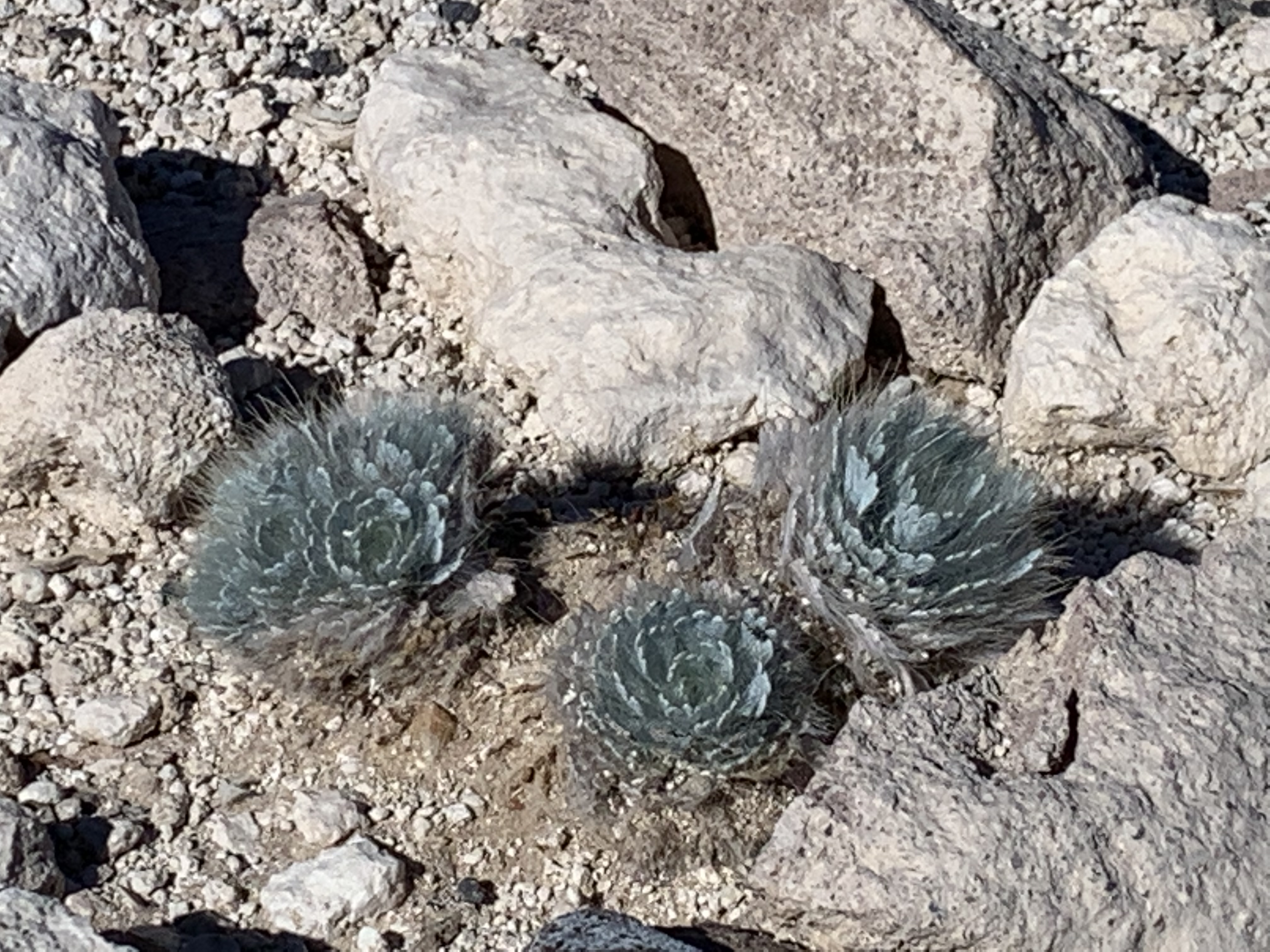
I’m pretty sure these are the endangered Las Vegas Bearpoppy with yellow flowers in spring. Endangered, because Vegas sprawl exceeds monumental. Honestly, there wasn’t much else to see in this “still in planning stage” park site. There’s a temporary 3.25 mile Alicante Loop Trail and parking on North Aliante Parkway at West Moonlight Falls Ave, but the desert is subtle in natural features. There are mats of desert mistletoe in the acacia and mesquite, but they’re parasitic plants best appreciated by the rare silky flycatcher. Despite free dog waste bags and signs, the locals use this place to let their pets run off leash and much of the brush has poop and trash stuck in it. The park extends for miles from North Vegas up 95 northwest, and hopefully they will soon be employing a ranger to protect the park from the residents and pets of the lushly landscaped neighborhoods across the street. Vegas isn’t known for keeping realistic boundaries.
I hiked out here 2 miles round trip to Spectra Point to get a view with Bristlecone Pines, so that you can tell this is not another photo of Bryce. There are a number of Bristlecone Pines here and a few more near Chessmen Ridge Overlook, although they are likely younger than some at Great Basin. By the way, if you’re looking for cedar trees, there never were any. Early visitors from back east mistakenly thought that the juniper trees were cedars, and the misnomer stuck. Cedar Breaks is over 10,000’, so it’s a step or two above Bryce, but since it extends down through and exposes the same layer of rock, it looks similar near the top. The view down the gorge looks down over 5,000’ towards also misnamed Cedar City, so you get a good look at the various layers of the grand staircase. Be careful hiking here, as high altitude contributes to vertigo. Due to the heights and erosion, there aren’t any recommended trails down from the rim, but there are a few rim trails and seven overlooks, four of which are near parking. While the road and trails may still be open, there was frost on the trail when I visited, and the roads will close as soon as it snows. The temporary visitor center and store has now closed for the season, and the new visitor center at Point Supreme Overlook is still under construction. Hopefully it’s open next year.
For millennia people had been using this spring to live, grow crops and travel through, but then the Mormons built a fort and walled it off. 80% of the Kaibab Paiute population died off between 1490 and 1860, many from starvation. The Mormons also enslaved the natives, technically 20 years of indentured servitude, after purchasing them from native slavers, a practice the natives learned from the Spanish.
On this trip I saw both the Green River at Dinosaur and the Colorado River in the Grand Canyon explored by John Wesley Powell, who employed Kaibab Paiute guides. Years later when Powell became director of the US Geologic Survey in DC, a Mormon missionary, translator and expedition member named Jacob Hamblin wrote to his old friend about how the Kaibab Paiutes were dying of starvation.
“The foothills that yielded hundreds of acres of sunflowers which produced quantities of rich seed, the grass also that grew so luxuriantly… the seed of which was gathered with little labor, and many other plants that produced food for the natives is all eat out by stock.”
Hamblin to Powell, 1880
Eventually, the US government intervened and gave the Kaibab Paiutes rights to 1/3 of the water, along with 1/3 to the perpetrators who were using the fort as a hideout for ‘plural families’, and 1/3 to the federal government. Like many wrongdoers, the Mormons at the time tried to justify their killing of the natives by saying that some natives had killed two Mormons, that they were bringing civilization to the natives and that they were more productive. I wasn’t interested in the Mormon pioneer fort or the old self-serving justifications, but the historic conflict over marriage rights seemed ironic, given the 2008 Mormon campaign against gay marriage in California. In any case, the native history is fascinating and helps explain why Utah is 1% Native American and over 2/3 Mormon. There’s a garden run by the local tribe that grows the three sisters (corn, beans & squash) along with Amaranth, which was a beautiful deep purple.
Overall, Utah does an exceptionally good job in managing its remarkable natural resources, but the climate crisis allows no time for delays. Today the spring above is full of toxic algal mats that can release deadly Cyanobacteria neurotoxins, which appears to be spreading as the climate warms. Civilization is destroying life on earth, via carbon pollution, so it hardly deserves the name.
In the center of the alcove across the canyon is the cliff dwelling of Betatakin. Due to Covid, the five mile guided hiking tour is currently suspended, but a 1.3 mile round trip hike to the the view above is open and beautiful. There’s also normally a 17 mile permitted hike to Keet Seel, a large and well preserved village, where guided tours are also currently suspended. Navajo Nation is taking a cautious approach to the pandemic, and masks are required. Please respect their wishes and culture.
Many visitors confuse this site with Monument Valley Navajo Tribal Park, which has been featured in many western films, but that site is northwest of here and run by Navajo Nation, not the park service. This park service site is in the Tsegi Canyon area and preserves Ancestral Puebloan dwellings, culture and homeland. As well as builders, they were great traders of tools, pottery, turquoise, shells, parrots and macaws. The Hopi, Navajo, Paiute and Zuni are some of the tribes that trace their roots back to this site. The visitor center has some trade items on exhibit and a gift store.
The Bridges, so designated because water flowed through them and formed them, are much older (Permian) than Utah’s famous Arches (Jurassic). There are three main bridges to see here, each only a short hike from the scenic drive to view, and they span two canyons, Armstrong and White. The Owachomo Bridge above is over a dry creek bed and can easily be hiked under. The Kachina Bridge is at a more challenging viewing angle near the intersection of the canyons, but if you’re up for the Loop Trail hike, I bet it’s spectacular. Sipapu Bridge, second in size only to Rainbow Bridge, is named for the emergence gateway mythology common to Native American tribes. There’s an impressive view from the overlook, and if you hike and climb about halfway down and go out along a wide ledge, you can get a view from the other side, which is equally magnificent.
This is one of my favorite parks for geologic features. Unfortunately, none of the bridges were working as portals to distant past or other dimensions. The surrounding forest and beautiful canyon lands are part of the Bears Ears National Monument (managed by the US Forest Service and the Bureau of Land Management), and the mesa top buttes that look vaguely like ears from a distance can be seen from the parking lot as well as from miles away in several directions. I drove in from the east, stunned by the scenery, and then left south, where the road drops into Monument Valley. Wow.
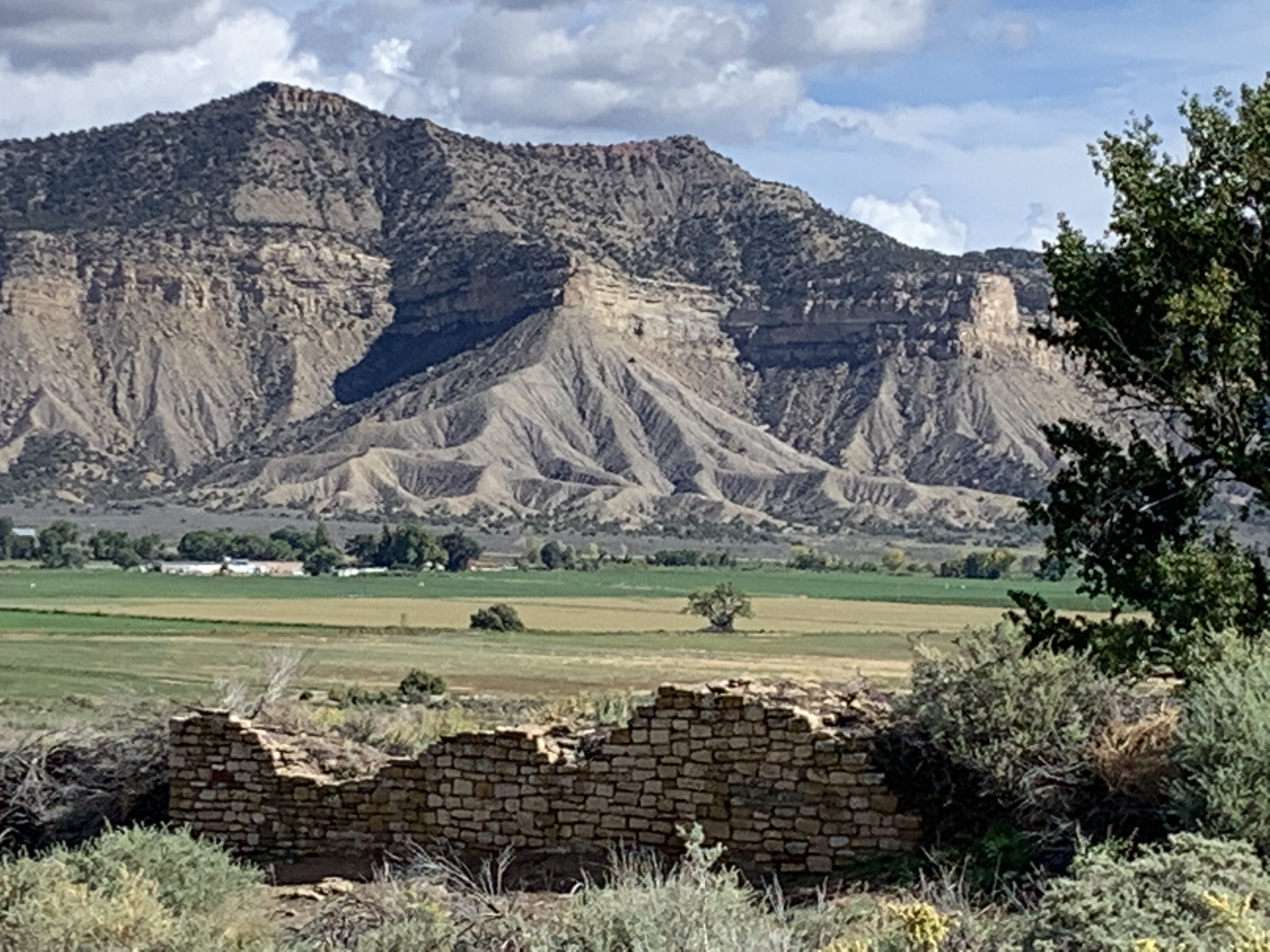
The rangers I asked discouraged me from visiting, because the reconstructed wall above and small mounds are all there is to see. But what makes this place special is that it is in the middle of the rich agricultural valley below Mesa Verde, and it wasn’t completely destroyed, vandalized or eroded away. Large pueblos, like this one with hundreds of rooms, used to be scattered across the region, but, as at Hopewell, the ones located in rich farming areas were often plowed under. This is actually one of the largest archaeological sites in southwest Colorado, recognized by researchers in the 1870’s, protected as a monument in 1919 (and by a bequest from the landowner at the request of an archaeologist) and protected unofficially by another landowner who donated an access route in 2002. Also unlike other sites, the archaeologists have mainly used less-invasive techniques in their research, saving the site for future generations.
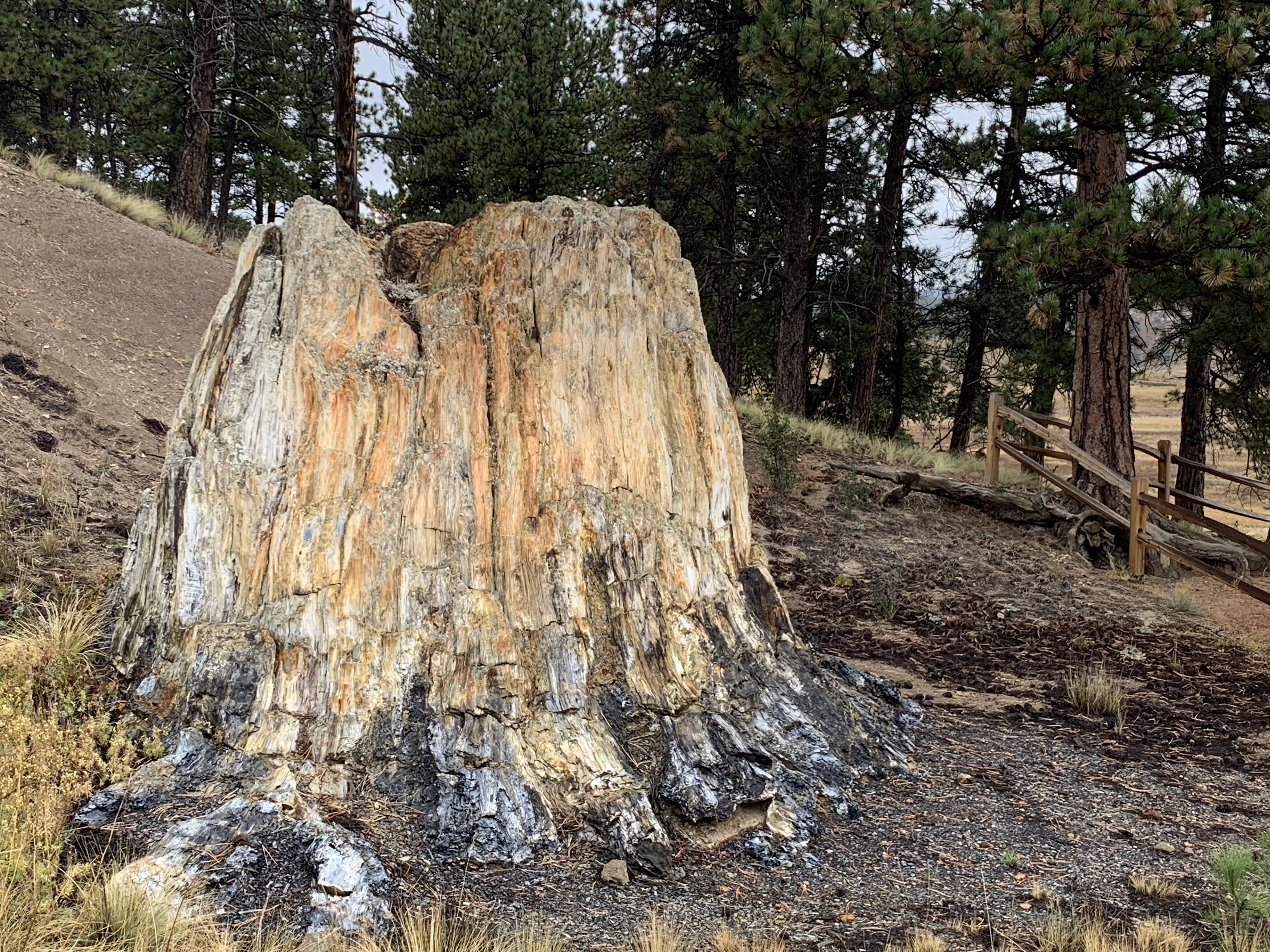
Giant Redwood trees once lived here, in Colorado, and many of their colorful stumps were preserved by volcanic ash along the easy 1 mile Petrified Forest Loop (at 8,400’). Early visitors took pieces of the petrified stumps and even left saw blades in the Big Stump above. See an array of Eocene fossils in the visitor center, including plants, bugs, fish and animals, and a rhinoceros bone. The volcanic ash layer captured a snapshot of the lake, meadow and forest here, which helps us understand how various plants and creatures evolved and adapted to a changing climate. But make no mistake, the current man-made climate crisis does not provide time for evolution or normal adaptation. Suddenly, our planet has a new, unprecedented and deadly climate, and most life won’t survive, unless we fix it now.
I wondered how large the peak range of the redwood trees must have been to have survived until today. They must have been successful in many different areas, like here, where the climate eventually become inhospitable to them. Now they only remain naturally in California and Oregon. People don’t seem to appreciate that for plants to survive over the long term, they need more than a few small, isolated reserves. They need to thrive in many different locations to have a chance of finding a stable and suitable one where they will have a future. Human limits, including pollution caused climate change, will extinguish species and ecosystems until we prioritize the protection of living things. Otherwise, all that will remain will be fossils and images of once thriving species.
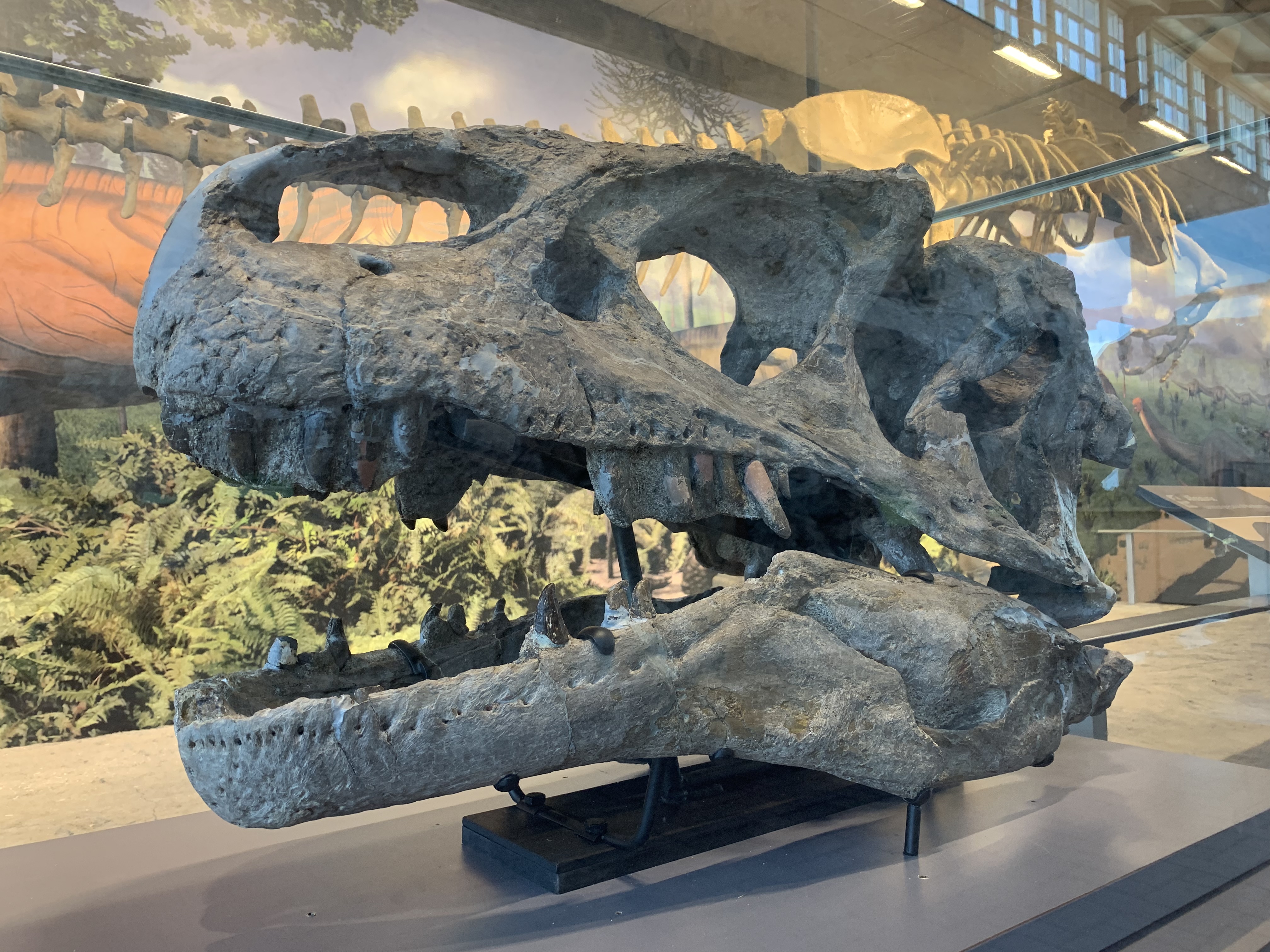
The Quarry Exhibit Hall, near Jensen Utah, has a crazy collection of large, late Jurassic dinosaur bones set in a two story high, very wide quarry wall, and you can touch them. It’s awesome. The Allosaurus skull above, a raptor talon-claw, Apatosaurus leg bones, and many Camarasaurus bones including a skull still set high in the quarry wall are all fascinating. This dinosaur exhibit is at the east end of the park after the Green River comes out of Split Mountain Canyon, and there’s a nice view, petroglyphs & pictograms.
Up the Green River is the extremely deep Canyon of Lodore, explored by John Wesley Powell, accessed from the north via permitted river trips or visible after a hike from the Gates of Lodore campground. Colorado’s Yampa River joins the Green from the east near Harper’s Corner, which has “the best view in the park” at the end of a hike and a 48 mile round trip drive. Unfortunately, I did not plan my charging to include either of those sections, so maybe next time.
There aren’t many good Tesla chargers around Dinosaur. Not sure why, but I noticed that some of the surrounding towns still support coal, have Halliburton operations, and have unfortunately unstable, irrational, fossil-fuel supporting representation in Congress. There’s a welcome center in Dinosaur Colorado with EV charging, but I don’t (yet) have the right kind of “combined charging system” CCS adapter. Since I’m in a hurry trying to visit high altitude parks during a short timeframe, I made due with a couple of 3rd party chargers I found using the PlugShare app, rather than stay in state park campgrounds. Especially when you get unexpected roadwork detours, being able to tap into other chargers is helpful.
The park is only accessible for zero carbon travel for a few weeks after the required shuttle service ends (mid September) and before the road closes (early to mid October). Shuttle buses are useful for reducing carbon pollution, but unless they’re sustainably fueled, they’re out of bounds to me. Red’s Meadow Cafe was still open, but the resort was closed when I arrived late September.
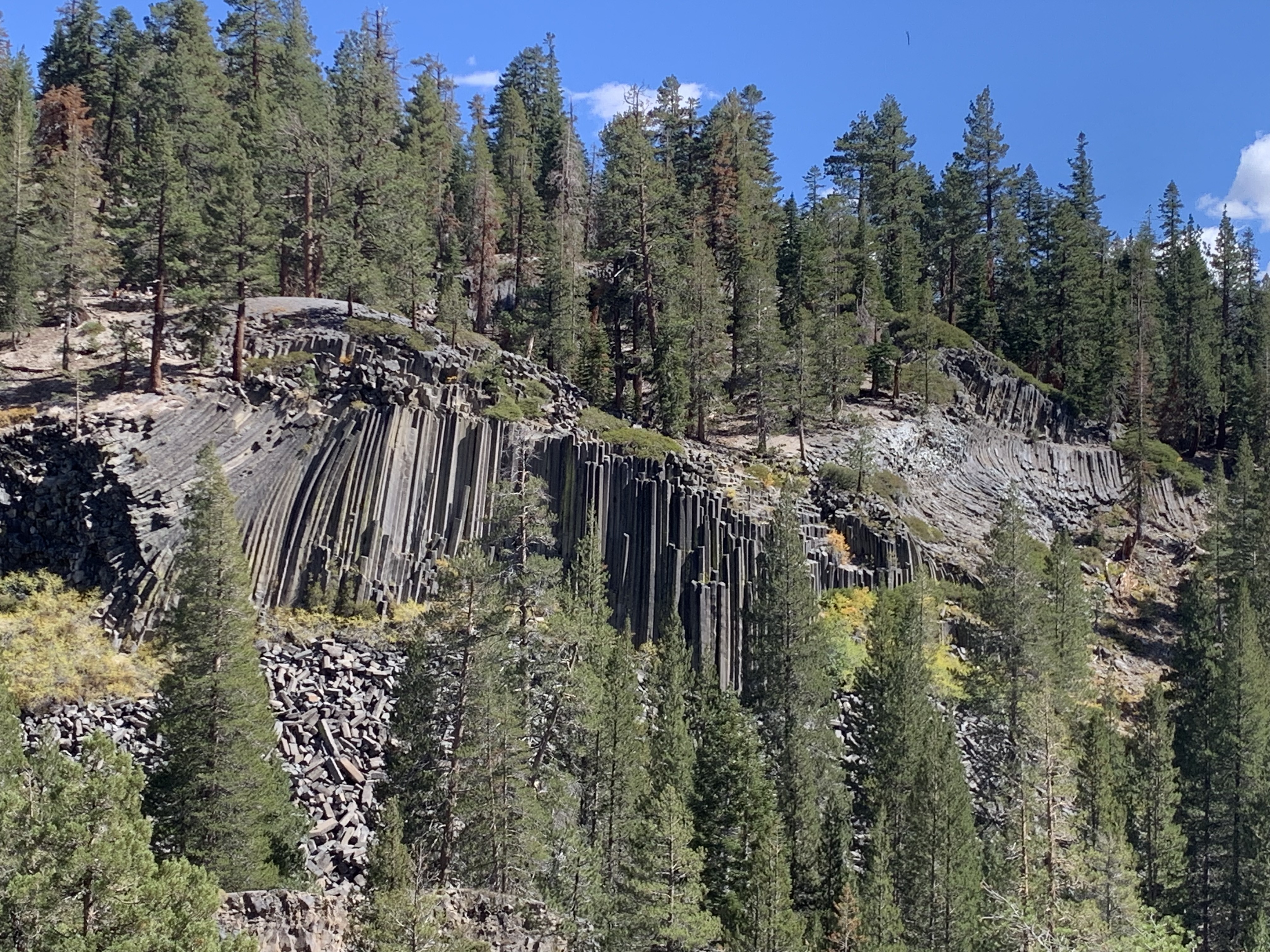
Since both the John Muir and Pacific Crest Trails run together through the park, I recommend you hike in a loop around the base of the broken basalt columns, across one of the two bridges across the Middle Fork of the San Joaquin River, along the combined JMT & PCT trail ridge where I got the photo, and back across the other bridge. There are also pretty waterfalls at both the north and especially south ends of the monument, but be careful hiking as the park is at around 7,500 feet in altitude up near the Mammoth Mountain ski area. There’s also a trail up through the trees to the top of the columns, which were formed 80,000 years ago when a diabolically molten lake cooled and cracked deeply in hexagonal and similar shapes and which were revealed by glaciation 15,000 years ago. Enjoy!
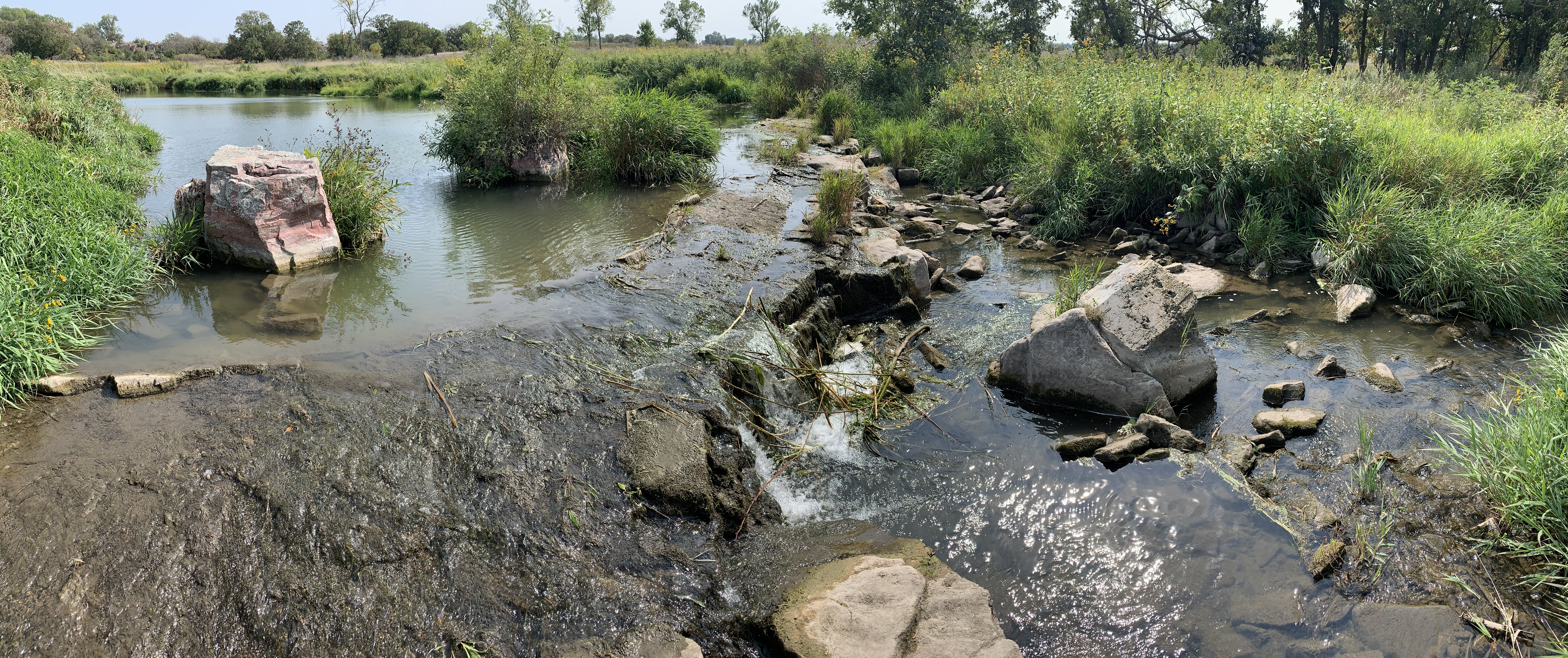
In some Native American mythology stories, the red pipestone comes from the blood of ancestors killed in floods. Similar to the story of Noah, prayers are heard and a few survive. The pipes send prayers to heaven. So this quarry has special religious and cultural significance, and the pipes are still formed using traditional techniques. There’s a great exhibition inside the visitor center, where native artisans answer questions while working and beautiful pipes are displayed. The film explains the importance of the local plants, including a field of red Smooth Sumac, used in making medicine and blends to smoke or hang in offering ties on sacred cottonwood trees where ceremonies like the Sun Dance are performed. The short circle trail up the creek past the small Lake Hiawatha leads through a beautiful hewn ravine of red pipestone across a footbridge and back around to an exhibit quarry.


 Zero Carbon Travel