Mainers are tough. While other Americans talk incessantly, wear flashy clothes, and spend every day seeking attention, folks here say little, dress simple and get stuff done. It’s a pleasant sail from Boston to coastal Maine in the summer, downwind and northeasterly or ‘down east’ as the area became known. But the coast is rugged and dramatic, with rocky beaches, serious storms, cold winters and endless forests. Not the place for overly dramatic flights of fancy.
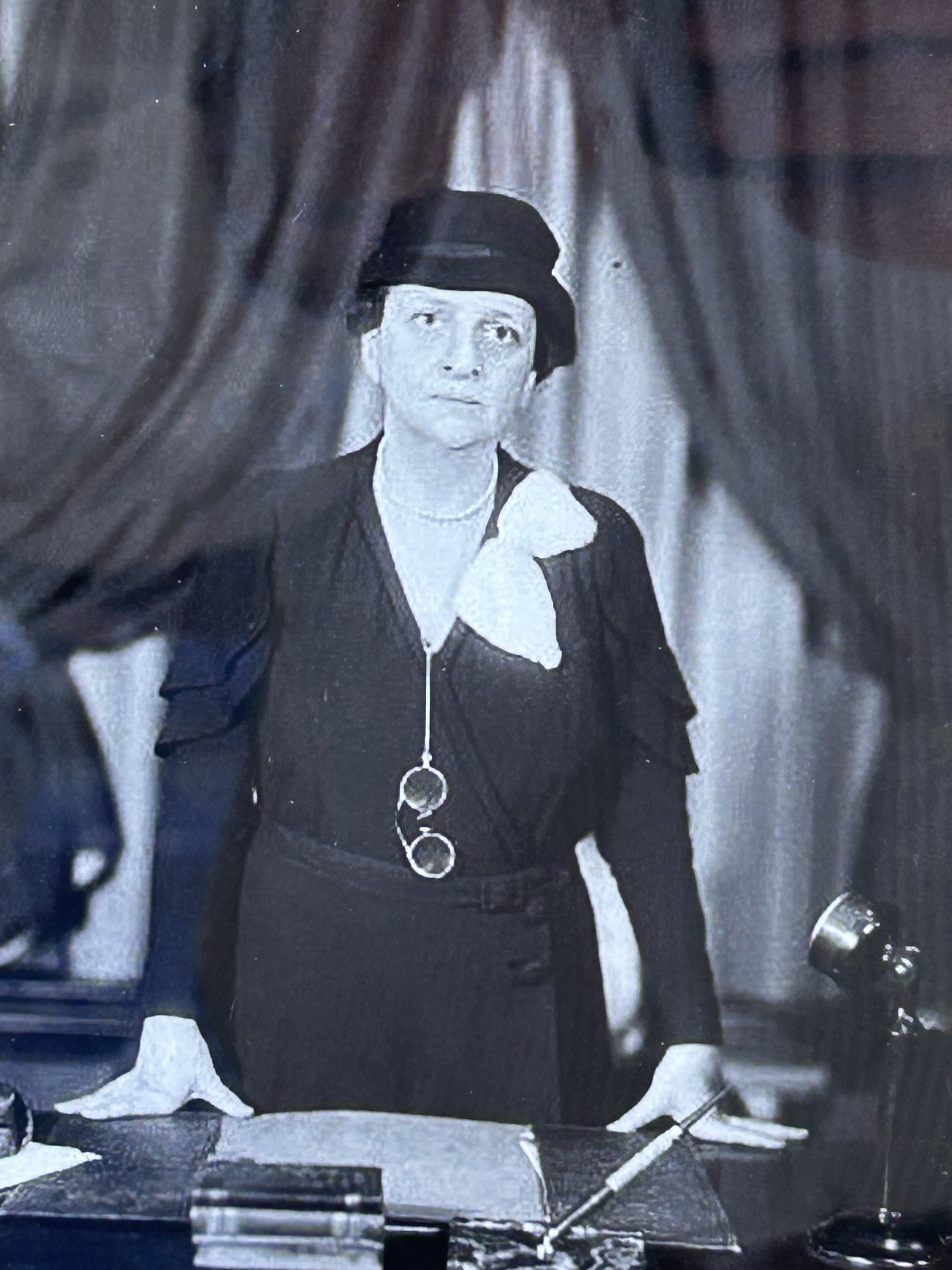
Perkins was tough too. Her family made bricks on their large piece of land overlooking the oyster farms on the Damariscotta River south of Newcastle—a “Slow Village” warns a road sign. An ancestor protested ‘taxation without representation’ and survived having his skull cracked by a ‘lobster back’ redcoat in return. Frances got an exceptional education, saw firsthand the social problems of her time, and buckled down to do the hard work of solving them.
She found social worker allies in alleys, witnessed the Triangle Shirtwaist Fire, learned the tough politics of Tammany Hall, reinvented herself to join the powerful and got stuff done. She worked on worker safety, health and poverty with two Governors of New York, and was singularly qualified when FDR asked her to be his Secretary of Labor. Frances Perkins was the architect and driving force behind his New Deal, including minimum wage and social security.
Perkins had practical training, the courage of her convictions and a moral authority to improve the lives of those in need, especially during the Great Depression. She did not seek the spotlight, but she wielded more power than any other woman in US history. Have you benefited from having drinking water & clean restrooms at work, a sprinkler system & fire escape, unemployment insurance, or not having to work weekends? Then you should remember and thank Frances Perkins.
Her Brick House family home isn’t open yet, but there are photos & exhibits in the barn. And the walk through the woods and meadow to the river is lovely. With this new park unit I re-complete the North Atlantic region and finish all park units the contiguous 48 states, until the next one is designated.
This is a new national monument on the 18th century Carlisle Army Barracks in Pennsylvania, which also hosts the Army War College and the Army Heritage and Education Center. The base is currently open to visitors on weekdays, but there are no park site visitor services yet.
“All the Indian there is in the race should be dead. Kill the Indian in him, and save the man.”
Richard Pratt, founder & superintendent
From 1879 to 1918, towards the end of its War on Native America, the US Army established a boarding school here, a re-education camp far from native reservations. There are only a few Native American graves left on base, as many were repatriated by law after 1990, but otherwise, not much remains of the school that once set the standard for ‘assimilation’. Around 8,000 children from 150 tribes were taken from their parents and shipped off to this school—as happened at other schools across the country—for the expressed purpose of ending their culture. Considered a step forward from massacres, forcing natives to become white was the primary goal from day one. While today, many such students might gain PhDs in Native American studies in recognition of the value of their cultural contributions to our civilization, prejudice meant there was practically only one way for these students to excel: on the field.
Unlike college admissions or job hiring, there is no effective way to cheat by race in sports like track & field. Once allowed to compete, the results are judged fairly, regardless of color. The field above is still known as ‘Indian Field’, but officially it is named after Frank MT Pleasant Jr, a student—and member of the Tuscarora Nation—here for 12 years around 1900, known for his prowess in football and track. In 1908, he placed 6th in two events at the Olympics in London. He earned his degree in 1910 at the neighboring Dickinson College, the first native to do so. He served honorably in WWI and later played semi-pro football. While he and other athletes like baseball hall of famer ‘Chief’ Bender are remembered here, they’re all overshadowed by another classmate.
In 1907, a Sac & Fox youth was walking by the track above when he stopped to watch the high jumpers. He had been to many different schools growing up, and he had run away from most. This was his second time here; the first cut short by the death of his father. Jim Thorpe walked up to the bar and jumped 5’9”—a school record—in his street clothes. He would excel at virtually every sport he tried: ballroom dancing, baseball, boxing, handball, lacrosse—a native sport—, and tennis. The football coach, ‘Pop’ Warner, didn’t want his school’s track star injured, but Jim asked for a chance to play. He ran through the opposing team back and forth, and then said, “coach, nobody is going to tackle Jim”. And nobody did. Jim set all kinds of college football records, rushing almost 2,000 yards a season, scoring hundreds of points with over 25 touchdowns a year, according to incomplete records.
At the Stockholm Olympics in 1912, Jim Thorpe competed in the two most challenging competitions, the pentathlon and the decathlon, which require mastery of 5 and 10 different events respectively: 100 m, 400 m, long jump, high jump and shot put for the pentathlon and the same five plus the discus, javelin, 110 hurdles, pole vault and 1500 m for the decathlon. Despite someone stealing his shoes before the competition, Thorpe found two mismatched shoes and still won 8 of 15 events outright, winning the gold medal in both combined events. Later, Thorpe would go on to play professional baseball, basketball and football. Considering how well-rounded he was, in my opinion, Jim Thorpe is the greatest athlete in history.
So, if you want to take a lap on the same track where Jim Thorpe began his athletic career, bring a map and your real id and go to the base visitor center between 10 am and 3 pm on a weekday—not a Federal holiday—and get your criminal background check. But consider the cultural cost of Indian schools, the families broken, the languages silenced, the oral histories lost, the natural and medicinal secrets forgotten, and the songs and dances not taught, just so white people would feel more comfortable with Native Americans. Fortunately, the Sac and Fox Nation survives in Oklahoma—they were removed from the Great Lakes region in the 1870s—and many other tribes still thrive today as well.
Daniel Romero marched with César Chávez back in the day, so when a nationwide protest against recent cuts to the national parks & US forest service popped up today at noon, of course, he came wearing his ‘¡Si, Se Puede!’ T-shirt. He knows from experience that predicting turnout is a fool’s game, but instead of the expected 3, there were around 20, even at a very small park in a rural area best known for a loop of track for trains to change elevation to traverse the Tehachapi pass. Another was Fernando Chávez, a grandson of César, who discussed the need for solidarity, coalition building, and activism at the base of the old oak tree next to Martyr’s Garden, where his grandparents lie at rest. “We’ve been protesting forever”, said Romero. “Even though we are sometimes excluded, we have always tried to support each others’ causes”, said Chávez, recounting how spontaneous protests recently broke out after a particularly brutal local raid by ICE. Romero listed the unions that marched with them, describing diverse families and even weddings during the boycott and strike.
This was an early park visit for me, as it’s local. Unlike my quiet visit 3 years ago, folks here today were sad, angry and surprised by the chaotic decisions to cut 1,000 NPS staff and 10% of the USFS. One employee here had just transferred from New Mexico when his job was axed by Elon Musk. Many of those affected were young, promising staffers, full of optimism. Supposedly he is scrambling to get the transfer reversed to stay employed. While there may be some cost savings, in the long run, the work these folks do protects and adds a lot of value to our country, so cutting when hiring is needed is counterproductive. I felt the need to apologize for still driving a Tesla, but folks understood, knowing others who are now trying to unload theirs. I’m keeping mine, as the climate crisis is going to get worse, despite efforts to delete the word climate from government documents.
I know Saturdays are supposed to alternate state photos, so I’ll add another and a video below. But I thought you might like this real time update from a very appropriate park for a protest, with people whose lives were defined by the proud history of protesting in America. Next week will return with another western state. Thanks for reading!
Most of our border with Canada is a straight line from Minnesota to the Pacific, except for Canada’s Vancouver Island, which dips below the line. When the border was negotiated, the treaty put the border through the “middle of the channel”, i.e. the Straits of Georgia and Juan de Fuca. Except where the San Juan Islands are in the middle, and then which is the main channel becomes a matter of interpretation. San Juan Island is much closer to Victoria Canada than to the mainland, so the British claimed it. But the Haro Strait is larger than the rest of the channel, so the Americans claimed San Juan Island too. Nobody really cared much about the sparsely populated islands, until an American squatter killed a British pig for rooting in his garden. Then, both sides prepared for war.
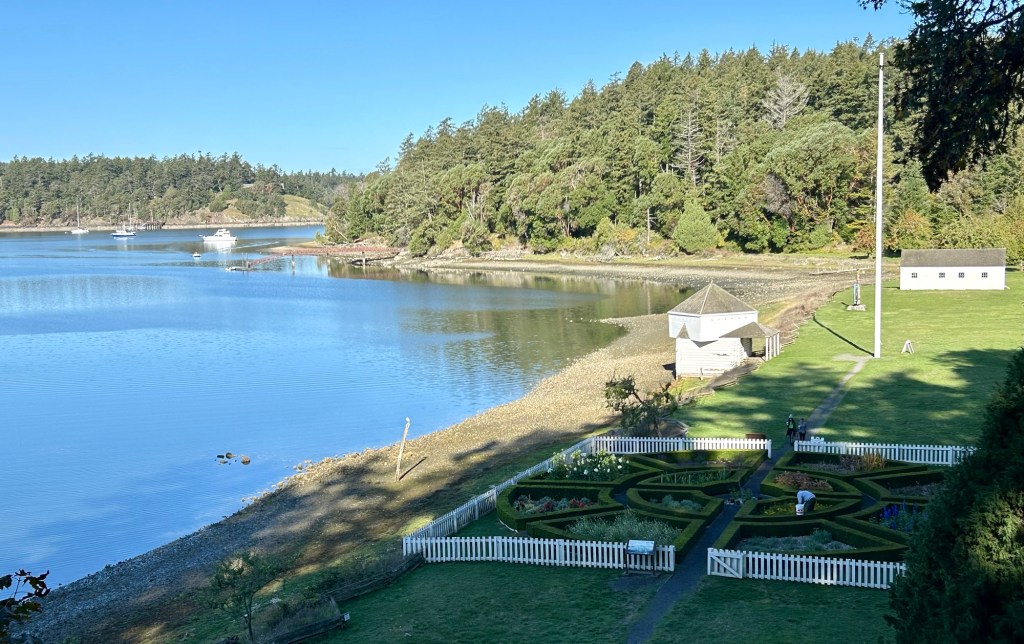
English Camp in the northwest is lovely, set on a well protected bay amidst large oaks, hemlock, and madrona trees. Well supplied from Victoria, the British created a formal garden above, kept calm and carried on. The Americans—actually the Robert’s Rules of Order writer—built a fort on the exposed southeastern point, conducted rigorous drills and maintained strict discipline. Large flag poles were erected at both camps. At the time, the US was entering the Civil War, so the government sent General Scott to negotiate peace. Fortunately, the border dispute was settled diplomatically.
There is an interpretive center at the American camp, while the English camp visitor center was closed when I visited late last September. Regular car ferries run to San Juan Island, with pleasant views along the way. Friday Harbor is between the English and American camps, 9 and 6 miles respectively, and has nice restaurants and more.
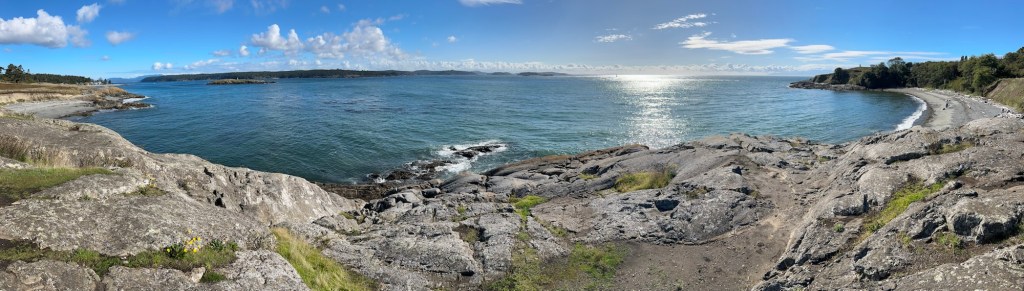
I also stopped at Cattle Point below on the southern tip which is part of a BLM National Monument protecting points, small islands and rocks in the San Juan Islands.
President Biden’s parks legacy is now complete, and overall he’s accomplished more than the first term of his predecessor, who approved five small park units, cut Bears Ears & Grand Escalante by over a million acres, and removed 19 US Biospheres from UNESCO. Biden doubled the scenic trails units from three to six, and his parks help protect the history of American Concentration Camps, desegregation in education, the Underground Railroad, and Black History.
Biden has also made many other changes that don’t affect the official total of park units.
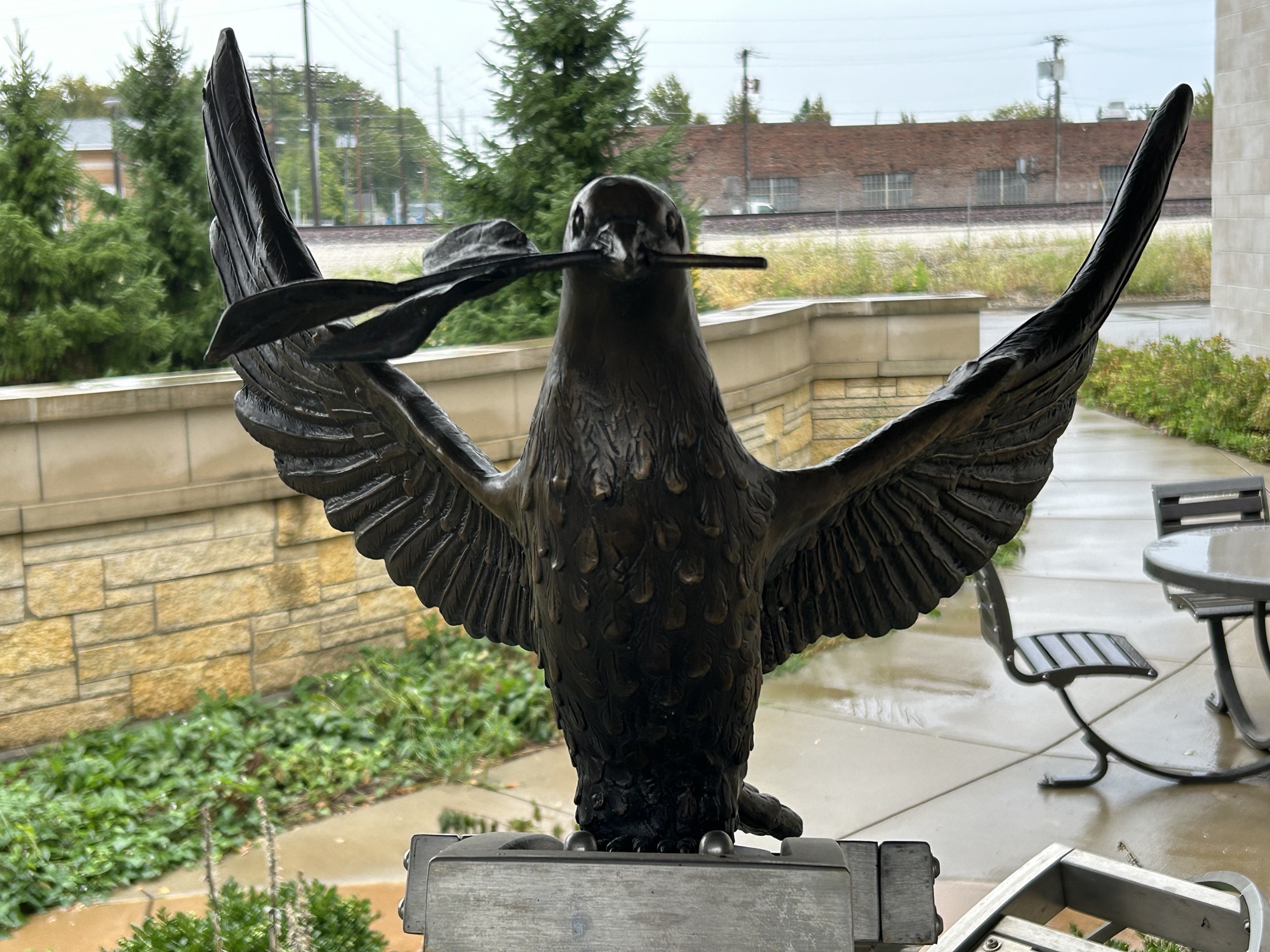
This new park established by President Biden this August is still a fenced off construction area next to the railroad tracks, but there are several art installations dedicated to the riot, including the dove above and a mural at the Children’s Hospital next door. 11th Avenue along the site is known as Reconciliation Way, to commemorate the terrible events here in 1908.
In mid August 1908, in Springfield Illinois, a white mob of five thousand lynched 2 black men, killed 7 others, burned out millions of dollars worth of black homes and businesses and also targeted Jews and whites deemed sympathetic to the black community. The police did nothing to stop the riot. The burning, looting, ransacking and violence lasted 3 days until put down by the state militia, which resulted in 6 dead rioters.
Church leaders blamed the victims for being “sinful”. Although everyone knew the perpetrators and many were arrested, only one 15 year old was convicted after he confessed to stealing revolvers, shooting at black people and starting 15 fires. The others denied any responsibility, the witnesses denied seeing them, and the charges were dismissed. The judge denied that there was racism in Springfield.
Many Americans were shocked by the scale of the violence in Abraham Lincoln’s home town, and civil rights advocates like W.E.B. Du Bois and Ida B. Wells helped form the NAACP in 1909 in response. In 1910 speaking before the NYC Republican Club (the party of Lincoln), Du Bois argued that if racial hierarchy were the natural order of the world, then there would be no need to use social and physical weapons to oppress a race.
“So soon as the prejudiced are forced into this inevitable dilemma, then the real bitterness and indefensibility of their attitude is revealed; they say bluntly that they don’t care what [slurs] may be capable of—they do not like them and they propose to keep such folk in a place of permanent inferiority to the white race—by peaceful policy if possible, but brute force if necessary. And when a group, a nation or a world assumes this attitude, it is handling dynamite. There is in this world no force as the force of a man determined to rise. The human soul cannot be permanently chained.”
The photo is from the moose exhibit upstairs at the visitor center. I failed to photograph a bald eagle flying right in front of the reconstructed fort, which includes a great hall, kitchen, warehouse, lookout and wooden palisade. The monument is surrounded by Anishinaabe (Ojibwe/Chippewa) land, and the tribe co-manages the unit, a first for the NPS. I stayed at the casino to catch an early ferry from Grand Portage, and I had a delicious ‘lunker’ (big fish) for dinner. From the dock, you can see Isle Royale in the distance, and there are various demonstrations of the fur trading life during the summer season.
Traders wanted access to the western rivers and lakes, and the easiest way to get there was to carry their canoes on the ~10 mile Grand Portage Trail around some impassable waterfalls (including Minnesota’s largest) on the Pigeon River at the border with Canada. At a site called Fort Charlotte, the voyageurs entered the Pigeon River—now the US-Canada border—and continued with shorter portages upstream on the Athabasca, English & Saskatchewan Rivers. They would pass through what’s now Voyageurs National Park, Rainy Lake, Lake of the Woods, and deep up into the Canadian Rockies to the Athabasca, Great Slave, and Winnipeg Lakes. The trail carried beaver and other pelts, typically trapped by natives, in 90 pound packs from inland Canada down to Montreal (skipping the polar bears around Hudson Bay), bound for global markets in Europe, Russia and China. Vast fortunes were made wiping out the abundance of our wildlife.
Quick logistical update: until summer, Mondays are Mexican World Heritage Sites, Thursdays are eclectic, and Saturdays are bonus park photos. I took the photos above yesterday in New Mexico and Colorado.
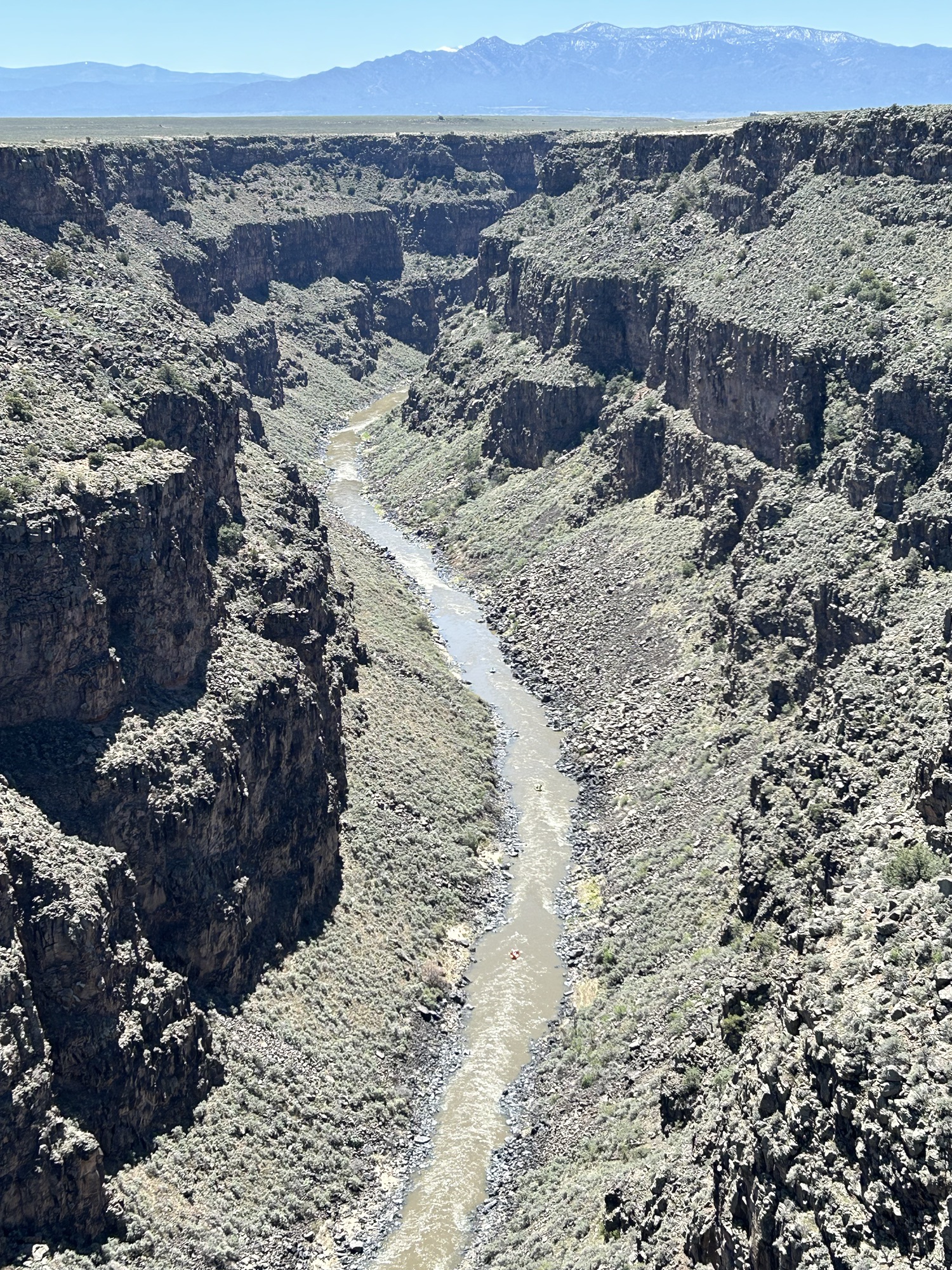
While technically in different regions, both National Heritage Areas are linked by the river, the mountains and our cultural heritage. The Rio Grande begins in the San Juan Mountains in south central Colorado and flows east through the San Luis Valley where it turns south into New Mexico. The scenic north section is called the Río Grande del Norte to distinguish it from the southern section that defines the Texas-Mexico border. The river flows through the Rio Grande Gorge and is now popular for whitewater rafting (see three rafts above left). In the distance are the Sangre de Cristo Mountains (both photos).
Native Americans and Spanish explorers traveled up and down the river, settling on the fertile valleys. The native land was claimed by the Spanish, Mexicans, and Texans, and for a dozen years, the Río Grande del Norte defined the US-Mexico border in Colorado, before the US claimed the land all the way to California by treaty in 1848. In the Civil War, Texas secessionists battled Colorado volunteers at Glorietta Pass in New Mexico to decide the war in the southwest.
The Northern Río Grande National Heritage Area in New Mexico celebrates this magnificent natural scenery and the cultural heritage it guided. It also includes Taos Pueblo, wild & scenic rivers, historic trails, scenic byways, and several cliff dwellings. Much of the land is also a BLM managed National Monument. The area is both beautiful and fascinating, and I was not going to miss another chance to drive through on my way northeast.
The Sangre de Cristo Mountains tower over the east side of the Río Grande del Norte from east of Santa Fe NM up into Colorado past the Great Sand Dunes. Meaning ‘blood of Christ’ in Spanish, the name likely refers to the scarlet colors of the mountains at sunset. The helpful illustration (my favorite photo above right) is on the Stations of the Cross trail up to a church that overlooks the historic San Luis Valley.
The Sangre de Cristo National Heritage Area in New Mexico borders the Northern Rio Grande National Heritage Area in Colorado, and includes the Cumbres and Toltec Scenic Railroad featured in Indiana Jones and the Last Crusade, the Monte Vista National Wildlife Refuge famed for Sandhill Cranes in March, and Fort Garland, a fine restored Kit Carson fort with an interesting museum on Buffalo Soldiers—one turned out to have been a woman who served for years as a man undetected. The area is lovely and pastoral amid snow-capped mountains, with many other worthy attractions, but I’m on the road again.
The animosity against African Americans, especially in the Deep South, is hard to comprehend, but it is deep, real, persistent and extremely dangerous. Emmett Till’s mother warned him, but even she underestimated the risk. In late August of 1955, Emmett Till was kidnapped from his great uncle’s home by a shopkeeper’s husband and his half-brother, who accused Emmett of whistling at the shopkeeper, a white woman. From past midnight to pre-dawn, the two men, along with several others, held Emmett, aged 14, in the back of a pickup truck, drove around the county, terrorized him, tortured him, shot him and dumped his body in the river. Witnesses reported hearing Emmett’s screams all over town for hours. His great uncle reported the kidnapping, the men were arrested, and the body was found a few days later. His mother, saying “let the world see what I see”, insisted on an open casket at the funeral in Chicago. Jet magazine published photos of his brutalized body. His mother became a lifetime activist, author and motivational speaker on education, poverty and Civil Rights with the NAACP. Many consider Emmett Till’s killing to be the beginning of the Civil Rights Movement, not least because Rosa Parks cited Emmett as the reason she kept her seat on the bus in Montgomery on 1 December 1955.
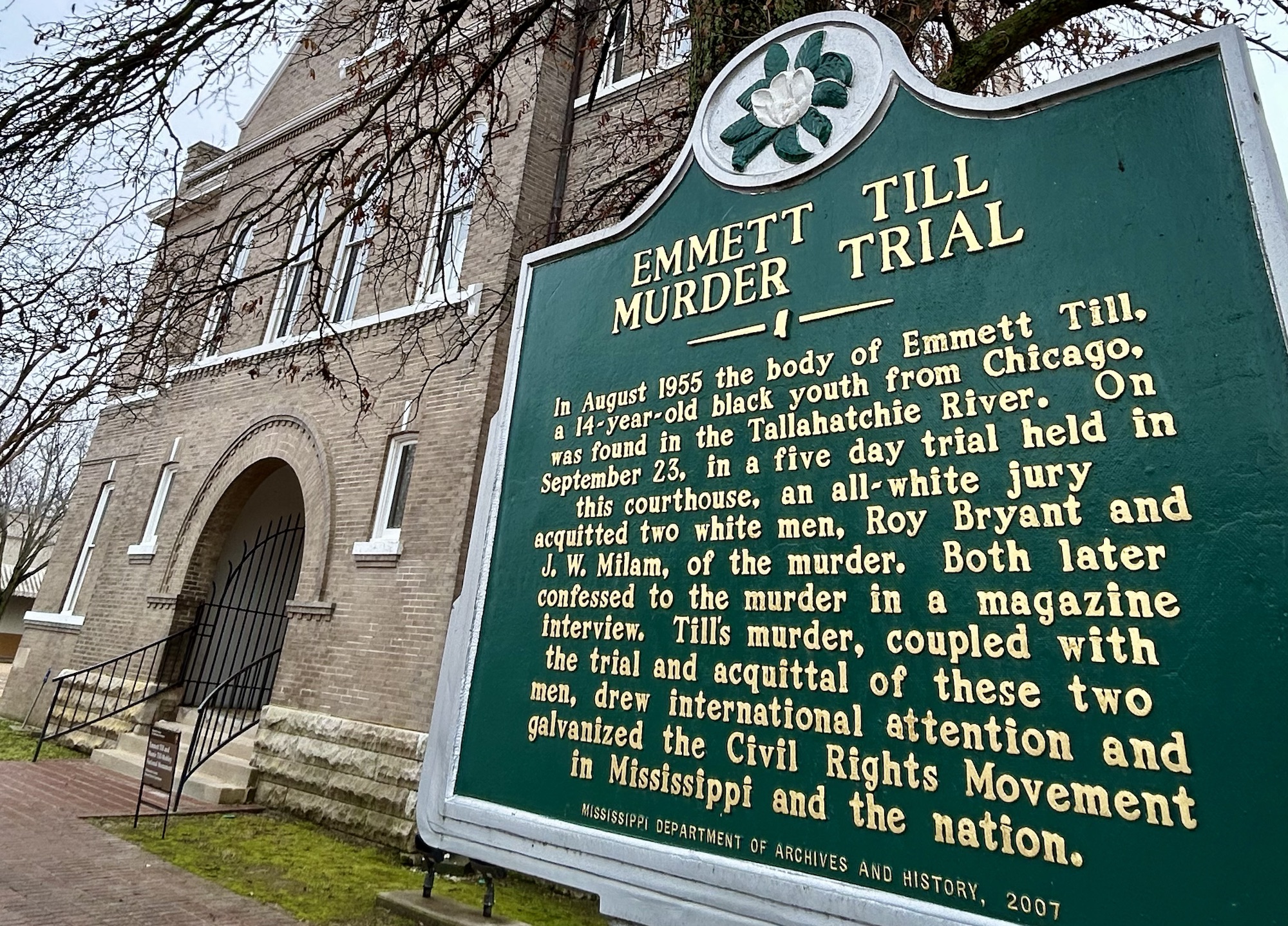
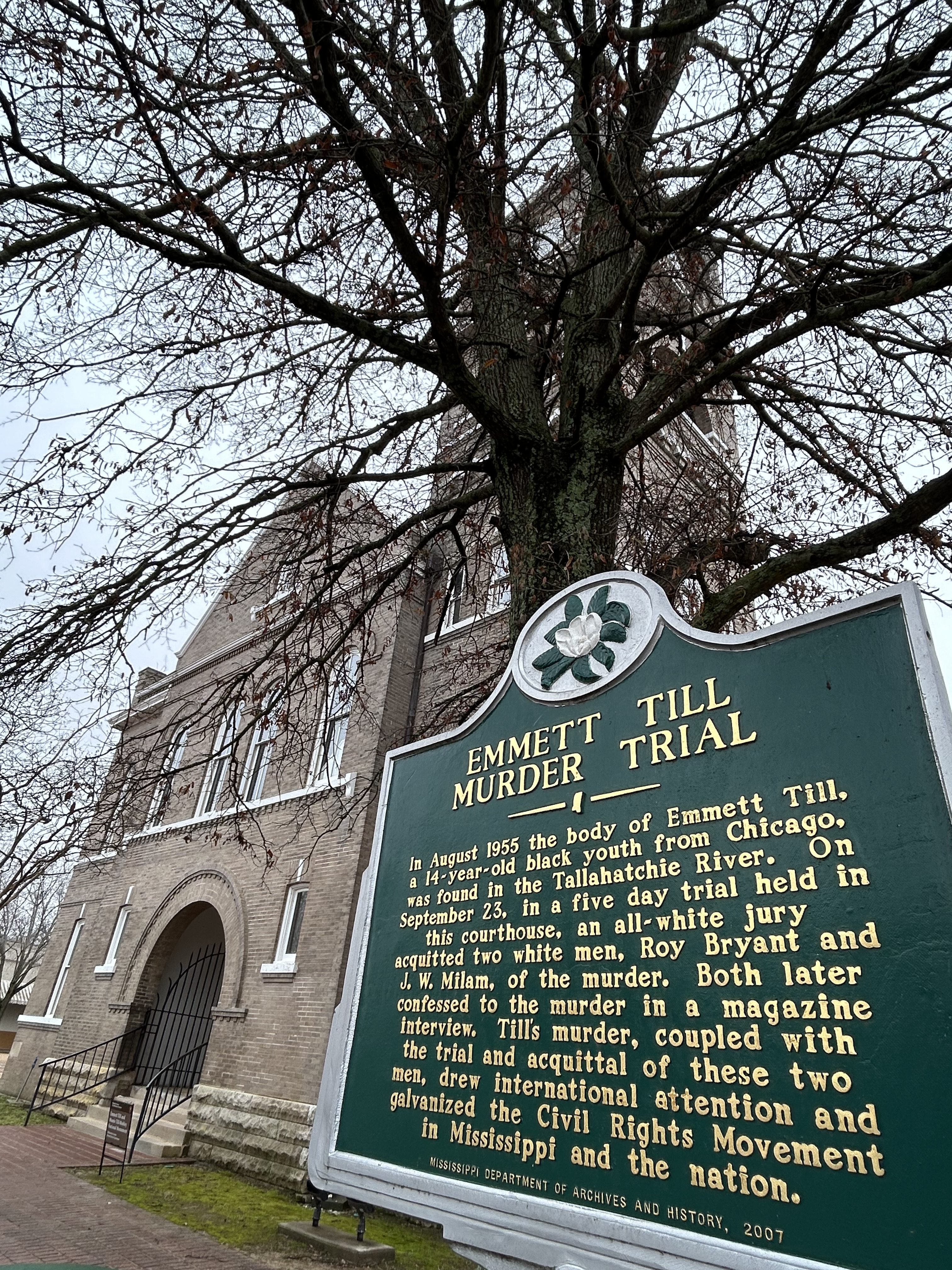
The trial was a foregone conclusion. Outside the courthouse (below) stood a statue dedicated to the “Heroes” of the Confederacy. Inside there was no justice. Instead of jurors, police, court officers and elected officials defending the Law, the courthouse became the focal point of a deep criminal conspiracy, based on racism. Witnesses were intimidated, hidden, immunized and silenced. Emmett’s great uncle testified at the trial, pointing out the kidnappers and murderers, and then he left town immediately and went into hiding under a false name. And for many years afterwards, there has been a concerted effort to conceal the truth. Evidence lost. Signs have been repeatedly shot and torn down. Historic artifacts and structures intentionally left to ruin or demolished. One witness, in hiding for decades under another name, still received death threats demanding silence. The confederate statue still stands in front of the courthouse, just left of the photo.
But despite the legacy of lies, terror and violence, people still work to tell the truth about Emmett Till. Especially if you’re exploring the new monument’s sites in Illinois and Mississippi, I recommend reading the darkly fascinating stories in the Emmett Till Memory Project app, after being introduced to it by one of the contributors at the Emmett Till Interpretive Center across from the courthouse in Sumner, MS. Emmett Till’s coffin is on display at the National Museum of African American History and Culture in Washington DC. His name was given to the Anti-Lynching Act of 2022. And this new national monument was established by President Biden on 25 July 2023, on what would have been Emmett Till’s 82nd birthday.
Have you ever wished that someone would build a road up along the canyon rim with cool tunnels and overlooks, so you could see the features up close and hike out on the points? Well, then this is the park for you! A man named John Otto began building that road over 100 years ago, including his trail out to view the point above.
The winding, tunneled scenic canyon rim road now has bicyclists and antique cannonball rally motorcycles. Besides the enviable promontory pictured, there are several 500’ deep steep canyons to explore along Rim Rock Drive: Ute, Red, Monument and more. Watch out for Bighorn Sheep—I saw one—and raptors—second time this week that one whooshed past my head as I stood on a cliff. I saw a flash of bright yellow, so I think this was a peregrine falcon. Watch your step along the cliff edge!
The Gunnison River runs from the Black Canyon past the monument and the scenic Dominguez-Escalante and McInnis Canyons conservation areas, making for a scenic drive.





 Zero Carbon Travel