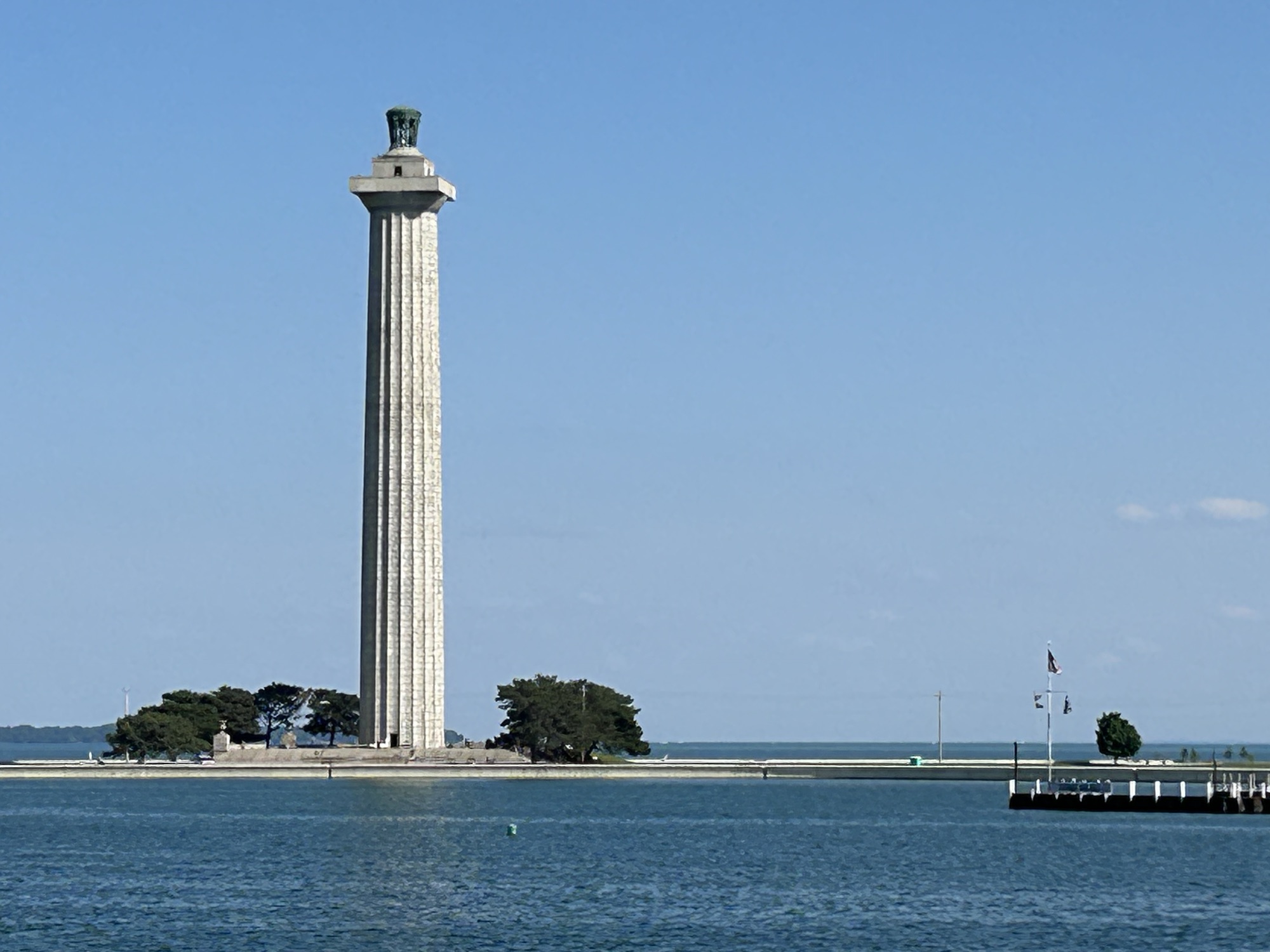
Perry’s Victory & International Peace Memorial

Captain James Lawrence was shot by the crew of a British ship blockading Boston in June of 1813. Dying, his last command was “don’t give up the ship”, but his ship was captured. Three months later, his friend Commodore Oliver Hazard Perry commanded the USS Lawrence under the flag “DONT GIVE UP THE SHIP” against the British for control of Lake Erie and access to the western Great Lakes. Despite balky support from the USS Niagara, Perry sailed up close under long range fire to bring his short range big guns to bear. The Lawrence suffered 80% casualties, was disabled, and Perry withdrew, taking command of the Niagara. He returned to the middle of the battle, pummeled the British ships and won the day. His fleet then ferried US troops across Lake Erie, where they forced a British retreat. US negotiators leaned heavily on these victories when negotiating peace, making Perry’s victory here perhaps the most consequential of the War of 1812 and for determining the US border with Canada today.

One of Perry’s younger brothers, Matthew, commanded the ‘Black Ships’ that sailed into Tokyo Bay and forced the internationally isolated Japanese Shogunate to open its country to the West in 1854. There are several ferry options for visiting the touristy island town of Put-In-Bay, and Perry’s monumental tower—the world’s largest Doric column—has great views of the surrounding islands, part of the longest undefended international border in the world, and the naval battlefield. Three British and three US officers are interred in the memorial, and the regular sailors killed were sewn up in their hammocks and committed to Lake Erie. Please take some time this Memorial Day weekend to remember those who gave their lives for our country.
Wright Brothers National Memorial

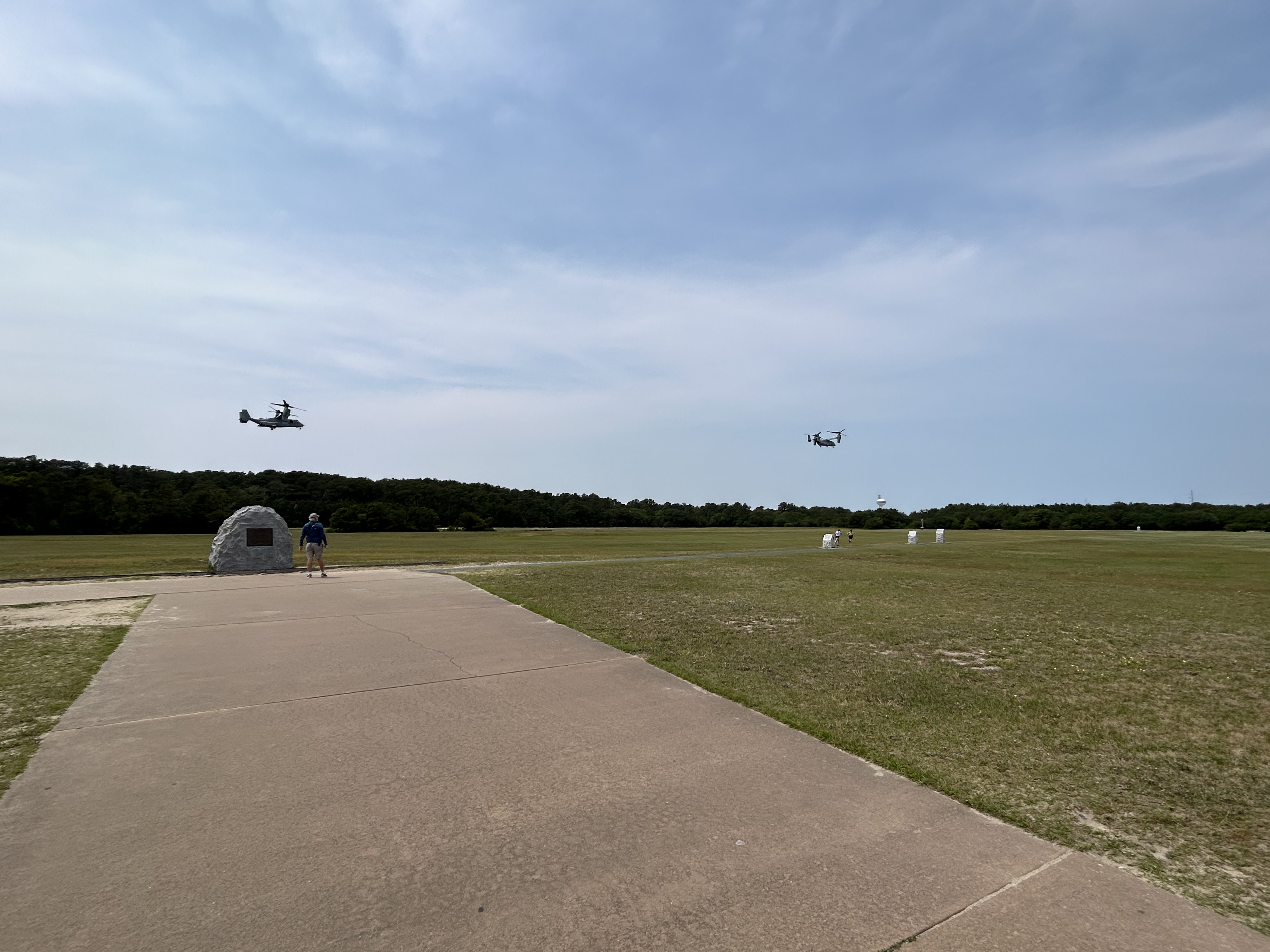
The boulder under the Osprey to the left marks the first flight takeoff, and the three stone markers under the right Osprey mark the first three landings. The fourth landing is marked by the white stone marker visible to the far right.

While the first flight happened here in North Carolina—at Kill Devil Hill near Kitty Hawk—due to favorable wind conditions and relatively soft sand, most of the work and final testing of a workable aircraft that could turn was done in Dayton. Inside the museum here you can see a full scale reproduction of the 1903 Flyer, and outside there’s a sculpture depicting the first flight. It’s a beautiful spot with a huge monument on the hill where they conducted gliding tests, and, yes, it’s still very windy.

Fort Caroline National Memorial

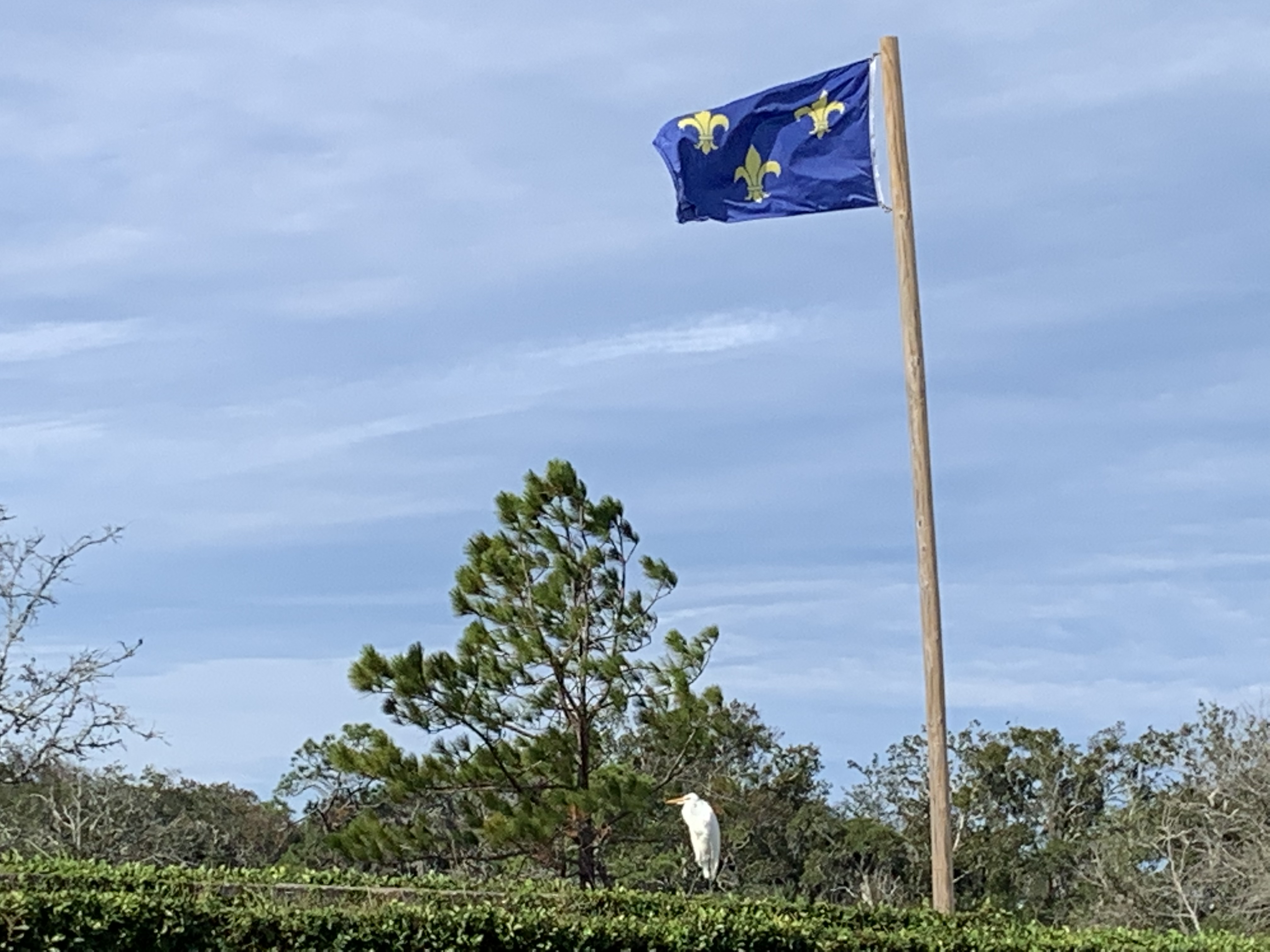
The French settled on the Atlantic coast of Florida in 1564, a year before the Spanish established the Castillo de San Marco in St Augustine. The French built a fort, but their settlement had fewer soldiers and more crafts people, as they intended to trade with the natives, rather than conquer them. Their relations with the Timucuan people were peaceful and friendly.

But the French intended to stamp out the Spanish newcomers, and the fort sent its troops by sea to take St Augustine. That didn’t end well: see Matanzas. Even worse for the French, the Spanish had the same idea and attacked Fort Catherine while its troops were away. The Spanish sacked the fort, killing 140 civilians and taking over the settlement. Only a few French survivors were spared to serve the Spanish.

The natives didn’t intervene when the Spanish attacked, but when another French force arrived for revenge three years later, the natives sided with the French. In the fighting, Fort Catherine burned down. The current fort is a replica created from old plans, drawings and descriptions, but roughly 1/3 the original’s size. The French lost their foothold in Florida to the Spanish.

In settling colonial claims at the Treaty of Paris in 1763, the Spanish traded Florida to the British for the return of Cuba and the Philippines. With American independence, Florida reverted to Spain, before eventually becoming a US territory in 1821, a state in 1845, then seceding in 1861, and then re-joining the Union in 1868. Florida was part of Spain longer than it has been part of the USA.

My eyes used to glaze over in history class, especially with all the dates, places and people long ago. But now, when I think about how the French differed from the Spanish and British, I realize how those battles centuries ago determined who lived & died, who survived and who thrived. I wonder what could our history have been, if only our ancestors had cooperated peacefully, instead of fighting.

For example, the Timucuan natives were wiped out within 150 years or so, some because the Spanish took revenge on them, some by disease, some who joined neighboring tribes and some who were converted and perhaps assimilated. My DNA is 5% Neanderthal, and I’m glad some of the natives survived somehow and assimilated, rather than disappearing without any trace.

De Soto National Memorial

While the park unit is small, it is excellent, with knowledgeable rangers, many of these photographic outdoor displays, and an easy nature trail with beautiful birds along the Manatee River. There are frequent interactive events here, and the film in the visitor center is particularly well done, covering the important history of De Soto’s exploration and conflict with Native Americans.

The Spanish expedition from 1539 to 1543 was a brutal failure that cost De Soto his life and fortune, and it was his fault. After helping plunder the Incan Empire (Peru) in 1533, De Soto used his stolen gold to bring more Spanish soldiers to Florida to look for more gold. Some of the natives had recent run-ins with similar Spaniards, so they kept telling him, ‘sure, there’s more gold, but it’s a little further north’. Guides who failed to deliver the promised gold were killed. (Coronado was on a similar mission at the same time further west). De Soto took hundreds of natives captive as slaves, gave the women to his men, slaughtered thousands and told the natives that he was a deity, oh, and he brought a Catholic priest (see far right). For years, they marched through the southeast, killing, burning, pillaging, enslaving, raping and spreading disease. Many of the natives fought back, mimicking some of their brutal tactics, including the Chickasaw, who later owned slaves and fought for the Confederacy. After De Soto died of fever, his men gave up on his fruitless hunt for gold and maybe half made it back.

As horrific as that all was, several of the survivors wrote accounts of their first contact with the natives, and some of those accounts provide rare descriptions of the native cultures that existed (until the Spanish arrived). De Soto actually found an interpreter from Seville who had been adopted by a local tribe after his expedition starved to death, but he later died on this new expedition. One survivor’s record clearly states that a nearby shell mound was the foundation for the local chief’s dwelling, proving that the mounds in Florida were not simply middens but were built intentionally as elevated platforms for important people and functions, contradicting the park film at Canaveral. A large mound on this site was removed for building roads, before the park service began protecting them. After all the death and destruction inflicted on the natives, it feels especially cruel to erase the last remaining remnants of their culture without acknowledgement.

Port Chicago Naval Magazine National Memorial

At 10:15 pm on 17 July 1944, 320 people were vaporized in a munitions explosion while loading two ships simultaneously. The blast registered 3.4 on the Richter scale, disintegrated the docks above, blew one ship into small pieces, threw other ships hundreds of yards away, and injured people on the other side of Suisun Bay above. Most of the victims were young African Americans, and the Navy blamed the poorly trained black workers rather than the white officers in charge. When 50 survivors refused to return to work, they were sentenced to 8 to 15 years in prison and others were threatened with firing squad for mutiny. Despite the efforts of Thurgood Marshall to defend them and focus the blame on the Navy’s negligence, the ‘mutineers’ spent the rest of the war in prison, and the story was lost to history until a Cal professor named Robert Allen found a pamphlet, interviewed a dozen survivors and wrote a book in 1989.

The story is powerful, and the ranger and volunteer did an excellent job of painting a detailed picture of racism, dereliction of duty (among the officers who bet on load rates), the lies that the enlisted workers were told (that the bombs were inert), and the trial. Photographs, oral accounts and actually visiting the spot where it happened, including touring the revetments where munitions were transferred from boxcars and out to the docks, bring the impact home. The volunteer, Diana, noted that the Navy suffered an even more deadly munitions loading accident less than 4 months later, when the USS Mt Hood exploded in New Guinea on 10 November 1944, obviously not learning the lessons of Port Chicago. The ranger, Eric, made a persuasive case that the negligence and racism uncovered and protested, while officially unpunished, likely prompted the Navy to be the first branch of the military to desegregate completely in February 1946, two years before the other branches.

This park unit is dedicated to preventing this unjust tragedy from being forgotten. Tours must be reserved at least two weeks in advance for Thursday through Saturday when the Army, who took over the base, allows visitors. Although the tour met at the Muir home, I was able to drive my EV to the site above. Fortunately, the park service is working on improving access by building a visitor center nearby.

Lincoln Boyhood National Memorial

When Lincoln’s father left Abe’s birthplace in search of a new home that wouldn’t be stolen, he took the family here, deep into the forest to make their new home from scratch. The park has a living historical farm (above) with crops, chickens and sheep that does a good job of showing life in the early 1800’s, when Abe lived here from age 7 to 21. Much emphasis is placed on the log cabins, to show Lincoln’s humble roots. The visitor center film explains the loss of his closest family members, mostly buried here. There is a trail with stones commemorating Lincoln’s lifetime milestones.

But for me, it is the initial experience that Lincoln had that defines him. His family had literally arrived at the end of the road, being “the poorest people”, and his father must have said, ‘let’s keep going, we’ll make our own road from here’. And they did. Lincoln became a log splitter in boyhood, because the first step at the end of that road was to chop down trees to make a path.

Yes, he was poor and hard-working. But more importantly, Lincoln was a path-making thinker. Unlike formally educated people who are provided answers and common ways of thinking, Lincoln had precious few educational resources available to him, requiring him to be a self-starting, inventive thinker, to use common sense and observation to extrapolate answers to a broad range of questions he had. His mother, who had taught his father how to read, died, and his step mother brought three children with her and about as many books. Faced with a life of endless labor without security that his father had endured and given him, Lincoln viewed knowledge as his pathway into a bigger and broader world.

One of his formative experiences on an early journey was when he got sued for ferrying folks out to catch passing steamboats. The ferry operator said that he was encroaching on their business without a license. Lincoln, arguing his own case in court, said that he wasn’t carrying people all the way across the river, just halfway. And he won.

Another was when he traveled down the Ohio and Mississippi rivers to Natchez, where he saw slaves auctioned. His family was against slavery, but seeing the cruelty up close made a powerful impression on him. He would spend the rest of his life convincing people to abolish slavery.

Where other people in his time may have been educated to believe that slavery was normal and even justifiable, Lincoln was used to forming his own thoughts. Arguing against those who thought slavery normal, he noted that none of them are willing to volunteer for it themselves. He argued to those who believe that slavery is justified by skin shade, intellect or self-interest, that they should logically become the slaves of anyone lighter in color, smarter or greedier than they are. His arguments persuaded people.

The times were leading to an inevitable bloody conflict to choose slavery or Democracy, and Lincoln would be the one to find the path forward.

LBJ Memorial Grove on the Potomac

I bet LBJ would joke that this monolith is a middle finger salute to DC. But the grove is a tribute by his wife to his environmental legacy, recognizing LBJ’s unsurpassed legislative achievements in one term: the Wilderness Act, the Clean Water and Clean Air Acts, the National Historic Preservation Act, the Endangered Species Act, and the Wild and Scenic Rivers Act. While meant to reflect nature and his Texas roots, the monolith looks unfinished, like the work ahead of us to save our climate.

Martin Luther King, Jr. Memorial

“Injustice anywhere is a threat to justice everywhere.
We are caught in an inescapable network of mutuality,
tied in a single garment of destiny.
Whatever affects one directly, affects all indirectly.”

letter from a Birmingham jail

“Darkness cannot drive out darkness, only light can do that.
Hate cannot drive out hate, only love can do that.”

Strength to Love

“I believe that unarmed truth and unconditional love will have the final word in reality.
This is why right, temporarily defeated, is stronger than evil triumphant.”

Nobel Peace Prize acceptance speech

Dwight D. Eisenhower Memorial

Ike was a farm boy, raised by Mennonite pacifists, who chose military school because tuition was free. His only outstanding role at West Point was leading the cheerleading squad. But the military valued his leadership skills, and George Marshall picked him to plan the European war effort, form the allies into an effective team and lead them to victory in North Africa, Southern Italy, D-Day, and Germany.

A popular President, Ike expanded the social safety net, created the interstate highway system (thanks), started NASA, spied on the Soviets, and sent troops into Little Rock Central High School. When leaving office, he warned about the “unwarranted influence [of] the military-industrial complex”.

“Only an alert and knowledgeable citizenry can compel the proper meshing of the huge industrial and military machinery of defense with our peaceful methods and goals.”

Ike Eisenhower

Arlington House

Arlington House is “a riddle, wrapped in a mystery, inside an enigma, but perhaps there is a key.” The key is slavery. The house belonged to the descendants of George Washington’s stepson, John P. Custis, and Robert E. Lee married John’s granddaughter. Lee was a veteran (Mexico) and West Point grad who put down John Brown’s abolitionist rebellion at Harper’s Ferry. Abraham Lincoln offered him command of the Union Army, but here Lee declined and chose treason.

While it would have been better if Lee had chosen morally, it was no surprise to his slaves here. When John Custis’ son G. W. P. Custis died, his will ordered his slaves freed, except that Lee didn’t free them and cracked down instead. Some slaves resisted, escaped, were caught, jailed and lashed.

Lee fought to dissolve the Union to preserve slavery and against those who fought to preserve the Union without slavery. The country split in half right near here, with Maryland staying with DC and the traitors set up their HQ nearby in Virginia. When Lee evacuated, his slaves were finally freed, and one, Selina Gray, personally handed the keys to the cellar over to the Union General in order to preserve George Washington’s personal relics (including his war tent now on display in the Museum of the American Revolution in Philadelphia).

Periodically, slavery-supporting “lost cause mythology” believers try to rehabilitate Lee’s reputation. After the war, Lee supported disarmament and peaceful reconciliation, but that doesn’t excuse either his own slave owning or his treason on behalf of slave owners. Still, there have been periodic political attempts to elevate Lee, especially in times when white nationalism is in vogue or politicians feel that “reconciling his legacy” would be worth a few votes. This house, previously known as the Custis-Lee House, became known as “Arlington House, The Robert E. Lee Memorial”, but there’s legislation pending to remove his name again.

The site is educational, especially the slave quarters exhibits with audio. There’s a metro stop in front of Arlington National Cemetery, and it’s a healthy walk from there, through security, past the idling gas-polluting buses, past the Military Women’s Memorial and up the hill on a path between the graves to the park site. Be sure to visit the Tomb of the Unknown Soldier and watch the Sentinels of the Old Guard change the Tomb Guard every hour every day. The Old Guard is the name General Winfield Scott gave to the 3rd U.S. Infantry Regiment, and only their most elite volunteers may serve as Sentinels.

“You have made the greatest mistake of your life,
but I feared it would be so.”

General Scott’s response to Lee on his refusal to fight for the US