Bryce Canyon National Park

This view is of Bryce Amphitheater from Bryce Point in the morning. Below are the 5.5 mile Peekaboo Loop, 1.3 mile Navajo Loop, 1.8 mile Queens Garden and other trails through the hoodoos. Definitely do at least one hike, if you’re able at this altitude, or even better, book a trail ride from the lodge. I won’t ever forget the spectacular feeling of riding through a layered maze of brightly colored hoodoos with my family; it is one of the best park experiences I have ever enjoyed.

There are around 15 different trails and as many overlooks, including Mossy Cave, Natural Bridge, Rainbow Point and Fairyland Point. Carbon burners should stay home or at least park and take the free shuttle, which goes from the hotels and campground near the entrance to the lodge and the most popular viewpoints and trailheads, but, since the shuttle is not yet electric, I drove my EV around early.

Bryce Canyon is between 7,500’ and 8,500’, and it is one of the prettiest places to appreciate geology. Long story short, the inland sea dried up, the land rose and erosion created the hoodoos and the rest of the canyons in the area. Grand Canyon is the bottom of the grand staircase, Zion in the middle and Bryce near the top. The colors of the steps span from ancient dark rock, tans, chocolate, vermillion, marble, to pink and white. And, if that’s not enough, it’s easy to see mule deer and other wildlife, wildflowers and to appreciate the dark night sky.

Grand Canyon National Park

The white peak on top of the center red rock is Mount Hayden, 5000’ above the canyon floor, viewed from Point Imperial, North Rim, looking east. The Colorado River is down there somewhere, along with the Painted Desert and Marble Canyon to the left. Everyone should visit the Grand Canyon, and the grandest, widest and most awe inspiring views are from the popular South Rim. I took my family there years ago, and I’ll never forget ‘Ooh, Aah’ point, which was so windy that the name required exclamation marks of terror.

But the North Rim is more conducive to contemplation than the South Rim, because instead of development and crowds, there are bright yellow and gold Aspen forests, meadows and quieter vistas. The yellow Cliffrose was in bloom along the trail, and a large coyote crossed the road in front of me. Angels Window makes for a nice photo and has a great overlook on top. Bright Angel Point is just a few steps from the Grand Canyon Lodge, and it is one of several overlooks nearby that have spectacular panoramic views.

The season is shorter on the higher altitude North Rim, but fall is beautiful. There was wildfire damage and some smoldering burns in the Kaibab Forest, but overall the forests still look healthy. The ranger gave a talk trying to explain how difficult it is for them to respond to climate change locally, let alone nationally or globally. Logistically, my long range EV can visit the North Rim from Page AZ, where there’s a supercharger, round trip, but getting all the way out to Cape Royal would have been too far. The nearest destination chargers are at Cliff Dwellers Lodge at Lees Ferry (mean steak & eggs) and at Days Inn in Kanab Utah. I used both and continued northwest.

Natural Bridges National Monument

The Bridges, so designated because water flowed through them and formed them, are much older (Permian) than Utah’s famous Arches (Jurassic). There are three main bridges to see here, each only a short hike from the scenic drive to view, and they span two canyons, Armstrong and White. The Owachomo Bridge above is over a dry creek bed and can easily be hiked under. The Kachina Bridge is at a more challenging viewing angle near the intersection of the canyons, but if you’re up for the Loop Trail hike, I bet it’s spectacular. Sipapu Bridge, second in size only to Rainbow Bridge, is named for the emergence gateway mythology common to Native American tribes. There’s an impressive view from the overlook, and if you hike and climb about halfway down and go out along a wide ledge, you can get a view from the other side, which is equally magnificent.

This is one of my favorite parks for geologic features. Unfortunately, none of the bridges were working as portals to distant past or other dimensions. The surrounding forest and beautiful canyon lands are part of the Bears Ears National Monument (managed by the US Forest Service and the Bureau of Land Management), and the mesa top buttes that look vaguely like ears from a distance can be seen from the parking lot as well as from miles away in several directions. I drove in from the east, stunned by the scenery, and then left south, where the road drops into Monument Valley. Wow.

“I’m pretty tired…. I think I’ll go home now.”

Forrest Gump

Black Canyon of the Gunnison National Park

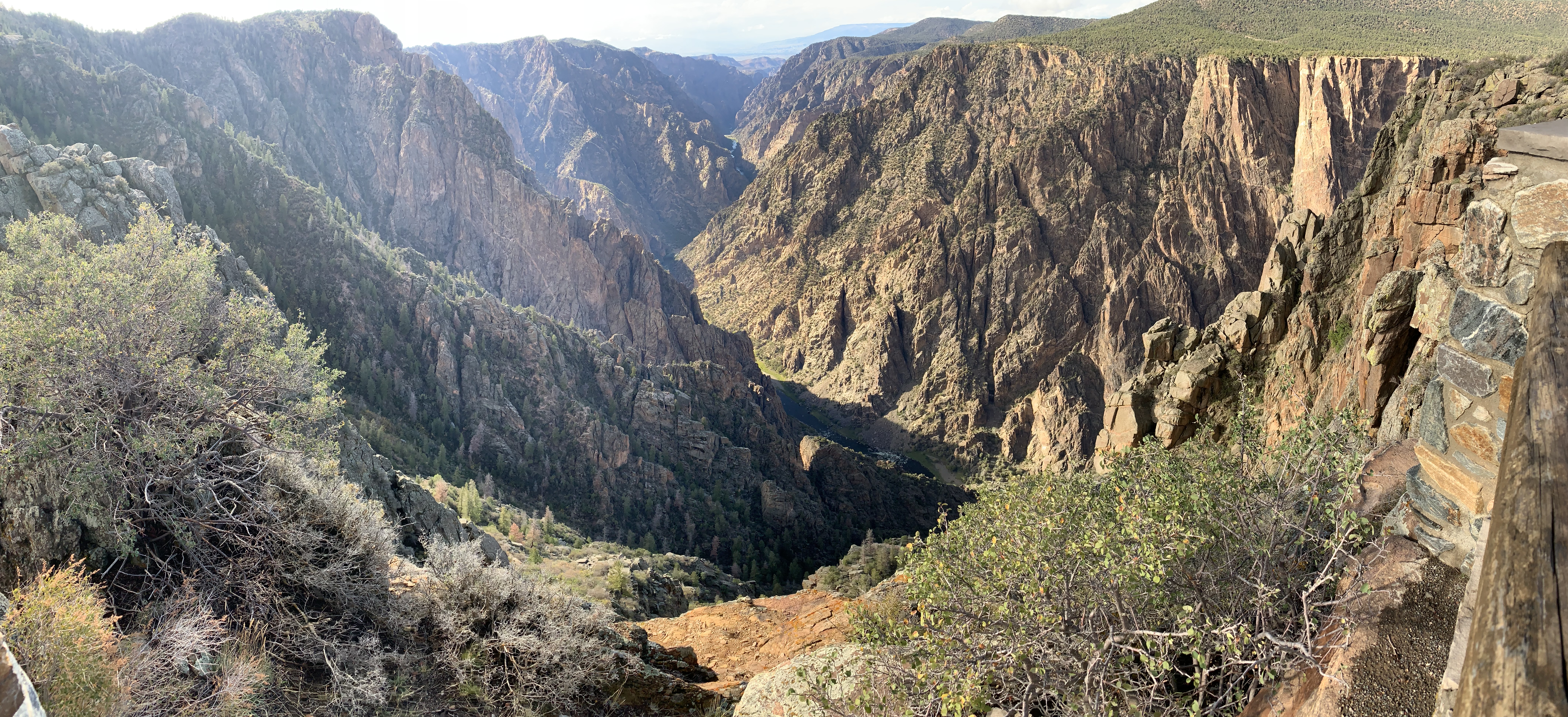
This view is looking downstream from Sunset View overlook, but the upstream view is blacker, steeper and narrower. The canyon there is over twice as deep (2250’) as it is wide at the top. The Sawatch Range, Elk Mountains and San Juan Mountains all feed into the canyon in spring. There are half a dozen good overlooks on the South Rim to peer down into the canyon, and some cause vertigo, as the cliffs are near vertical drops from the rim. The North Rim is a 2 hour remote drive, has fewer overlooks, a campground and horseback riding.

The South Rim has a campground and a visitor center, and is only steps from Gunnison Point, which may have the best view down into the canyon, although my photography skills were insufficient. The short hiking trails along the rim, down into the canyon (a little) and to the high point to the left above each provide a different view into the geologic depths.

The East Portal campground is technically in Curecanti NRA and is accessed by a steep road down to the Gunnison River (barely visible above) near the upstream dam. I’ll have to come back. Since I arrived here in October, there was already snow falling in the mountain pass on 50 to the east. The road was also being repaired after some fearsome rockslides. On the plus side, the drive through the mountains included bright fall foliage that contrasted with the black rocks. Montrose makes a convenient spot to charge, and it has two well-reviewed Himalayan restaurants.

Florissant Fossil Beds National Monument

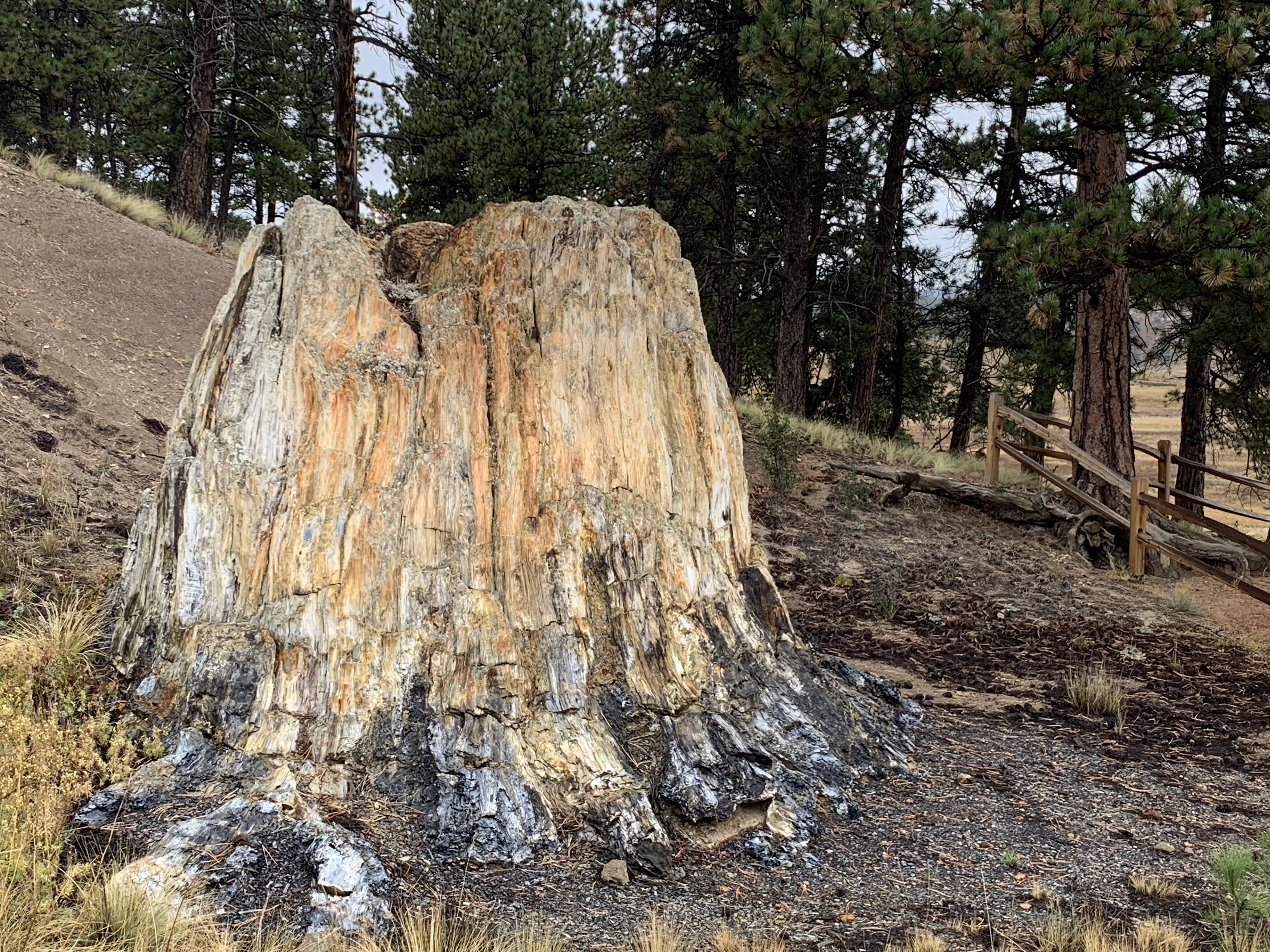
Giant Redwood trees once lived here, in Colorado, and many of their colorful stumps were preserved by volcanic ash along the easy 1 mile Petrified Forest Loop (at 8,400’). Early visitors took pieces of the petrified stumps and even left saw blades in the Big Stump above. See an array of Eocene fossils in the visitor center, including plants, bugs, fish and animals, and a rhinoceros bone. The volcanic ash layer captured a snapshot of the lake, meadow and forest here, which helps us understand how various plants and creatures evolved and adapted to a changing climate. But make no mistake, the current man-made climate crisis does not provide time for evolution or normal adaptation. Suddenly, our planet has a new, unprecedented and deadly climate, and most life won’t survive, unless we fix it now.

I wondered how large the peak range of the redwood trees must have been to have survived until today. They must have been successful in many different areas, like here, where the climate eventually become inhospitable to them. Now they only remain naturally in California and Oregon. People don’t seem to appreciate that for plants to survive over the long term, they need more than a few small, isolated reserves. They need to thrive in many different locations to have a chance of finding a stable and suitable one where they will have a future. Human limits, including pollution caused climate change, will extinguish species and ecosystems until we prioritize the protection of living things. Otherwise, all that will remain will be fossils and images of once thriving species.

Rocky Mountain National Park

Rocky was not what I expected. The strict timed entry system limits access to two hour windows and sells out within minutes after 5 pm the day prior, unless you reserve up to two months in advance in releases on the first of each month or unless you book a campground. The headwaters of the Colorado River are lovely, but not a huge source of water for over 40 million people downstream. The wildfires have been obviously devastating, especially in the western side of the park. The unique alpine landscape along the trail ridge road was smooth and barren, with low mats of tiny waxy hairy plants and, although I didn’t see any, only one species of bird, the Ptarmigan, tough enough to live there year round. Amid hail and high winds I failed at photography along the Trail Ridge Road over 12,000’, but the views were desolate, stormy and magnificent. Only after descending down to Upper Beaver Meadows did I manage to photograph a herd of elk and listen to the bull elk bugle.

In the line of cars, I keenly felt how masses of humans put pressure on fragile, limited nature. There were far more elk photographers and cars than elk. Even in unpleasant weather near the end of the season with controlled entry, every parking lot was full, and on the short trails I saw far more hikers than total wildlife. The best experience might be to book a summer campground at Bear Lake and try to hike into the backcountry. Park visitors love wildlife, but we’re overwhelming all the other species and increasingly encroaching on their last refuges. The towns surrounding the park are packed with galleries, gift shops and mini golf. Skiers fly into Colorado resorts and rent gas guzzling SUV’s, while the Congresswoman from western Colorado denies that the climate crisis exists. We are on the wrong path.

Dinosaur National Monument

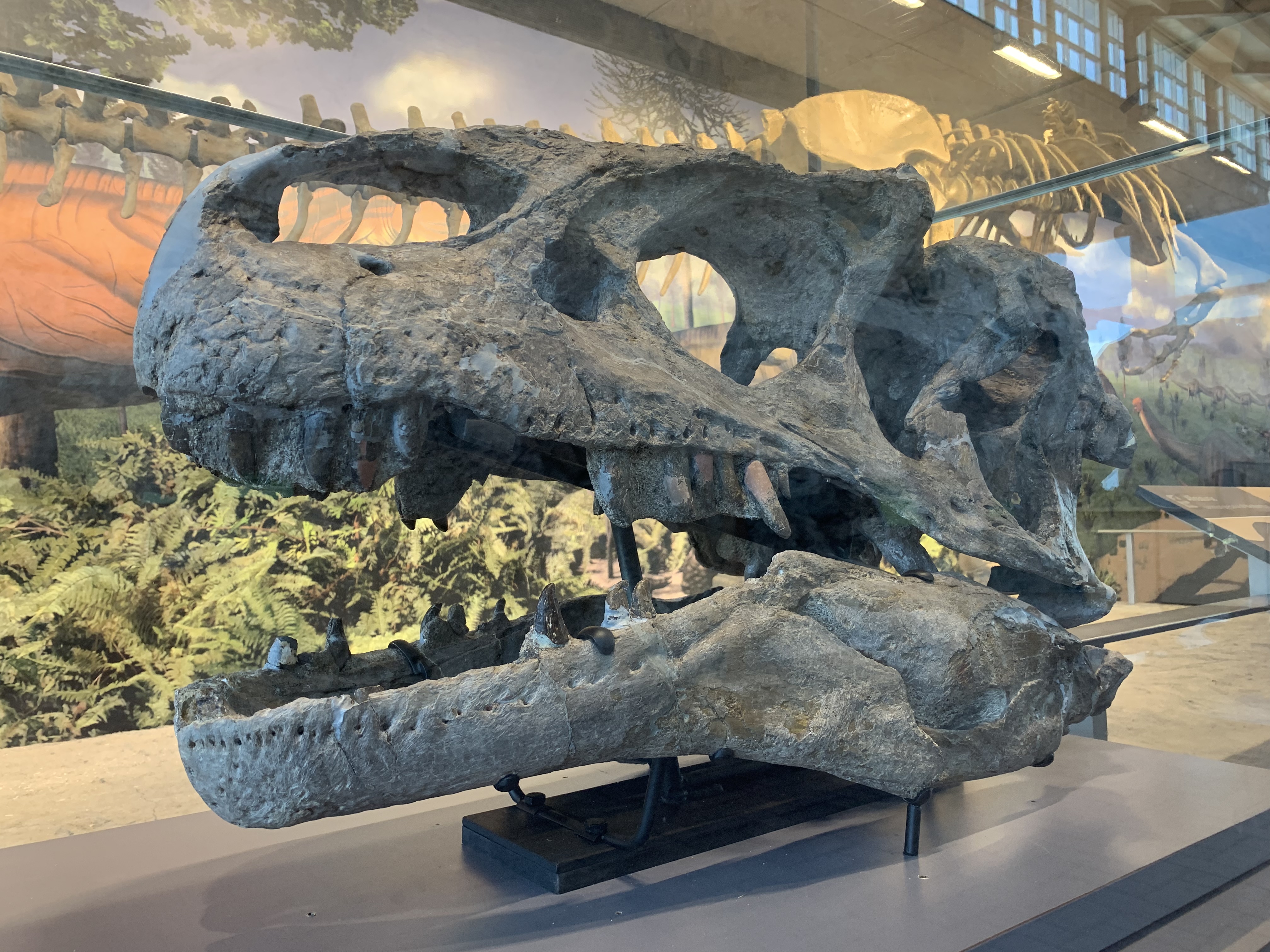
The Quarry Exhibit Hall, near Jensen Utah, has a crazy collection of large, late Jurassic dinosaur bones set in a two story high, very wide quarry wall, and you can touch them. It’s awesome. The Allosaurus skull above, a raptor talon-claw, Apatosaurus leg bones, and many Camarasaurus bones including a skull still set high in the quarry wall are all fascinating. This dinosaur exhibit is at the east end of the park after the Green River comes out of Split Mountain Canyon, and there’s a nice view, petroglyphs & pictograms.

Up the Green River is the extremely deep Canyon of Lodore, explored by John Wesley Powell, accessed from the north via permitted river trips or visible after a hike from the Gates of Lodore campground. Colorado’s Yampa River joins the Green from the east near Harper’s Corner, which has “the best view in the park” at the end of a hike and a 48 mile round trip drive. Unfortunately, I did not plan my charging to include either of those sections, so maybe next time.

There aren’t many good Tesla chargers around Dinosaur. Not sure why, but I noticed that some of the surrounding towns still support coal, have Halliburton operations, and have unfortunately unstable, irrational, fossil-fuel supporting representation in Congress. There’s a welcome center in Dinosaur Colorado with EV charging, but I don’t (yet) have the right kind of “combined charging system” CCS adapter. Since I’m in a hurry trying to visit high altitude parks during a short timeframe, I made due with a couple of 3rd party chargers I found using the PlugShare app, rather than stay in state park campgrounds. Especially when you get unexpected roadwork detours, being able to tap into other chargers is helpful.

Great Basin National Park

First, if you can’t get a reservation in time to visit Lehman Caves, just visit the park anyway. I took the virtual cave tour, and, I suspect that Timpanogos in Utah is better and less damaged. Besides, the park isn’t a cave park, it’s the highlight of the Great Basin area, which includes most of Nevada, western Utah and parts of three other states, and has a glacial basin of its own at the top of a 13,500 foot mountain.

Second, stop at Mather Overlook to admire the views and fall foliage of yellow and orange Aspen amid the dark green conifers. There’s a bronze model there that shows the structure of the basin, which is helpful orientation, since it is a long winding road.

Third, understand that the glacier here, “the only glacier in Nevada”, is gone. In theory, there might be some subterranean ice under some of the rocks for another couple years, but climate change has wiped this glacier off the face of the earth. The park maps showing a “rock glacier” in white are out of date. Any snow you see up there is seasonal.

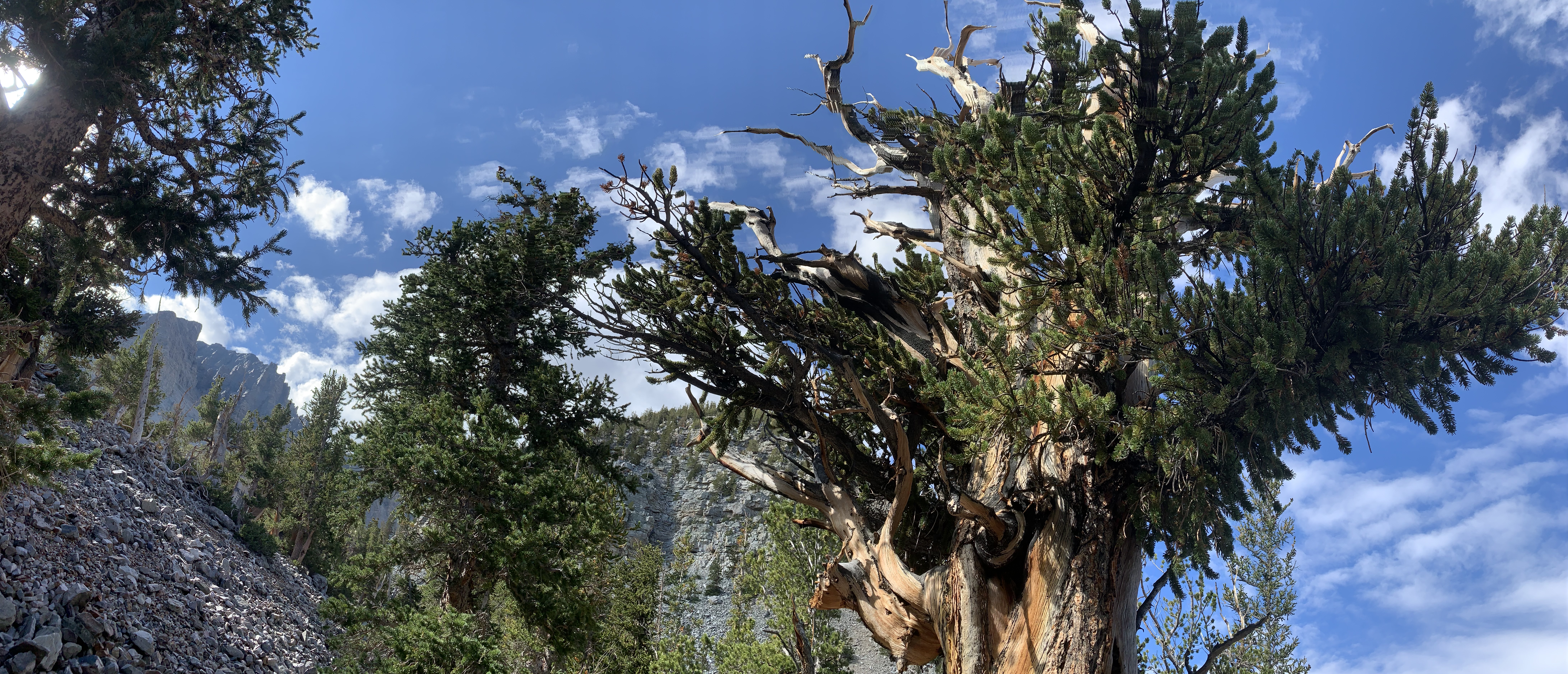
Fourth, take the Glacier Trail anyway, since it goes through the Bristlecone Pine grove and up into the basin. If you only get as far as the grove (2.8 miles roundtrip), that’s what I felt was the highlight of the park. The other two Bristlecone Pine groves are in very remote areas of the park. There are also some trails to pretty alpine lakes, but be careful, as many of the hikes are over 10,000 feet. Spending the night at altitude can help, as well as give you lovely views of the Milky Way.

Finally, this is my favorite park for old trees. The Bristlecone Pine, far from merely eking out a bleak minimal survival, is a gold resinous Adonis, shining in the bright Alpine sun, with luxurious thickly packed bright green bristles. We don’t know how long they can live. One that was removed from here in 1964 was over 4,900 years old. Unfortunately, climate change will likely make them extinct, as other trees will grow at higher elevations, crowding them and subjecting them to more wildfire damage.

Devils Postpile National Monument

The park is only accessible for zero carbon travel for a few weeks after the required shuttle service ends (mid September) and before the road closes (early to mid October). Shuttle buses are useful for reducing carbon pollution, but unless they’re sustainably fueled, they’re out of bounds to me. Red’s Meadow Cafe was still open, but the resort was closed when I arrived late September.

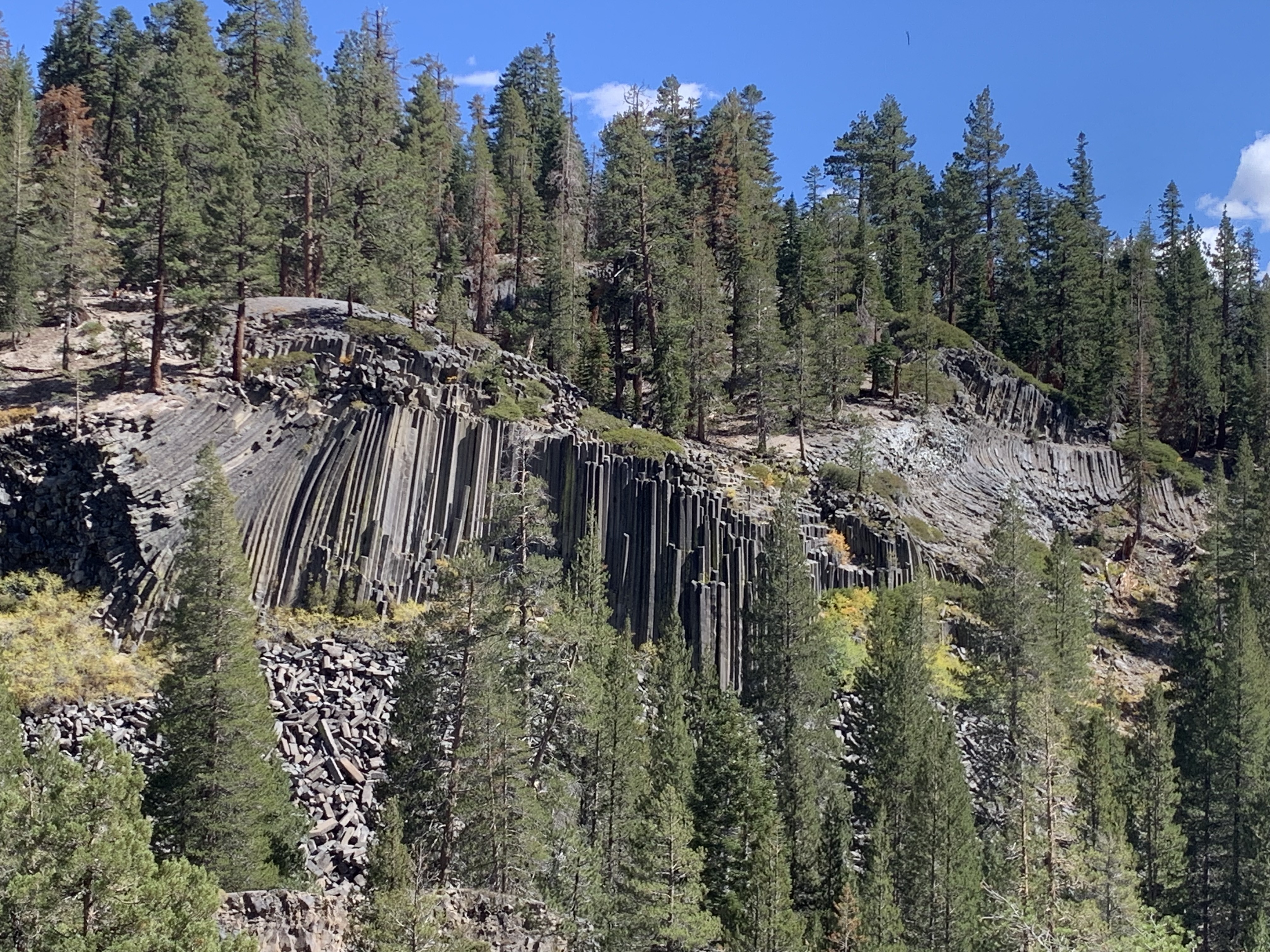
Since both the John Muir and Pacific Crest Trails run together through the park, I recommend you hike in a loop around the base of the broken basalt columns, across one of the two bridges across the Middle Fork of the San Joaquin River, along the combined JMT & PCT trail ridge where I got the photo, and back across the other bridge. There are also pretty waterfalls at both the north and especially south ends of the monument, but be careful hiking as the park is at around 7,500 feet in altitude up near the Mammoth Mountain ski area. There’s also a trail up through the trees to the top of the columns, which were formed 80,000 years ago when a diabolically molten lake cooled and cracked deeply in hexagonal and similar shapes and which were revealed by glaciation 15,000 years ago. Enjoy!

Appalachian National Scenic Trail

It was hiking on the trail in New England as a boy that I got the idea to visit as many national parks as I could. Some of the counselors were discussing their trail names and talking about the best natural places to visit in the country. I never forgot that feeling of walking deep into nature, exploring, seeing wildlife, jumping into a swimming hole and imagining traveling to even more beautiful places. It took a long time, but I’m finally fulfilling part of that dream.

I don’t know if I have it in me anymore to hike the whole trail, but I would love to try. The relief map (above) in the park-partner Appalachian Trail Conservancy visitor center in Harpers Ferry gives you a sense of both the distance and the many mountains that must be summited. But I wasn’t about to take a gas-polluting bus to get from the Harpers Ferry visitor center parking lot into town, especially when I could walk a couple miles of the AT to get there. And I would recommend hiking the trail, even just a small section, if you can. For the adventurous, the expert suggested thru-hiking the trail in two sections, from Harper’s Ferry in the spring north to Katahdin in Maine and then from Harper’s Ferry south to Springer in Georgia in the fall.

Below, I’ve listed the units either on or next to the trail.