New Bedford Whaling National Historical Park

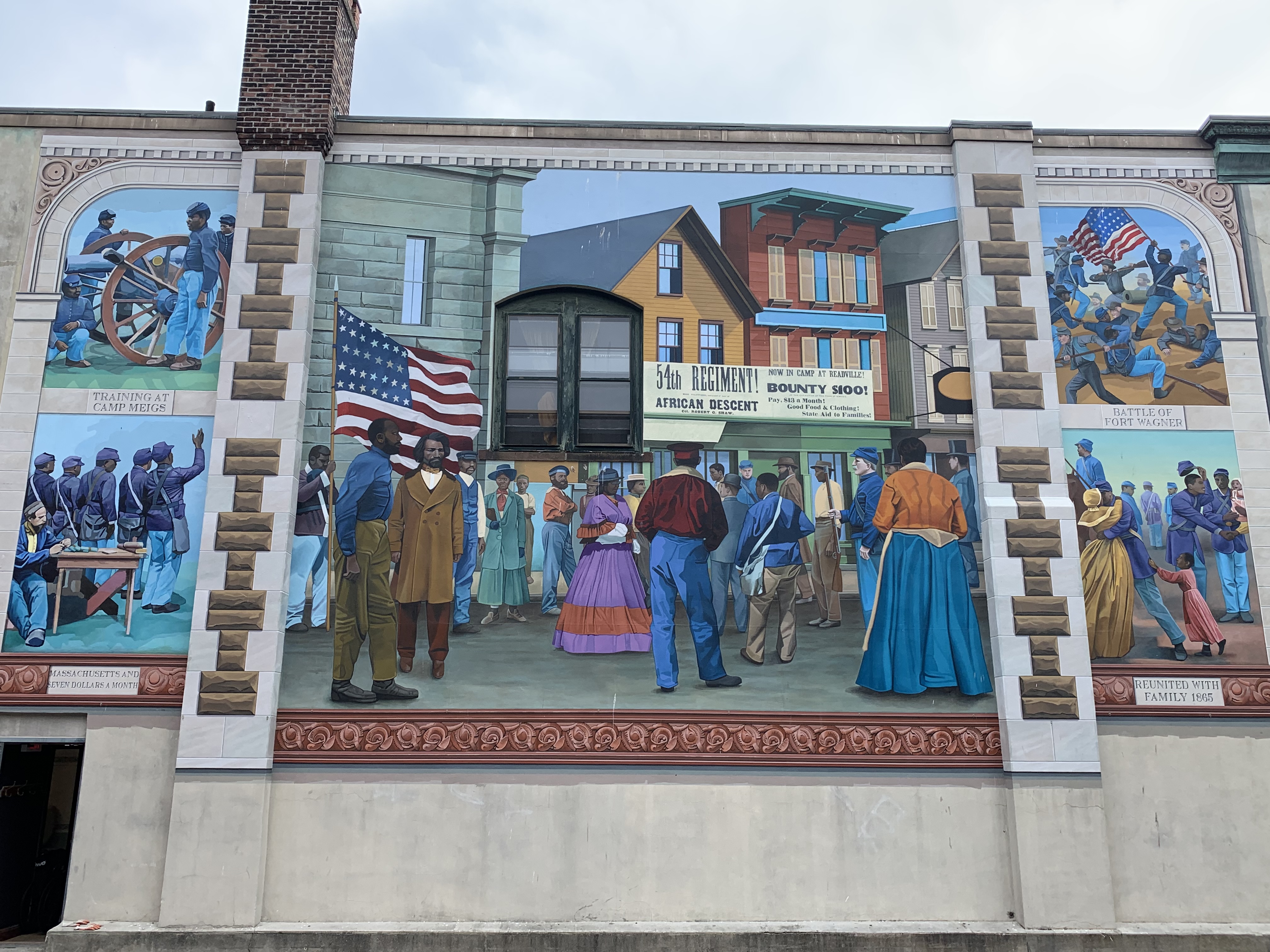
Why am I showing a mural of the Massachusetts 54th instead of the blue whale or the model ship Lagoda from the Whaling Museum? Well, this park covers a lot of history, and most of the recruits for the famed 54th (see the movie Glory) joined here. They were here in part because the whaling industry had long employed people of all kinds, including free African Americans and escaped slaves, and because this was an important stop on the Underground Railroad. Before the Civil War, New Bedford was an abolitionist city, run by Quakers with people of color making up 7.5% of the population . A young Frederick Johnson escaped slavery and stayed in Nathan Johnson’s house here in 1838. To avoid confusion, he accepted the new name “Frederick Douglass”.

And the whaling history may be even more interesting. Today New Bedford is the largest scallop port, but from 1825 to 1925, its major commodity was whale oil, which once powered lamps across the country and had a hundred other uses. Besides the whaling museum, there’s the Seaman’s Bethel with memorials to those lost at sea, historic homes, living history, the Ernestina-Morrisey schooner along the fascinating wharf, fast ferries to the islands and many other interesting things to see and do. And, there are plenty of seafood places, including the Black Whale, which has both an excellent sit-down restaurant and a more casual dockside stand.

Allegheny Portage Railroad National Historic Site

A fascinating feat of engineering, stationary locomotives dragged canal boats and cargo over the Allegheny Mountains between Philadelphia and Pittsburgh, cutting travel time from over three weeks to about 4 days. Now, the best way to travel through the scenic wooded hills is probably bicycle, on one of the many converted old railroad trails. Maybe next year. Today I drove the route in just a few hours on one electric charge.

Gateway Arch National Park

This park is the lynchpin of the nation. If it were removed, the whole country would fall apart.

OK, maybe not, but it is an important spot. The domed courthouse above heard the infamous Dred Scott case, which was used by the Supreme Court to take the country backwards, deny people their basic rights and help spark the Civil War. (How times change). The arch represents a gateway to western expansion, facilitated by Jefferson’s Louisiana Purchase in 1803 and subsequently explored by Lewis & Clark from here.

Many factors came together for the territory to wind up as ~12 US states. France traded with the Native Americans who lived there, and all along the rivers there were French communities, from Pittsburgh to St Louis and from Quebec to New Orleans. Shortly before we became independent, Britain declared war on France, used their ships to take Quebec and blockaded Spain from their colonies, and in exchange for peace, they took Canada and Florida, while France kept Haiti and Spain wound up with the Louisiana territory.

That peace treaty didn’t last long. The British heavily taxed the colonists to pay for that war (bad idea), the US declared independence (and won), the slaves in Haiti revolted (and won), Spain secretly gave Louisiana back to France, and France & Spain were preparing to invade England (and lose). Amidst this chaos, Napoleon wanted cash more than colonies that he couldn’t control, and Jefferson wanted to secure the Mississippi and expand our new country. Both sides approached each other to make a deal.

Golden Spike National Historical Park

The two sides racing to complete the transcontinental railway actually went far past each other before they finally agreed to meet here. The celebration drew many, as did the centennial, but the location is fairly remote and sparsely populated. There’s a plaque honoring Chinese laborers who contributed, even though many were not allowed to remain in the US.

Many visitors come to see the old style trains shown periodically, but the site is most interesting as a historic symbol of a new age dawning. There’s a large solar array under construction nearby, and hopefully our next transportation revolution from fossil-fueled to electric vehicles can be as dramatic and sudden as the shift from horse to train and telegraph.

City of Rocks National Reserve

I think the best way to explore here is to camp. Many of the most interesting rock formations are steps from the primitive campsites and the best views are after dawn and around sunset. I spent a quiet night here imagining what the California Trail settlers thought as they camped nearby. The hard granite offers many handholds and steps for novice scramblers. Of course, the site is also popular among technical rock climbers who can prep on Practice Rock before working their way up to more challenges.

Grant-Kohrs Ranch National Historic Site

Before barbed wire many ranches raised cattle free range, meaning without fences, and cowboys would drive herds of cattle up to halfway across the country. This ranch helps preserve a few elements of that iconic way of life, as a working ranch with beaver-slide hay stackers (invented nearby) and a variety of animals. The displays depicting the cowboys put real faces on the young men whose lifestyle was romanticized by books, radio, TV and film.

When I stay in state park campgrounds, like Bannack near here, I’ve been reading Louis L’Amour’s books which helped mythologize the West. I often find I’m following the same routes and seeing the same places he did. One of his scripts could easily have come from the history of Bannack where a corrupt sheriff and his gang, ”the innocents”, killed over 100 people and robbed even more before the townspeople figured it out and hung him from his own gallows.

Another local site is the Anaconda copper mine smelting tower, site of a horrific pollution scandal. There’s still a large Superfund site cleaning up here. The mountains, valleys, forests and rivers here are stunning, but greed often drives men to devastate both their communities and their environment. We must look deeper than myths, see what’s going on behind the scenes and act before damage becomes irreparable.

Fort Union Trading Post National Historic Site

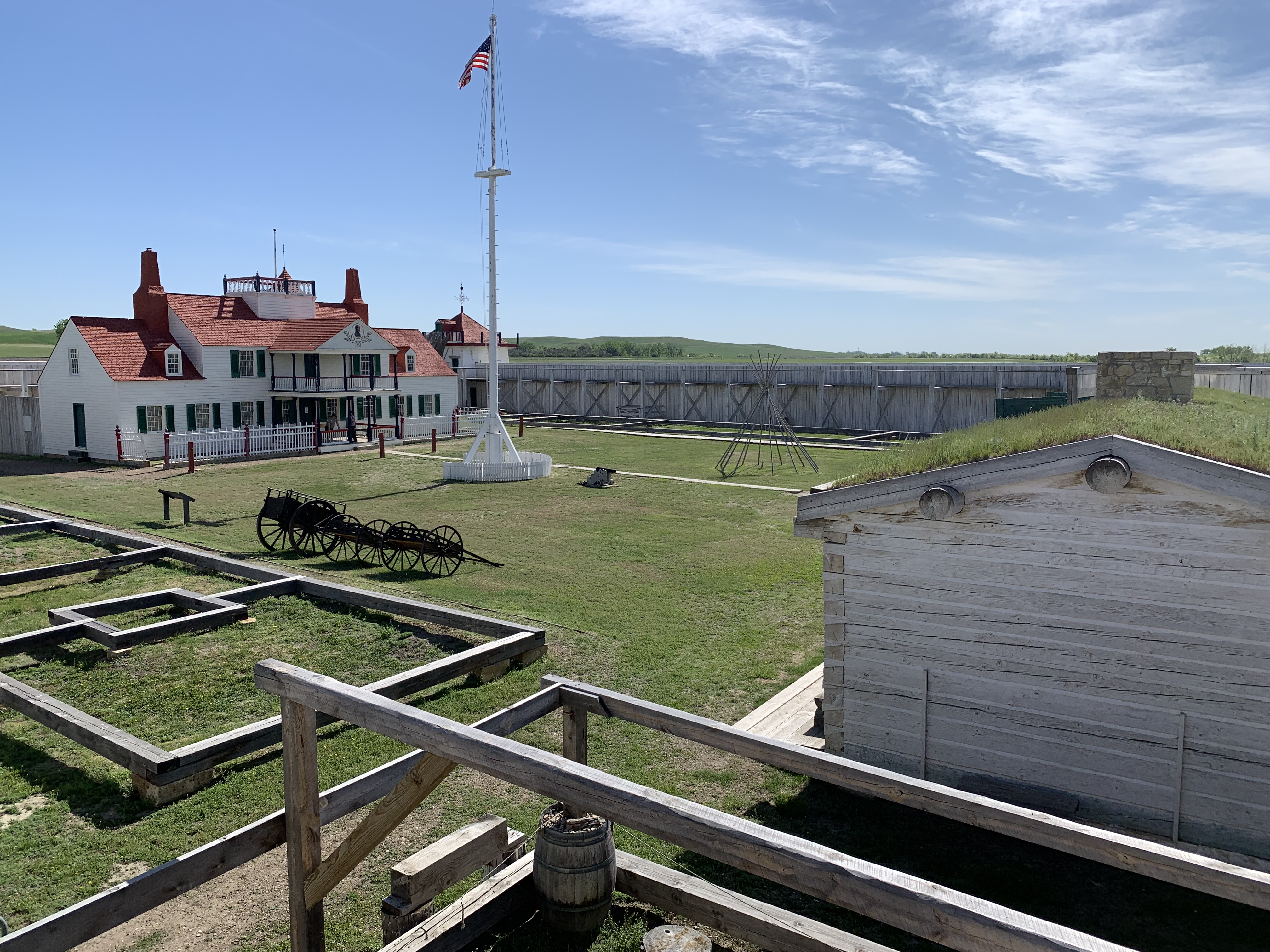
Not to be confused by the other Fort Union, this was strictly a trading post built for the fur trade at the invitation of the Assiniboine. The post was open for 40 years, peacefully and profitably trading with the Native Americans. Large numbers of natives brought stacks of furs, which were sorted and pressed outside the fort to determine payment, and then at a window they bought various goods, especially cloth. The large fur press outside the fort is basically a long pole on a fulcrum to measure fur stack thickness. Fort Vancouver in Oregon has one too, reconstructed from photos, but the rangers didn’t know what it was. (I showed them a picture and told them to call my favorite rangers here.)

Audubon came here to study mammals after finishing his bird book. Catlin came here to paint portraits of natives and portray their lives without the hateful bias that was common at the time, and he first suggested a series of national parks to protect the beautiful, historic and vanishing way of life in the West. The rangers here were among the best I’ve heard at bringing the old fort to life with engaging stories.

There’s also a small plaque, near where Lewis & Clark must have stopped, to a national parks founder named Mather, praising him for good works that “will never come to an end”. But if we lose the climate fight, many of our national parks will fail in their mission to protect nature and fail to pass that natural world on the future generations.

Knife River Indian Villages National Historic Site

This is a great place to learn about earthlodges due to the continuous maintenance of traditional culture here. Videos tours are available online too. Clearly the lodges were multi-use, serving both daily needs and special ceremonies. Having seen various ruins of similar structures around the country, it is informative to view such a complete exhibit.

The other reason these particular villages are important is that Lewis & Clark landed here and added a few folks to their expedition, including a French trapper named Toussaint Charbonneau and his wife and their infant son. Since she acted as interpreter and guide, Sakakawea became the expedition’s most valuable player and is memorialized on a US $1 coin first minted in 2000. A hike down to the river is worth the short walk.

Scotts Bluff National Monument

Like many folks, I grew up watching Westerns, so when I think of wagon trains of pioneers, I think of circling the wagons to defend against native attacks. But that’s another myth. More pioneers were killed by gun accidents than native raids. Pioneers traded peacefully with Native Americans as a rule. There was another school shooting recently, and the myth that guns make us safer is still being repeated today.

Of course, the main cause of death for the pioneers was cholera, so what actually protected them was coffee. Folks who drank “cowboy coffee” (strong enough to float a horseshoe) were saved by boiling water. I knew there was a reason I love espresso.

The park is beautiful, and many of our ancestors in the west walked (“prairie schooners” or wagons were for supplies) through the pass above. The rangers are both informative and engaging, and as always I learned more in a brief conversation than from any other source. Since I arrived early, I hiked up the Saddle Rock trail, but you can also drive up. The bluffs aren’t the highest or most brightly colored in the whole country, but they offer pleasant views of the historic trail.

Blue Ridge Parkway

A couple of elk were crossing the parkway, and I managed to take a quick photo. As I slowly started to pass, trying not to scare them, the complete idiot behind me decided that would be a good time to pass me on the right, inches from the elk, practically pushing them away into the woods. Who hates mega fauna that much? So I decided to demonstrate what instant acceleration looks like in a Tesla, and I never saw him again.

The parkway isn’t the fastest way to get anywhere. My navigation kept telling me to get off and take a straighter road, so I turned it off. Anybody who is in too much of a hurry should take another route. It winds along the ridge line from Great Smoky through North Carolina and Virginia to Shenandoah, and it is delightful. I saw some kind of light pink rhododendrons blooming along the wet ridge rocks above 5000 feet. I think Catawba, named after a local Native American tribe, or maybe Vaseyi, named after the famous botanist who discovered them 150 years ago. The former would be early, but it’s unseasonably warm now, due to the climate crisis.

The parkway is best enjoyed at leisure or in segments, and people who don’t care about nature should avoid it.