Lower East Side Tenement Museum National Historic Site

While I took the 1902 tour focusing on Jewish immigrants and the beef riots, the film in the museum was about two Joseph Moores, one black and one Irish, and explored the unequal outcomes dictated by law and society. I highly recommend both, as seldom does history provide so valuable a perspective on current issues such as the importance of activism in resisting inequality and injustice and as the long term impact of systemic racism.

The Levine family lived and worked in a three-room sweatshop tenement producing garments like those above (the one on the right is original), and their butcher’s family lived and worked in the basement. In the spring of 1902, the new scion of the Armour meatpacking firm of Chicago decided to hike the price of Kosher beef by 50%. He was trying to build an estate for his wife which would include a bowling alley, 20 marble fireplaces, fish ponds, a large herd of deer, and a greenhouse for growing oranges. (He inspired Upton Sinclair’s novel The Jungle). The Beef Trust had a monopoly on Kosher beef in New York City (at the time the largest Jewish city in the world), so they simply dictated the new price to all the butchers. The firm was renowned for low pay, strike-breaking, and hardball tactics to get whatever they wanted.

But they underestimated the Jewish housewives of the Lower East Side tenements. The women organized, boycotted, threw bricks through butcher shop windows, burned meat on their floors and even climbed down from the synagogue balconies to throw raw ground beef in the butchers’ faces. In a month, the price rise was reduced by 2/3rds, and a whole generation of suffragettes, union leaders and political activists was born. (In my first job, I worked with old women who had numbers tattooed on their arms, and they were not to be underestimated).

One of the historic Orchard St buildings is undergoing renovations, but all the tours, including the walking tours of the neighborhood are insightful. I recommend Katz’s deli or Russ & Daughters for a bite before or after your tour.

Paterson Great Falls National Historical Park

While Blackstone was operational two years earlier, Paterson’s mills were churning out fabric a few years before Lowell. Where Lowell was focused on all things fabric, Paterson went through a variety of industries, including silk, revolvers, locomotives and even airplanes, including the Spirit of St Louis. Also, Lowell made clever use of a much smaller drop in elevation, using a large volume of water to drive many small engines. But the Great Falls at Paterson, which inspired Alexander Hamilton to found the town, had enough vertical drop to drive electric turbines (from Thomas Edison), which still run in the building on the left. As in the other mill towns, child labor was exploited and dyes poisoned the river. Here, young mill workers went on the “baby strike” for a shorter workweek, and cheaper competition eventually doomed many of the huge businesses. In the background at the top, there’s an old Negro League Baseball Stadium under reconstruction where a local high school star named Larry Doby played before he broke the color barrier in the American League just 3 months after Jackie Robinson. And it’s all part of this relatively new park, which has big plans for improvements.

Thomas Edison National Historical Park

Note well that the statue is carrying an illuminated electric lightbulb. From his work-study above to his inventions, patents, accolades, experiments, machine shops, laboratories, greenhouse, and especially to his garage, with it’s electric wall charger and multiple electric vehicles, Edison’s park is wondrous to explore. I did nothing in the proper order, ignored the scheduled tours, skipped the film, neglected to reserve a house tour, poked around, peeked in every corner and enjoyed it immensely.

In particular, I studied the evolution of his recording devices, from telegraph and phonograph to motion picture. I was very pleased to see that he took the time to invent a coffee maker (drip style, also makes tea). I noted that his wife drove him around in their electric car. And it was interesting to learn how his higher quality proprietary records lost out to cheap vinyl recordings, in part due to his unpopular taste in music. So much more than merely the inventor of the light bulb.

“I’ve not failed. I’ve just found 10,000 ways that won’t work.”

Thomas Edison

Hopewell Furnace National Historic Site

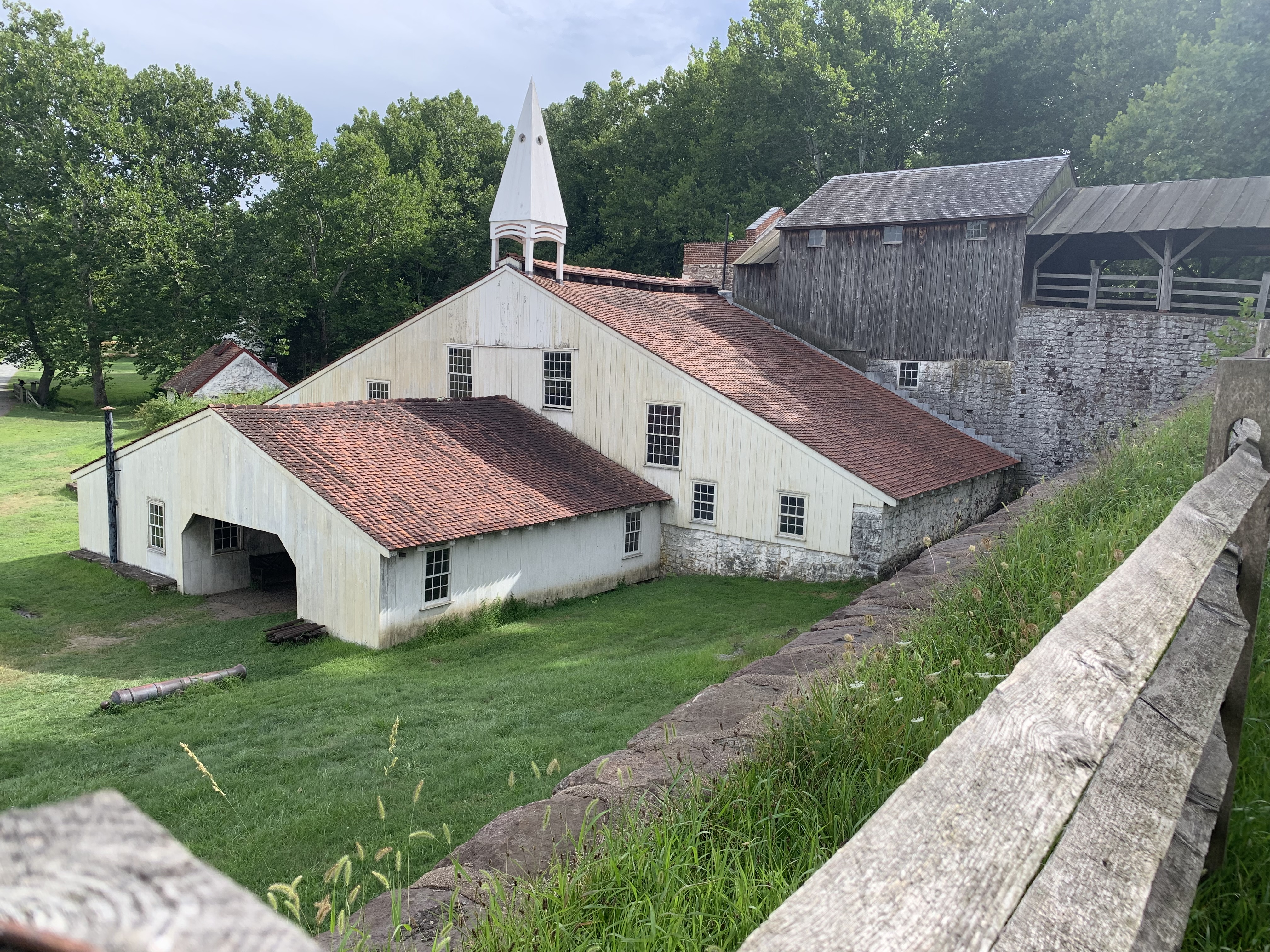
Among the sheep in this bucolic valley is the most complete early ironworks industrial site in America (unrelated to Hopewell Culture). Over 130 years after English settlers built the Saugus Iron Works, a more elaborate and higher volume factory was built here in 1771. Cannon and shot used at Yorktown and in our early Navy were forged here. Inside the red roofed cast house is a giant stone furnace, fed down the chimney by a constant stream of charcoal, limestone and iron ore through the grey wood building above. For over 100 years, the giant water wheel (which still turns today) blasted air into the crucible to pour iron ingots into the floor inside.

Upon arrival, I recalled visiting here at age 12, a number of years ago, on a school trip to Philadelphia and DC. One of my teachers still volunteers at a military park nearby. Each step in the process can be seen here, basically unchanged, from wood pile, to charcoal, worker housing and eventually to pig iron, ready for sale. Many great forests were felled for America to rise to the top of the iron and steel industry, but I notice that the owners kept many of their own fine old trees for shade and beauty. Now that we can harness nearly infinite clean, non-destructive power from the sun, I hope we make progress restoring nature.

Steamtown National Historic Site

Coal-burning transportation? What kind of site is this?!? Well, I rode a steam locomotive, and I liked it. Thankfully, this form of transportation is obsolete, replaced by the diesel-electric hybrid. So, I’m here to celebrate the demise of the historic steam engines, and I hope that coal-burning will soon go the way of the dinosaur. But I’m not driving to these sites by electric vehicle to skip the guided tours and lessons of history. If traveling 3 miles on a multi-million pound vehicle is the only way to learn the difference between local hard anthracite and common soft bituminous coal, then I’ll pay my $6 to get the full historic experience, 45 minutes of carbon fuel be damned. This is my favorite carbon-burning park.

Before visiting Scranton, I didn’t understand why President Joe Biden was such a fan of trains. Well, this place is a fascinating Mecca for rail-fans. The old trains were part of Blount’s Edaville RR amusement parks in New England, before being saved from the scrapyard through donations of train-spotters across the country. Here, our tax dollars are converted to educational opportunities for kids of all ages, to teach about the Gilded Age of RR Barons and the gritty roots of Pennsylvania. (A history echoed, perhaps, in the local Senate campaigns of Dr Oz v. Fetterman).

Scranton is also known as the Electric City, because they skipped the whole “horse-driven trolley” stage and started off first with all-electric trolleys. The best time to adopt future technology is always now. The county runs a museum right next door with electric trolley rides, but, since they’re not part of the National Park Service, I skipped it. (The whole ‘Zero Carbon Travel’ idea can be confusing at times).

This summer, I’ve had people try to tell me that Americans will never give up their loud smelly cars and that EV’s are somehow worse for the economy than gas cars. There’s a whole industry of anti-electric propaganda out there, doubtless funded by folks who would lose out if we all switched to electric vehicles. There’s actually no real economic argument for continuing heading for disaster. The Titanic received seven warnings about icebergs, but refused to either slow down or alter course. The loss of the ship disproved that brand of short-sighted “economics”. We can now see the beginnings of the carbon climate disaster unfolding, so there’s no excuse for inaction.

Vanderbilt Mansion National Historic Site

I think this is the living room downstairs, but the European Baroque extravagance made me dizzy. I’ve now been to four Vanderbilt mansions, so I’m halfway done. Fortunately, a combination of the Great Depression, regulation and taxation ended the Guilded Age, so the mansion spree ended. FDR convinced the last owner to donate this estate to the government, since she already had several other estates.

Today’s unregulated multi-billionaires fly rockets into space, while some regular citizens lack basic healthcare available for free in other countries. Corporations have more rights than pregnant women, but they pay little to zero taxes. I think individuals should be allowed to incorporate to get similar benefits. You would only owe tax on your savings, not your income, for example. Or maybe corporations should pay taxes like we do. Either way, we need to figure out a way to make things fairer, before everyone is broke except the one guy who owns all the corporations and robot workers. Maybe after AI puts the bankers, lawyers and doctors out of work, voters will decide that the system should work for people and not the other way around.

Lowell National Historical Park

Some of the old factories are empty ruins, and many have been remodeled into chic housing or modern offices. Lowell followed on the success of the cotton spinning mills of the Blackstone River Valley, but many times larger in scale: all stages of production automated from spinning to cloth, cotton & wool, printed patterns & carpets, powered by two rivers, two layers of canals running 6 miles through the city, 10 multistory mill complexes, and 10,000 mill workers. 19th century visitors from Europe were astounded to see England’s Industrial Revolution expanded on American shores. Today, visitors walk the canals (or take a park tour boat or trolley), see the power looms in action, and take in the exhibits & public art in this university town. While there are paid parking spaces all around the historic district, the visitor center will validate free parking in the neighboring structure.

Since the factories sold “Lowell” brand cheap cloth to the plantations for slave clothing, this was not a city that attracted many ex-slaves for work. The owners who profited from their slave-labor suppliers did not support abolition, but many workers did. There was an active Underground Railroad site under the Second Universalist Church, attended by many workers and led for many years by a staunch critic of slavery. The minister also supported the “mill girls” who organized strikes and agitated for their rights 90 years before women won the right to vote. Many suffragettes began their struggle in Lowell’s mills.

Lowell also teaches important environmental lessons. The forests were cut down and burned to bake bricks, the river was polluted with heavy metal dyes and untreated sewage, and the air was polluted with coal to power the steam engines that replaced the greener hydropower. By 1970, the Merrimack River was declared a “non-river”, since it was essentially slow-moving toxic sludge. Lowell was not a pleasant place to live, and many good jobs had moved elsewhere. Citizens voted to clean up the environment, and gradually the environment has improved. The river is now passably clean, and there are green spaces amid the old industrial sites (see photo above). In the long run, polluting for profit is terribly destructive and often irreversible. We need to make better decisions to stop carbon pollution now, or we will regret our lazy, thoughtless inaction later.

Boston National Historical Park

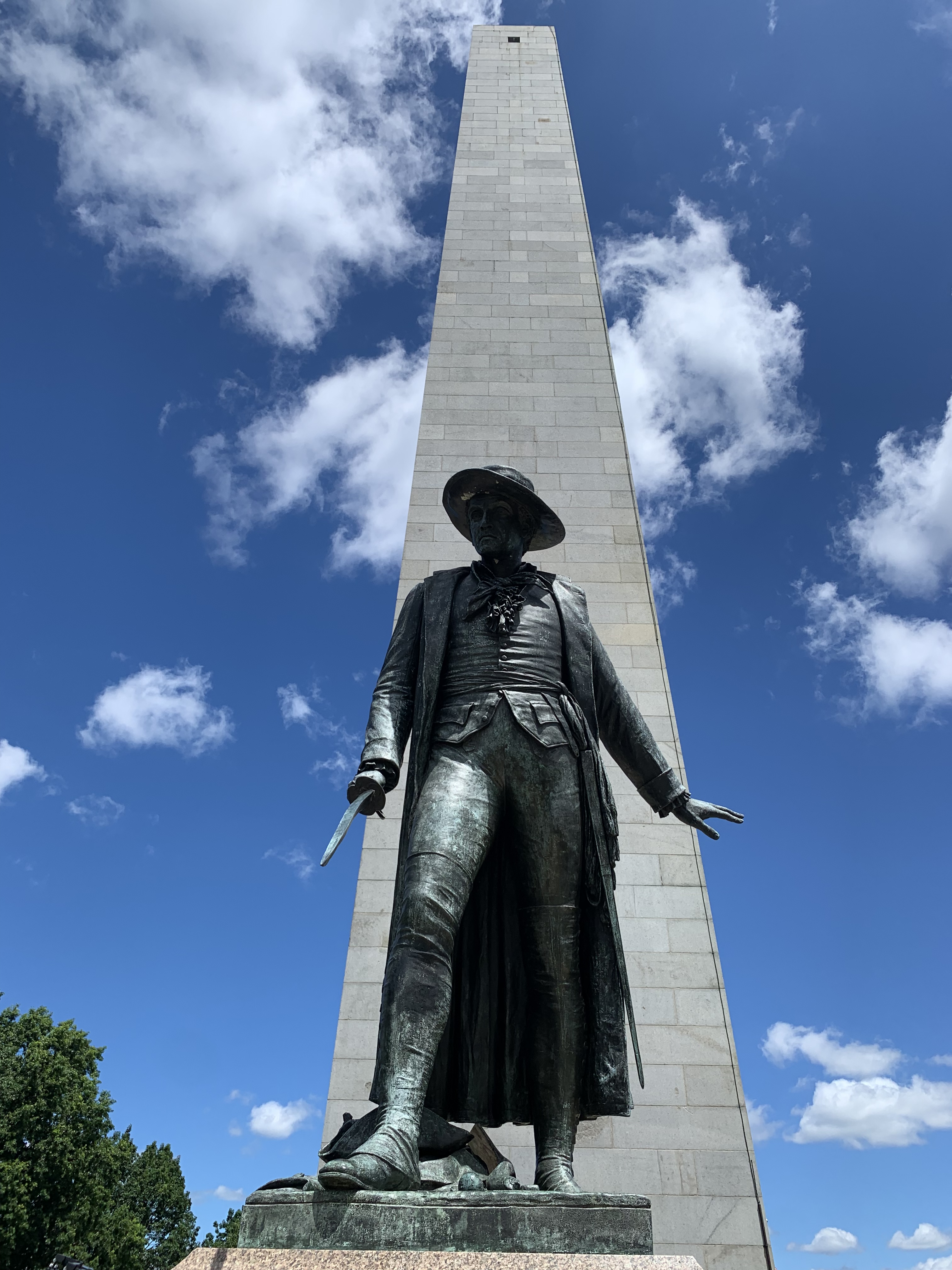
“Do not fire until you see the whites of their eyes.”

Colonel William Prescott, 1775

While the way to the top of the Bunker Hill Monument is currently closed, there is a live webcam. The monument is at the top of Breeds Hill, which the colonial soldiers defended against repeated attacks, before retreating to Bunker Hill. There’s a free museum facing Prescott’s statue across the street.

Boston has an embarrassment of historic sites in this park: the USS Constitution, Paul Revere’s house, the Old South Meeting House, the Old North Church, the Old State House, and Faneuil Hall. Each one is worth exploring to learn how we became independent, how we developed our democracy in town hall meetings, and how we debated our rights as Americans. Oh, and I’ve forgotten another historic ship (WWII), another historic battlefield (not open), another museum, a historic navy yard, living history exhibits, and other fascinating sites on the popular Freedom Trail.

Since the traffic and parking are even more horrendous than I remember, I definitely recommend taking the subway (electric and also historic) and walking. Many of the sites are clustered together, and the Rose Kennedy Greenway has beautiful art, flowers, and fountains along the way. Faneuil Hall is a great place to try local foods, and I recommend the thin cheesy Regina Pizzeria slices.

Saugus Iron Works National Historic Site

So far, none of the New England sites are new to me, and as soon as I got here, I remembered visiting as a kid. The visitor center is in an original building, while the blast furnace, casting shed, forge and blacksmith’s shop were reconstructed on their foundations. There was some work being done to get the park completely reopened this summer, but the museum and most buildings were open. It’s an impressive site, and you can see an egret in the river to the right.

As at Blackstone in Pawtucket Rhode Island, the site is on a water fall, and the local tribe (now dispersed) was known as the Pawtucket, meaning Falls. To the left above, you can see the spillway where the diverted water turned the giant mill wheels, powered the bellows for the forge and worked the heavy trip hammer to make iron bars, and while the river isn’t as deep here, the marshes were filled with iron ore. While Blackstone had America’s first cotton mills in 1790, the English settlers here in 1640 built the first iron mill. The Puritan Massachusetts Bay Colony owed much of its success (and all of its nails) to this mill. When the iron workers moved on for new opportunities, they built similar iron works where they settled.

Blackstone River Valley National Historical Park

The river flows from northern Massachusetts into Rhode Island and has a natural waterfall not far from a navigable ocean ship channel. That made it a perfect location for an experimental mill, to see if the fledgling Americans could copy the British mill industry. Here Moses Brown, a Quaker and reformed transatlantic slave trader, gathered an English mill expert/ industrial spy, several inventors, blacksmiths, shipwrights and skilled craftsmen to build the first successful water-powered cotton-spinning machine in America. Here, America joined the Industrial Revolution.

The mill owners knew that the cotton came from slave-plantations and some later owners even invested in plantations while still claiming to be Abolitionists. (The Brown family founded the eponymous University here with slave trade money). The ranger at Slater’s Mill did an excellent job in describing this hypocrisy and the pros and cons of industrial capitalism, along with explaining the mechanics and the history of the mill company towns that grew up all along the valley, until electrification moved the mills south. Pollution from heavy dyes is still a problem as are the dams, but major clean ups have restored much of the riparian ecosystems, for birds, fish, plants, hikers, bikers and paddlers to enjoy. The entire area is interesting, with old shops, an Audobon park, and legacy industrial buildings.